
Weight management: how to use the Body Condition Score in dogs
The scale lies. A 30-kilogram dog that has lost 4 kilograms of fat and gained 4 kilograms of lean muscle will weigh exactly the same on the bathroom scale, but its body has changed completely. The Body Condition Score (BCS) is the only practical tool that catches that distinction, which is why every veterinary nutritionist I work with uses BCS — not the scale — to make weekly decisions about a weight-loss plan. This guide is the version I give to every client starting a canine weight-loss program: how to score accurately, how to interpret the number, and how to combine BCS with weekly weighing to actually reach a healthy weight without losing muscle along the way.
What the Body Condition Score actually measures
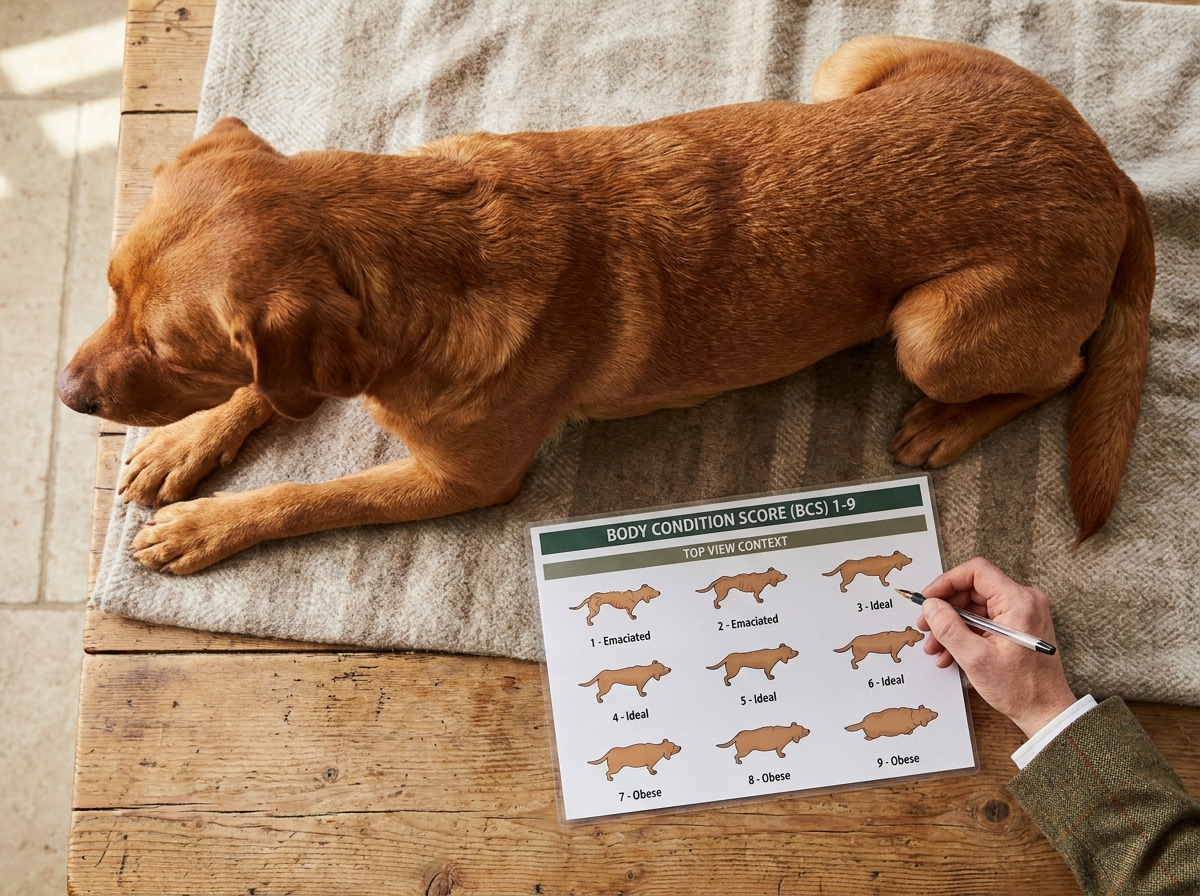
BCS is a 1-to-9 visual and tactile scoring system. You are looking at three things in order: how easily the ribs can be felt under a thin layer of fat, how obvious the waist is when viewed from above, and how the abdomen tucks up when viewed from the side. Each level on the scale has a specific definition, and the numbers are not linear — a dog at BCS 9 is not "9 percent" overweight, it is roughly 30-40% above its ideal body weight. A dog at BCS 4 is roughly 10-15% below ideal. The target for a healthy adult dog is BCS 5, with a working range of BCS 4.5 to 5.5.
The reason BCS works when the scale fails is that fat and muscle have very different densities. A dog that has lost weight but kept its muscle — the goal of every well-designed weight-loss plan — will move several BCS points without the scale changing. A dog that has lost weight by losing muscle (the common bad outcome of a poorly designed diet) will lose scale weight without BCS improving at all. BCS is the only tool that separates these two outcomes.
The four landmarks you are scoring against
Stand over the dog and look at the waist. The waist is the inward curve between the end of the ribcage and the start of the pelvis. In a BCS 5 dog, the waist is visibly narrower than both the ribcage and the hips. In a BCS 7 dog, the waist is barely visible. In a BCS 9 dog, the waist has disappeared entirely and the dog looks like a tube. From the side, look at the abdominal tuck. In a BCS 5 dog, the line from the last rib to the pelvis rises sharply. In a BCS 7 dog, the line is nearly horizontal. In a BCS 9 dog, the line sags.
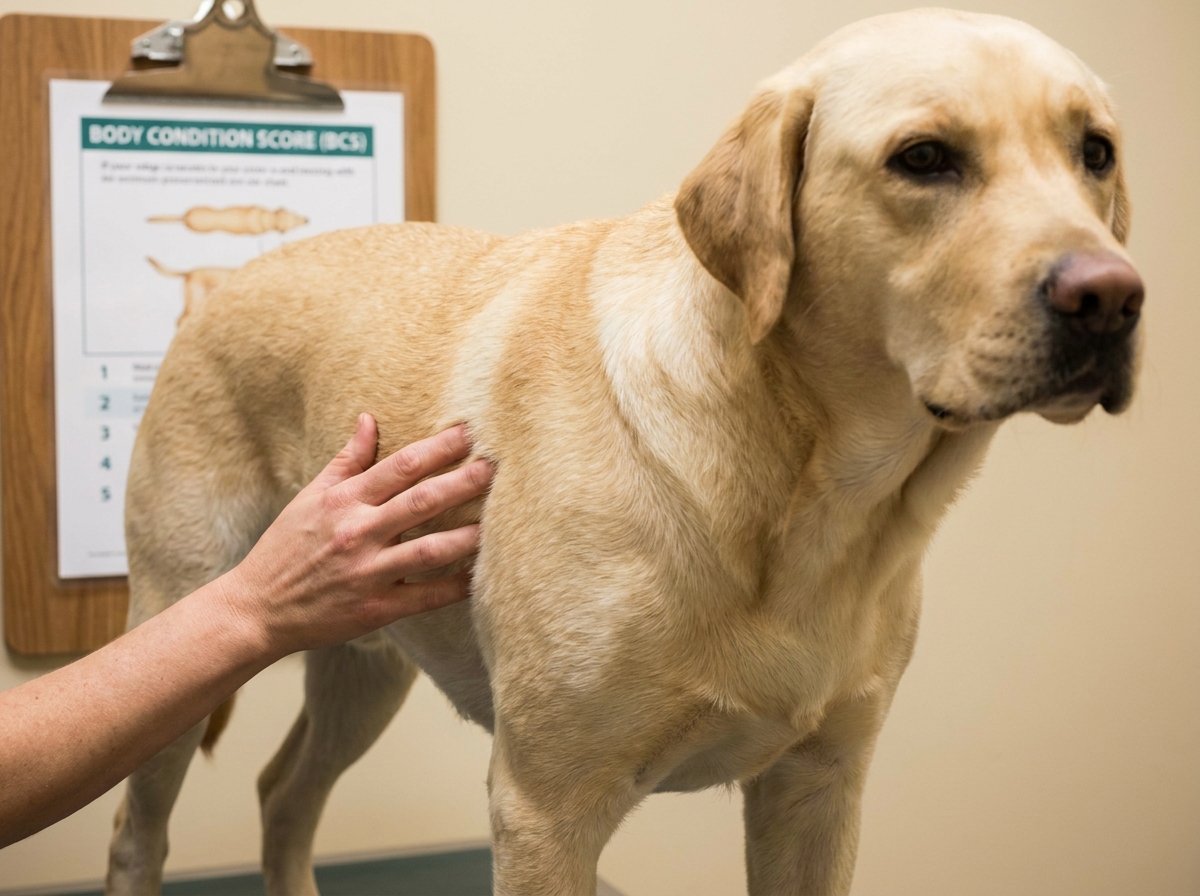
Put your hand on the ribcage. With your fingers flat and your thumb on one side, press gently. In a BCS 5 dog, you feel the ribs as easily as the bones on the back of your hand, with a thin layer of skin over them. In a BCS 7 dog, you have to press through a soft layer of fat to feel the ribs. In a BCS 9 dog, the ribs can only be felt with firm pressure through an obvious fat layer. At the base of the tail, feel the bony prominences. In a BCS 5 dog, they are visible. In a BCS 7 dog, they are smooth. In a BCS 9 dog, they are buried.
Using BCS to make weekly decisions
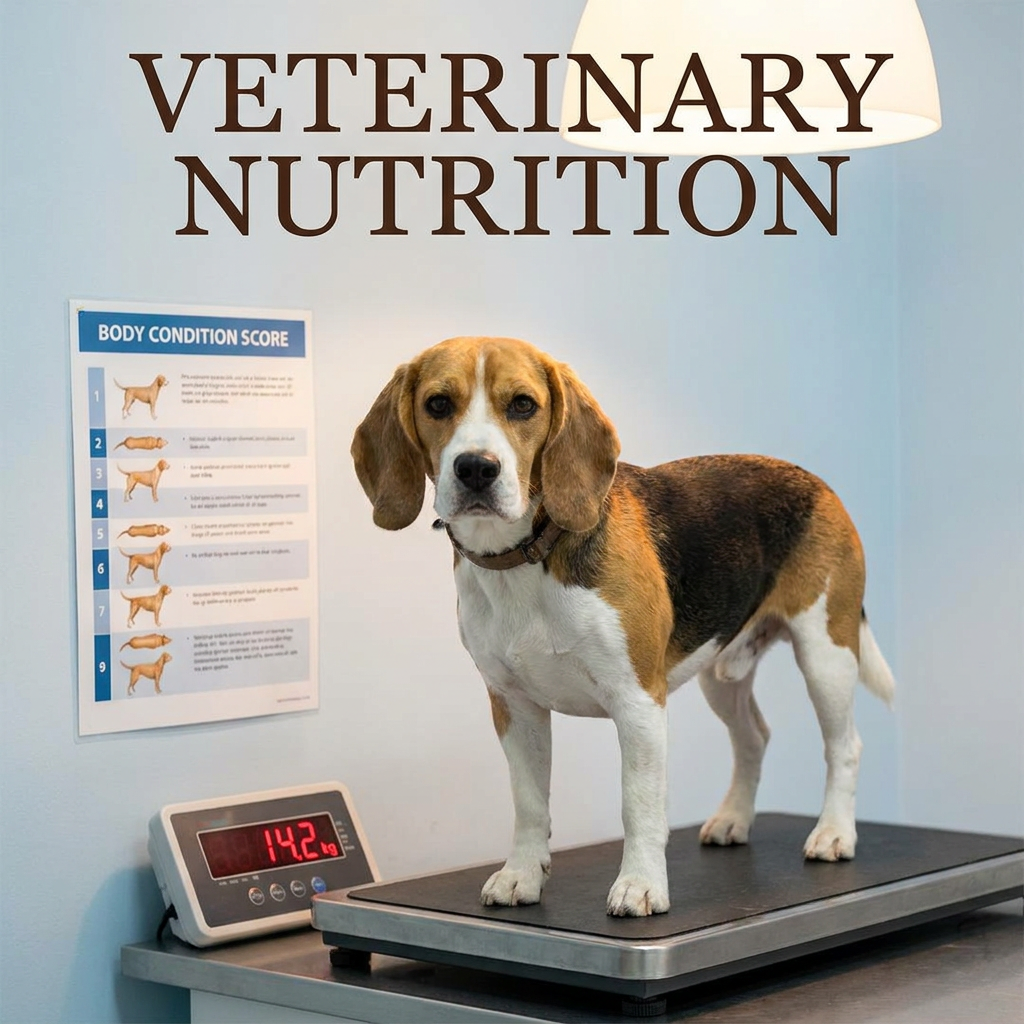
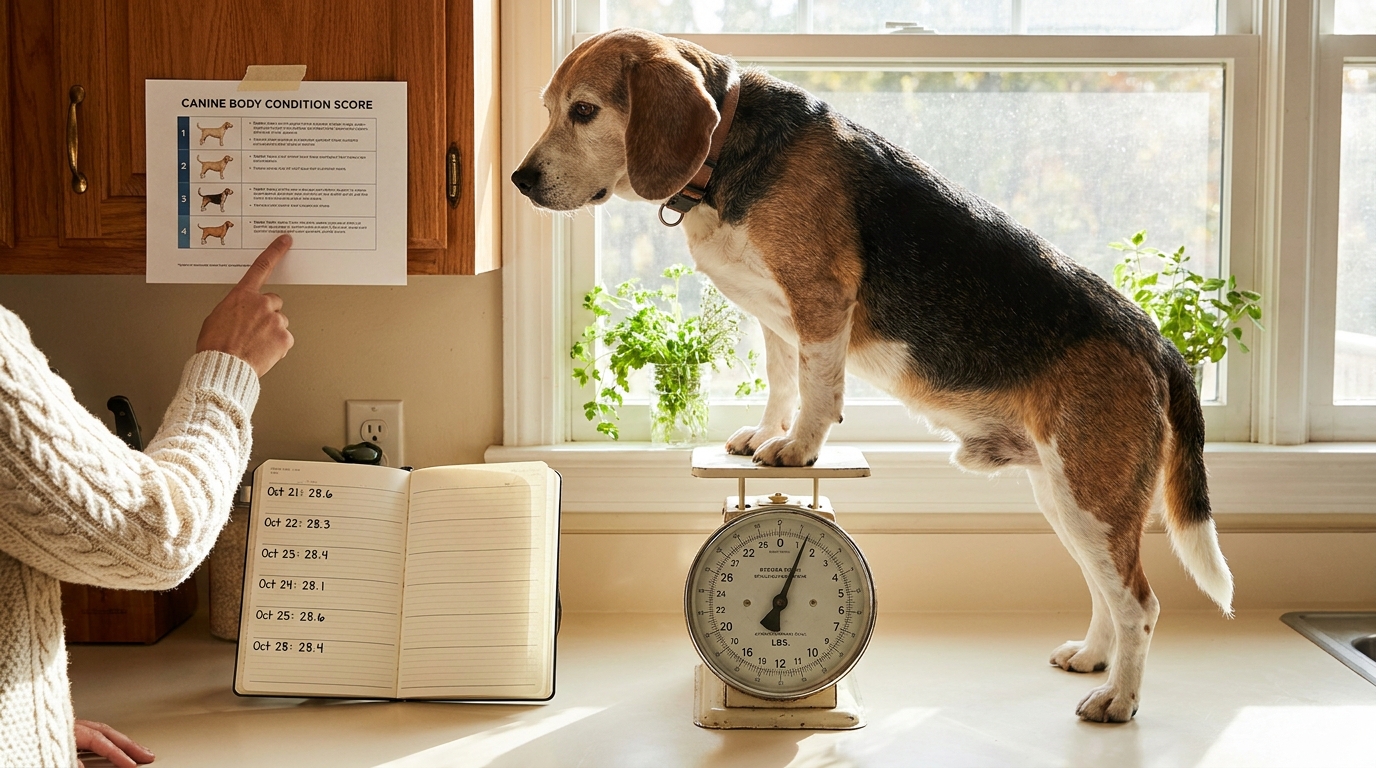
Weigh the dog once a week, at the same time of day, on the same scale, before a meal. Record the weight. Then score the BCS the same day. The scale catches large weekly changes. BCS catches the slow drift over months. Together, they tell you whether the plan is working.
For a dog that needs to lose weight, the target is 1-2% of current body weight per week. A 30-kilogram dog should lose 300-600 grams per week. Faster loss risks muscle loss. Slower loss is not enough to make the metabolic changes that break the obesity cycle. The scale is how you monitor week-to-week. BCS is how you monitor month-to-month and confirm the loss is fat, not muscle. Score BCS every 2-4 weeks, not every week — BCS does not change fast enough to be useful weekly, and over-scoring tends to push owners into making calorie cuts the dog does not need.
The two failure modes I see most often
The first is the "calorie math" failure. An owner calculates the dog's daily calories precisely, feeds the calculated amount, and sees no weight loss. Nine times out of ten, the calculation is not the problem — the BCS is. The dog is at BCS 7, not BCS 5, and the calculated amount for BCS 5 is roughly 20% too high for the dog's actual current state. Recalculate against the dog's current weight, not its target weight, and reduce the starting amount by 10%. Then re-score BCS in 4 weeks. The second is the "human food" failure. An owner feeds the calculated amount of kibble, then adds treats, table scraps, dental chews, and training rewards. The added calories can easily double the calculated amount. The fix is to budget all of those extras into the daily calorie target: if the kibble is 80% of the daily target, the remaining 20% covers every other food item the dog eats in a day. Anything over that 20% cancels out the deficit.
When BCS stops being useful and you need a vet
BCS is a screening tool, not a diagnostic. Three situations need veterinary input beyond BCS: a dog that loses BCS rapidly without diet change (could be hyperthyroidism, diabetes, or cancer), a dog that cannot lose BCS despite a strict calorie deficit (could be hypothyroidism or Cushing's disease), and a dog that loses BCS but becomes lethargic or develops a dull coat (could be a nutrient deficiency from an unbalanced homemade diet). For any of these, get a full blood panel before continuing the weight-loss plan. The body condition is the same; the cause is different, and the cause determines whether the plan needs to change at all.
Putting it all together
Score your dog today. Use the four landmarks — waist, tuck, ribs, hip bones. Record the score. Weigh the dog. The combination tells you where the dog is right now. Calculate a daily calorie target against the dog's current weight, set treats and extras at 20% of the total, and re-score in 4 weeks. A healthy weight-loss plan takes 12-16 weeks for a moderately overweight dog and 6-12 months for a severely overweight one. The scale is for the weekly check. BCS is for the monthly check. Both are needed. Neither is sufficient on its own.