

Puppy to senior: a full life-stage feeding chart that adapts as the dog ages
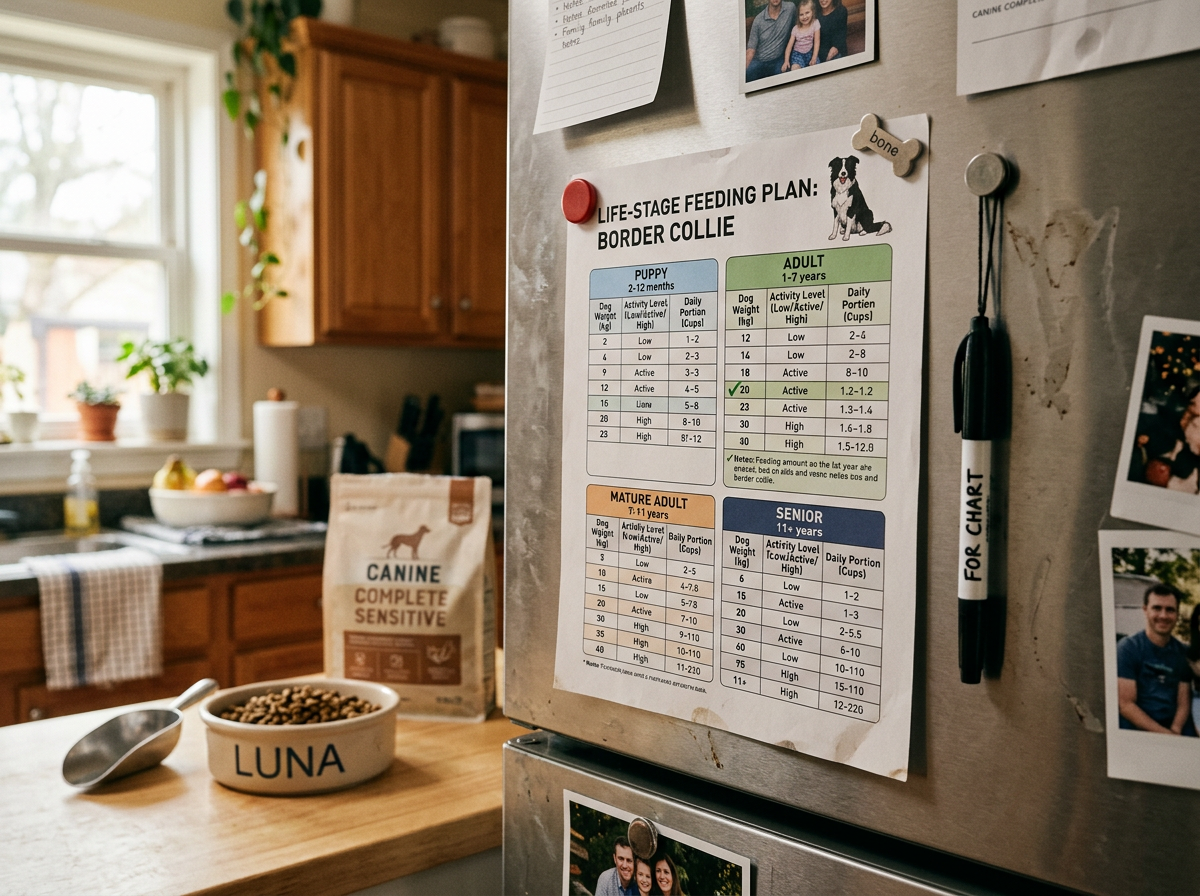
The dog that comes home at 8 weeks of age will be the same dog at 14 years of age, but the nutritional needs of that dog will change at least six times. A feeding plan designed for an 8-week-old puppy is wrong for a 6-month-old adolescent, wrong for a 2-year-old adult, wrong for a 7-year-old mature adult, wrong for an 11-year-old senior, and wrong for a 14-year-old geriatric. The owner who feeds the same food in the same amount for the dog's whole life is feeding the dog a slowly increasing mismatch between intake and need. The owner who adjusts the food and the amount at each life stage transition is feeding the dog in alignment with the dog's current metabolism, current body composition, and current disease risk. In this article I will walk through the six life stages, the feeding adjustments that go with each transition, and the body-condition monitoring that should drive every change.
The six life stages and the nutritional shift at each transition
Stage 1: the neonatal puppy (0-3 weeks). The puppy is nursing, and the dam's milk is the entire diet. Owner intervention at this stage is rare and not relevant to most pet owners. Stage 2: the weaning puppy (3-8 weeks). The puppy transitions from milk to solid food over a 3-4 week period, with the puppy food soaked to a gruel and gradually dried out. Stage 3: the growth puppy (8 weeks to 12-18 months depending on size). This is the most nutrient-dense stage of the dog's life, and the most common stage for nutritional mistakes. Stage 4: the young adult (12-18 months to 5-7 years depending on size). Maintenance nutrition, calorie-matched to activity, body condition monitored. Stage 5: the mature adult (5-7 to 9-11 years depending on size). The first signs of age-related changes appear — slower metabolism, joint stiffness, dental disease — and the diet starts to shift. Stage 6: the senior and geriatric (9-11+ years). The diet is adjusted for kidney function, joint health, cognitive function, and weight stability.
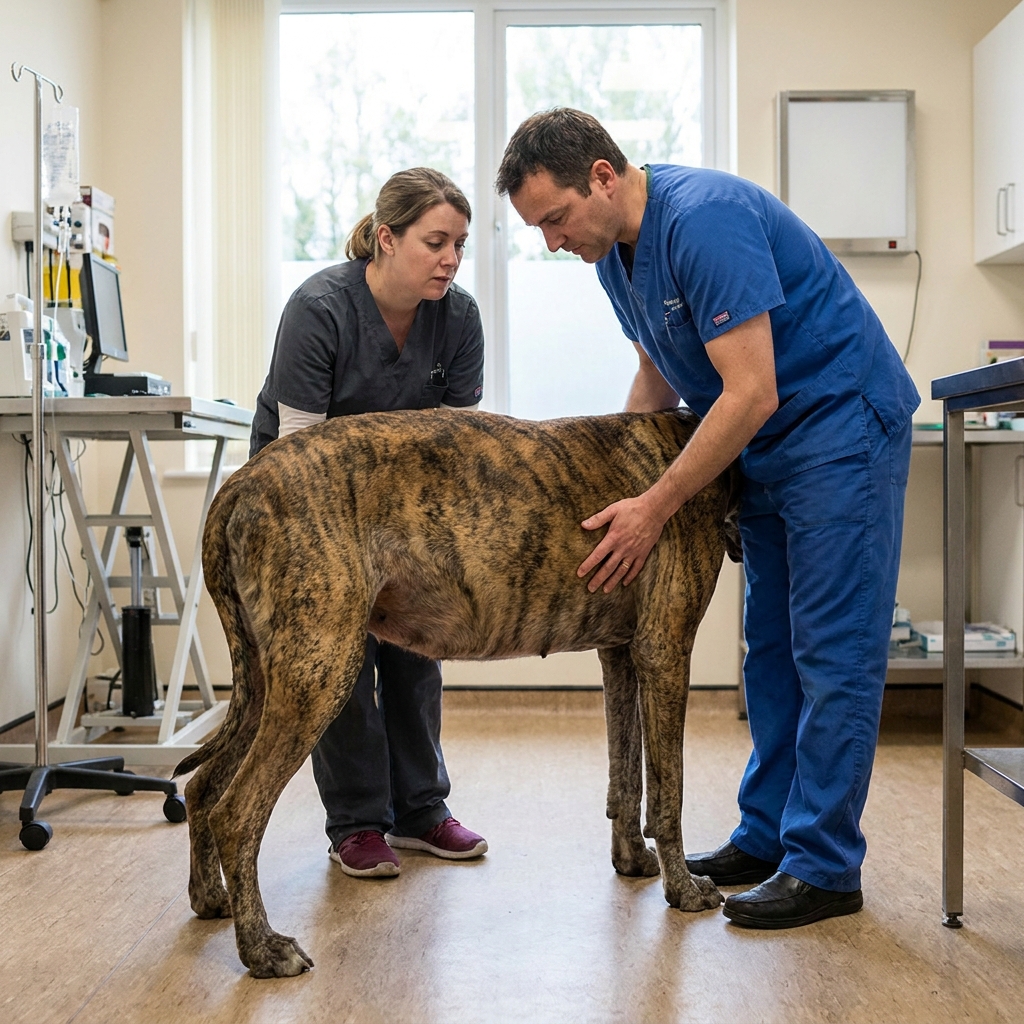
The transitions between stages are not hard cutoffs. They are gradual, and they are driven by the individual dog's body condition, activity level, and health status, not by the calendar. A 4-year-old Great Dane is a senior; a 4-year-old Chihuahua is a young adult. The owner who goes by the calendar gets the life stage wrong for half of the dogs in the house.
Stage 3: the growth stage (8 weeks to 12-18 months)
The growth stage is the most calorie-dense, most nutrient-dense stage of the dog's life. The puppy is laying down bone, muscle, organ tissue, and skin at a rate that the adult dog will never approach again. The caloric requirement per kilogram of body weight is 2-3 times the adult requirement. The protein requirement is higher (28-30% dry matter for growth, vs 18-25% for adult maintenance). The calcium and phosphorus requirements are higher and in a specific ratio (1.2:1 to 1.4:1 calcium:phosphorus). The essential fatty acid requirements are higher.
The growth stage is also the stage where overfeeding does the most long-term damage. A puppy that is fed to maximum appetite (free-choice feeding) grows faster than its skeletal frame can support. The result is a dog with hip dysplasia, elbow dysplasia, osteochondritis dissecans, and other developmental orthopedic diseases that would not have developed at a slower growth rate. The major veterinary nutrition bodies (AAFCO, FEDIAF, the WSAVA) all recommend feeding growth puppies to a measured body condition, not to maximum appetite. A puppy that is fed to lean body condition — ribs easily felt, waist visible, tuck visible — has a dramatically lower risk of developmental orthopedic disease than a puppy that is fed to plump body condition.
The feeding protocol for a growth puppy: feed a complete and balanced puppy food labeled for "growth" or "all life stages" (the "all life stages" formulation has to meet the more stringent growth-stage nutrient profile). Feed a measured amount based on the puppy's current weight and the food's calorie density. Re-measure every 2 weeks as the puppy grows. Feed 3-4 meals per day from 8-16 weeks, transitioning to 2 meals per day by 6 months. Body condition is checked weekly; the puppy should be lean, not plump. The transition to adult food happens at 12 months for small and medium breeds, 12-18 months for large breeds, and 18-24 months for giant breeds.
Stage 4: the young adult (12-18 months to 5-7 years)
The young adult stage is the lowest-maintenance stage nutritionally. The dog's growth plates have closed, the metabolism has stabilized, the activity level is at its adult peak. The feeding protocol: complete and balanced adult maintenance food, measured amount based on the dog's current weight and body condition, 2 meals per day. The body condition is checked monthly. The food is adjusted up or down by 10% based on whether the dog is gaining or losing weight. The owner who maintains lean body condition throughout the young adult stage has a dog that enters the mature adult stage at a healthy weight, with healthy joints, and with a metabolism that is well-tuned to the food intake.
The young adult stage is also the stage where the owner's habits matter most. A dog that is fed table scraps during the young adult stage develops the expectation of table scraps that persists for life. A dog that is fed a measured amount of kibble at scheduled meals develops the expectation of a measured amount of kibble at scheduled meals. The owner who trains the dog to expect a specific feeding protocol in young adulthood has trained a dog for life. The owner who trains the dog to expect "whatever is around" has trained a dog for life, in the opposite direction.
Stage 5: the mature adult (5-7 to 9-11 years)
The mature adult stage is the first stage where the body's metabolism starts to slow and the first age-related changes start to appear. The metabolism drops by 10-20% from the young adult peak. The activity level drops by 10-30%. The body condition starts to drift upward if the food amount is not adjusted. The dental disease is often present, sometimes severe. The first signs of joint stiffness appear, particularly in large breeds.
The feeding protocol for a mature adult: continue the complete and balanced adult maintenance food, but reduce the amount by 10-20% to match the lower metabolism. Body condition is checked every 2-4 weeks. The food is adjusted down by 5-10% increments if the dog is gaining weight. The transition to a "mature adult" or "senior" formulation is considered at 7 years for small and medium breeds, 6 years for large breeds, 5 years for giant breeds. The mature adult formulation has slightly lower calories, slightly higher joint-support nutrients (glucosamine, chondroitin, omega-3 fatty acids), and sometimes cognitive support nutrients.
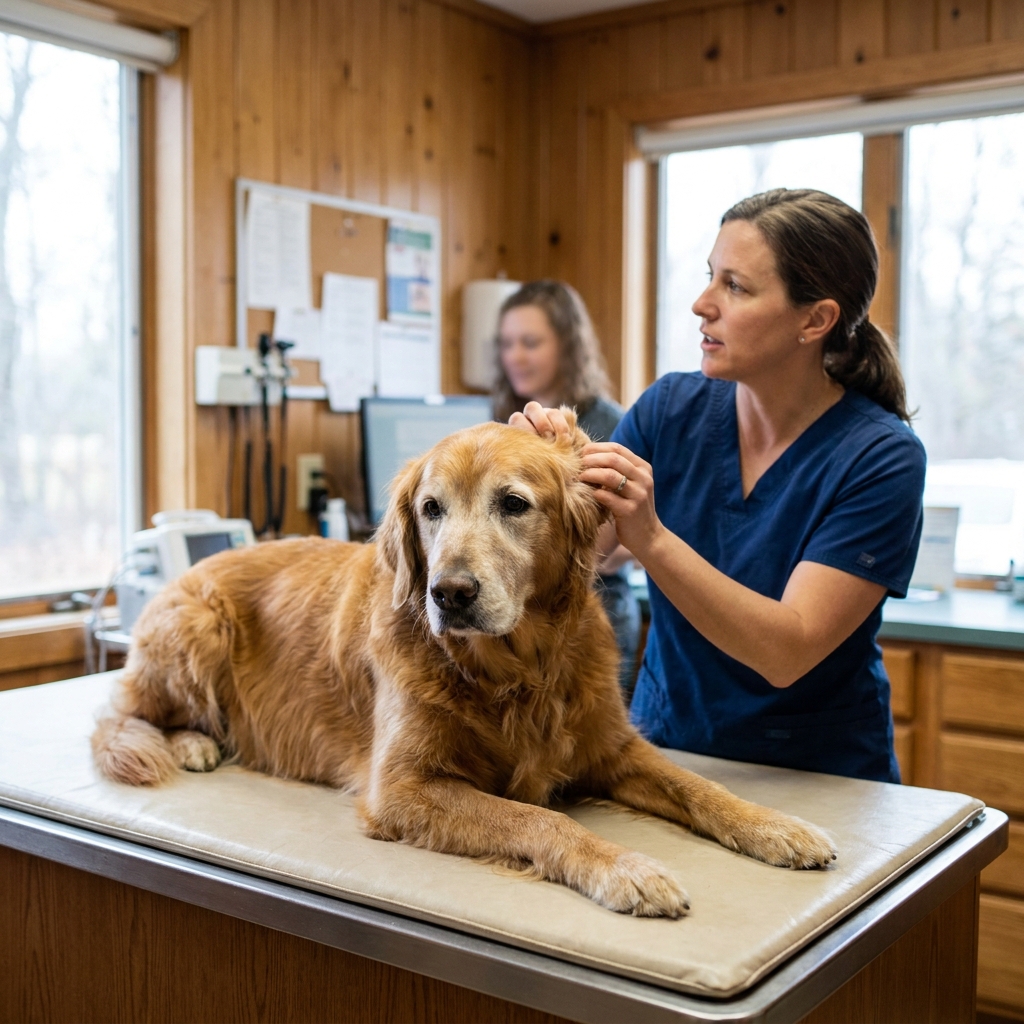
The mature adult is also the stage where a baseline blood panel becomes part of the annual exam. The panel catches early kidney disease, early liver disease, early thyroid changes, and other age-related issues that the food can be adjusted to support. A dog with early kidney disease is transitioned to a renal-support diet. A dog with early heart disease is transitioned to a sodium-restricted diet. The annual blood work drives the nutritional adjustments.
Stage 6: the senior and geriatric (9-11+ years)
The senior stage is the most individually variable stage nutritionally. A healthy 11-year-old Border Collie has very different needs from a 14-year-old Labrador with kidney disease and arthritis. The feeding protocol for a senior is based on the dog's specific health status, not on the calendar.
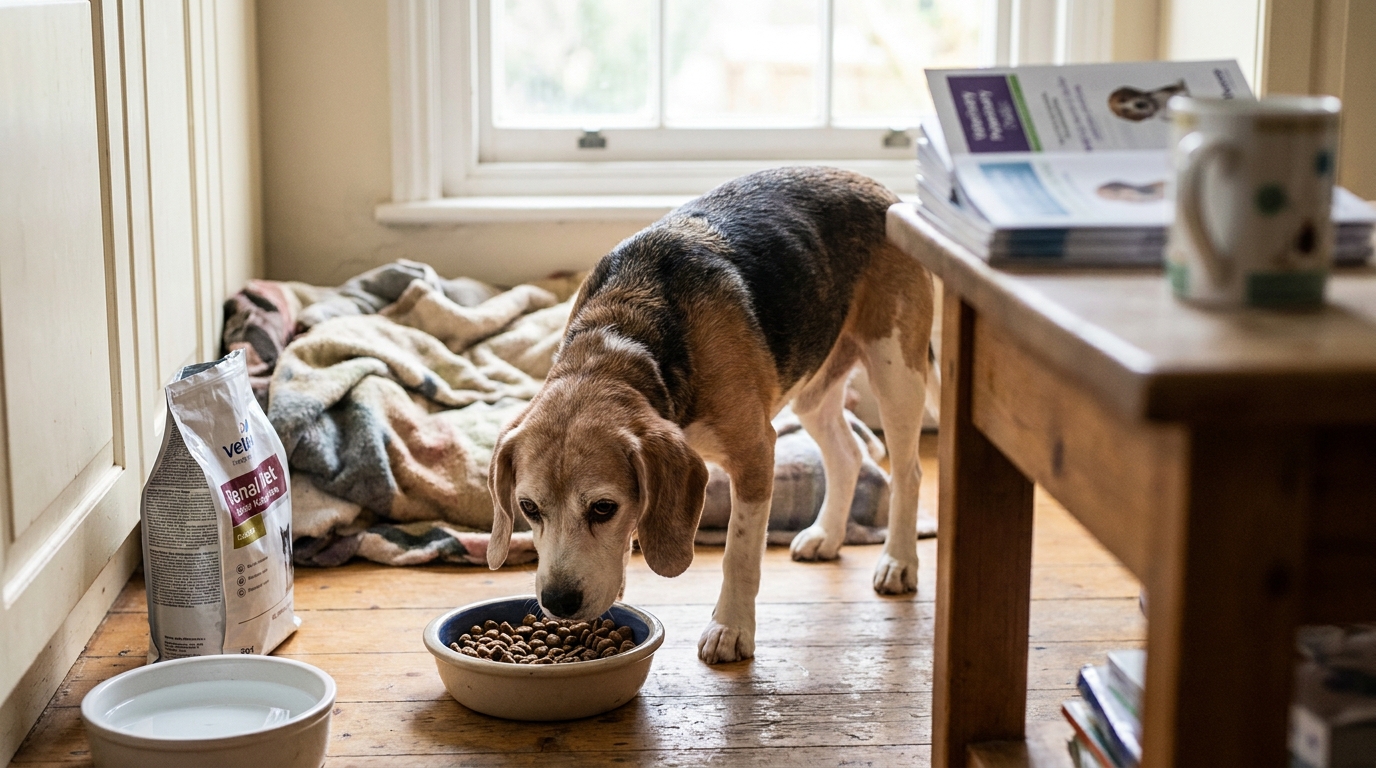
The general protocol: complete and balanced senior formulation, adjusted for the dog's specific health issues. Renal disease: low-phosphorus, moderate-protein diet. Heart disease: sodium-restricted diet. Joint disease: omega-3 supplementation, joint-support diet. Cognitive dysfunction: antioxidant-enriched diet, MCT supplementation. The senior dog that is otherwise healthy can stay on a quality senior maintenance food, with body condition checked every 2-4 weeks and the amount adjusted to maintain lean body condition. The senior dog that is losing weight (a common pattern in geriatric dogs) is fed a higher-calorie, higher-protein, more palatable food, often with multiple small meals per day.
The body condition check that drives every change
The body condition score, covered in detail in the previous article, is the single tool that drives every feeding change in every life stage. The owner who checks body condition monthly and adjusts the food amount up or down by 5-10% based on the score is the owner whose dog is at a healthy weight throughout life. The owner who never checks body condition and never adjusts the food amount is the owner whose dog drifts toward obesity in the young adult and mature adult stages, and toward cachexia in the senior stage. The dog that is at a healthy weight throughout life has a 1.5-2 year longer median lifespan than the dog that is overweight, with fewer joint problems, fewer metabolic diseases, and a higher quality of life in the senior years. The food and the amount matter. The body condition is the proof that they are right.
The one-page summary
A growth puppy is fed a measured amount of growth-stage food, body condition checked weekly, transitioned to adult at 12-24 months by size. A young adult is fed a measured amount of adult maintenance food, body condition checked monthly. A mature adult is fed a measured amount of adult or senior formulation, body condition checked every 2-4 weeks, with senior food considered at the breed-appropriate age. A senior is fed a measured amount of senior or condition-specific food, body condition checked every 2-4 weeks, with adjustments for specific health issues. The body condition check is the constant. The food and the amount change. The body condition stays at a 4.5-5 on the 9-point scale, from 8 weeks to 14 years.