
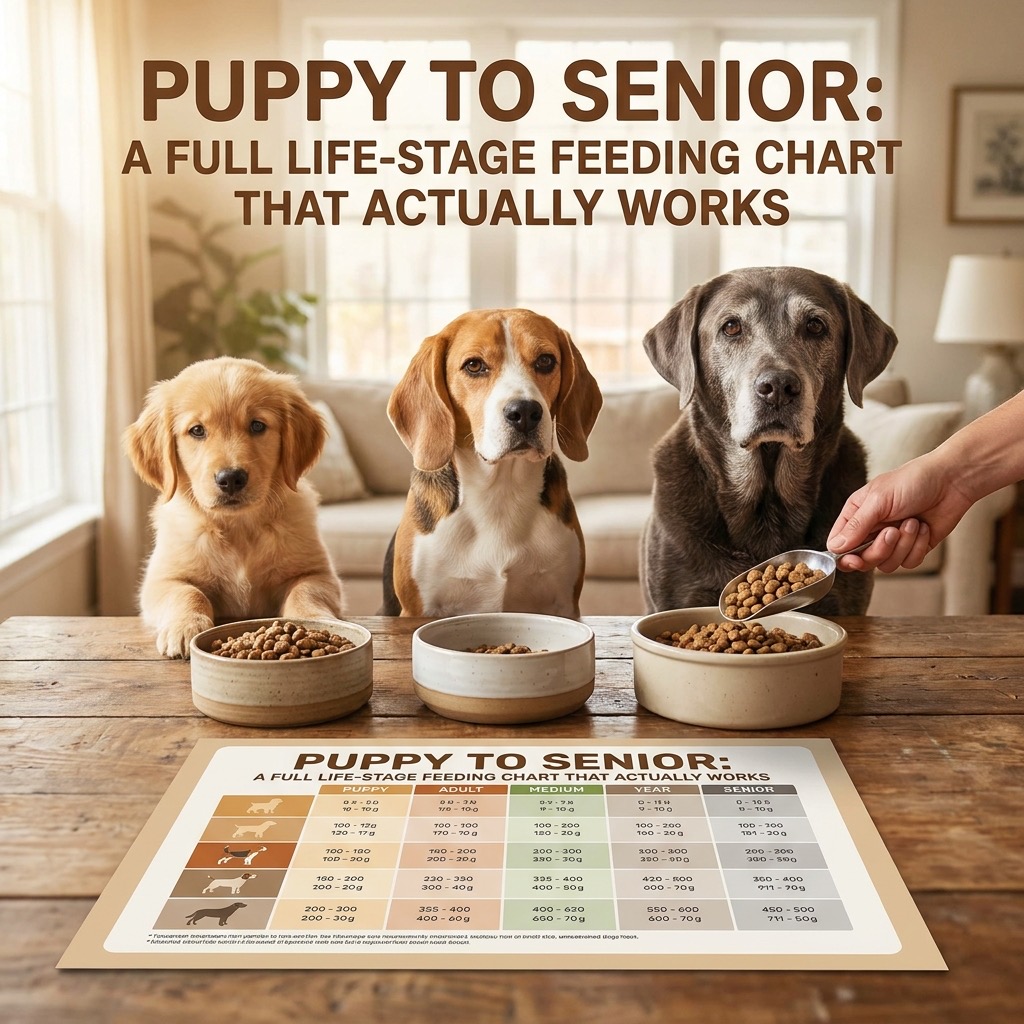
Puppy to senior: a full life-stage feeding chart that actually works
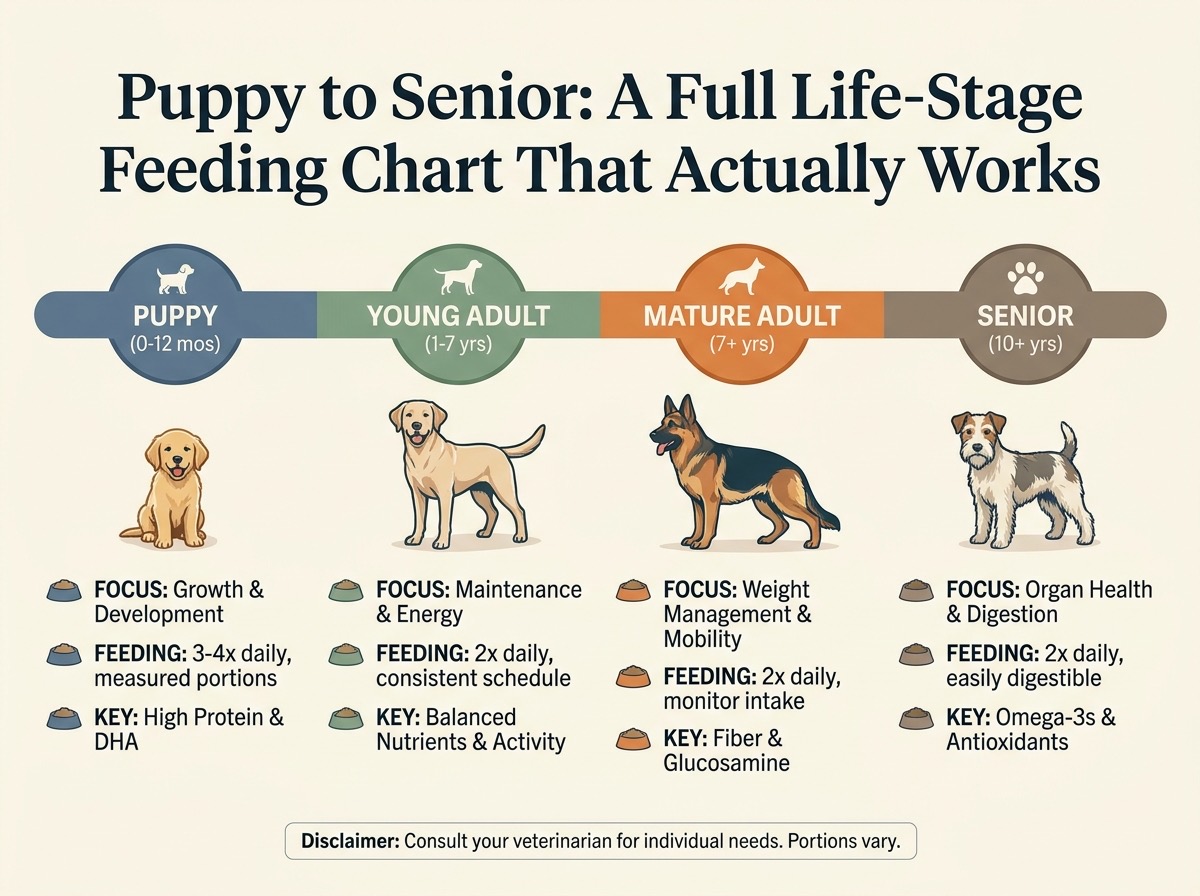
Dog feeding recommendations that say "feed to ideal body condition" are technically correct but practically useless. The owner wants numbers: how much, what kind, how often, and when to change. The chart below gives the numbers, with the physiology and the food choices behind them, stage by stage.
The big picture: a dog's calorie requirement per kilogram of body weight drops about 4x from peak puppy growth to senior maintenance. The change is not linear. It happens in distinct phases with different nutritional priorities, and getting the transitions wrong — feeding puppy food to a senior dog, or adult food to a pregnant bitch — has predictable, often irreversible consequences.
Phase 1: neonatal (0-4 weeks)
The neonate is on the bitch's milk exclusively. The breeder's job is to keep the bitch well-fed (she's producing 2-3x her maintenance calories in milk) and the puppies gaining weight daily.
What to feed the neonate
- Nothing, if the bitch is healthy and the puppies are nursing. Colostrum in the first 24 hours is essential for immune protection
- If the bitch cannot nurse: commercial puppy milk replacer (Esbilac, PetLac) every 2-3 hours, including overnight. Cow's milk is unsuitable — wrong protein-fat balance, can cause diarrhea
What to feed the bitch during nursing
- Free-choice feeding of a high-quality puppy food (or all-life-stages food) for the first 4 weeks
- Expect her intake to roughly double by week 3-4
- Free access to fresh water (lactation is thirsty work)
Phase 2: weaning (4-8 weeks)
The transition from milk to solid food. Puppies typically begin showing interest in the bitch's food at 3-4 weeks, and most are fully weaned by 6-8 weeks.
Weaning protocol
- Weeks 3-4: offer puppy food soaked in warm water or milk replacer to a porridge consistency. The puppies will walk through it before eating it; this is normal
- Weeks 4-6: gradually thicken the porridge until the puppies are eating moistened kibble
- Weeks 6-8: dry kibble, possibly with a small amount of water added for palatability. By 8 weeks, puppies should be eating dry food
Calorie target at weaning
- 4 weeks: ~200 kcal ME per kg of expected adult weight per day
- 8 weeks: ~250-300 kcal ME per kg of expected adult weight per day
- This is the highest calorie-requirement phase in the dog's life (per kg of body weight)
What to feed
- A high-quality puppy food labelled for "growth" or "all life stages"
- AAFCO statement confirming the food meets growth requirements
- Protein 28-32% (dry matter basis), fat 18-22% (dry matter basis), calcium 1-1.5% (dry matter basis), phosphorus 0.8-1.2% (dry matter basis)
Common mistakes
- Feeding adult food to weanlings: insufficient calories, calcium, and phosphorus for growth
- Adding calcium supplements: causes skeletal abnormalities in large-breed puppies. The food is balanced
- Switching foods frequently: causes GI upset. Choose one good food and stick with it
Phase 3: rapid growth (8 weeks - 6 months)
The peak growth phase. Puppies gain 2-4 g per kg of expected adult weight per day, depending on breed. Toy breeds reach adult size in 6-9 months; giant breeds continue growing until 18-24 months.
Calorie target during rapid growth
- 8-12 weeks: 250-300 kcal ME per kg of expected adult weight per day
- 3-4 months: 200-250 kcal ME per kg of expected adult weight per day
- 4-6 months: 175-200 kcal ME per kg of expected adult weight per day
- 6-12 months: 150-175 kcal ME per kg of expected adult weight per day (gradually declining)
What to feed
Continue the growth-formulated food. For large-breed puppies (expected adult weight over 25 kg), use a large-breed puppy formula. These foods have:
- Lower calorie density (preventing too-rapid growth)
- Slightly lower calcium and phosphorus ratios
- Added joint support nutrients (glucosamine, chondroitin, omega-3s)
The reason: large-breed puppies that grow too fast develop skeletal problems — hip dysplasia, elbow dysplasia, osteochondritis dissecans (OCD). The large-breed puppy food moderates growth rate to reduce these risks.
Feeding frequency
- 8-12 weeks: 4 meals per day
- 3-4 months: 3 meals per day
- 5+ months: 2 meals per day
How to know if the puppy is the right weight
- Body condition score (BCS) 4-5 out of 9: ribs easily felt but not seen, waist visible from above, abdominal tuck present
- A 9 on the BCS chart is obese; a 4-5 is ideal
- Adjust the amount fed to maintain this score, not to follow the bag's recommendation
Common mistakes
- Overfeeding: free-choice feeding of puppy food leads to overweight puppies. Measure the food, feed in meals
- Feeding adult food to large-breed puppies: too low in calcium, may cause developmental orthopedic disease
- Switching to adult food too early: most puppies need puppy food until 12 months (small breeds) or 18-24 months (giant breeds)
Phase 4: late growth / adolescent (6-18 months)
Growth rate slows. The puppy is still growing, but the metabolic rate is declining toward adult maintenance.
When to switch to adult food
- Small breeds (under 10 kg adult): 9-12 months
- Medium breeds (10-25 kg adult): 12 months
- Large breeds (25-40 kg adult): 12-15 months
- Giant breeds (over 40 kg adult): 18-24 months
Transition protocol
- Days 1-3: 75% puppy food, 25% adult food
- Days 4-6: 50/50
- Days 7-9: 25% puppy food, 75% adult food
- Day 10+: 100% adult food
Watch for loose stools during the transition. If they occur, slow the transition. Some dogs need 2-3 weeks to adjust.
Calorie target at adult transition
- 100-120 kcal ME per kg of body weight per day for most breeds
- Large breeds: 80-100 kcal ME per kg per day
- Working dogs: 150-200+ kcal ME per kg per day, depending on activity
Body condition check
- Continue to assess BCS monthly
- The most common reason for adult dog obesity is failing to adjust the food amount as the dog matures
Phase 5: adult maintenance (1-7 years)
The longest phase. Most adult dogs need 80-120 kcal ME per kg per day, depending on size, breed, and activity. The amount of food needed is approximately 2-3% of body weight per day for dry food, less for wet food.
What to feed
- An adult maintenance food appropriate for the dog's size (small breed, medium breed, large breed, giant breed)
- AAFCO statement for "adult maintenance"
- Protein 22-28% (dry matter basis), fat 12-18% (dry matter basis)
The size difference in foods
Large-breed adult foods have:
- Lower calorie density (to prevent weight gain)
- Added joint support (glucosamine, chondroitin, omega-3s)
- Larger kibble size (encourages chewing, reduces gulping)
Small-breed adult foods have:
- Higher calorie density (small dogs have higher metabolic rates)
- Smaller kibble size (matches small mouths)
- Higher fat content (palatability, energy density)
A small dog fed a large-breed food may not get enough calories. A large dog fed a small-breed food may gain too much weight and develop joint issues from too-rapid growth or excess weight.
Adjusting for activity
- Sedentary adult (mostly indoor, short walks): 80-90 kcal ME per kg per day
- Moderately active (1-2 hours of exercise per day): 100-120 kcal ME per kg per day
- Highly active / working dog (3+ hours of exercise, agility, hunting): 150-200 kcal ME per kg per day
Common mistakes
- Free-choice feeding: leads to weight gain in 30-50% of adult dogs
- Treats comprising more than 10% of daily calories: the most common cause of "mystery weight gain"
- Following the bag's recommendation as gospel: the bag's recommendation is a starting point, not a final answer. Adjust based on BCS
Phase 6: mature adult (7-9 years)
The transition from adult to senior is gradual. Around 7 years (5 years for giant breeds), most dogs enter the "mature adult" phase where:
- Metabolic rate starts to decline
- Activity level often decreases
- Muscle mass starts to decline
- Joint issues may start
What to change
- Reduce calorie intake by 10-20%: most mature adults need 5-10% fewer calories than younger adults at the same body weight
- Increase protein to 28-30% (dry matter basis): helps preserve muscle mass. The old advice to reduce protein in older dogs has been overturned
- Add joint support: omega-3 fatty acids (EPA/DHA), glucosamine, chondroitin
- Add antioxidants: vitamin E, vitamin C, beta-carotene to support cognitive function
- Consider a senior food: many premium brands offer 7+ formulas
The senior food question
For most dogs, switching to a senior food at 7 years is reasonable. For some, the senior food is unnecessary until 9-10 years. The decision factors:
- Body condition: if the dog is gaining weight, a senior food's lower calorie density helps
- Activity: if the dog is less active, senior food's calorie adjustment is appropriate
- Health conditions: if kidney disease, heart disease, or cognitive decline is present, a therapeutic diet may be needed
A healthy 7-year-old dog of ideal weight can stay on adult food. A 7-year-old dog gaining weight should switch to senior.
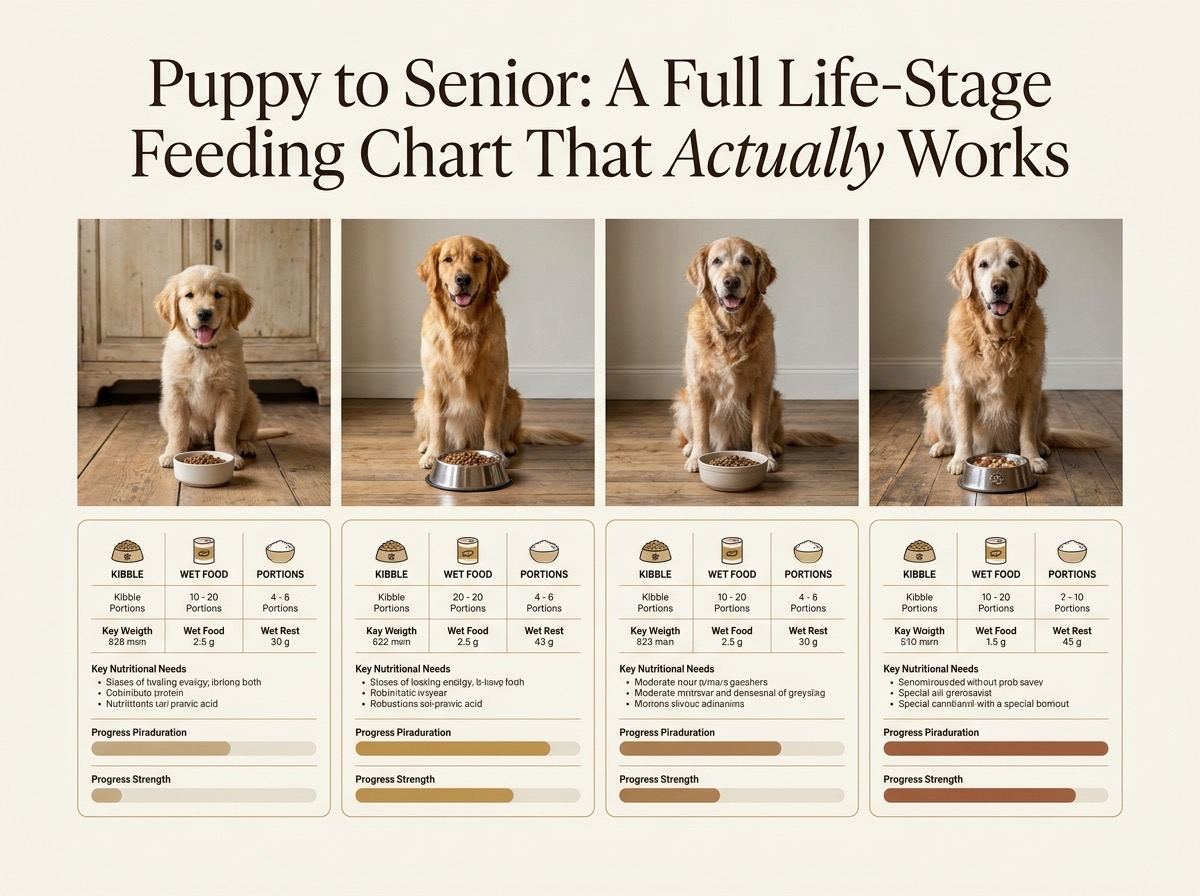
Phase 7: senior (9-11 years) and geriatric (11+ years)
The senior and geriatric phases have distinct nutritional priorities.
Senior (9-11 years for most breeds, 7+ for giant breeds)
- Calorie intake: 80-90 kcal ME per kg per day for typical activity
- Protein: 28-32% (dry matter basis) — important for muscle maintenance
- Phosphorus: moderate restriction if early kidney disease is suspected
- Sodium: moderate restriction
- Joint support: increased omega-3s, glucosamine, chondroitin
- Cognitive support: antioxidants, MCT oil (medium-chain triglycerides), SAMe
Geriatric (11+ years for most breeds, 9+ for giant breeds)
- Calorie intake: 70-90 kcal ME per kg per day
- Protein: still 28%+ — don't reduce protein unless kidney disease is advanced
- Digestibility: highly digestible ingredients, as digestive efficiency declines
- Palatability: warming food slightly (to body temperature) enhances smell and palatability
- Texture: for dogs with dental disease, soak kibble or switch to wet food
Common health issues and dietary responses
- Chronic kidney disease (CKD): phosphorus restriction, moderate protein restriction (in later stages), omega-3 supplementation. Prescription kidney diets (Hill's k/d, Royal Canin Renal, Purina NF) extend life in CKD
- Heart disease: sodium restriction, increased taurine and L-carnitine. Prescription cardiac diets (Hill's h/d, Royal Canin Cardiac)
- Cognitive dysfunction: antioxidants, MCT oil, omega-3s, SAMe. Prescription cognitive diets (Hill's b/d, Purina NeuroCare)
- Dental disease: dry kibble does not clean teeth (this is a myth). The gold standard is daily tooth brushing. For dogs that won't tolerate brushing, dental-specific diets (Hill's t/d) can help
- Obesity: weight loss diet, increased exercise, calorie restriction. Prescription weight loss diets (Hill's Metabolic, Royal Canin Satiety, Purina OM)
- Diabetes: high-protein, low-carbohydrate, high-fibre. Prescription diabetic diets (Hill's w/d, Royal Canin Diabetic, Purina DM)
A note on therapeutic diets: prescription diets are formulated to manage specific diseases and are supported by clinical evidence. They are more expensive than over-the-counter diets, but they typically outperform the alternatives. If the dog has a chronic disease, a prescription diet is a worthwhile investment.
Phase 8: end of life
For dogs in the final weeks to months of life:
- The priority is eating and quality of life, not perfect nutrition
- Whatever the dog will eat is the right food
- Warming food to body temperature enhances smell
- Hand-feeding may be necessary
- For dogs with nausea, anti-nausea medication (cerenia) from the vet
- For dogs refusing food entirely, appetite stimulants (mirtazapine, capromorelin)
- The decision to place a feeding tube is individual — some owners pursue this for additional months; others don't
The nutritional science matters less at this stage than the human connection. The goal is the dog's comfort, not optimal nutrient intake.
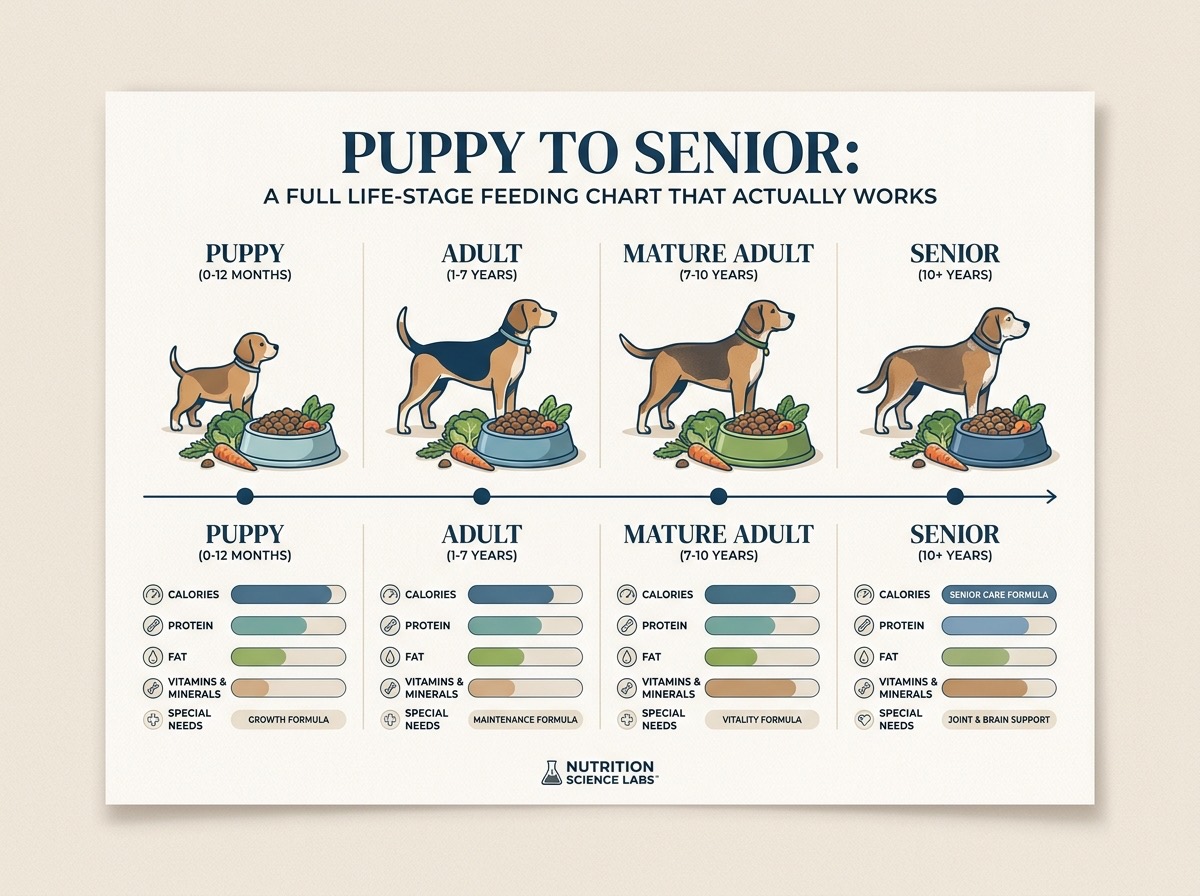
The full life-stage chart, summarised
| Phase | Age | kcal ME/kg/day | Protein % | Fat % | Feeding frequency |
|---|---|---|---|---|---|
| Neonatal | 0-4 weeks | Bitch's milk | 25+ | 15+ | Continuous (nurse) |
| Weaning | 4-8 weeks | 200-300 | 28-32 | 18-22 | 4 meals |
| Rapid growth | 8 wk-6 mo | 175-300 | 28-32 | 18-22 | 3-4 meals |
| Late growth | 6-18 mo | 150-200 | 28-30 | 16-20 | 2 meals |
| Adult maintenance | 1-7 yr | 80-120 | 22-28 | 12-18 | 2 meals |
| Mature adult | 7-9 yr | 70-100 | 28-30 | 12-16 | 2 meals |
| Senior | 9-11 yr | 70-90 | 28-32 | 12-15 | 2 meals |
| Geriatric | 11+ yr | 70-90 | 28+ | 12-15 | 2-3 small meals |
These are starting points. The actual amount depends on the individual dog's BCS, activity, breed, and health.
How to calculate the right amount
The most accurate way to feed a dog is by calories, not by cup. Here's the math:
- Determine ideal body weight (not current weight if the dog is overweight or underweight)
- Use the kcal/kg/day target for the life stage: e.g., a 15 kg adult moderately active dog needs about 110 × 15 = 1,650 kcal ME per day
- Check the food's kcal content: most premium foods list kcal per cup or per kg on the bag
- Calculate cups per day: e.g., 1,650 kcal ÷ 350 kcal per cup = 4.7 cups per day
- Adjust based on BCS after 2-4 weeks
If the food doesn't list kcal content (low-quality foods sometimes don't), switch to a food that does. The kcal information is essential for accurate feeding.
Treats and extras: the 10% rule
Treats should be no more than 10% of the dog's daily calorie intake. For a 1,650 kcal/day dog, that's 165 kcal of treats — about 1 medium biscuit, or a tablespoon of cheese, or a small piece of cooked chicken.
The most common reason for adult dog obesity: treats that the owner "forgets" to count. A few extra biscuits a day add up to pounds over a year. If the dog is overweight, the first place to look is the treat bag.
Healthy low-calorie treat options (under 10 kcal each):
- Baby carrots
- Green beans (fresh or frozen)
- Apple slices (no seeds)
- Zucchini
- Plain cooked chicken breast (small pieces)
- Ice cubes (for the hot days)
- Commercial low-calorie treats (typically 2-5 kcal each)
The bottom line
A dog's nutritional needs change significantly across life stages. The peak calorie requirement per kg is at weaning, the lowest is at senior maintenance, and the changes are not linear. The right food at the right stage — measured by calories, monitored by body condition, and adjusted every 3-6 months — produces a healthy dog at every age. The wrong food at the wrong stage — typically, free-choice feeding of an inappropriate food — produces obesity, orthopedic disease, or chronic illness. The chart and the math give the framework. The BCS gives the answer. Adjust from there.
---
About the author: [Sarah Chen](../Sarah%20Chen.md) holds a DVM from Cornell and a PhD in Animal Nutrition from UC Davis, with 12 years of clinical nutrition consulting, board certification by the American College of Veterinary Nutrition, and over 30 peer-reviewed publications.