
Weight management: how to actually use the Body Condition Score for dogs
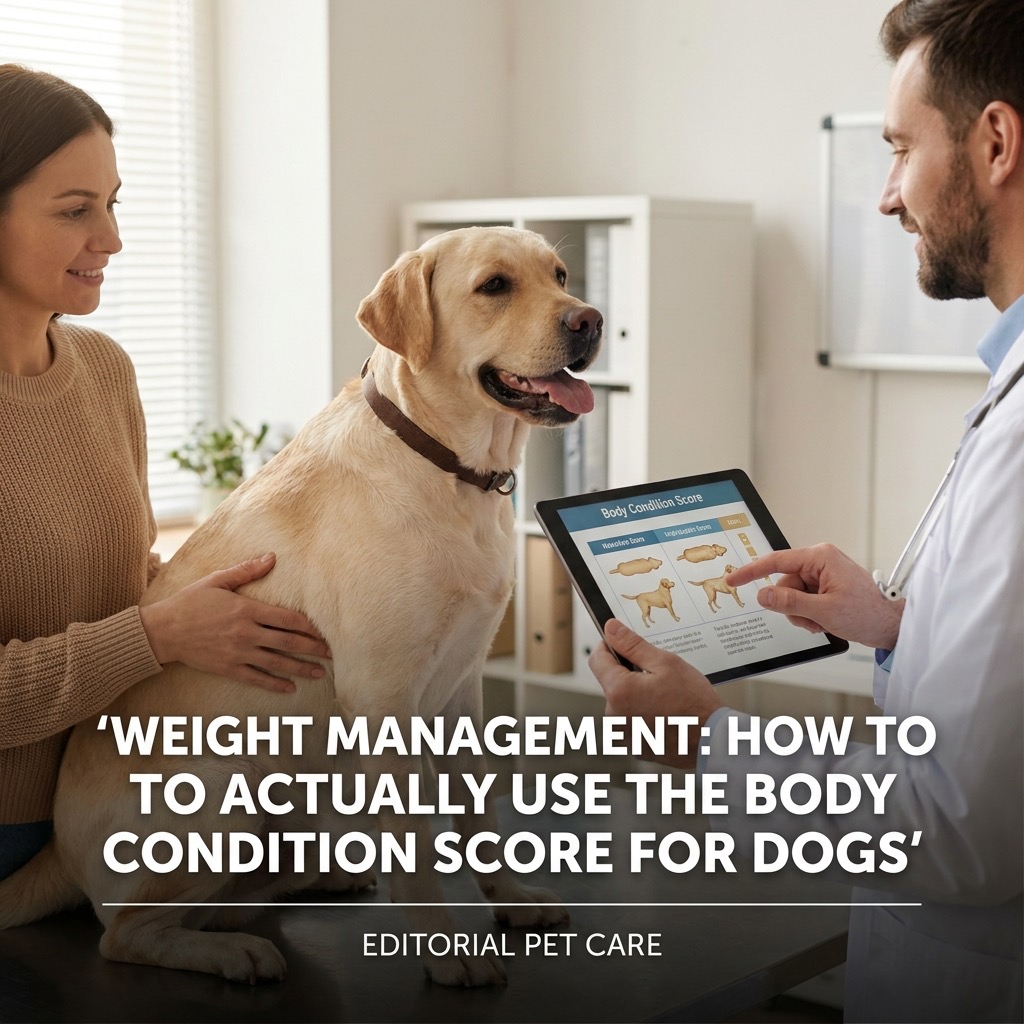
The Body Condition Score (BCS) is the most useful tool in canine weight management. It is faster, cheaper, and more meaningful than the bathroom scale. It is also the most often misapplied — by owners, by vets, and by pet food company "ideal weight" calculators. A dog can weigh exactly what the breed standard says and still be obese by BCS; a dog can weigh 20% over the breed standard and still be at ideal BCS if it has significant muscle mass.
This is how to actually use BCS in clinical practice.
What BCS actually measures
BCS is a 9-point scale (or 5-point scale, doubled) that estimates body fat percentage based on visual and tactile assessment. The original 9-point scale was developed at Nestlé Purina in 1997 and validated against DEXA scan body composition in dogs.
| BCS | Body fat % | Description |
|---|---|---|
| 1 | <5% | Emaciated. Ribs, lumbar vertebrae, pelvic bones visible. No body fat. |
| 2 | 5–10% | Very thin. Ribs easily palpated, minimal fat covering. Lumbar vertebrae visible. |
| 3 | 10–15% | Thin. Ribs easily palpated, slight fat covering. Waist obvious. |
| 4 | 15–20% | Underweight. Ribs easily palpated with minimal fat. Waist easily noted. |
| 5 (ideal) | 20–25% | Ideal. Ribs palpated without excess fat covering. Waist visible. Abdominal tuck apparent. |
| 6 | 25–30% | Overweight. Ribs palpable with slight excess fat. Waist visible but not prominent. |
| 7 | 30–35% | Heavy. Ribs palpable with difficulty. Waist barely visible. No abdominal tuck. |
| 8 | 35–40% | Obese. Ribs not easily palpated under heavy fat cover. No waist. No abdominal tuck. |
| 9 | 40–45%+ | Severely obese. Massive fat deposits. Obvious abdominal distension. |
The "ideal" range for most dogs is BCS 4.5–5.5 out of 9. Some breeds have different ideal ranges (e.g., sighthounds naturally run BCS 4, bulldogs naturally run BCS 6), but for the average dog, BCS 5 is the target.
How to score your own dog
The visual and tactile assessment:
Visual assessment (look from the side and above)
From the side: Look at the abdomen. There should be a clear abdominal tuck — the abdomen rises from the ribcage to the hindquarters. No tuck = overweight.
From above: Look at the waist. There should be a clear hourglass shape behind the ribs. The waist should narrow visibly from the ribcage to the hips. No waist = overweight.
Overall silhouette: An overweight dog looks like a sausage on four short legs. A fit dog looks like an hourglass from above and has a clear waist-tuck transition from the side.
Tactile assessment (feel the ribs and spine)
Ribs: Place your fingers flat on the ribcage. You should be able to feel the ribs without pressing hard, with a thin layer of fat over them. If you have to push to feel the ribs, the dog is overweight. If the ribs are visibly protruding, the dog is underweight.
Spine and hips: Feel the lumbar vertebrae (lower back) and the hip bones. They should be palpable without excess fat but should not protrude.
A common visual error
Owners frequently score their overweight dog as "ideal" because they are used to seeing the dog at that weight. The visual reference point drifts over time. A dog that has gained 10% of body weight over two years looks "normal" to the owner but is BCS 7 to an outside observer.
The fix: take a monthly photo of the dog from above and from the side, against a neutral background. Compare month-to-month. The photos reveal gradual weight gain that the eye misses.
Why BCS is more useful than the scale
The bathroom scale measures body weight, which is the sum of fat, muscle, bone, water, and gut contents. BCS measures body fat percentage, which is the actual health-relevant variable.
Two dogs of the same breed, both weighing 25 kg:
- Dog A: BCS 5, well-muscled working dog. Body fat 22%. Healthy.
- Dog B: BCS 7, sedentary pet. Body fat 32%. Overweight, at risk for joint disease, diabetes, pancreatitis.
The scale says both are 25 kg. BCS says one is healthy and the other is overweight. BCS is more useful for management decisions.
A common scenario: an owner says "the vet said my dog needs to lose 4 kg". The owner puts the dog on a diet, the dog loses 3 kg, the owner is happy. But if the dog lost muscle mass rather than fat (which happens on overly aggressive calorie restriction without adequate protein), the dog is now at BCS 7 with lower muscle mass — actually less healthy than before.
BCS measures what matters: the proportion of fat to lean.
The "ideal weight" fallacy
Pet food bags and many vet clinics use "ideal weight" tables based on breed standards. These tables are wrong for most dogs in two ways:
- The breed standard weight range is wide (e.g., Labrador retrievers range from 25–36 kg depending on frame). Most "ideal weight" recommendations pick a single number that doesn't reflect individual variation.
- The breed standard weight is for show-condition dogs with specific muscle mass and conformation. A working field Labrador and a show Labrador at the same weight have different body compositions.
The right approach: use the breed range as a starting point, then BCS as the deciding factor. If the dog is BCS 5 at 28 kg and the breed range is 25–36 kg, the dog's ideal weight is 28 kg, regardless of what the bag says.
The weight loss protocol using BCS
Once you have established that the dog is overweight (BCS 6+), the protocol:
Step 1: target BCS
Set a realistic target. Most vets aim for BCS 5 (ideal). For a dog at BCS 7, the goal is to lose enough weight to drop 2 points. For a dog at BCS 8, the goal is to drop 3 points.
Step 2: calculate target weight
You cannot directly translate BCS to a target weight, but a rough estimate:
- Each BCS point ≈ 10–15% of body weight
- BCS 7 dog at 30 kg: target weight is roughly 25–27 kg
- BCS 8 dog at 35 kg: target weight is roughly 25–28 kg
The exact target weight is whatever the dog weighs at BCS 5. You find this by feeding the weight loss plan and weighing monthly until the dog reaches BCS 5.
Step 3: calculate daily calories for weight loss
The formula for weight loss calories in dogs:
- RER (Resting Energy Requirement) = 70 × (body weight in kg)^0.75
- Weight loss calories = RER × 1.0 (instead of the usual 1.4–1.6 for maintenance)
For a 30 kg overweight dog with target weight 26 kg:
- RER at 26 kg = 70 × 26^0.75 = 70 × 11.5 = 805 kcal
- Weight loss target = 805 kcal/day
In practice, this often means cutting the maintenance diet by 20–30%. Most maintenance diets are around 1,000–1,200 kcal/day for a 26 kg dog.
Step 4: choose the diet
The best diet for canine weight loss is one the dog will eat consistently at the calorie target. That usually means:
- A veterinary weight-loss diet (Hill's Metabolic, Royal Canin Satiety, Purina Pro Plan OM): formulated for satiety with high fibre and protein, lower fat
- A home-cooked diet balanced by a veterinary nutritionist: effective but requires commitment
- A reduced portion of the regular diet: simplest, often least effective (the dog feels hungry)
Veterinary weight-loss diets are often the most effective because they are formulated for satiety at lower calories. The dog feels fuller on fewer calories, which improves compliance.
Step 5: monitor and adjust
- Weigh weekly for the first month, then monthly
- Score BCS monthly: take the photo, score, log
- Adjust calories if not losing: if no weight loss after 4 weeks, reduce by 10%
- Adjust if losing too fast: weight loss faster than 1–2% of body weight per week risks muscle loss. Slow down
Common mistakes
1. "My dog is big-boned"
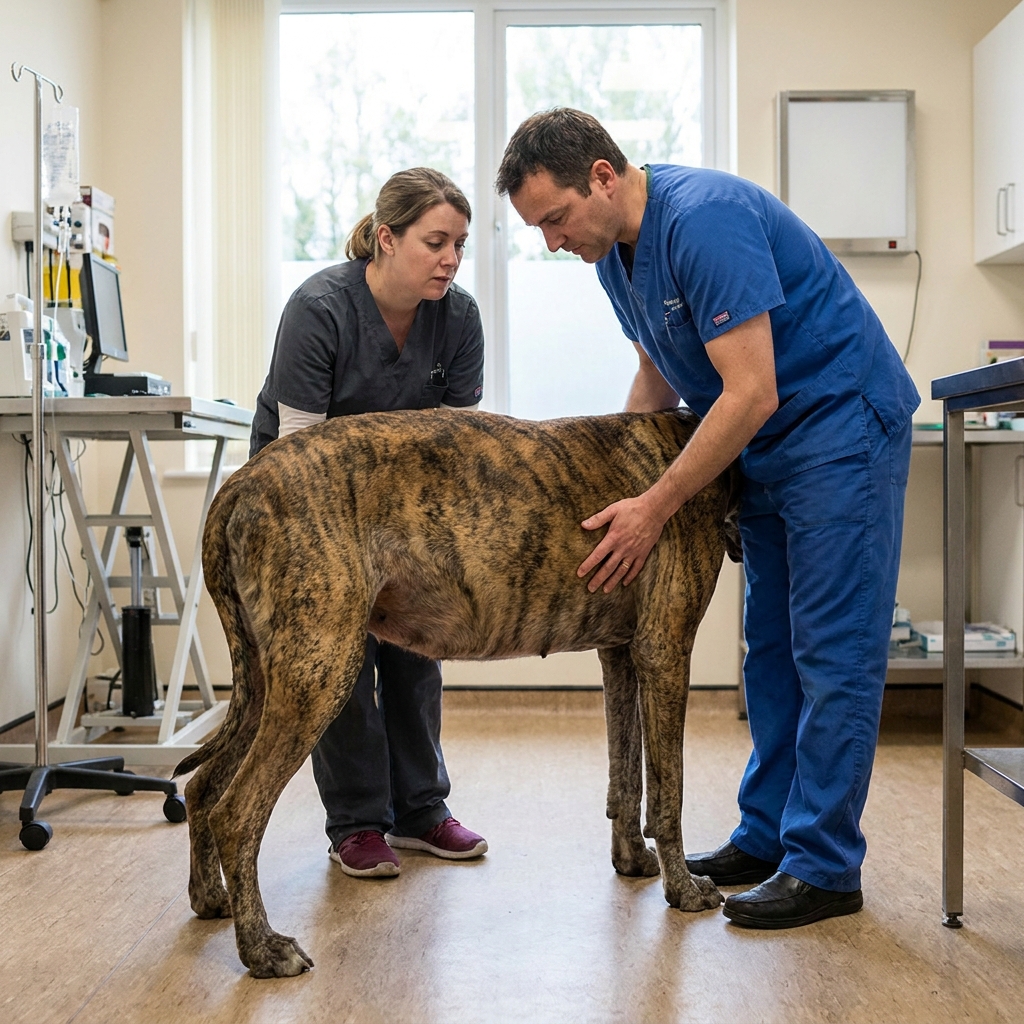
A common owner explanation for why their dog is BCS 7–8. Big-boned dogs exist (English mastiffs, Great Danes), but their BCS at healthy weight is still 5–6, not 7–8. The size of the bones does not affect the size of the fat layer over them.
2. "He won't lose weight on diet food"
The most common reason: the owner is feeding too much. Veterinary weight-loss diets are calorie-controlled; overfeeding them defeats the purpose. Measure portions. Use a gram scale for accuracy.
3. "He's always hungry"
Hunger on a weight loss diet is real but manageable:
- High-fibre, high-protein diets: more satiating per calorie
- Frequent small meals: 3–4 meals per day instead of 2
- Low-calorie vegetables as snacks: green beans, carrot, cucumber (raw or steamed)
- Slow feeders: extend meal duration
- Lickimats and Kongs: spread the daily ration over 30–60 minutes of licking
If hunger persists despite these strategies, the diet may need to be even more calorie-dense in fibre, or the weight loss rate may be too aggressive.
4. "Treats!"
Treats are the silent calorie addition that derails most weight loss programmes. The 10% rule applies — treats should be no more than 10% of daily calories. For a dog on 800 kcal/day for weight loss, treats can be at most 80 kcal/day. Two medium Milk-Bone biscuits are 60 kcal. A dental chew is 100+ kcal.
Switch to low-calorie training treats: freeze-dried chicken, baby carrots, green beans. Count them in the daily total.
5. "Multiple-dog household feeding is hard"
Yes. Solutions:
- Separate feeding areas: feed in different rooms or crates
- Microchip-activated feeders: SureFeed, PortionPro — open only for the assigned pet
- Feed at scheduled times, not free-choice: pick up uneaten food after 15 minutes
6. "The family gives in"
The spouse, the children, the in-laws. Everyone needs to agree on the weight loss plan. A single "he looks so hungry" treat from a family member can ruin a week's progress.
Solution: a household meeting. Explain the plan. Give everyone permission to say no to begging. Show progress photos to motivate.
What success looks like
A successful weight loss programme:
- Loses 1–2% of body weight per week (faster than this risks muscle loss)
- Achieves target BCS within 4–8 months
- Maintains target BCS for 6+ months before considering the maintenance phase
- Reduces or eliminates medications for obesity-related conditions (joint pain medication, insulin dose)
- Improves energy, mobility, and quality of life
The visible improvements:
- Visible waist
- Palpable ribs without pressing
- Abdominal tuck
- More energy, more willingness to play
- Better joint mobility
- Easier breathing in hot weather
The bottom line
BCS is the most useful, most underused tool in canine weight management. It is faster and more meaningful than the scale, and it captures what matters: the proportion of fat to lean. The protocol is straightforward: score BCS monthly, target BCS 5, calculate calorie needs based on target weight, choose a weight-loss diet, measure portions, weigh regularly, and adjust. The success rate with consistent execution is over 80%. The dogs that don't make it are the ones with inconsistent households, inaccurate portion measurement, and unrealistic expectations. Get the BCS right, get the family aligned, and the rest is patience.
---
About the author: [Sarah Chen](../Sarah%20Chen.md) is a registered animal nutritionist (DAN) with a Master of Veterinary Medicine from the University of Melbourne, and served as canine nutrition consultant at RSPCA Australia for 12 years.