
Common allergens in dog food: the proteins, grains, and additives worth understanding
The internet has a long list of foods that "cause allergies in dogs." Most of the list is wrong, or at least exaggerated. The actual list of ingredients that are clinically documented to cause true IgE-mediated food allergies in dogs is short. Chicken, beef, dairy, eggs, and wheat account for the vast majority of confirmed cases. The rest of the ingredients the internet worries about - corn, soy, rice, "fillers," "by-products," "additives" - are either rare allergens, common culprits for other reasons (intolerance, not allergy), or not allergens at all.
This article is the real list, the symptoms to look for, and the clinical decision logic for what to do when you suspect a food allergy.
The four facts about food allergy in dogs
Before the list, four facts that change how to think about the problem:
Fact 1: True food allergy is uncommon. Adverse food reactions are common (10-15% of dogs with chronic skin or GI issues have some dietary component). True IgE-mediated food allergy is a smaller subset, probably 1-5% of all dogs. Most "food allergies" are intolerances - digestive, not immune - and most of those resolve with a different diet without an elimination trial.
Fact 2: The allergen is almost always a protein. The immune system recognizes the protein structure of the food. Carbohydrate allergies exist but are rare. Fat allergies are essentially unheard of. The ingredient on the label that has the protein is what the immune system reacts to.
Fact 3: The allergen is almost always something the dog has eaten before. Food allergies develop after repeated exposure. A dog cannot be allergic to an ingredient it has never eaten. This is why a "novel protein" only works if the protein is genuinely novel for that dog.
Fact 4: The symptoms are mostly skin and gut. Food allergy in dogs typically presents as:
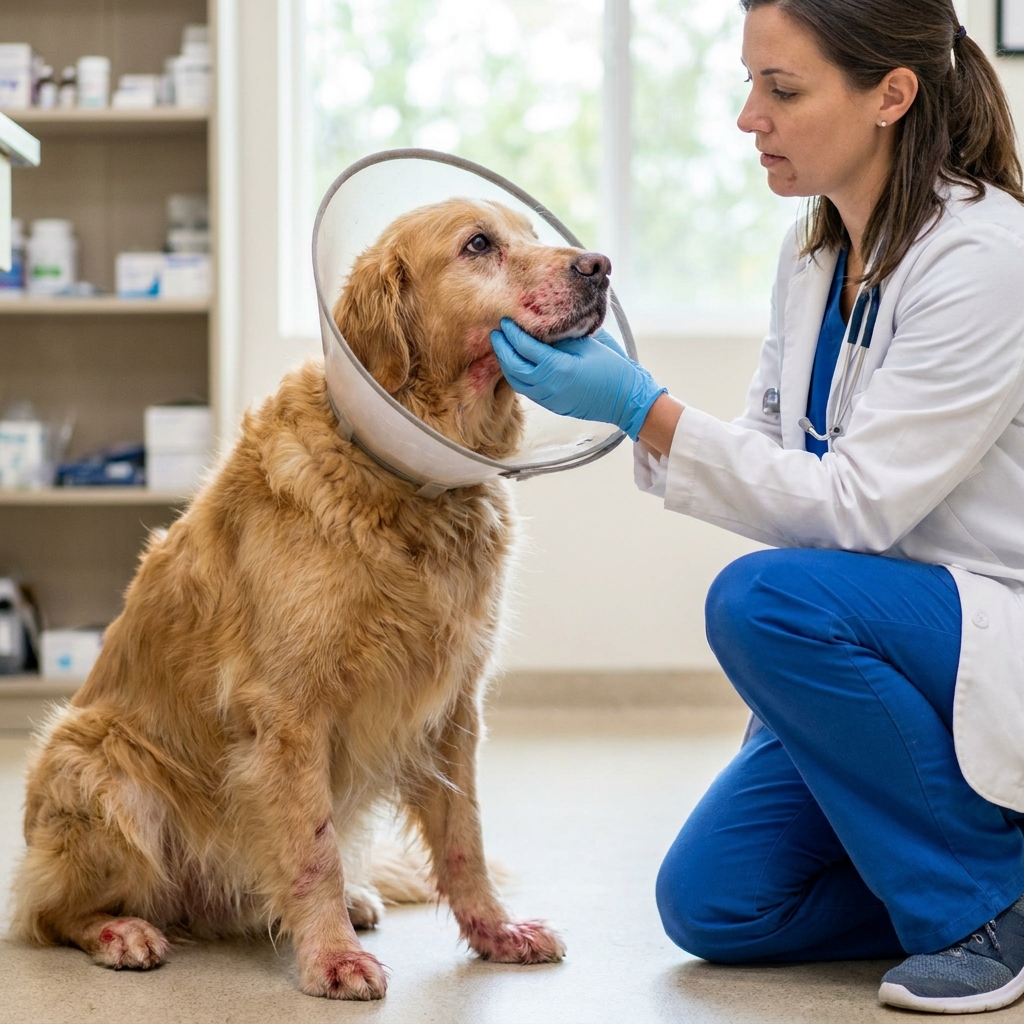
- Chronic itching, especially around the face, ears, paws, and rear
- Recurrent ear infections (otitis externa)
- Hot spots
- Chronic loose stool or intermittent diarrhea
- Vomiting in some cases
- Less commonly: respiratory signs, hives, anaphylaxis
A dog that has a sudden skin eruption after a single meal is more likely to have an intolerance or a contact reaction than a true allergy.
The list: the top 5 allergens in dogs
1. Chicken
The single most common food allergen in dogs. Chicken is in nearly every commercial dog food, in treats, in many medications (flavored preventives), in table scraps, in raw diets. A dog fed chicken-flavored kibble, chicken-based treats, and a chicken-flavored heartworm preventive has had a high cumulative exposure. The dog has had every opportunity to develop a chicken allergy.
The symptoms: ear infections, paw licking, facial itching, recurrent hot spots. Most chicken-allergic dogs have been eating chicken for years before the symptoms appear.
The trap: the dog's owner does not suspect chicken because "he's been eating it his whole life with no problem." This is the wrong frame. Food allergy is a delayed hypersensitivity that develops over time. The dog ate chicken for three years and then became allergic at year four. The chicken is the problem, despite the years of apparent tolerance.
2. Beef
The second most common allergen. Like chicken, beef is in most commercial foods, in many treats, and is fed in raw diets and as table scraps. A dog with a beef allergy typically has been eating beef-based food for years before symptoms emerge.
The symptoms are similar to chicken: skin, ear, GI. The diagnosis is the elimination trial.
The trap: many "lamb" and "venison" diets from the 1990s and 2000s actually contained beef protein that was not on the label. A dog that "tried lamb" but continued to react may have been reacting to hidden beef. The current generation of limited-ingredient diets is more reliable, but a single-protein test still has contamination risk.
3. Dairy
The third most common allergen. Lactose intolerance in dogs is widespread and is not the same as a dairy allergy - lactose intolerance is a digestive issue (the dog lacks the enzyme to break down milk sugar), and dairy allergy is an immune reaction to milk proteins (casein, whey).
A dog can be both lactose intolerant and dairy allergic. Symptoms overlap. The elimination trial distinguishes them.
The trap: most dogs are fed dairy at some point - cheese, milk, yogurt, ice cream. The cumulative exposure is high. The "my dog loves cheese" observation is not a guarantee that the dog is not allergic to it.
4. Eggs
The fourth most common allergen. Eggs are in many commercial foods (egg powder, dried egg), in many treats, and in many homemade diets. Egg allergy is a less common component of confirmed elimination diet trials than chicken, beef, or dairy, but it does occur.
The trap: raw eggs are sometimes promoted as a "natural" protein that dogs are not allergic to. The data does not support this. Egg-allergic dogs react to raw and cooked egg equally.
5. Wheat
The fifth most common allergen and the most common grain allergen. Wheat protein (gliadin, glutenin) is the immune trigger. Wheat allergy is real but less common than the four protein allergens above.
The trap: "grain-free" marketing has created the impression that wheat is uniquely allergenic in dogs. It is not. The top four allergens in dogs are all animal proteins. A grain-free diet that still contains chicken is not addressing the most likely allergens. The "grain-free" formulation has its own concerns (the FDA's investigation of diet-associated dilated cardiomyopathy in dogs is one of them).
The "long tail" of less common allergens
The next 5-10% of confirmed food allergens in dogs include:
- Soy - a less common allergen, often found in lower-quality commercial foods
- Lamb - was novel 30 years ago, now common, so true lamb allergies are emerging
- Fish - a less common allergen but relevant for dogs fed fish-based diets
- Corn - rare true allergy, but corn is often implicated by owners because of outdated information
- Rice - rare true allergy
- Potato - rare true allergy
- Peanut - true allergy exists but is uncommon
- Various preservatives and dyes - not common IgE allergens, but some dogs react to artificial colours
A dog on a typical commercial diet that has been eating the same food for years has been exposed to most of these ingredients. The allergy could develop against any of them.
What is NOT on the list
A few ingredients the internet worries about that are not significant canine food allergens:
- Corn - despite the bad reputation, true corn allergy is rare. Most "corn allergy" in dogs is intolerance or coincidence.
- Soy - less common than the top five
- "By-products" - rendered animal protein from organs and offal. The protein source is the allergen, not the rendering process. A dog allergic to chicken is allergic to chicken meal, chicken by-product meal, and fresh chicken.
- "Fillers" - any ingredient a marketing campaign has decided to call a filler
- "Grain-free" formulations - removing grain does not remove the most common canine allergens, which are animal proteins
- Artificial preservatives and colours - not common IgE allergens
- GMO ingredients - no evidence of allergenicity change from genetic modification
The internet list of "bad ingredients" is a marketing artifact, not a clinical list. The clinical list is the top five, with chicken at the top.
The diagnostic approach: elimination trial
The diagnostic approach is the 8-week elimination trial covered elsewhere in this guide. The choice of elimination protein depends on the dog's history:
- If the dog has been on chicken-based food, choose a non-chicken elimination (rabbit, venison, or hydrolyzed)
- If the dog has been exposed to multiple proteins, choose hydrolyzed
- If the dog is from a shelter with unknown history, choose hydrolyzed (or a synthetic amino acid diet in severe cases)
The trial is strict for 8 weeks. The rechallenge is the confirmation. The diagnosis is reliable.
The "limited ingredient" trap
The "limited ingredient" market has exploded. A limited ingredient diet (LID) is a commercial food with a restricted ingredient list, often a single protein source.
The trap: many LIDs are produced on the same equipment as other foods. The "single protein" label does not always mean "single protein in the bag." A 2018 study found detectable levels of non-listed proteins in a significant fraction of tested LIDs.
The fix: use hydrolyzed protein diets (where the protein is broken into peptides too small to be recognized by the immune system) for the elimination trial, not LIDs. Use LIDs only after the diagnosis is confirmed and the offending protein is identified.
Common mistakes
A few things I see owners do that make the food allergy work worse:
Switching foods every few weeks
The owner suspects food allergy, switches food, sees partial improvement, switches again, sees more improvement, switches again. By the end of six months, the dog has been on five different foods and the owner still does not know which one was the problem. The partial improvements are often unrelated to the food change. The proper protocol is one elimination trial with one test protein for the full 8 weeks.
"Grain-free" without trial
The owner switches to grain-free without doing the elimination trial. The dog improves because grain-free is often also limited-ingredient. The owner concludes "grain was the problem" without testing. The next food change, the dog reacts again. The cycle continues.
Removing chicken, then adding chicken-flavored treats
The owner removes chicken from the kibble but feeds chicken-flavored treats "as a special reward." The treats contain chicken protein. The elimination trial is contaminated. The improvement is partial. The owner concludes the elimination trial failed.
Blood tests for food allergy
Serum IgE tests for food allergens in dogs are unreliable. Multiple studies show poor agreement between blood test results and actual food trial results. The skin-prick test has slightly better agreement but is also not reliable enough to be the basis for a diagnosis. The elimination trial is the only reliable diagnostic.
The bottom line
The list of common canine food allergens is short and well-established. Chicken, beef, dairy, eggs, and wheat account for the vast majority. The diagnostic is the elimination trial. The internet list of "bad ingredients" is not a clinical list. The protocol is the protocol. Follow it.
About the author
Sarah Chen is a canine nutrition scientist based in Melbourne with a PhD in veterinary nutrition from the University of Sydney. She has worked with breeding kennels, guide dog organizations, and individual breeding clients to manage nutritional risk during pregnancy, lactation, and puppyhood, and has published peer-reviewed work on the topic. See her full profile at [authors/Sarah Chen/](../Sarah%20Chen.md).