
Weight management: how to use the Body Condition Score (BCS)
Roughly 56% of dogs in North America are overweight or obese by veterinary assessment, and the number is closer to 60% in some European surveys. That means the dog in your kitchen is statistically more likely to be overweight than not, and most owners do not see it. In twelve years of nutrition referral, the most common sentence I hear from owners of a 7-out-of-9 dog is, "but he eats the right amount." He does not. The owner has simply lost the ability to see the extra fat.
The fix is the Body Condition Score. It is a 9-point visual and tactile scale developed in the 1990s and validated against dual-energy X-ray absorptiometry (DEXA) — the gold standard for body composition. It is free, takes 30 seconds once learned, and works in any breed, size, or coat type. If you only learn one piece of nutrition assessment this year, this is the one.
The 9-point scale and what each point means
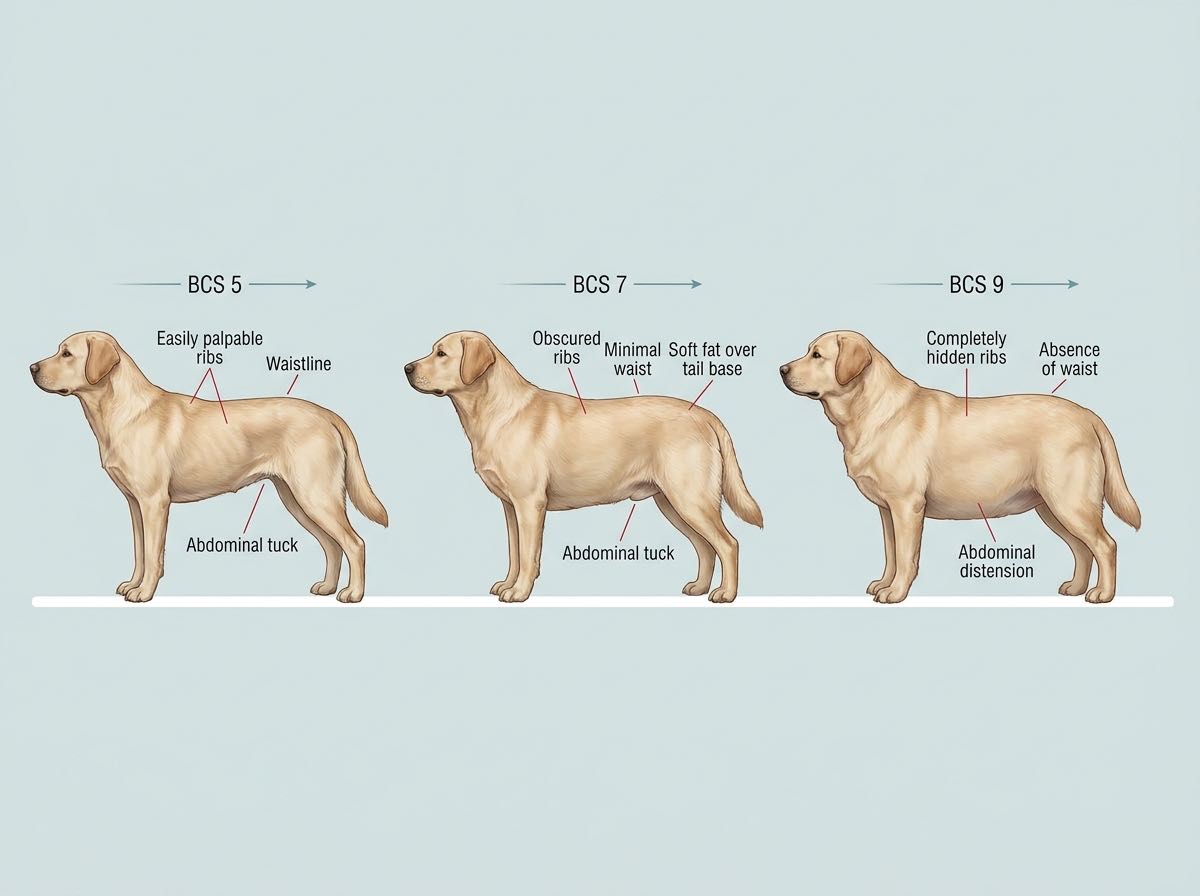
The 9-point BCS scale runs from 1 (emaciated) to 9 (severe obesity), with 4–5 as the ideal range for most adult dogs. Each point corresponds to roughly 10–15% body fat above or below ideal, so a dog at BCS 7 is carrying 20–30% more fat than a BCS 5 dog of the same lean mass — a healthy adult versus a dog with measurably increased orthopedic, endocrine, and anesthetic risk.
In practice:
- BCS 1–3 (underconditioned): Ribs, lumbar vertebrae, and pelvic bones visibly prominent. Severe abdominal tuck.
- BCS 4 (under ideal): Ribs easily palpable with minimal fat. Visible waist from above. Pronounced tuck.
- BCS 5 (ideal): Ribs palpable without excess fat. Waist visible. Tuck present but not exaggerated.
- BCS 6 (over ideal): Ribs palpable with slight excess fat. Waist visible but not pronounced. Tuck still present.
- BCS 7 (overweight): Ribs palpable with difficulty. Waist barely visible. Tuck minimal or absent. The most common BCS I score in general practice — roughly 30% of dogs.
- BCS 8–9 (obese to severe): Ribs not palpable under heavy fat. No waist, no tuck. Visible abdominal distension and fat deposits over the lumbar area and base of tail at BCS 9.
The two breeds I score the worst on average are Labrador Retrievers (genetic predisposition via the POMC mutation in roughly 25% of the breed) and Beagles (food-driven, sedentary when bored, frequently overfed by owners who use food for enrichment). Cocker Spaniels are a close third. None of this is the dog's fault. All of it has a solution.
How to score your dog at home in 30 seconds
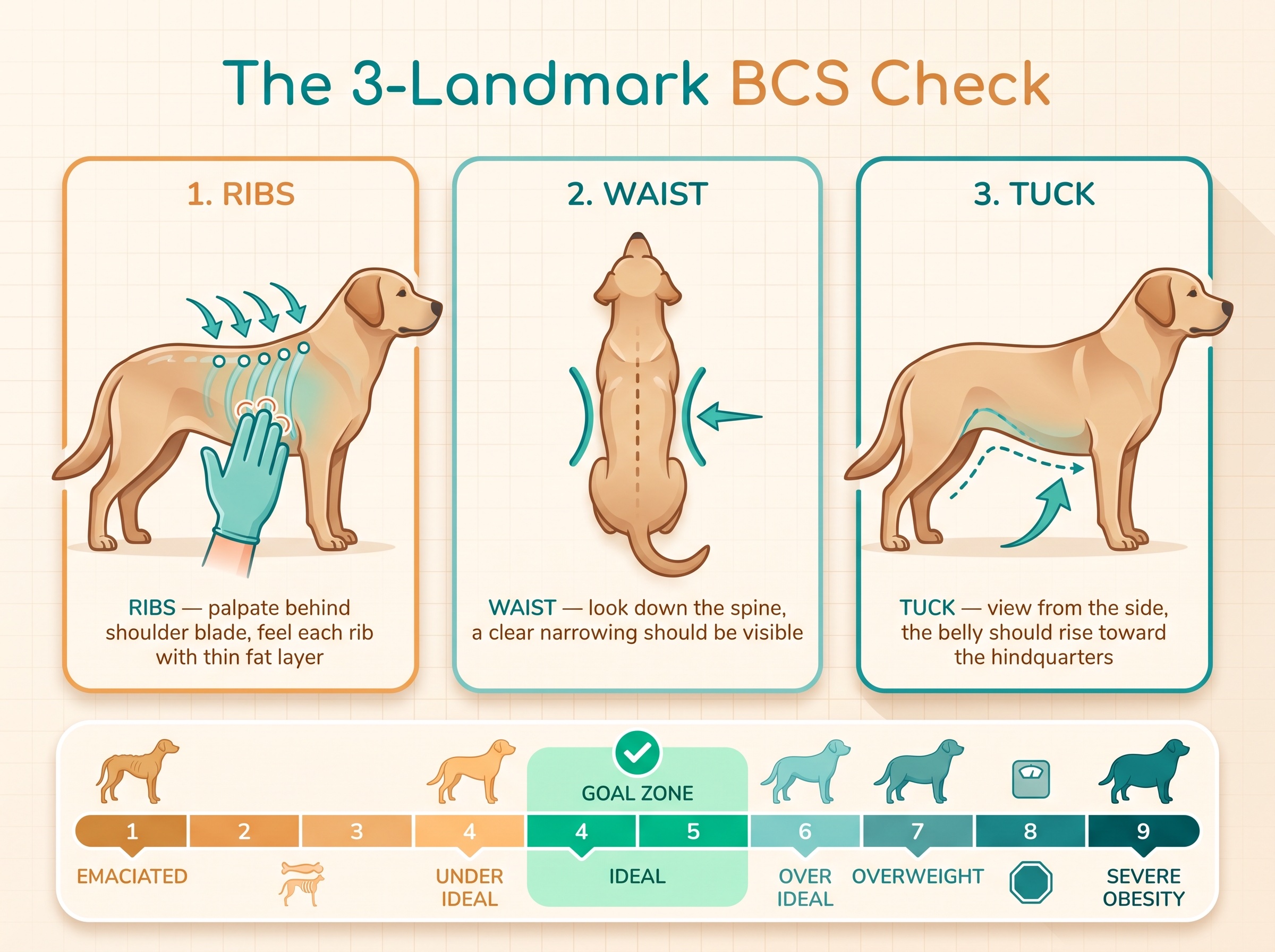
You do not need a clinic. You need a dog that can stand still and your own two hands. There are three assessment points: ribs, waist, and tuck.
Ribs. Place your fingertips on the ribcage just behind the shoulder blade, thumb on the spine. Press gently. You should feel each rib individually, with a thin fat layer between skin and bone. If you have to push hard to find the ribs, the dog is at least BCS 7. If the ribs are visible from across the room, BCS 3 or lower.
Waist. Stand directly over the dog and look down at the spine. There should be a clear narrowing behind the ribcage before the hips — the hourglass shape of a show-condition dog. No narrowing means BCS 7 or higher. A pronounced hourglass with prominent hip bones means BCS 3 or lower.
Tuck. Stand at the dog's side and look at the underside. From the end of the ribcage back to the hips, the belly should rise up toward the hindquarters. The tuck should be visible but not extreme. A straight line from ribs to hips with no rise is BCS 7+. A pronounced upward curve is BCS 3 or lower.
Score on a flat, hard surface — not carpet or a sofa. Coat type matters: heavily coated breeds like a Pomeranian or Old English Sheepdog will hide the waist and tuck, so palpate the ribs and push your fingers through the coat to the skin before scoring.
The four errors that lead owners to under-score their own dog
I have rechecked the BCS scores of several thousand dogs over the years, and the most common pattern is that owners under-score their own dog by 1–2 points. The dog is a 7, the owner calls it a 5. The reasons are consistent.
- Habituation. You see your dog every day. A dog that gained 2 kg slowly over three years looks normal because he has always looked that way. The fix: look at photographs from 2–3 years ago. The difference is usually obvious in the photo and invisible in person.
- Coat camouflage. Long or dense coats hide the waist and rib definition. A Shetland Sheepdog at BCS 7 can look like a BCS 5 from the side because the coat creates a visible tuck illusion. Always palpate, do not just look.
- Breed bias. Owners of stocky breeds — Bulldogs, Pugs, Basset Hounds — frequently score their dog 1–2 points low because the breed standard itself is overweight. A Bulldog at BCS 6 looks "normal for the breed" but is actually overweight. Score the dog, not the breed standard.
- Wishful thinking. The most human error. I have watched owners argue a BCS 8 is a BCS 5 because the dog "isn't that big." The scale is the scale. Name it accurately and fix it.
A useful discipline: have a veterinary team member score the dog at every wellness visit and record the number in the chart. Trends matter more than any single point. A dog that moves from BCS 5 to BCS 6 over a year has gained 10–15% body fat — a 3–4 kg gain on a 30 kg dog, and it happened in front of the owner's eyes without being noticed.
The weight loss math: how much to feed
Once you have a BCS and a target weight, the math is straightforward. I use the resting energy requirement (RER) formula as the starting point and multiply by an activity factor.
RER (kcal/day) = 70 × (body weight in kg)^0.75
For a target weight of 12 kg, RER is approximately 473 kcal/day. For weight loss, I feed at 1.0–1.2× RER, which gives 473–568 kcal/day — the total daily budget including all treats.
Three therapeutic diets I trust for weight loss, in order of how often I reach for each:
- Hill's Prescription Diet Metabolic — high protein, high fiber, with a published 28% reduction in body fat at 2 months in feeding trials. The fiber blend reduces voluntary intake.
- Royal Canin Satiety Support — high protein, high fiber, with a texture and palatability designed to extend feeding time and improve satiety. Useful for the food-motivated Labrador or Beagle.
- Purina Pro Plan OM — high protein, moderate fiber, and the most affordable per-kcal cost of the three. My first choice for owners on a budget.
For an OTC alternative, a high-protein, moderate-fat, low-carb canned food can work, but you must measure the portion to the gram. The "scoop and pour" approach is where most home weight-loss plans fail.
The target rate of loss is 1–2% of body weight per week. Faster loss risks lean mass loss, and rapid weight loss in obese dogs can trigger serious metabolic complications. A 14 kg dog should lose 140–280 g per week. Recheck the BCS every 4 weeks. If the dog has not lost, reduce the portion by 10%. If the dog is losing faster than 2% per week, increase by 10% to protect lean mass.

Treats, exercise, and the 10% rule
Treats are where most weight loss plans die. A single medium Milk-Bone is roughly 40 kcal. Two a day is 80 kcal — about 15% of a weight-loss RER, more than the entire daily deficit you are trying to create. The rule I give every client: no more than 10% of daily calories from treats, and the treats must be measured.
The most useful trick I know: replace 20–30% of the daily kibble portion with frozen green beans (plain, no salt, no butter). Green beans are roughly 30 kcal per 100 g, and the volume satisfies begging behavior. Dogs that beg at the table will eat green beans from a fork.
Exercise matters less than owners think. A 30-minute walk for a 15 kg dog burns roughly 80–100 kcal — about one-quarter cup of kibble. You cannot outrun a bad diet. Exercise is essential for lean mass preservation and joint health during weight loss, but the diet is doing the heavy lifting.

What success looks like at 6 months
A successful weight loss plan reaches BCS 5 (or the breed-appropriate equivalent for stocky breeds) at 6–9 months, with steady weekly loss the entire time. At goal weight, transition to a maintenance portion of the same diet — or an adult maintenance food — at 1.4× RER, and recheck the BCS every 3 months for the first year. Roughly 30% of dogs that lose weight regain it within a year if the maintenance portion is not actively managed. The dog is not "cured" of being overweight. The dog is at a weight that requires active feeding to maintain.
The most important sentence: the BCS is a number, and the number tells you what to feed. If you cannot feel the ribs easily, feed less. If the waist is gone, feed less. If the tuck is straight, feed less. The scale is a useful supplement for tracking trends, but the BCS is the clinical decision tool. Learn it, do it monthly, and write the number down. The dog will be healthier, live roughly 2 years longer on average, and have measurably lower risk of osteoarthritis, diabetes, and cruciate disease. It is the highest-leverage thing you can do for an overweight dog.