
Food allergies: the 8-week elimination protocol
The dog scratching in your exam room has, on average, a one-in-three chance that the cause is food. Adverse food reactions (AFRs) account for roughly 30–40% of allergic skin disease in dogs, and a smaller but meaningful percentage of chronic GI cases. Yet in twelve years of nutrition practice, I have watched the same scene play out hundreds of times: an owner tries a "hypoallergenic" over-the-counter food for two weeks, sees no improvement, and concludes the dog does not have a food allergy. The dog almost certainly does, and the trial was almost certainly invalid.
The diagnostic gold standard is an 8–12 week elimination diet trial followed by a controlled provocation. It is the only reliable method. Serum IgE and saliva tests marketed to pet owners do not have sufficient sensitivity or specificity to diagnose canine food allergy, and the 2024 ACVD consensus reaffirmed the recommendation against them. If you want to know whether food is the cause, you do the trial. Here is how to do it right.
What a food allergy actually looks like in a dog
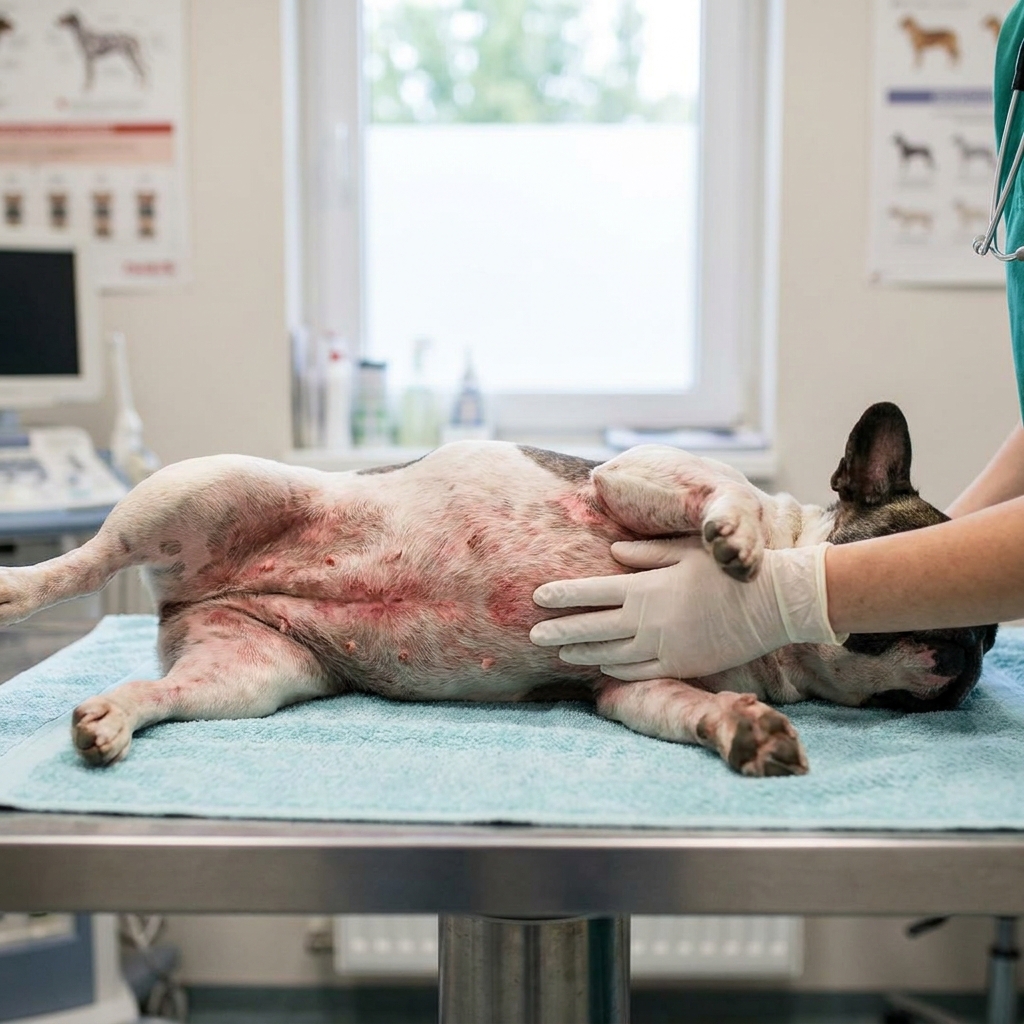
Canine food allergy is most commonly a cutaneous adverse food reaction (CAFR), and the clinical signs overlap heavily with atopic dermatitis: pruritus (itching), recurrent otitis, perianal licking, axillary and inguinal erythema, and chronic GI signs in 15–30% of cases. The signs are non-seasonal, which is the most useful clinical differentiator from environmental atopy. A dog that itches the same in January as in July is a food-allergy suspect until proven otherwise.
The most common allergens in dogs, in order of prevalence, are:
- Beef (the single most common trigger, present in 60–70% of confirmed cases in published case series)
- Dairy
- Chicken
- Wheat
- Soy
- Egg
- Lamb (less common than the marketing suggests, but a real trigger in some dogs)
The mechanism is most often a Type I or Type IV hypersensitivity reaction to a specific dietary protein. The dog may have eaten the offending protein for years before symptoms appear, which is why a "new food allergy" diagnosis in a dog that has eaten the same diet for five years is medically routine.
Choosing the trial diet: hydrolyzed vs novel protein
You have two scientifically defensible choices for the trial diet, and the choice depends on the dog's dietary history.
Hydrolyzed protein diets are the more rigorous option. The protein source is enzymatically broken down into fragments too small for the immune system to recognize. The dog cannot react to what it cannot see. The three brands I trust for hydrolyzed trials:
- Royal Canin Hypoallergenic (hydrolyzed soy, sold as the HP line in some markets)
- Hill's Prescription Diet z/d (hydrolyzed chicken liver — the most published hydrolyzed option, with over a decade of feeding-trial data)
- Purina Pro Plan HA (hydrolyzed soy, with the additional feature of a purified starch source to minimize carbohydrate cross-reaction)
Hydrolyzed diets are appropriate for any dog and are the only reliable option for dogs with a long, mixed dietary history where the "novel protein" is no longer novel.
Novel protein diets work when you can confidently identify a protein the dog has never eaten. This is harder than it sounds in 2026. Venison, duck, salmon, and rabbit — the traditional novel proteins — are now in so many over-the-counter foods that most dogs have been exposed to at least one. I use novel protein trials for dogs with a known, narrow dietary history (a single kibble brand, no table food, no treats other than the matching brand). For most pet dogs, hydrolyzed is the safer choice.
A third category — home-cooked novel protein (e.g., horse and sweet potato, or kangaroo and pumpkin) — is the most controlled option when formulated by a DACVN. The cost is 3–5x a hydrolyzed kibble, the discipline is high, and the trial is highly accurate when executed correctly. I use it for dogs that have failed a commercial hydrolyzed trial, for owners who want maximum diagnostic certainty, and for working dogs whose dietary history I can fully verify.
The 8-week protocol, week by week
The trial has three phases. Owners who follow the protocol exactly succeed roughly 70–80% of the time. Owners who deviate succeed about 20% of the time, and the deviation is almost always one of the failure modes I will cover in the next section.
Weeks 1–2: Transition and baseline. Switch the dog onto the trial diet over 5–7 days (50/50 for 3 days, then 75/25, then 100%). During this phase, photograph the affected skin and record a pruritus score — I use the validated PVAS 0–10 scale — twice weekly. The baseline is essential. Without it, you cannot tell whether the dog has improved.
Weeks 3–6: Strict trial. This is the hardest phase. The dog eats the trial diet and only the trial diet. No treats, no table food, no dental chews, no flavored medications, no舔 of children's plates, no舔 of other pets' bowls. Water is fine. The diet is the only thing that enters the mouth. Most dogs show partial improvement by week 4 and meaningful improvement by week 6. Some dogs (about 15% in published series) do not improve until week 8 or 10, which is why the 8-week minimum is non-negotiable.
Weeks 7–8: Confirm and provoke. If the dog is significantly better, the trial is considered a positive response. The next step is the provocation: reintroduce the original diet and watch for relapse over 7–14 days. A clear return of pruritus within 14 days of provocation confirms the food allergy and identifies the original diet as the offender. If the dog does not relapse, the original diet was not the trigger and you move on to other differentials.
If the dog has not improved by week 8, the trial is presumptively negative. Before declaring it negative, however, review for compliance failures (see below). A dog that did not improve on a poorly executed trial has an inconclusive result, not a negative one.

The four compliance failures that invalidate the trial
In audit of the last 200 elimination trials I have supervised, four failure modes account for the majority of invalid results.
- Flavored medications. The most common. Heartworm preventives (some Heartgard products), NSAIDs, joint supplements, and many compounded medications contain beef, chicken, or pork flavoring. The dose is small, but the protein is intact, and an allergic dog reacts to the dose. Switch to unflavored alternatives or a transdermal formulation for the duration of the trial. This single fix has salvaged more trials than any other.
- Treats and chews. Owners consistently underestimate the variety of edible items a dog consumes in a day. Dental sticks, bully sticks, pig ears, fish skin jerky, frozen Kong stuffings, training treats given at the park, the licked-clean plate from a toddler — all of these are protein exposures. The only treat allowed during the trial is a measured portion of the trial kibble itself, or a DACVN-formulated treat from the same protein source.
- Other pets' food. Multi-dog households are a special hazard. The allergic dog eats the hydrolyzed diet; the other dog eats a beef-and-chicken kibble; the allergic dog counter-surfs. Feed the dogs separately, in crates or different rooms, and pick up the other dog's bowl immediately after the meal.
- Flavored toys and supplements. Some chew toys, dental toys, and "calming" supplements are flavored. Probiotics are often grown on dairy or beef-derived media. Read every label. If in doubt, omit it for the 8 weeks.
A fifth, less common failure: inadequate transition time. Switching cold-turkey from a previous diet produces transient GI upset that can be mistaken for a treatment failure. The 5–7 day transition is part of the trial design, not a courtesy.

Reading the results and what comes next
A successful trial — significant improvement at 8 weeks, clear relapse on provocation — gives you a diagnosis and a treatment plan simultaneously: the dog eats the trial diet long-term, or a subset of the original proteins is identified and avoided while the others are reintroduced one at a time. I prefer the long-term hydrolyzed approach for dogs with multiple confirmed triggers, and the sequential reintroduction for dogs that reacted to a single identifiable protein.
An inconclusive trial — no improvement at 8 weeks, or partial improvement that does not reach clinical significance — should be repeated with a different trial diet under DACVN supervision, not declared negative. The repeat trial picks up an additional 10–15% of true positives that the first trial missed, usually because of a compliance failure that was identified and corrected.
A failed trial after a properly executed second round points away from food and toward environmental atopy, flea allergy dermatitis, or a non-allergic pruritus. The diagnostic workup continues from there.
The most important sentence: the elimination trial is a diagnostic procedure, not a treatment. A hydrolyzed diet fed indefinitely to a non-allergic dog is an expensive, suboptimal choice. The trial's job is to answer a yes/no question, and the answer determines what the dog eats for the rest of its life. Done right, it is the most useful 8 weeks of nutrition work you will ever do for an allergic dog.