

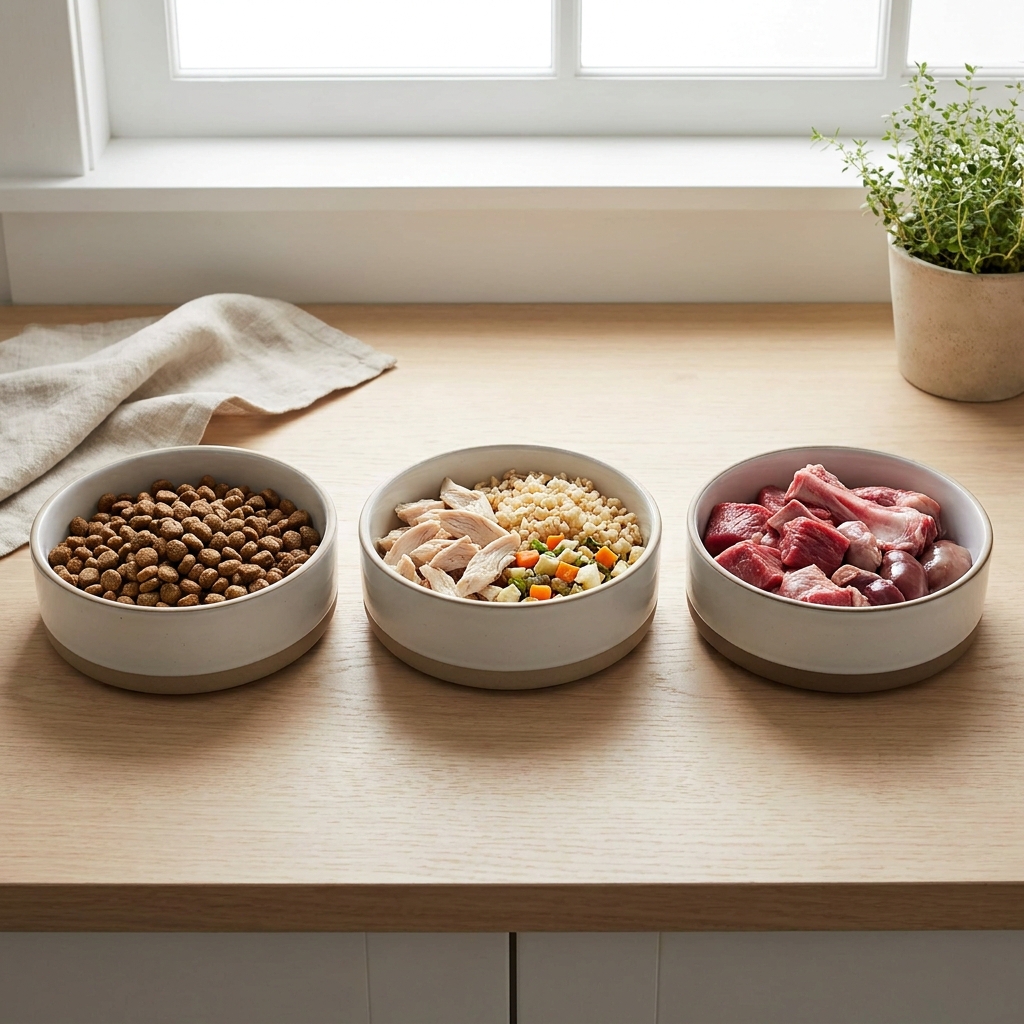
Kibble vs home-cooked vs raw: an evidence-based comparison
The question I get most often in clinic is also the most emotionally loaded: "Which is better — kibble, home-cooked, or raw?" The honest answer is that all three can feed a dog well, and all three can feed a dog badly, depending on formulation, execution, and the individual animal.
I have been formulating canine diets for twelve years, including four on the RSPCA Australia nutrition hotline. The data has shifted considerably since the 2018 FDA DCM investigation. The 2026 headline: a properly formulated complete and balanced diet of any type outperforms a poorly formulated diet of any other type. "Properly formulated" is just harder to achieve in some categories than others.
Why this debate exists in 2026
Three forces drive the modern debate. First, the humanization of pet food — owners want to know what is in the bowl and recognize the ingredients. Second, the post-DCM market correction — grain-free and boutique-exotic diets are under sustained scrutiny, and the 2023 FDA update confirmed the original signal in legume-heavy, grain-free, exotic-protein formulations. Third, the raw-feeding community has professionalized, with several veterinary nutritionists now offering commercial raw formulations that meet AAFCO or FEDIAF standards.
The old "kibble is junk, raw is natural" framing is no longer accurate. Modern extruded kibble from a manufacturer with a DACVN on staff is one of the most rigorously tested food categories in the pet industry. Commercial raw from a similarly credentialed manufacturer is also a complete and balanced option in 2026, where it was not in 2010. The risk profile of each style is now well-characterized, and it is not what most owners assume.
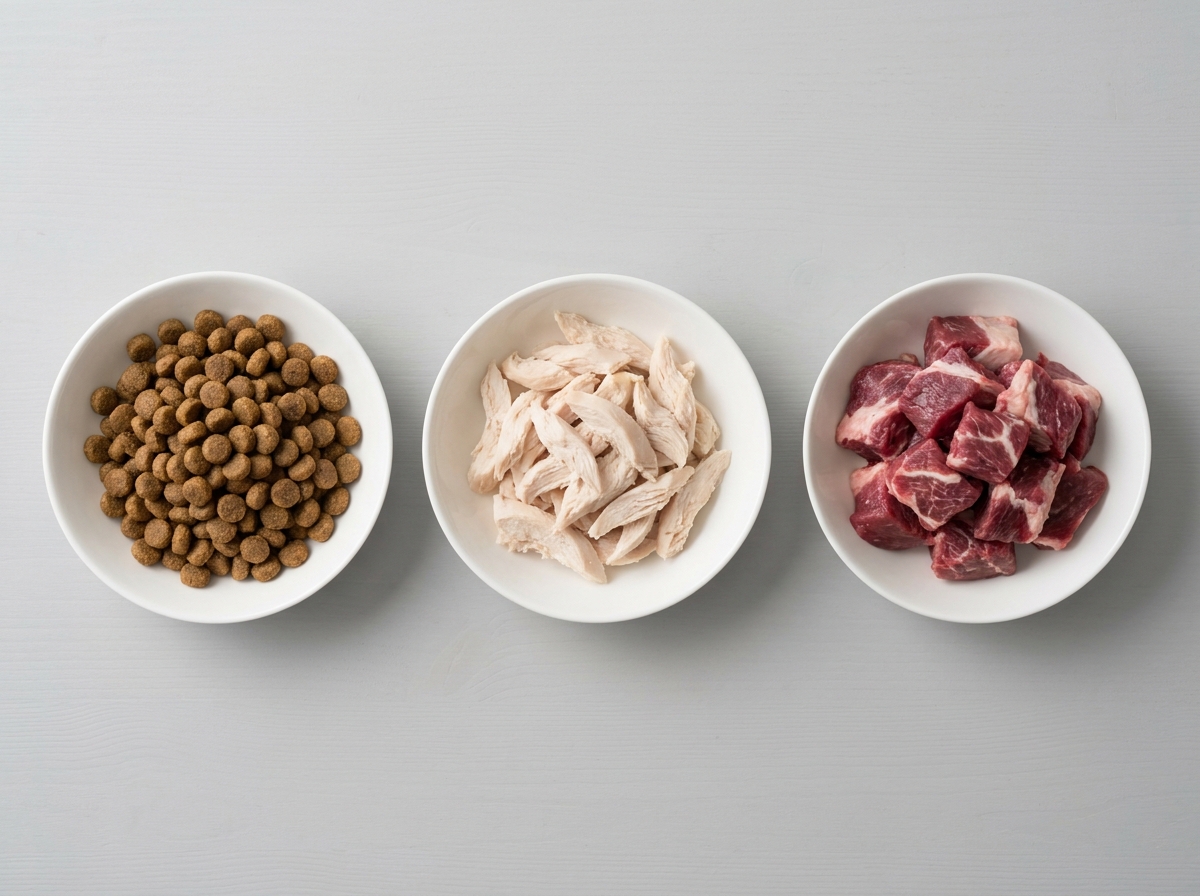
Kibble: the modern formulation landscape
Extruded kibble is the dominant feeding style globally, and the reason is not just convenience — it is safety. A kibble that carries an AAFCO nutritional adequacy statement for "all life stages" has been either formulated to meet AAFCO profiles, analyzed to confirm it does, or fed through a feeding trial (the gold standard, AAFCO protocol 6-month). Brands that do this rigorously are nutritionally complete in a way that home-cooked and raw diets often are not.
The brands I currently recommend as baseline options:
- Royal Canin (breed-specific and life-stage lines, formulated with in-house DACVNs)
- Hill's Science Diet and Hill's Prescription Diet (the most published feeding-trial database in the industry)
- Purina Pro Plan (the SAVA Centre in Australia runs one of the largest canine nutrition research programs)
- Eukanuba (long-history adult maintenance and performance lines)
- Farmina N&D Ancestral Grain (the ancestral-grain versions, not the wild boar/turkey grain-free versions, meet my criteria)
What has changed in 2026 is the grain-free question. The FDA's 2022 update and the 2023 Tufts reanalysis concluded the original DCM signal was real but concentrated in diets that were simultaneously grain-free, legume-heavy, and from a small manufacturer without a DACVN on staff. Kibble from a major manufacturer that includes a named grain and does not lead with legumes has a much lower DCM signal. I have shifted many clients off grain-free boutique diets onto grain-inclusive mainstream formulations, and the cardiac parameters have stabilized.
The honest weakness of kibble: palatability variance between brands is large, and a dog on one brand for years may flatly refuse another. The calorie density (typically 3,500–4,500 kcal/kg) also makes precise weight management harder than with home-cooked or raw, where moisture content is higher.
Home-cooked: benefits and the real risks
Home-cooked diets occupy a strange middle ground. The ingredients are recognizable, the protein source is usually high-quality, and the owner feels in control. The problem is that the majority of home-cooked diets fed to dogs are nutritionally incomplete. The most cited paper is the 2013 UC Davis study (Stockman et al.), which evaluated 200 home-cooked recipes from veterinary textbooks, pet store staff, and the internet. Of the 200, only 9 (4.5%) met the NRC's essential nutrient requirements for adult dogs. The 2019 follow-up with 239 recipes (including raw) found a similar pattern.
The clinically important risks of an unbalanced home-cooked diet are:
- Calcium deficiency, the single most common error. Recipes that use boneless chicken breast and white rice without a calcium source produce a calcium-to-phosphorus ratio that drives secondary hyperparathyroidism within 6–12 months. I see this in young growing dogs as pathologic fractures and in adults as progressive bone loss.
- Iodine deficiency in recipes that avoid iodized salt or sea vegetables.
- Zinc deficiency in plant-heavy recipes.
- Vitamin E deficiency when wheat germ oil or a supplement is omitted.
- Copper imbalance in recipes high in legumes or low in organ meats.
The path to a safe home-cooked diet is to work with a board-certified veterinary nutritionist (DACVN) or a registered animal nutritionist (DAN in Australia) to formulate a recipe for the specific dog. A balanced home-cooked diet at maintenance typically costs 3–5x a premium kibble and takes 4–8 hours per week of preparation. For owners willing to do that, the diet can be excellent. For owners who find the discipline too high, the diet is usually unsafe by month 6.
Pre-formulated home-cooked fresh food brands (JustFoodForDogs, The Farmer's Dog, Lyka in Australia, Freshpet) solve the balance problem with DACVN-formulated recipes and pre-portioned servings. The cost is similar, and the nutritional adequacy is publishable. I increasingly recommend this category to clients who want fresh food without the formulation workload.

Raw: the bacterial, nutritional, and behavioral picture
Raw meat-based diets (RMBDs) are the most contested category, and the evidence has matured. On the bacterial side, the 2024 meta-analysis in The Veterinary Journal confirmed what smaller studies have shown for years: dogs fed raw shed significantly more Salmonella, E. coli (including STEC), Campylobacter, and Listeria than dogs fed cooked diets. The clinical significance for the dog is debated — many raw-fed dogs are asymptomatic carriers — but the household significance is not. A 2022 BMJ Public Health paper found that households feeding raw had measurably higher contamination of food-prep surfaces and a 2.4x higher rate of household member gastrointestinal illness, particularly in homes with children under 5 or immunocompromised adults.
On the nutritional side, the 2023–2026 generation of commercial raw diets (K9 Natural, Primal Pet Foods, Stella & Chewy's, Ziwi Peak air-dried) is nutritionally complete when fed as a full meal and labeled for the dog's life stage. These are not the same category as home-prepared raw from the supermarket meat counter, which is consistently nutritionally incomplete and high in bacterial load.
There is one area where raw feeding has a legitimate clinical advantage over kibble: severe food allergies that have not responded to hydrolyzed or elimination diets. The ability to feed a single novel protein (kangaroo, horse, possum, rabbit) without cross-contamination is a real clinical tool. I use it in roughly 3% of my allergy caseload.
The behavioral argument — that raw diets improve coat, stool, and energy — is real in some dogs, but the effect size is smaller than the raw-feeding community often claims, and most of the apparent benefit is reproducible on a high-quality cooked fresh diet. The dogs that look best on raw are usually the ones that look best on any premium, well-formulated, animal-protein-dense diet.
Hybrid feeding: a practical middle path
A category I increasingly recommend is hybrid feeding — a complete and balanced kibble as the nutritional base, with fresh or raw toppers for palatability and enrichment. The math is straightforward: if the kibble provides 80% of daily calories and the topper 20%, the kibble's nutritional adequacy covers the gaps in the topper, and the topper adds variety, moisture, and behavioral enrichment.
The rule I share with clients:
- Kibble 80% / topper 20% by calorie count (not volume)
- Toppers should be plain cooked meat or fish, offal in moderation, or a commercial fresh product (not seasoned table scraps)
- Re-calculate kibble portion when you add the topper — the most common mistake is adding a topper without reducing the kibble, which produces weight gain
- Avoid mixing raw and kibble in the same meal if the raw includes bone — the calcium carbonate can bind kibble nutrients in the stomach and reduce digestibility. (Mixing raw meat without bone and kibble is fine.)
A good target for a 15 kg adult dog at maintenance: 250 g of a complete kibble (about 950 kcal) plus 60 g of cooked chicken breast (about 110 kcal). The kibble provides complete nutrition, the chicken adds palatability and moisture, and the overall cost is roughly 1.5x a straight-kibble diet.

How to choose — and when to escalate to a DACVN
The decision tree I walk clients through:
- Start with a complete and balanced base diet — kibble, fresh, or commercial raw — that carries an AAFCO or FEDIAF statement for the dog's life stage.
- Match the diet to the dog and household. A high-energy working dog, a sedentary senior, a puppy, a dog with CKD, and a household with an immunocompromised family member have different optimal diets.
- Avoid the failure modes of each style: bag overfeeding and grain-free boutique choices for kibble, recipe imbalance and calcium omission for home-cooked, bacterial load and household contamination for raw.
- Measure body condition every 2 weeks and adjust portions to BCS, not to the bag.
- Escalate to a DACVN or DAN if the dog has a chronic disease (CKD, heart disease, diabetes, food allergy, IBD, cancer), is a large or giant-breed puppy, is pregnant or lactating, or has failed to thrive on a commercial diet. A 60–90 minute consultation costs the same as 3–4 months of premium food and almost always improves the outcome.
The most important sentence in this article: the best diet is the one that is nutritionally complete for your specific dog, that you can afford to feed consistently for years, and that your household can execute safely every day. If you can answer yes to all three for a premium kibble, that is an excellent diet. If yes for a fresh or raw diet, also excellent. The mistake is to choose by ideology rather than execution.