
Water testing cadence: ammonia, nitrite, nitrate — when to test, how often, and which kit
The freshwater hobby has a testing problem that has not changed in twenty years: new keepers either do not test at all (until fish die), or they test every day on a mature tank and waste reagents chasing meaningless micro-variations. The right cadence depends on which phase your tank is in, which kit you are using, and what your tap water already contains. This is the 2026 protocol I run in my own fishroom and recommend to clients.
What you are actually testing for
Out of the dozen things you can test, four parameters are non-negotiable for any freshwater setup. The fifth (GH/KH) only matters at setup and when something goes wrong.
| Parameter | Why | Target (freshwater) |
|---|---|---|
| Ammonia (TAN as NH3/NH4+) | Lethal at low levels; the AOB substrate | 0 mg/L |
| Nitrite (NO2-) | Lethal at low levels; binds haemoglobin | 0 mg/L |
| Nitrate (NO3-) | Chronic toxin, algae driver | <40 mg/L fish, <20 mg/L planted, <10 mg/L shrimp |
| pH | Drives NH3 fraction, plant health | Species-specific (6.5–8.2 typical) |
| GH / KH | Only at setup and after large water changes | Species-specific |
Skip phosphate, copper, TDS, and chlorine testing unless you have a specific reason. Phosphate only matters in a planted tank with a known algae issue; copper only matters after medication; TDS is a derived number that does not tell you anything GH and KH did not already say.
Test method comparison: strips, liquid, and digital
This is where most keepers overspend or underspend. The three formats are not interchangeable.
Test strips (Tetra EasyStrips 6-in-1, API 5-in-1, JBL EasyTest). Cheap, fast, but ±20% accurate on NH3 and ±30% on NO3. They are colour-matched by eye under household lighting, which is the worst possible reference. Strips are fine as a qualitative check (is NO3 above or below 40 mg/L?), useless as a quantitative one (is it 38 or 52?). They expire 6–12 months after opening regardless of the printed date because the reagents oxidise in air. Do not stockpile.
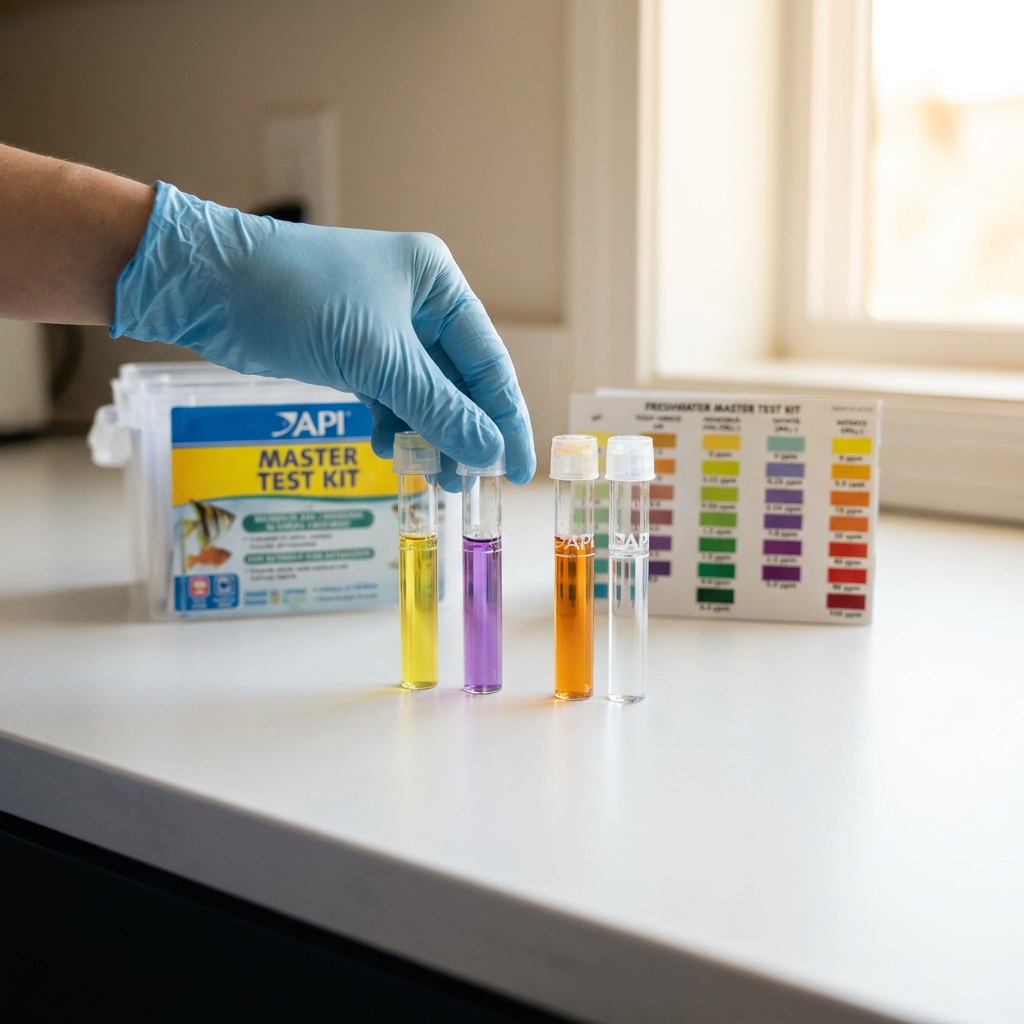
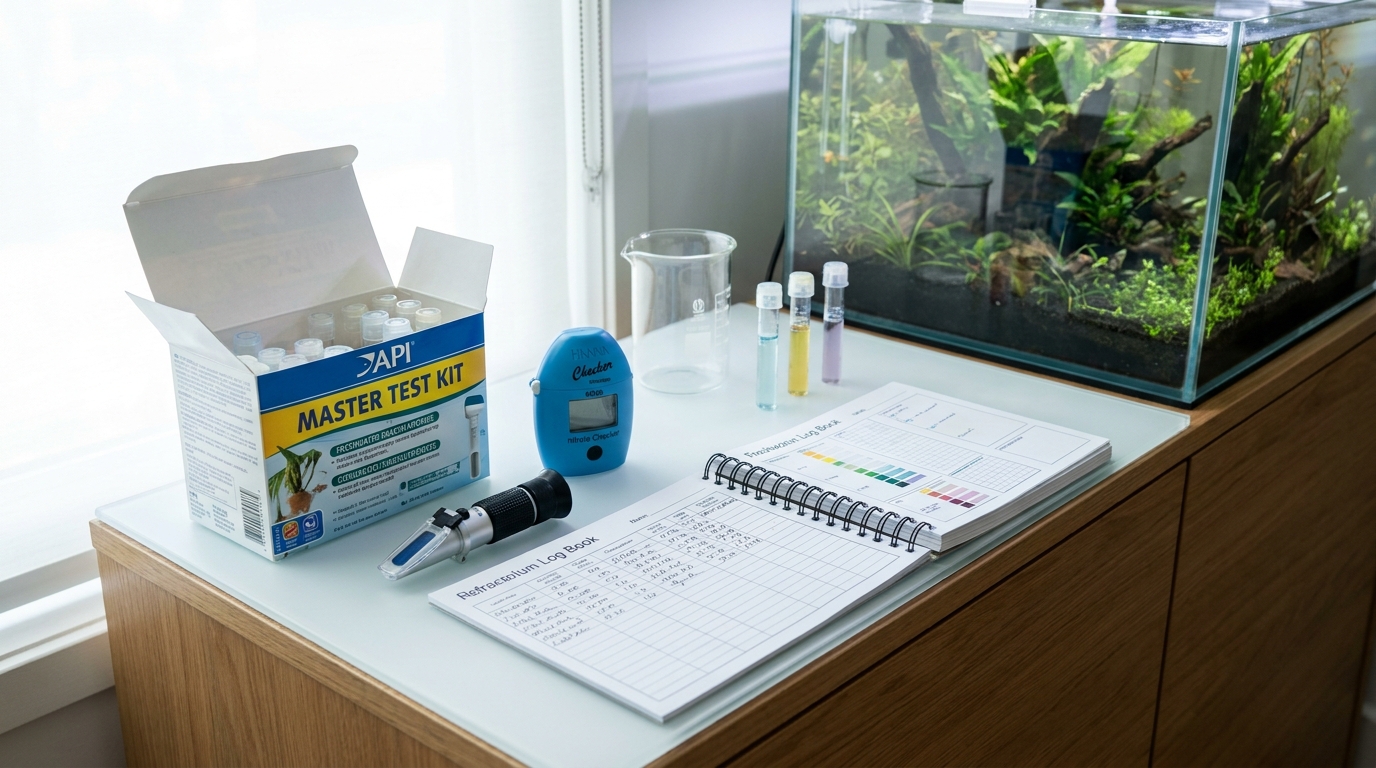
Liquid test kits (API Freshwater Master Test Kit, API NH3/NH4 individual, Seachem MultiTest). The API Master kit (NH3, NO2, NO3, pH, ~$28) is the hobby baseline. It uses Nessler chemistry for ammonia (a mercuric iodide reaction that reads total ammonia nitrogen at a fixed pH of about 12) and a zinc-reduction method for nitrate. The catch: the ammonia test reads TAN, not NH3. The NH3 fraction is derived from pH and temperature — the kit does not do that calculation for you. This is the single most common source of false alarm in the hobby.
Digital meters (Hanna Instruments HI715, HI708, HI782 for NH3/NO2/NO3 respectively). ±2% accurate, no colour matching, reagent shelf life of 18–24 months. A full freshwater panel (NH3 + NO2 + NO3 + pH) costs roughly $350 in meters and another $100/yr in reagents. Worth it if you have more than 400 L of water or if you breed. Not worth it for a single 75-gallon community tank.
For 80% of keepers, one API Freshwater Master Test Kit plus one API GH/KH kit is enough. Add the Seachem Ammonia Alert badge (a continuous-diffusion NH3 indicator that sits inside the tank) if you want a 24/7 sanity check between liquid tests.
Cadence by tank phase
The single biggest mistake is using the same cadence across all phases. Here is the protocol I use.
Phase 1 — Fishless cycle (days 0–42). Test ammonia, nitrite, and nitrate every 48 hours. The exceptions: test ammonia 24 hours after each redose, and test nitrite once you see NO2 rise above 1.0 mg/L (you will be testing it daily then, until it peaks and starts falling). Daily testing is wasteful. The cycle biology does not change on a 24-hour timescale.
Phase 2 — First 8 weeks with fish. Test NH3 and NO2 weekly, NO3 weekly, pH every 2 weeks. The biofilter is still maturing. A spike here means the colony has not caught up to your bioload. Weekly catches it before fish show symptoms.
Phase 3 — Established tank (months 3–12). Test NO3 weekly to set your water change schedule; test NH3 and NO2 monthly as a sanity check. After month 6, you can drop NH3/NO2 to every 6 weeks if every reading has been zero. The only reason to break this cadence is a trigger event (power outage >4 h, filter maintenance that disturbs >30% of the media, new fish added, medication dosed, fish looking off).
Phase 4 — Mature tank (year 2+). Test NO3 every 2 weeks; test NH3/NO2 only after a trigger event. A mature biofilter is stable; routine testing of the things that should be zero is mostly ritual.
The chemistry: NH3 versus NH4+
This is the part most guides skip, and it is the part that determines whether you panic for no reason.
Total ammonia nitrogen (TAN) is the sum of two species in equilibrium:
$$\text{NH}_4^+ \rightleftharpoons \text{NH}_3 + \text{H}^+ \quad\quad \text{p}K_a = 9.25 \text{ at 25 °C}$$
NH3 (unionised ammonia) is the toxic form. It diffuses across gill membranes freely. NH4+ (ammonium) is roughly 200× less toxic because it cannot cross the gill as easily.
The fraction that exists as NH3 depends on pH and temperature. At pH 7.0 and 25 °C it is about 0.56% of TAN. At pH 8.0 and 25 °C it is about 4.4%. At pH 8.6 and 30 °C (a hot African cichlid tank in summer) it is 18%. Same TAN reading on your kit, wildly different toxicity.
The NH3 fraction is given by:
$$f_{\text{NH}_3} = \frac{1}{1 + 10^{(pK_a - pH)}}$$
with pKa corrected for temperature (roughly −0.03 per °C above 25). Work the example: at pH 7.5 and 26 °C, pKa ≈ 9.22, and f_NH3 ≈ 1.8%. A TAN reading of 1.0 mg/L means NH3 = 0.018 mg/L — well under the 0.05 mg/L chronic threshold for most freshwater fish. No action needed.
At pH 8.2 and 28 °C, pKa ≈ 9.19, f_NH3 ≈ 9.4%. The same 1.0 mg/L TAN reading means NH3 = 0.094 mg/L — acute lethal range. Action needed now, even though your "ammonia test" said the same thing.
This is why pH and temperature belong on every test-log entry, not just ammonia.
Action thresholds and what to do
| Parameter | Reading | Action |
|---|---|---|
| TAN | >0.25 mg/L with fish | Stop feeding, 25–50% water change, retest in 24 h |
| NO2 | >0.5 mg/L with fish | 25–50% water change, add NaCl or KCl at 1 tbsp/100 L, retest in 12 h |
| NO3 | >40 mg/L (fish) / >20 mg/L (planted) | Increase water change volume or frequency |
| pH | swing >0.4 in 24 h | Check KH; if KH <2 dKH, dose bicarbonate (see ratios below) |
The chloride-nitrite relationship for brown-blood disease prevention: dose 1 tbsp of NaCl per 100 L (≈30 ppm Cl−) for every 0.5 mg/L NO2 you are holding. The chloride competitively inhibits NO2 uptake at the gill chloride cells. For planted tanks, substitute KCl at the same chloride dose to avoid sodium buildup.
pH stability is a KH problem, not a pH problem. To raise KH by 1 dKH in 100 L, dose 2 g of NaHCO3 (baking soda) dissolved in tank water before adding. To raise both KH and GH by 1 unit in 100 L, dose 4 g of CaCO3 (aragonite) — but that is slow (1–2 weeks). For instant results on a crashing tank, use NaHCO3 for KH and CaCl2 for GH separately.
The test log
A log is not optional. Memory is not a measurement system. The minimum log has seven columns: date, time, TAN, NO2, NO3, pH, temperature. Add an eighth column for notes (water change done, fish added, medication dosed).
After three months you will see the NO3 trend that determines your water change schedule. After six months you will see the seasonal pH swing your tap water produces (most municipal supplies drift 0.3–0.6 pH between winter and summer as the source water changes). The log is the data that turns guessing into a schedule.
A printed log template lives in my maintenance article — print twelve copies, keep one in the fishroom, replace monthly.
When to escalate
Ammonia or nitrite above 0.5 mg/L with visible fish distress (gasping, clamped fins, lying on the bottom) is a fish-emergency situation. Do a 50% water change with dechlorinated, temperature-matched water, add chloride (NaCl or KCl) at the dose above, and retest in 6 hours. If the fish are not improving in 24 hours or you see visible lesions, fungus, or behavioural changes beyond gill distress, hand off to a fish health specialist with a photograph, your last 7 days of test log entries, and your water-change history. The test log is what makes the next conversation fast.