Reef lighting: PAR and spectrum fundamentals that actually grow coral
Lighting is the second most expensive purchase in a reef tank (after the tank itself) and the most common cause of either coral starvation or nuisance algae. Most reef keepers buy the wrong light, or buy the right light and run it wrong. The fundamentals — PAR, spectrum, mounting height, photoperiod, acclimation — are not complicated once you understand what each parameter does.
This is what each one means, what numbers to target, and what to buy for the tank you actually have.
What coral actually needs from light
Corals are animals with symbiotic algae (zooxanthellae) living inside their tissues. The algae photosynthesise and share sugars with the coral host. The coral provides nitrogen and phosphorus waste products the algae need.
For this symbiosis to work, the light reaching the coral must:
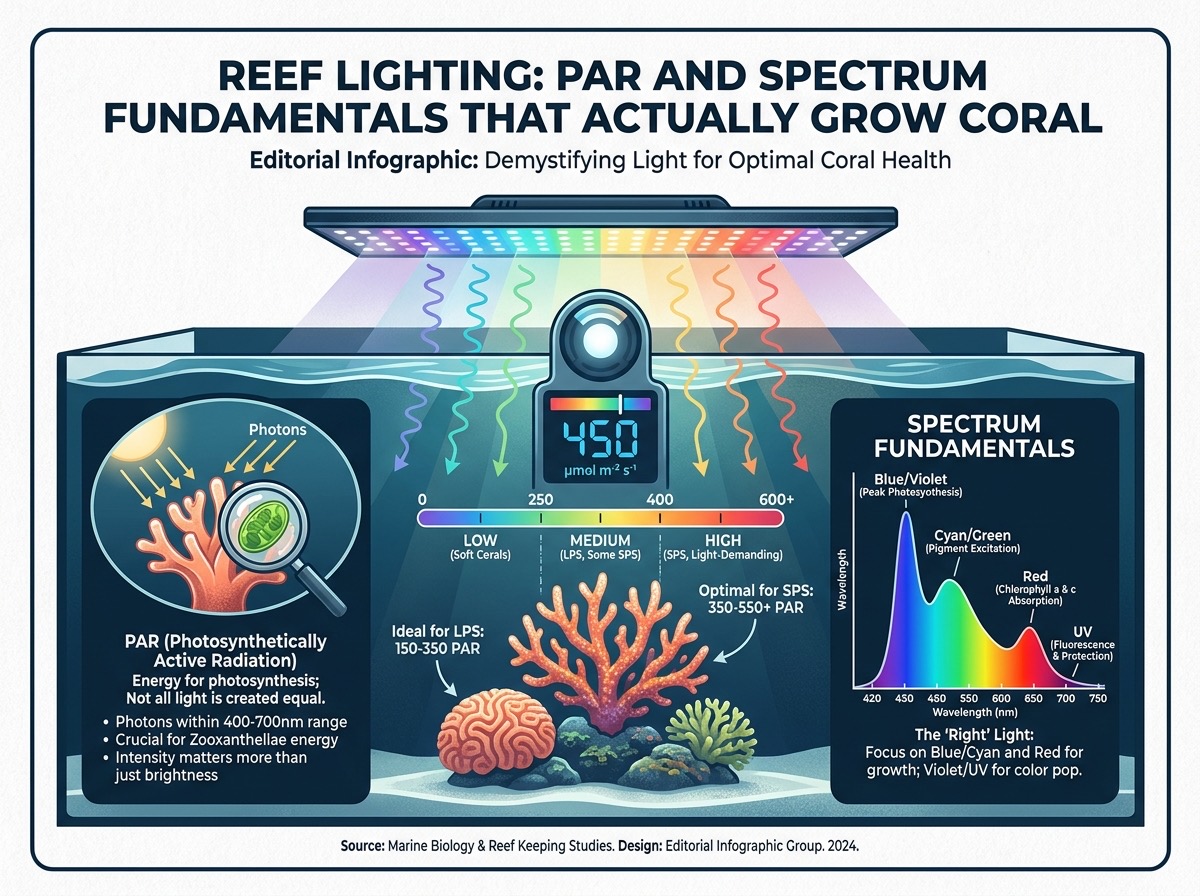
- Provide enough photosynthetically usable radiation (PUR): this is the actual light energy the algae can use. PAR (photosynthetically active radiation, 400–700 nm) is the proxy for this
- Be in the right wavelength range for the algae's pigments: zooxanthellae absorb primarily in the 400–550 nm (blue-cyan) and 620–700 nm (red-orange) ranges, with peaks around 430 nm and 660 nm
- Be stable and consistent: corals adapt their zooxanthellae populations to the available light over weeks. Stable lighting supports stable coral colour and growth
- Not be too intense: excessive light causes the coral to expel its zooxanthellae ("bleaching"). Insufficient light starves the symbiosis and the coral slowly starves
The balance between too little and too much light is what most reef keepers struggle with.
PAR: the most useful measurement
PAR = Photosynthetically Active Radiation. It is the light in the 400–700 nm wavelength range, measured in µmol/m²/s (micromoles of photons per square metre per second).
PAR is what matters because:
- It measures the light coral can actually use (not all light is photosynthetically usable — far-red and UV are not)
- It is independent of spectrum. Two different lights at the same PAR are equivalent for photosynthesis (assuming reasonable spectrum)
- It is measurable with a PAR meter, allowing objective comparison between lights and across the tank
PAR targets vary by coral type:
| Coral type | PAR target at coral surface |
|---|---|
| Soft corals (mushrooms, leathers) | 50–150 |
| LPS (brain, hammer, torch) | 100–200 |
| SPS (Acropora, Montipora) | 250–450 |
| Ultra-low nutrient SPS (ULNS) systems | 350–600 |
| Clams (Tridacna) | 250–400 |
Note: PAR at the coral surface, not at the water surface. Light loses intensity through the water column (the deeper the coral, the lower the PAR reaching it). PAR also decreases with distance from the light source.
Spectrum: the colour of the light
Spectrum refers to the wavelength distribution of the light. Different wavelengths have different effects on coral:
| Wavelength | Colour | Effect on coral |
|---|---|---|
| 380–420 nm | UV-A | Some benefit to coral colour, but excess damages zooxanthellae. Most modern LEDs minimise this range |
| 420–470 nm | Deep blue (royal blue) | Peak absorption by zooxanthellae chlorophyll. Drives photosynthesis efficiently |
| 470–490 nm | Blue | Useful for photosynthesis, brings out blue fluorescence in some corals |
| 490–520 nm | Cyan/green | Less used by zooxanthellae but penetrates water deeply. Used for "pop" colour in some corals |
| 520–580 nm | Green/yellow | Low absorption by zooxanthellae. Contributes to colour but drives little photosynthesis |
| 580–620 nm | Orange | Moderate absorption. Contributes to colour |
| 620–700 nm | Red | High absorption but limited water penetration; contributes to growth and some colour |
| 700–750 nm | Far-red | Not photosynthetically usable by zooxanthellae; minimal benefit |
Modern reef LEDs typically tune the spectrum heavily toward blue and royal blue, with some white and occasional UV or violet accents. A spectrum that is "blue-dominant" looks deep blue to the eye but provides the wavelengths coral uses most efficiently.
The rule of thumb for spectrum:
- SPS-dominant tank: 60–80% blue/royal blue, 20–40% white, minimal green/yellow
- Mixed reef (LPS + soft + some SPS): 40–60% blue, 40–60% white, some green/yellow for colour
- Soft coral/LPS tank: 30–50% blue, 50–70% white, broad spectrum acceptable
The aesthetic (how the tank looks) is determined by spectrum. A "yellow tank" (high white content) shows coral colours vividly but uses light less efficiently. A "deep blue tank" (high blue content) looks dramatic and uses light efficiently, but you see less of the coral's true colour.
Mounting height and spread
The distance between the light and the coral surface affects PAR dramatically:
- PAR at the coral surface is approximately inversely proportional to the square of the distance (inverse square law). Double the distance, quarter the PAR
- Mounting height also affects "spread" — the area of the tank that gets usable light
For a typical reef tank:
| Mounting height | Effect |
|---|---|
| 4–6 inches above water | High PAR at surface, narrow spread |
| 8–12 inches above water | Moderate PAR, wider spread (recommended for most tanks) |
| 18–24 inches above water | Lower PAR, very wide spread (for deeper tanks or low-light corals) |
Modern reef LEDs are designed to be mounted 8–12 inches above the water surface for most reef applications. Adjust height to dial in PAR at the coral surface.
The PAR measurement protocol
PAR meters cost $150–500 (Apogee MQ-510, Li-Cor LI-190R). Worth it for any serious reef tank. Without a PAR meter, you are guessing.
How to use it:
- Calibrate the meter according to manufacturer instructions (most are pre-calibrated)
- Measure at the water surface to see the maximum PAR the light provides
- Lower the sensor into the water at the depth of your dominant coral
- Take readings at multiple locations — directly under the light, at the edges, in the corners. PAR varies significantly across the tank
- Take readings at the time of peak intensity — usually midday
- Adjust light intensity or mounting height to hit your PAR targets at coral depth
For an SPS-dominated tank:
- Target PAR at the dominant SPS area: 300–450
- PAR at the LPS area: 150–250 (acceptable, LPS tolerates lower light)
- PAR at the bottom (sand bed): 50–100 (intentional — prevents nuisance algae from carpeting the sand)
A spread of 5–10× between the brightest and dimmest coral areas is fine. Many reef keepers create intentional shading by placing LPS in lower-PAR areas and SPS in higher-PAR areas.
Acclimation: the most under-appreciated step
When you introduce new coral to a tank, or change the light in an existing tank, the coral's zooxanthellae populations need time to adapt. Acclimation prevents bleaching shock.
The protocol:
New coral introduction
- Place the coral in a low-light area of the tank first (under a rock ledge, in a shaded corner)
- Leave for 2 weeks with reduced photoperiod (4–6 hours)
- Gradually move to its target location over 2 weeks
- Gradually increase photoperiod to target (8–10 hours) over 2–4 weeks
Light change
- Reduce light intensity to 50% of final target
- Run for 2 weeks
- Increase to 75% for 2 weeks
- Increase to 100% target
Skipping acclimation is the most common cause of coral bleaching in new setups. The coral expels zooxanthellae in response to light shock, turns white, and either slowly dies or slowly recovers over months.
LED vs T5 vs metal halide
The light technology matters for efficiency, heat, and spectrum flexibility.
LED (current standard)
- Most efficient: 40–60% efficient at converting electricity to PAR, vs 15–25% for metal halide
- Customisable spectrum: each channel can be tuned (UV, violet, royal blue, blue, cyan, white, red)
- Programmable: intensity curves, sunset/sunrise simulation, cloud effects, acclimation modes
- Long life: 50,000–100,000 hours of useful life (5–10+ years of typical use)
- Low heat: minimal heating of the tank water
- Brands: Ecotech Marine Radion, AI Hydra, Kessil, Philips CoralCare, Maxspect, Reef Breeders Photon
T5 fluorescent
- Excellent spectrum and even spread: T5 fixtures with multiple tubes give broad spectrum and even coverage
- Lower efficiency: 25–35% efficient
- Heat: significant heat output
- Lamp life: 6–12 months before spectrum shifts and intensity drops
- Used less in 2025: most new tanks use LED, but some experienced reefers prefer T5 for coral colour
Metal halide
- Highest single-light PAR: 250–400 PAR at the surface from one pendant
- Best colour rendition: the spectrum produces the most natural-looking colours in fish and corals
- High heat: significantly heats the tank water; needs a chiller in warm rooms
- High energy use: 250–400 W per pendant
- Lamp life: 6–12 months before significant UV output drops
- Mostly phased out: most new reef installs use LED
What to buy
For a 60–100 gallon (230–380 L) mixed reef:
- 2–3 LED fixtures from a reputable brand (Radion, AI Hydra, Kessil, etc.)
- Combined PAR output: 250–400 at the dominant SPS area
- Mounting: hanging kit or tank-mounted arms, 8–12 inches above water
- Controller: Apex, Hydros, or simple outlet timer for photoperiod control
- PAR meter: critical for setup, optional for ongoing monitoring (PAR drifts as LEDs age)
For a 30–60 gallon (115–230 L) nano reef:
- 1 LED fixture (Kessil A360, AI Prime, similar)
- PAR: 200–350 at dominant coral area
- Mounting: tank-mounted arm
For a 100–200 gallon (380–760 L) large reef:
- 3–4 LED fixtures or 2 high-output pendants
- PAR: same targets but distributed across more fixtures
- Consider supplemental T5: some large reefers use LED+T5 hybrid for best colour
Common mistakes
1. Too much light too fast
The single most common cause of coral bleaching. New tanks often have LEDs at 100% intensity from day 1. Coral cannot adapt fast enough. Bleaching shock results.
Solution: start at 50% intensity, ramp up over 4–6 weeks.
2. Buying the cheapest LED
The cheapest LEDs on Amazon use generic diodes with poor spectrum tuning. They look bright (high PAR) but use the light inefficiently. Coral colour is muddy, growth is mediocre.
Solution: stick with reef-specific LEDs from established brands (Ecotech, AI, Kessil, Philips, Maxspect, Reef Breeders).
3. Ignoring PAR measurement
Without a PAR meter, you are guessing. Lights positioned 12 inches vs 8 inches above the water produce very different PAR at the coral surface. The same model light at the same height may produce different PAR across the tank.
Solution: buy or borrow a PAR meter, measure at multiple locations, adjust intensity or height to hit targets.
4. Running the same photoperiod for all corals
Some corals (SPS) want 8–10 hours of high light. Others (LPS, soft corals) want 6–8 hours. Running 12 hours because that's the default stresses lower-light corals.
Solution: 8–10 hours is the sweet spot for most mixed reefs. Adjust by coral placement if you want different photoperiods.
5. Not acclimating new corals
I covered this above. It bears repeating because the failure rate is high.
6. Replacing LEDs only when they fail
LEDs lose intensity gradually, not catastrophically. A 3-year-old LED may produce 70% of its initial PAR. If you don't notice the slow decline, coral gradually starves. Most reefers upgrade LEDs every 3–5 years not because they fail but because they have dimmed.
Solution: PAR-check the tank annually. Replace LEDs if PAR has dropped below your target range.
The bottom line
Reef lighting is one part PAR (the amount), one part spectrum (the colour), one part placement (mounting height and spread), and one part management (acclimation and photoperiod). Modern LEDs from reputable brands give you all four. The most common mistakes are too much light too fast, ignoring PAR measurement, and buying cheap LEDs that look bright but deliver poor spectrum. With a PAR meter, a 4–6 week acclimation schedule, and a moderate photoperiod, even a basic LED fixture can grow colourful SPS. The light is the foundation. The rest is husbandry.
---
About the author: [Olivia Brown](../Olivia%20Brown.md) is a marine biologist (PhD, University of Miami) with 10 years of marine aquarium practice, and consults for several U.S. saltwater aquarium brands on system design and livestock care.