
Koi pond filtration: moving bed vs fluidized bed — 2026 sizing, chemistry, and brand guide
The two technologies are unchanged in principle since 2020, but the chemistry conversation has matured and the market has consolidated. Hobbyists are now asking sharper questions: how much media per kilo of koi, what feed rate, what alkalinity demand does the bed actually impose, and what is the realistic 10-year cost? This is the 2026 answer.
Why koi filtration is a different problem
A koi pond is not a big aquarium. The loading math is what trips people up.
A 60 cm koi at 4 kg eats roughly 15 g of feed per day in summer, metabolises about 40% of the protein, and excretes the rest as ammonia through the gills and as solid waste. A typical 40 L community tank holds fish that produce maybe 0.5 g of waste per day total. One adult koi is producing the ammonia load of an entire living-room tank.
The classical "feed rate" rule for koi is:
$$\text{Feed rate (g/day)} \approx 0.5\% \text{ to } 2\% \text{ of body weight, seasonally}$$
A 4 kg koi at 1% summer feed = 40 g of feed per day. Of the nitrogen in that feed, roughly 30 g of NH3-N-equivalent is produced and must be oxidised by the biofilter per month per koi. Pond volume is large (1,000–50,000 L), so the hydraulic side of the filter matters as much as the biological side. A bed can have infinite surface area and still be useless if water passes through it in 90 seconds.
Moving bed filters (MBBR) — how they work
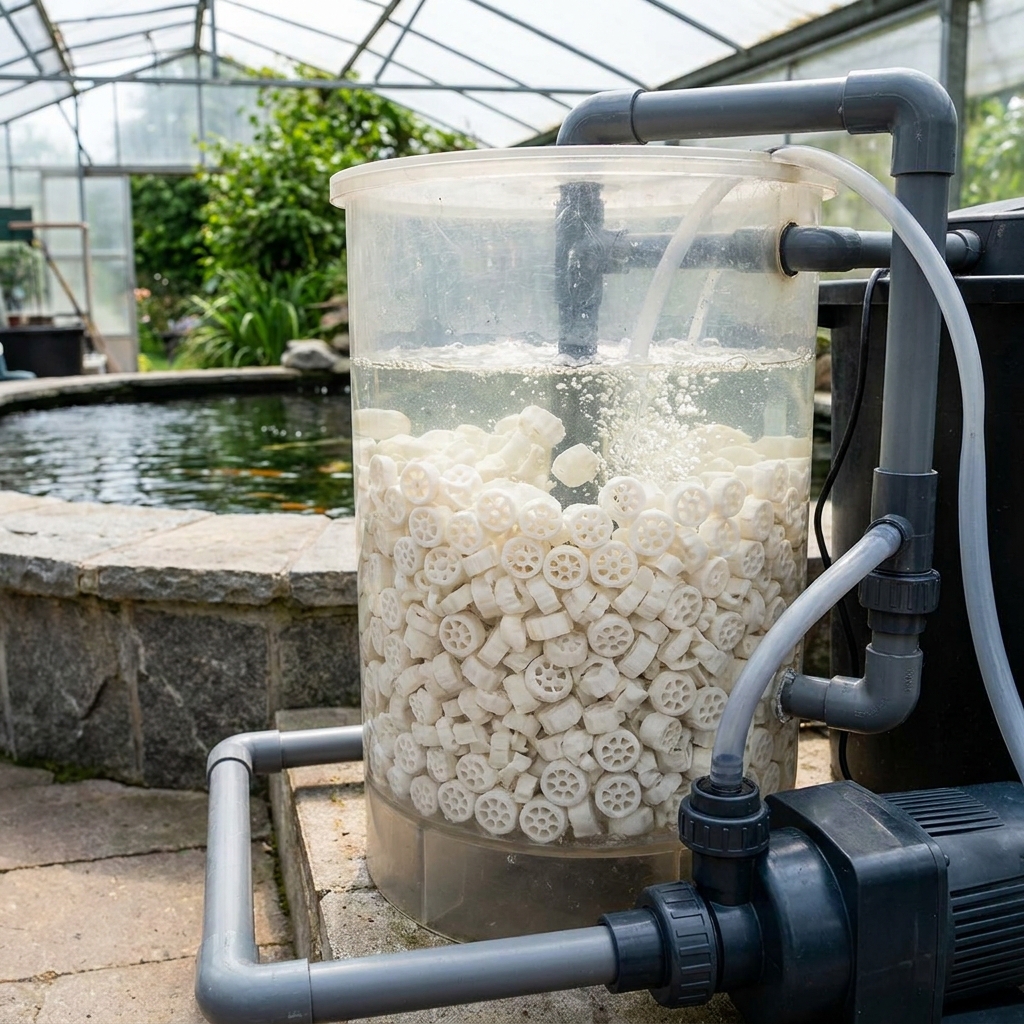
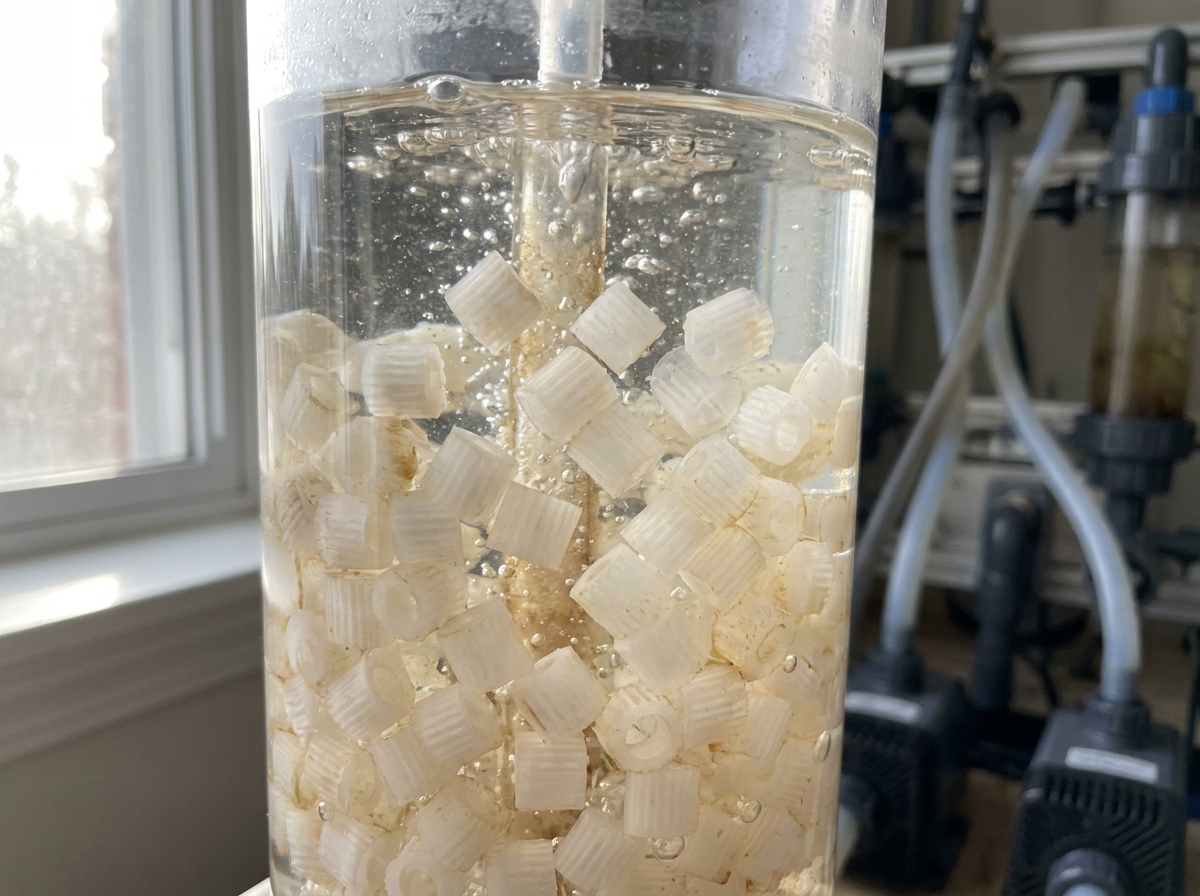
A moving bed reactor is a chamber roughly 50–70% filled with plastic media (Evolution Aqua K1, K3, Kaldnes next-gen, Aquaculture Solutions Hel-X). Air from a diaphragm pump or venturi drives the media into a continuous slow tumble that prevents channeling, self-cleans the biofilm (dead bacteria slough off), and keeps dissolved oxygen at near-saturation.
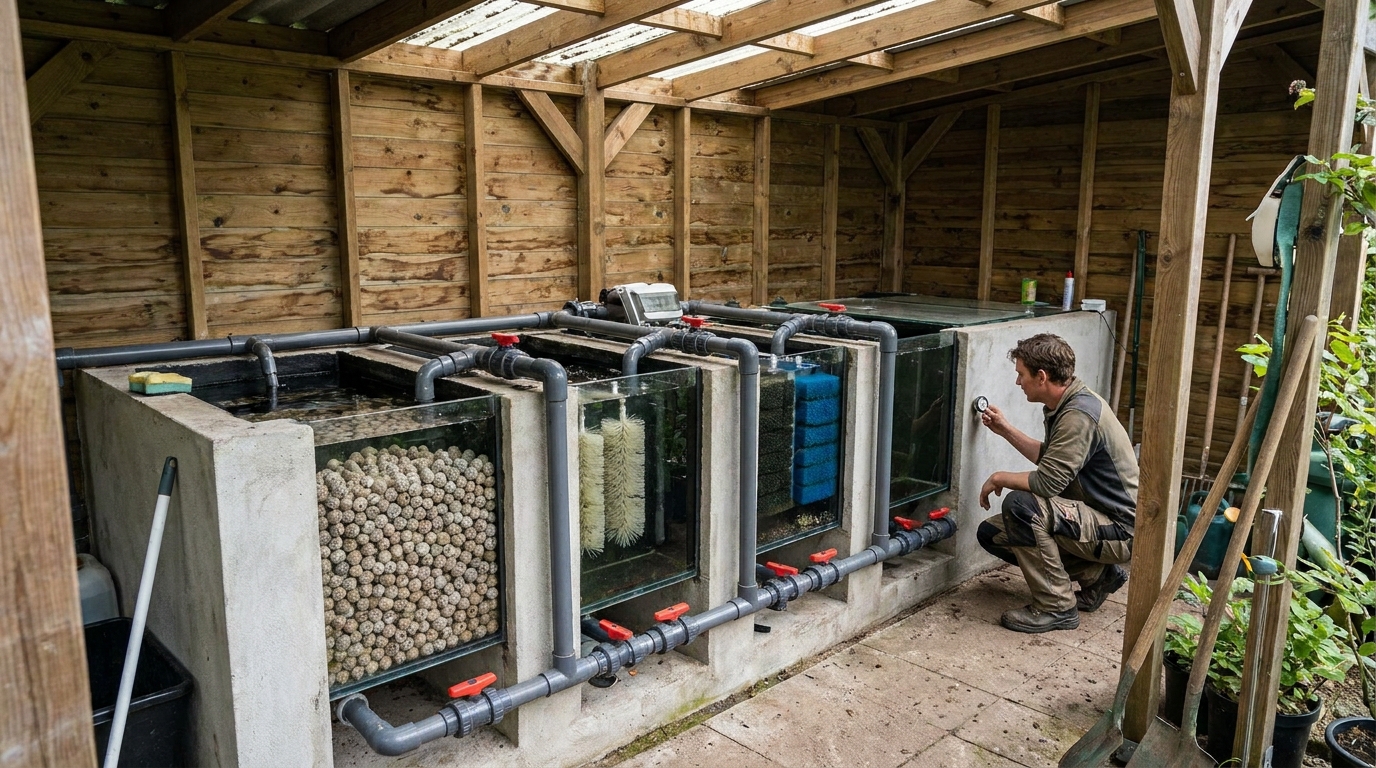
The canonical product is the Evolution Aqua Nexus 220 / 320, which combines a mechanical pre-filter (the EAZY filter section on top) with a moving bed below. For larger ponds, the Evolution Aqua Cetus sieve paired with a separate K1 chamber is the build most UK professional koi keepers run.
Sizing rule for MBBR: minimum 1 L K1 media per 50 L pond; comfortable 1 L per 25–30 L; high stocking (>5 kg/1,000 L) 1 L per 15 L. Surface area of virgin K1 is ~800 m²/m³; effective area after biofilm maturation (3–6 weeks) is ~500 m²/m³.
Fluidized bed filters (FBB) — how they work
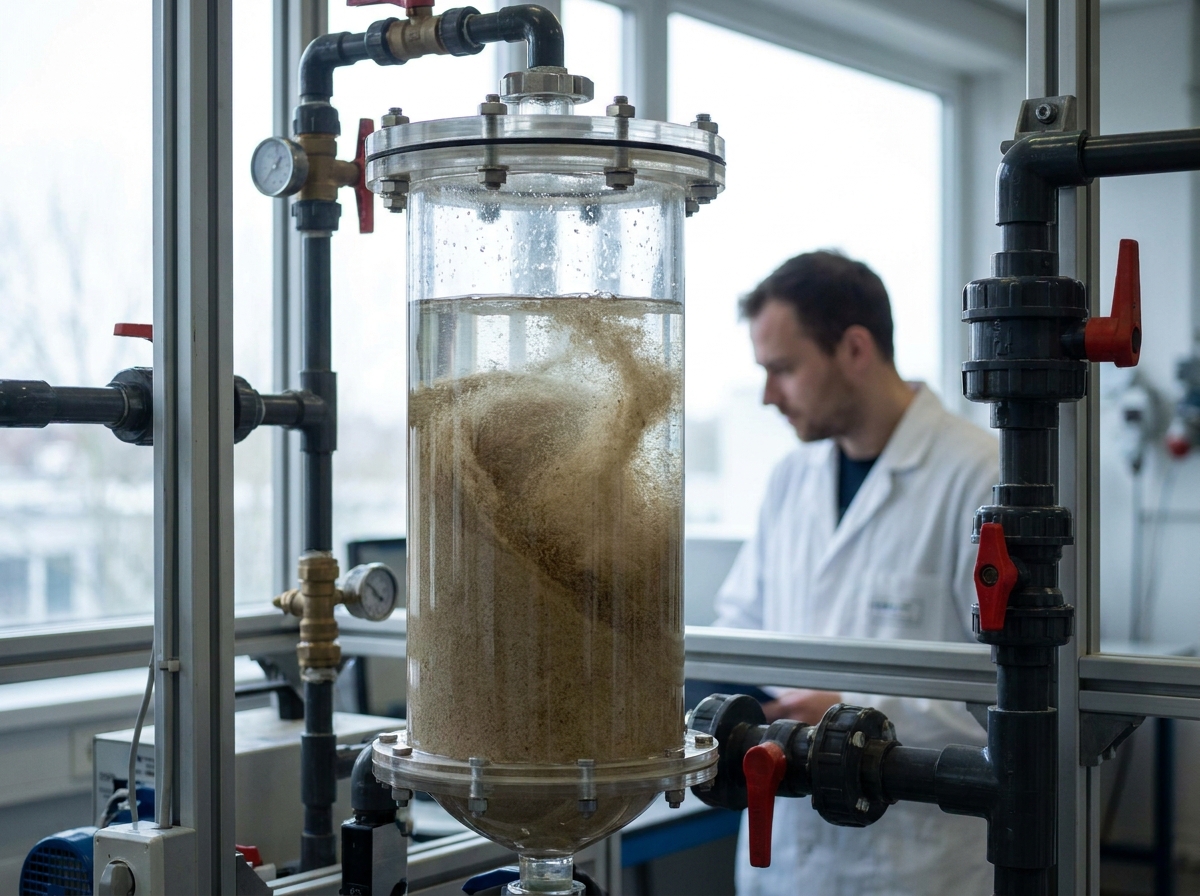
A fluidized bed is a tall, narrow chamber (1.5–2 m tall, 30–60 cm wide) packed with fine sand or plastic beads. A water pump pushes flow upward through the bed at a velocity that lifts the media into a suspended state. The flagship products are the Evolution Aqua Nexus FBB add-on and the Oase ProfiClear Premium series in the European market. In Japan, the Bakki shower (a percolating tower over media beds) is a related final-polishing stage.
Sizing rule for FBB: bed volume 5–10% of pond volume; upflow velocity 15–25 m/h for sand, 20–35 m/h for plastic bead; HRT in the bed 2–5 minutes. Surface area of fluidized sand is ~2,000–3,000 m²/m³ — 2.5–3× the surface area per unit volume of an MBBR. The trade-off is fragility (see below).
Sizing math you can do on a napkin
Three numbers determine whether a filter is sized correctly: pond volume (L), stocking (kg), and feed rate (g/day).
Step 1 — daily NH3-N production:
$$\text{NH}_3\text{-N (g/day)} = \text{Feed (g/day)} \times 0.025$$
(roughly 2.5% of feed ends up as excreted ammonia-N)
Step 2 — required biofilter surface area:
A well-functioning nitrifier biofilm oxidises ~0.4 g NH3-N per m² per day at 25 °C (0.2 at 20 °C, 0.6 at 28 °C). So:
$$\text{Surface area (m}^2\text{)} = \frac{\text{NH}_3\text{-N (g/day)}}{0.4 \text{ (at 25 °C)}}$$
Step 3 — required media volume: MBBR (K1, 500 m²/m³ effective): V = Surface / 500. FBB (sand, 2,500 m²/m³ effective): V = Surface / 2,500.
Worked example. 10,000 L pond, 20 kg of koi, summer feed 200 g/day.
- NH3-N = 200 × 0.025 = 5 g/day
- Required surface area at 25 °C = 5 / 0.4 = 12.5 m²
- MBBR volume needed: 12.5 / 500 = 25 L of K1 (the standard 1 L per 50 L rule gives 200 L, roughly 8× over-built — that is the safety margin)
- FBB volume needed: 12.5 / 2,500 = 5 L of sand (the biological minimum; manufacturer curves specify 50–100 L for a 10,000 L pond because they assume worst-case stocking)
The chemistry: alkalinity demand, pH drift, and the formula nobody writes down
Nitrification consumes alkalinity. For every 1 mg/L of NH3-N oxidised to NO3-N, the bed strips 7.14 mg/L of CaCO3-equivalent KH:
$$\text{NH}_4^+ + 2\text{O}_2 \rightarrow \text{NO}_3^- + 2\text{H}^+ + \text{H}_2\text{O}$$
The two H+ produced consume 1 mole of bicarbonate per mole of ammonia oxidised. In a heavily-fed summer pond, the bed can consume 50–100 mg/L of KH per week. If your tap water is 50 mg/L KH, the pond will run out of buffering capacity in 3–7 days. The pH then crashes, the NH3/NH4+ equilibrium shifts toward the toxic NH3 side, and the bed — now operating in suboptimal pH — slows down. This is the runaway failure mode that wrecks koi ponds in late August.
Daily KH dose (g of NaHCO3) = NH3-N oxidised (g/day) × 2.86
The 2.86 factor converts g NH3-N to g NaHCO3 needed to neutralise the resulting acidity (molecular weight ratio of NaHCO3 to N is 84/14 = 6.0, but with the empirical 30% excretion profile of koi feed, 2.86 g NaHCO3 per g N maintains pH at 7.8). In practice: dose 1 g of NaHCO3 per 100 L of pond water, every 2–3 days in summer. Test KH weekly; target 80–120 mg/L (4.5–6.8 dKH). Below 60 mg/L is the danger zone.
Brand and product comparison (2026 market)
| System | Product | Pond size (L) | Media volume | Price (USD, 2026) | Notes |
|---|---|---|---|---|---|
| MBBR | Evolution Aqua Nexus 220 | Up to 18,000 | 150 L K1 | $1,500 | UK market leader; integrated pre-filter |
| MBBR | Evolution Aqua Nexus 320 | Up to 36,000 | 300 L K1 | $2,800 | Same architecture, larger bay |
| MBBR | AquaForte KoiPro MBBR | Up to 25,000 | 200 L K1 | $1,200 | Budget alternative, EU market |
| FBB | Evolution Aqua Nexus FBB add-on | Up to 36,000 | 100 L sand | $1,000 | Bolts on to existing Nexus |
| FBB | Oase ProfiClear Premium | Up to 40,000 | 120 L bead | $3,200 | Drum pre-filter + FBB; German engineering |
| FBB | Bakki shower (custom) | Any | 100–200 L lava | $400–800 DIY | Japanese method; needs 1.5 m+ fall height |
For a 10,000 L koi pond with moderate stocking (15 kg, summer feed 150 g/day), the AquaForte KoiPro MBBR is the value play; the Nexus 220 is the safe choice; the Oase ProfiClear is the premium play with the lowest maintenance burden because of the drum pre-filter.
Decision matrix: when to choose which
Choose MBBR if stocking varies seasonally, you want forgiving operation, you have reliable mains power, the pond is 1,000–15,000 L, or the budget is under $1,500.
Choose FBB if stocking is stable, space is tight, you want quiet operation (pond near living area), you have backup power for the pump, or you want the smallest media-volume footprint.
Combine both if you are running a serious koi room with >25,000 L and you want the FBB to do the steady-state work and the MBBR to absorb the swings. This is what I run in my own fishroom and what the ZNA judges I trust do as well.
Maintenance, failure modes, and the 10-year cost
The four failure modes I see most often:
- MBBR — media clogging. Water level rising in the chamber, air pump labouring. Fix: service the pre-filter; rinse media in pond water (never tap — chlorine kills the biofilm) every 6–12 months.
- FBB — bed collapse after power outage. Sand settles into a dense layer, water channels through cracks. Fix: backup power on the pump, or manually rake the bed to re-fluidisze. Recovery takes 2–3 weeks.
- Both — pH crash from alkalinity demand. pH drops 1.0+ unit in days, fish gasp, NH3 spikes. Fix: dose NaHCO3 as above; pre-empt with weekly KH testing through summer.
- Both — cold-water derating. Nitrification halves every 10 °C drop. Below 10 °C, the bed's effective capacity is roughly 25% of summer. Stop feeding below 12 °C.
Maintenance cadence for a 10,000 L pond:
- Weekly: NH3, NO2, NO3, pH, KH panel. Brush sieves. Top off with dechlorinated water.
- Monthly: Inspect moving bed and air pump diaphragm. Check fluidized bed for channeling.
- Annually (spring startup): Replace air pump diaphragms (every 18–24 months). Rinse MBBR media. A 10% pump output drop = clean the pre-filter. ICP mineral panel ($25–40) catches problems early.
- Every 5–7 years: Replace FBB sand. MBBR K1 is permanent.
10-year cost (10,000 L pond): MBBR (Nexus 220 path) = $2,800. FBB (Oase ProfiClear path) = $4,000. MBBR is cheaper to buy and run; FBB is quieter, more compact, and gives faster biological response. Both work — pick by use case, not by price.
---
About the author: [Kenji Tanaka](../Kenji%20Tanaka.md) is a ZNA-certified koi judge with 25 years of freshwater ornamental fish research. He has served on the judging panel of the All Japan Nishikigoi Show on multiple occasions.