

Marker-assisted selection in ornamental fish: what it is and why it matters for your next breeder
If you have ever bought ornamental fish labelled "high quality", "show-grade", or "breeding stock" and wondered whether the label meant anything, marker-assisted selection (MAS) is the technical concept that explains why some breeders can justify the claim and others cannot.
This is what MAS is, how it works in ornamental fish, and what to ask a breeder before paying premium prices for breeding stock.
The breeder's old problem
For most of ornamental fish breeding history, selecting breeding stock was based on visible traits — colour, pattern, body shape, finnage. The breeder picks the male and female that look the most like the ideal, breeds them, and hopes the offspring inherit those traits.
This works, but it is slow and unreliable because:
- Many traits are polygenic: controlled by many genes, each contributing a small effect. The visible phenotype is an imperfect predictor of the underlying genotype
- Traits can be sex-linked: a stunning male may carry genes for poor-quality daughters
- Recessive traits hide in carriers: a fish that looks "average" may carry genes for the desired trait that only appear in offspring when bred to another carrier
- Inbreeding depression masks selection: closely related fish may have hidden deleterious alleles that only show up in homozygous form
- Environmental effects confound assessment: a fish raised in poor conditions may look worse than its genotype would predict
The result: breeders select on phenotype, guess on genotype, and progress is slow. A line may improve slightly each generation, or it may not. The breeder cannot tell.
What MAS does
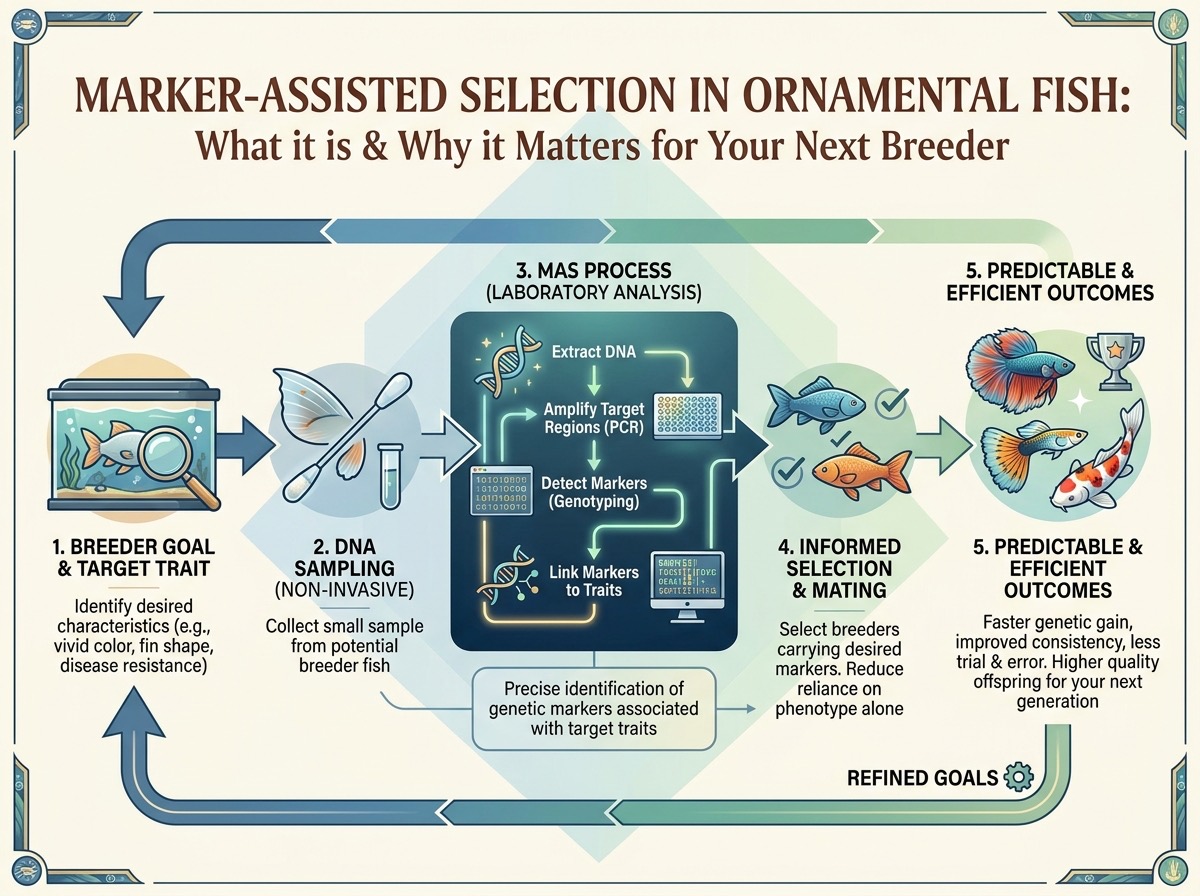
Marker-assisted selection uses DNA markers — stretches of DNA that are physically linked to the genes controlling the traits of interest — to predict the genotype of a fish before its phenotype is fully expressed, or to confirm the genotype in cases where the phenotype is ambiguous or environmentally confounded.
The workflow:
- Identify DNA markers linked to traits: geneticists study families or populations of fish, identify which DNA variants correlate with the desired phenotype, and validate that the correlation holds
- Sample DNA from each fish: a small fin clip, scale sample, or buccal swab provides enough DNA for analysis
- Test the sample for the markers: PCR-based tests amplify the marker regions; sequencing or gel electrophoresis reveals which alleles each fish carries
- Make breeding decisions based on genotype, not just phenotype: fish with the desired marker alleles are selected, regardless of how they look
The result: breeding decisions become more accurate, progress per generation accelerates, and inbreeding depression can be managed with genetic diversity metrics.
The types of markers
Different marker types have different costs, complexity, and utility:
Microsatellites (SSR — Simple Sequence Repeats)
Short DNA sequences (2–6 base pairs) repeated multiple times. The number of repeats varies between individuals. Microsatellites are:
- Highly polymorphic: many alleles per locus, useful for parentage verification and population diversity
- Moderately abundant: thousands of loci across the genome
- Standard for parentage testing: in many aquaculture species, microsatellite panels are used to verify pedigree
Use cases: parentage verification, genetic diversity assessment, inbreeding coefficient estimation.
Single Nucleotide Polymorphisms (SNPs)
Single base pair differences between individuals. SNPs are:
- The most abundant marker type: millions across the genome
- Cheap to genotype: SNP arrays can test thousands of markers at once
- Stable: less mutation rate than microsatellites, easier to standardise
- Increasingly used for MAS: SNP panels have been developed for several ornamental species
Use cases: trait-linked markers, genomic selection (see below), parentage verification.
Insertions/Deletions (Indels)
Larger DNA variants where sequences are inserted or deleted. Less common than SNPs but useful for specific traits.
Whole Genome Sequencing (WGS)
Sequencing the entire genome. Cost has dropped dramatically (under $200 for a fish genome in 2025). Currently used primarily for research, but as costs continue to fall, will become practical for high-end breeding programmes.
Use cases: identifying novel trait genes, validating marker-trait associations, building genomic prediction models.
What MAS has actually done in ornamental fish
Koi (Cyprinus carpio)
Japanese koi breeders have used MAS for over two decades. Specific marker-trait associations have been validated for:
- Red colour intensity: multiple loci contribute. Markers identify fish carrying more red alleles
- White ground (Shiroji): controlled by a small number of loci. Markers can identify homozygous white-ground fish with high confidence
- Sumi (black): complex inheritance, but markers exist for the major alleles
- Pattern genes: the "stepped" pattern in Kohaku and the "motoguro" pattern in Sanke are partly predictable from markers
A serious koi breeding programme using MAS can predict the colour outcome of a cross with reasonable accuracy before the offspring are raised, allowing selection of parent pairs for specific goals.
Goldfish (Carassius auratus)
Marker-trait associations have been published for:
- Body shape: the egg-shaped body of Ranchu, the short body of Ryukin, the long body of common goldfish
- Wen (head growth): the hood growth on Oranda and Lionhead is partly heritable, with markers in development
- Colour: red, orange, white, black, calico, and bi-colour patterns have known genetic bases
Guppies (Poecilia reticulata)
Guppy breeders have used MAS for colour traits for over a decade. The genetic basis of male guppy colour patterns is well-characterised, with multiple marker-trait associations in commercial use.
Betta (Betta splendens)
Betta breeders have begun using MAS for:
- Colour: red, blue, white, copper, marble
- Fin type: veiltail, crowntail, halfmoon, plakat — fin morphology is highly heritable
- Body colour cells: iridophores (blue), erythrophores (red), melanophores (black), xanthophores (yellow) — each controlled by identifiable genes
The economics: when MAS is worth it
MAS has costs — DNA extraction, PCR, sequencing, analysis. The economics depend on the value of the fish being bred:
| Fish value per individual | MAS justified? |
|---|---|
| <$100 | Generally no; phenotype selection is sufficient |
| $100–$1,000 | Maybe; depends on breeding programme scale |
| $1,000–$10,000 | Yes for serious breeders |
| >$10,000 | Definitely yes; the cost of MAS is a fraction of the fish value |
For commercial ornamental fish farms producing hundreds to thousands of fish per year, MAS becomes economical when the value of the output justifies the testing cost. For hobby breeders with a few pairs, MAS is usually overkill unless they are working with a specific high-value line.
What to ask a breeder
If you are considering buying fish from a breeder who claims "show quality" or "breeding stock", here are the questions that separate serious breeders from marketing:
1. "What genetic markers do you use?"
A serious breeder can name markers or a marker panel they use. If the answer is "we just look at the fish", the fish are selected on phenotype only — fine for pets, but the breeding stock claim is unsupported.
2. "Do you track parentage?"
Parentage verification ensures the fish you buy is from the claimed lineage. Microsatellite-based parentage testing is standard in serious programmes. If the breeder does not track parentage, you are trusting their records at face value.
3. "Do you measure genetic diversity?"
Inbreeding is the silent killer of breeding lines. A serious breeder tracks inbreeding coefficients and avoids matings that exceed thresholds. If the breeder has never heard of an inbreeding coefficient, the line is probably more inbred than they realise.
4. "How do you select for [specific trait]?"
If the trait is genetically simple (single gene), the breeder should be able to describe the inheritance pattern. If it is polygenic, the breeder should describe how they track multiple contributing factors.
5. "What is your culling rate?"
Most serious breeding programmes cull 50–95% of offspring. A breeder claiming "all our fish are breeding quality" is not selecting. Either they have no quality control, or they do not understand what breeding quality means.
6. "What is your line's history?"
A serious breeder can tell you the line's origin, how many generations they have bred it, the founders, and the selection criteria applied at each generation.
The relationship between MAS and other selection methods
MAS does not replace other methods. It complements them:
Phenotype selection
MAS predicts genotype, but phenotype is the ultimate test. Fish selected by markers but producing poor-quality offspring should be removed from the breeding pool regardless of their marker profile.
Performance testing
Some traits (growth rate, fertility, disease resistance) require performance testing. Markers for these traits exist but are less reliable than for visible traits. Performance testing remains the gold standard.
Genomic selection
Genomic selection uses thousands of markers across the genome to predict breeding values, without needing to identify the specific genes involved. It is the cutting edge of MAS for commercial aquaculture and is beginning to be applied in ornamental fish.
The combination of MAS + phenotype selection + performance testing is what the most advanced breeding programmes use. Each method catches errors that the others miss.
Limitations of MAS
MAS has real limits:
- Markers must be validated for the population: a marker developed in Japanese koi may not work in Thai koi or in a different Japanese lineage
- Many ornamental fish lack reference genomes: genome assemblies and marker panels exist for the most important species, but for many ornamental species, MAS is still in development
- Environmental effects still matter: a fish with great genes but raised in poor conditions will look worse than its genotype warrants. MAS does not fix husbandry
- Polygenic traits are harder: many ornamental traits (colour saturation, fin extension, pattern symmetry) are polygenic. MAS works best for traits with major-gene components
- Cost: per-fish testing is $20–200 depending on the marker panel. This is real money for high-volume operations
For most hobby applications, careful phenotype selection by an experienced breeder outperforms uncritical use of MAS data by an inexperienced one. The markers are tools; the breeder's eye and discipline still matter.
The future
The cost of whole-genome sequencing continues to drop. By 2030, per-fish whole-genome sequencing will likely cost less than $20. At that price, MAS will be available for any breeding programme, and genomic selection will become standard for serious commercial ornamental fish operations. The breeders who adopt these tools earliest will have a measurable competitive advantage in producing predictable, high-quality fish.
For hobby breeders, the practical advice is: focus on phenotype selection, cull ruthlessly, track pedigree, and ask breeders for evidence of any genetic claims. MAS will become a tool for you as the cost drops, but for now, the eye and the discipline still lead.
The bottom line
Marker-assisted selection uses DNA markers to predict breeding values, accelerating genetic progress in ornamental fish. It is well-established in koi, goldfish, guppies, and bettas, with validated markers for colour, pattern, body shape, and fin type. For most hobby applications, phenotype selection still does most of the work. For serious breeding programmes with high-value fish, MAS is worth the investment. The key questions to ask any breeder selling "show quality" or "breeding stock" are about which markers they use, how they track parentage, how they measure genetic diversity, and what their culling rate is. The answers tell you whether the claim is supported by data or just marketing.
---
About the author: [Liu Wei](../Liu%20Wei.md) is a doctoral supervisor in ornamental fish genetics and breeding at the Ocean University of China, with 30 years of aquaculture research and three nationally approved ornamental fish strains to his name.