
Cycling a new saltwater tank: live rock, bacteria, and the parameters that actually matter
Saltwater cycling looks superficially like freshwater cycling — both run the same nitrogen chemistry — but the parameters, the equipment, and the cost of a mistake are completely different. A stalled freshwater cycle delays stocking by a week or two. A stalled saltwater cycle can dissolve a $400 piece of live rock, crash alkalinity, or release enough phosphate to feed a cyanobacteria bloom for six months. Take your time, test your water, and don't trust any product promising "instant cycle in 24 hours."
This is the protocol I run for every new saltwater build — FOWLR, mixed reef, and SPS-dominated systems. Targets shift slightly at the end, but the first 42 days are identical.
Why saltwater cycling is different
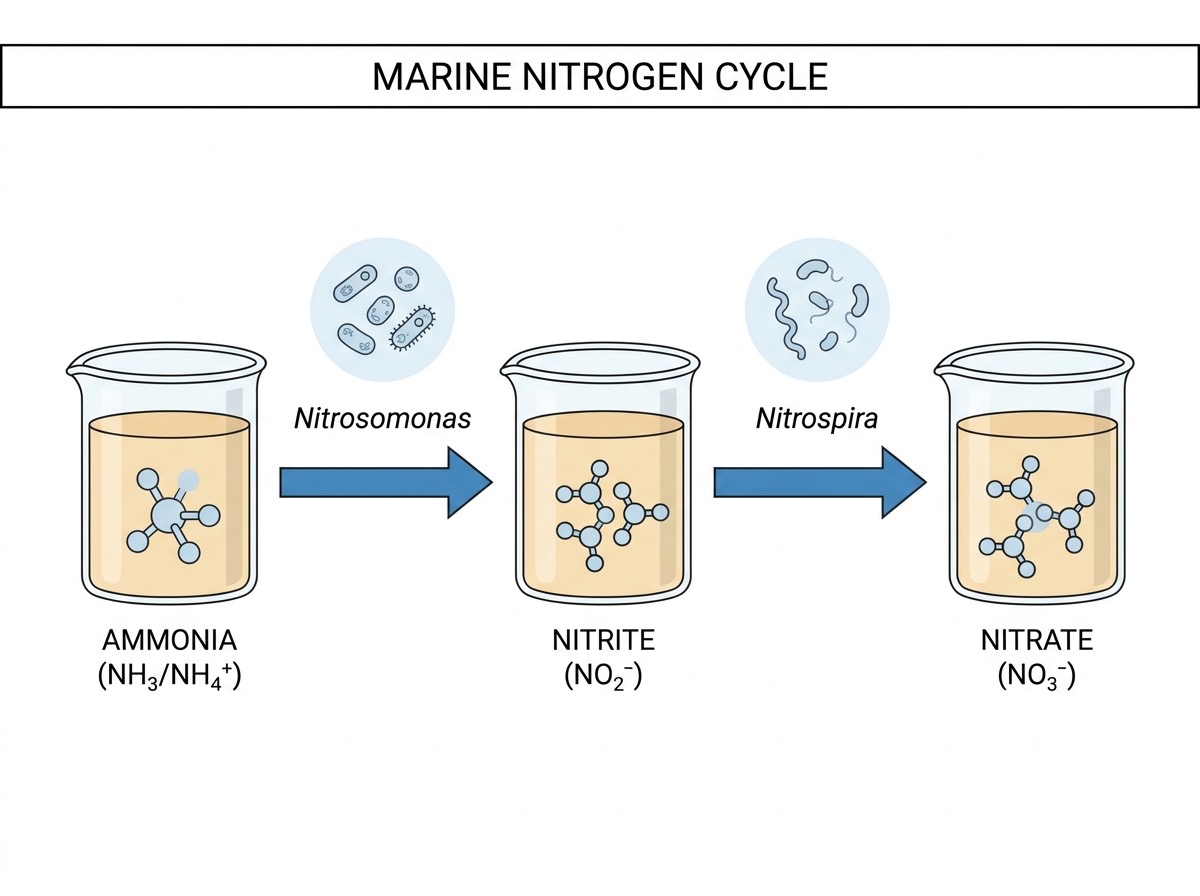
Both cycles run on the same chemistry:
$$\text{NH}_3/\text{NH}_4^+ \xrightarrow{\textit{Nitrosomonas}} \text{NO}_2^- \xrightarrow{\textit{Nitrobacter, Nitrospira}} \text{NO}_3^-$$
But saltwater adds three constraints freshwater does not.
Salinity. Target specific gravity 1.024–1.026 at 25°C (≈ 34–35 ppt). Nitrifying bacteria operate most efficiently here. Below 1.018 and bacterial metabolism slows measurably; above 1.030 and you're stressing the bacteria you are trying to establish. Calibrate your refractometer with RO/DI water at 25°C before you start.
pH and alkalinity coupling. Marine nitrification consumes alkalinity — roughly 2.5–3.5 meq/L (≈ 7–10 dKH) is consumed across a full cycle in a 200 L tank. If alkalinity drops below 6 dKH mid-cycle, bacterial activity stalls and pH swings with it. Target alkalinity 8–9 dKH at start and never let it fall below 7.
Phosphate and silicate from live rock. Uncured live rock carries die-off — dead sponges, brittle stars, worms, ascidians. As they decompose they release ammonia (good — feeds your cycle) and phosphate (bad — feeds algae later). A clean cure phase is what separates a tank that cycles in 42 days from one that struggles for 12 weeks.
Phase 1: ammonia spike and the live rock cure (days 1–14)
The first two weeks belong to the live rock. Whether you bought "cured" or "uncured" rock, treat it as a quarantine-cure cycle of its own.
Setup. Tank filled with Red Sea Coral Pro or Tropic Marin Pro-Reef at 1.025 sg, 24–25°C, pH 8.1–8.3, alkalinity 8–9 dKH. Heater: Eheim Jager 300 W set to 25°C with a Hydros Temperature Sensor as failsafe. Powerheads: 2× Ecotech Marine MP40 at 30–40% in a 200 L tank, or 2× Maxspect Gyre XF350 — turnover target 20–30× tank volume per hour. A Reef Octopus Classic 110-INT skimmer runs from day 1, pulling dissolved organic compounds out before they feed nuisance algae. Lighting: low — 20–30 PAR at substrate, 6-hour photoperiod, to discourage algae during cure.
Live rock ratio. FOWLR: 1.0–1.5 lb per gallon (1.2–1.5 kg per 4 L). Mixed reef: 0.7–1.0 lb per gallon. High-end SPS reef with heavy mechanical filtration: 0.5–0.7 lb per gallon.
Parameter targets, days 1–14:
| Parameter | Day 1 | Day 7 | Day 14 |
|-----------|-------|-------|--------|
| Ammonia | 0.5–2.0 ppm | 2.0–6.0 ppm | 0.5–2.0 ppm |
| Nitrite | 0 | 0.5–2.0 ppm | 1.0–4.0 ppm |
| Nitrate | 0 | 5–10 ppm | 10–25 ppm |
| Alkalinity | 8–9 dKH | 7–8 dKH | 7–8 dKH |
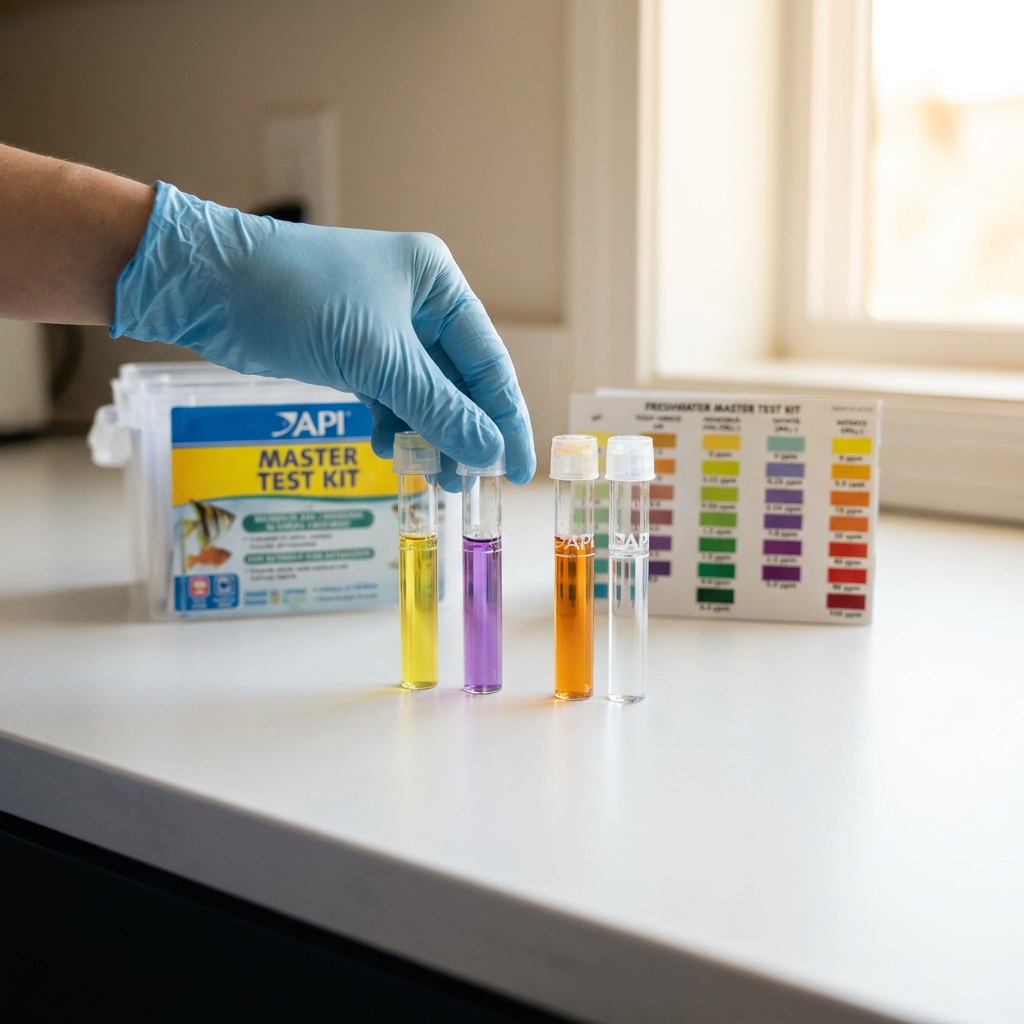
Test ammonia and nitrite every 2–3 days with a Hanna Marine HI784 Ammonia checker or Red Sea Ammonia Pro test kit (salt-calibrated). API tap-water test kits read low because the reagents are calibrated for freshwater chemistry — do not use them.
During cure: siphon die-off detritus with a turkey baster, empty the skimmer cup every 2–3 days, top off evaporation with 0 TDS RO/DI water only. Do not dose bottled bacteria on day 1 — if you dose at all, wait until day 5 when ammonia is already climbing, and use Fritz Zyme 9 or Dr. Tim's One & Only Marine at 1× dose. Do not run carbon or GFO yet — they pull ammonia out before bacteria can colonise. Do not add livestock.
Phase 2: nitrite peak and the bacterial handoff (days 14–28)
By day 14 the die-off has slowed. Ammonia should be dropping while nitrite climbs toward its peak (typically days 17–22). The chemistry matters here: as ammonia declines and pH rises, a portion of total ammonia switches from NH₄⁺ (ionised, less toxic) to NH₃ (unionised, far more toxic). At pH 8.0, NH₃ is roughly 3.5% of total ammonia; at pH 8.4 it is roughly 8.5%. Keep pH in the 8.0–8.2 band during this phase to favour the less toxic form.
Parameter targets, days 14–28:
| Parameter | Day 14 | Day 21 | Day 28 |
|-----------|--------|--------|--------|
| Ammonia | 0.5–2.0 ppm | 0.1–0.5 ppm | 0 ppm |
| Nitrite | 1.0–4.0 ppm | 2.0–8.0 ppm (peak) | 0.5–2.0 ppm |
| Nitrate | 10–25 ppm | 25–50 ppm | 30–60 ppm |
| Alkalinity | 7–8 dKH | 7 dKH | 7–8 dKH |
If alkalinity drops to 6.5–7 dKH by day 21, dose Red Sea Foundation B at half-strength to bring it back to 7.5–8 dKH. Do not dose calcium or magnesium yet — they read artificially high in a new tank and you do not need to add what is already leaching from the rock.
Around day 18–24 you may see ammonia rise again briefly. This is normal — the Nitrospira colony is establishing, and intermediate chemistry wobbles. Do not panic. Do a 10% water change with parameter-matched saltwater only if ammonia exceeds 2.0 ppm for more than 48 hours.
Phase 3: nitrate climb and the maturation tail (days 28–56)
By day 28 ammonia and nitrite should both be at 0 ppm, and nitrate should be 30–60 ppm. From here it's a maturation phase — letting bacterial colonies stabilise, letting the rock stabilise alkalinity and pH, and letting residual phosphate get bound by the rock's calcareous structure.
Parameter targets, days 28–56:
| Parameter | Day 28 | Day 42 | Day 56 |
|-----------|--------|--------|--------|
| Nitrate | 30–60 ppm | 20–40 ppm | 10–30 ppm |
| Phosphate | 0.05–0.15 ppm | 0.03–0.10 ppm | 0.02–0.05 ppm |
| Alkalinity | 7–8 dKH | 8 dKH | 8–9 dKH |
| Calcium | 380–420 ppm | 400–430 ppm | 420–440 ppm |
| Magnesium | 1250–1300 ppm | 1300–1350 ppm | 1300–1400 ppm |
Why nitrate drops on its own. In a cycled marine tank without fish, anaerobic denitrifying bacteria colonise low-flow pockets inside live rock and convert nitrate to nitrogen gas (N₂). The reaction is slow but real — expect a 30–60% nitrate drop over 4 weeks in an established, lightly stocked rock-only tank.
Bringing the reef trinity into balance. Target alkalinity 8–9 dKH (2.86–3.21 meq/L), calcium 420–440 ppm, magnesium 1,300–1,350 ppm. If magnesium is below 1,250 ppm, dose Red Sea Foundation C to bring it to 1,300 ppm before adjusting calcium or alkalinity. If you dose calcium and alkalinity first while magnesium is low, you will trigger a precipitation event and the tank will look like someone dumped milk into it.
When to add livestock — and how much
The tank is "cycled" when ammonia and nitrite are 0 ppm for 14 consecutive days and nitrate is below 20 ppm (FO/FOWLR) or below 5 ppm (reef). At that point: do a 25% water change to bring nitrate down, add cleanup crew first (10–20 Nassarius snails, 20–30 Cerith snails, 1 sand-sifting star per 100 L of sand bed, 10–15 hermit crabs of Calcinus or Clibanarius species), wait 7 days testing ammonia and nitrite daily for the first 3 days, and only then add your first fish at one fish per 75–100 L of tank volume — ocellaris clownfish, yellow assessor, royal gramma, six-line wrasse. Do not add a tang first. They require 300+ L of swimming length and an established pod population. They are not starter fish.
Test cadence and the working kit
A working lineup for the 56-day cycle: Hanna HI784 Ammonia (low range, marine-calibrated), Hanna HI764 Nitrite (Ultra Low Range), Hanna HI781 Nitrate (Low Range), Red Sea Alkalinity Pro, Red Sea Calcium Pro, Red Sea Magnesium Pro, Hanna HI736 Phosphate (Ultra Low Range). Skip 5-in-1 test strips — they read alkalinity ±2 dKH and you will chase noise.
Cadence. Days 1–14: ammonia, nitrite, alkalinity every 2–3 days. Days 15–28: ammonia, nitrite, nitrate, alkalinity every 2 days. Days 29–56: full panel weekly. After livestock: weekly for 4 weeks, biweekly to month 6, then weekly.
Troubleshooting stalls and escalation
Three common stall conditions and what they mean.
- Ammonia stuck above 2 ppm for 7+ days. Cause: under-cured rock or temperature below 22°C. Raise temperature to 26°C, dose Dr. Tim's One & Only Marine at 2×, and add a small amount of ammonium chloride (1 ppm NH₃ equivalent) to keep feeding the bacteria.
- Nitrite stuck above 4 ppm for 14+ days. Cause: pH drift or magnesium depletion. Test pH and Mg; correct alkalinity to 8 dKH and magnesium to 1,300 ppm. Nitrite conversion typically resumes within 5 days.
- Cyanobacteria bloom in week 3–5. Cause: phosphate from incompletely cured rock combined with high NO₃ and ambient room light. Siphon by hand, run GFO (Two Little Fishies PhosBan or Rowaphos) at 1 g per 40 L in a media bag, and increase skimmer draw. Do not increase lighting.
Escalate to an aquatic vet or experienced reefing consultant if you see live rock dissolving rapidly (calcium carbonate shedding), sustained pH below 7.6 or above 8.6, hydrogen sulfide smell (rotten eggs), or alkalinity stuck below 5 dKH or above 12 dKH with no recovery after dosing. These are out of scope for routine husbandry and require in-person assessment.
The honest 56-day timeline
For a 200 L saltwater system, set aside 56 days from rock-in to first cleanup crew, and another 7–14 days before the first fish. This is not slow — it is the rate at which the chemistry actually moves. Anyone promising a fully cycled reef in two weeks is selling you bottled bacteria in a bottle of marketing.
Test your water before you add anything. Then test it again tomorrow.