Cycling a new tank: the 42-day fishless cycle protocol, end to end
Before any fish touches the water of a new aquarium, the nitrogen cycle must be established. A "cycled" tank is one in which a community of nitrifying bacteria has colonised the filter media, the substrate, and every other high-surface-area surface, and is converting toxic ammonia (NH₃/NH₄⁺) into nitrite (NO₂⁻) and then into much-less-toxic nitrate (NO₃⁻) at a rate that matches the tank's bioload.
The 42-day fishless cycle is the most reliable way to get there. It is slower than some shortcuts (bacteria-in-a-bottle products can shave weeks off), but it is also more predictable, more controllable, and it does not put livestock at risk during the most dangerous phase of tank startup. This is the protocol I have used on every new freshwater setup since 2003, on everything from 20 L shrimp tanks to 25,000 L koi ponds.
What "cycling" actually means: the nitrogen cycle chemistry
The chemistry is simpler than most guides make it. Two bacterial genera do the work, in sequence:
Step 1 — Ammonia to nitrite, by Nitrosomonas spp. and related ammonia-oxidising bacteria (AOB):
$$2\,\text{NH}_3 + 3\,\text{O}_2 \xrightarrow{\text{Nitrosomonas}} 2\,\text{NO}_2^- + 2\,\text{H}^+ + 2\,\text{H}_2\text{O}$$
The AOB are slow. Under ideal conditions (pH 7.5–8.2, 28–30 °C, dissolved oxygen >6 mg/L) their doubling time is 7–10 hours. Under realistic aquarium conditions (pH 7.0, 25 °C, DO 5 mg/L) it is 14–20 hours. That is why a cycle takes weeks, not days.
Step 2 — Nitrite to nitrate, by Nitrobacter spp. and related nitrite-oxidising bacteria (NOB):
$$2\,\text{NO}_2^- + \text{O}_2 \xrightarrow{\text{Nitrobacter}} 2\,\text{NO}_3^-$$
NOB are even slower. Their doubling time is typically 18–30 hours under aquarium conditions. This is the bottleneck of the cycle, and the reason nitrite spikes and lingers for 1–3 weeks.
Why both matter:
- NH₃ (unionised ammonia) is lethal to fish at 0.02–0.05 mg/L; NH₄⁺ is far less toxic. The two species interconvert with pH and temperature.
- NO₂⁻ binds to haemoglobin and causes "brown blood disease" above 0.5 mg/L.
- NO₃⁻ is relatively harmless below 40 mg/L for freshwater fish (lower for invertebrates).
A fully cycled tank processes 2 ppm of added ammonia to <0.25 ppm nitrite and some amount of nitrate within 24 hours.
The 42-day timeline
I use a 42-day protocol because that is the conservative upper bound for a cold-start cycle at 24 °C with no seeded media. Warmer temperatures (27–30 °C) and seeded media shorten it to 21–28 days. The protocol is the same; only the timeline shifts.
Day 0 — Setup and dose.
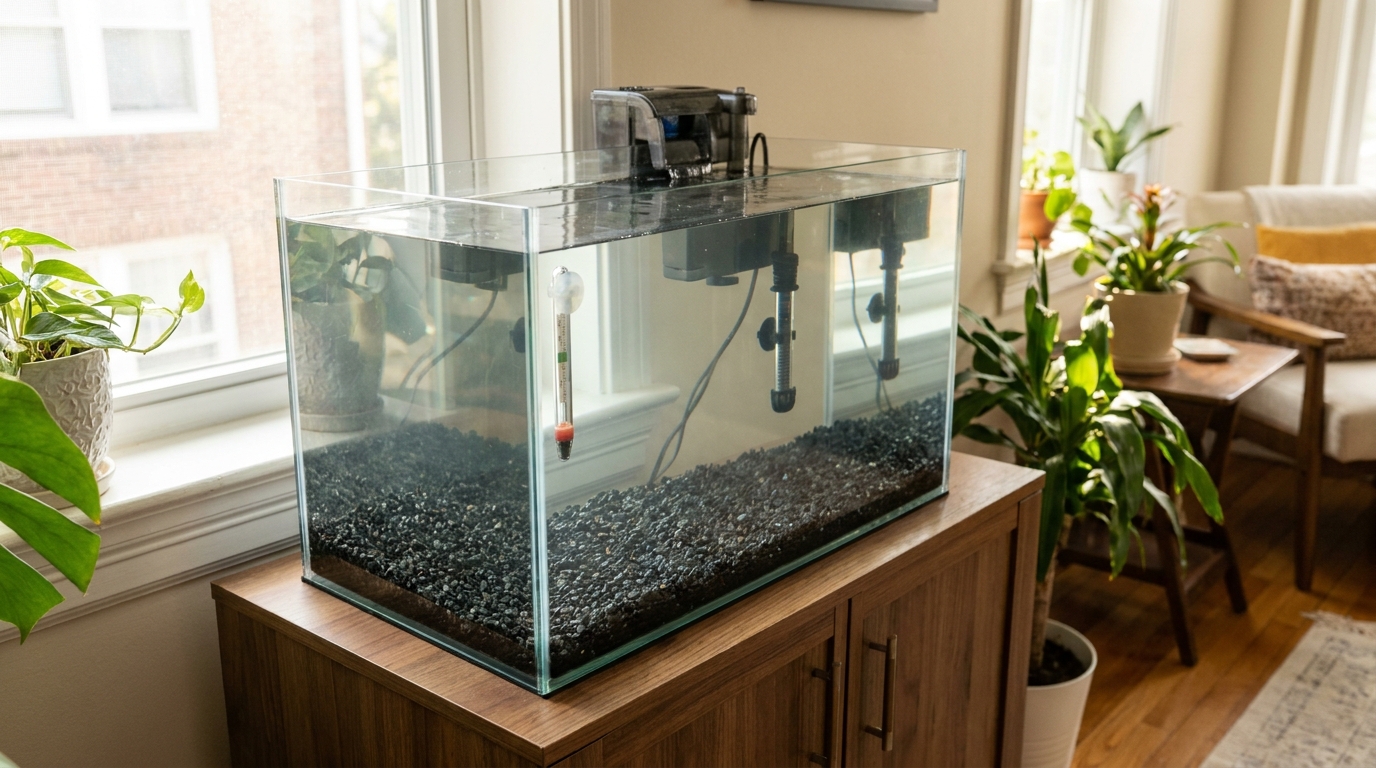
- Tank, filter, heater, substrate, decor, dechlorinated water. No fish.
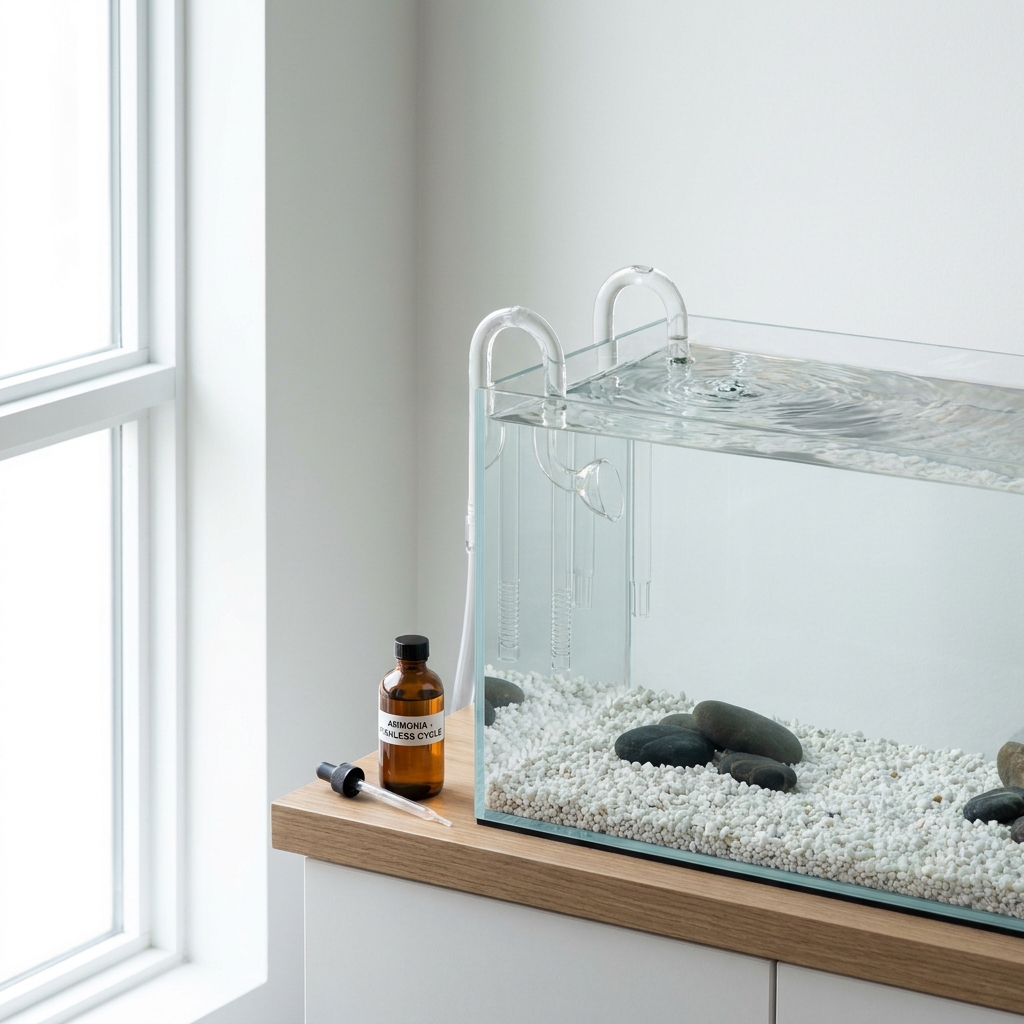
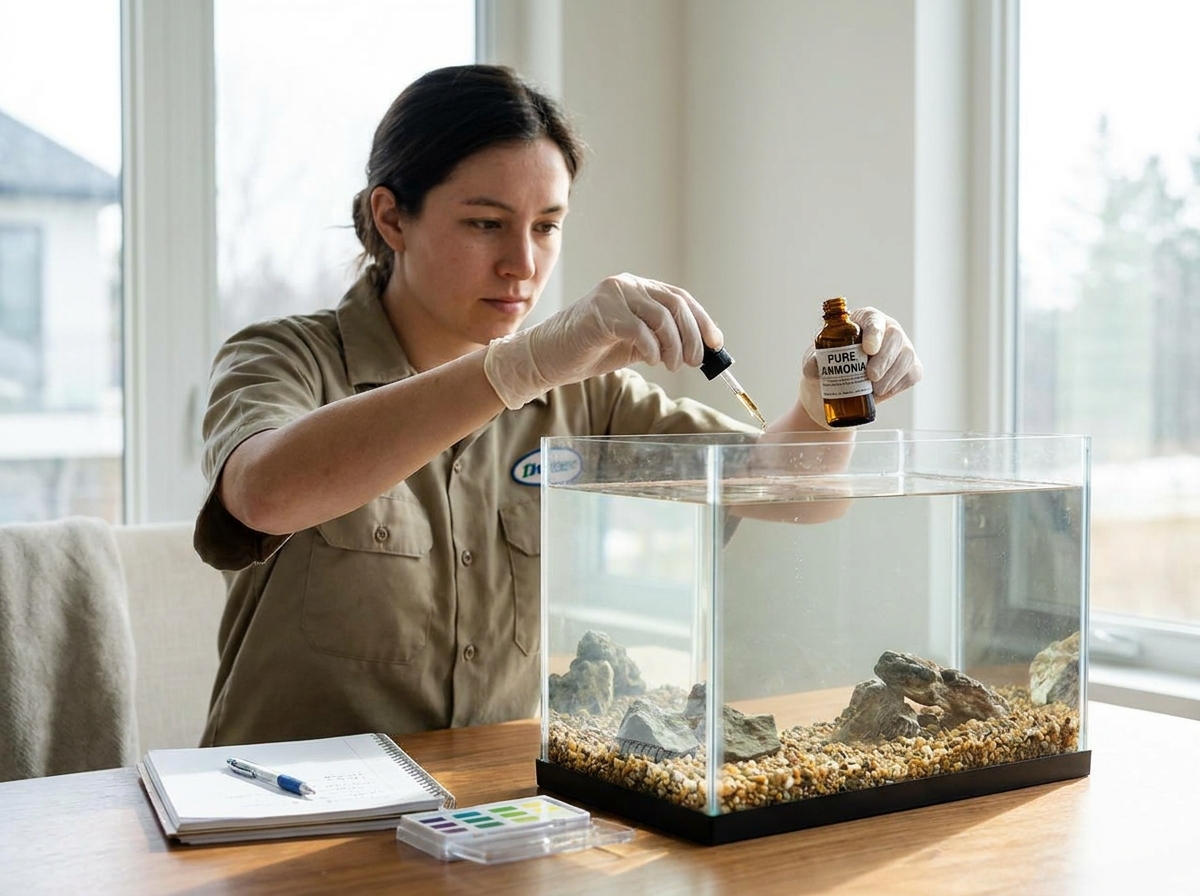
- Dose pure ammonia (no surfactants, no fragrance) to 2.0 ppm total ammonia nitrogen (TAN). Using ACE Hardware janitorial ammonia (~10% by weight, surfactant-free) or DrTim's Ammonium Chloride solution, this is roughly 4–5 mL per 100 L for the janitorial product.
- Optional: dose a bacteria starter now (see brands below) to seed the cycle. It does not skip the cycle but it can cut 1–2 weeks.
- Set temperature to 27 °C. Set pH to 7.5–8.0 with crushed coral in the filter if your tap is below 7.0. AOB and NOB both work best in this range.
Day 1–7 — Ammonia phase.
- Test ammonia daily. Dose back up to 2.0 ppm every time it drops below 1.0 ppm. This is the food that drives AOB growth.
- Nitrite will start appearing around day 4–6 as AOB colonies establish.
- Nitrate will follow nitrite by 2–4 days.
Day 8–21 — Nitrite phase.
- Continue dosing ammonia to 2.0 ppm every time it drops below 1.0 ppm.
- Nitrite will spike, often to 5+ ppm, and stay high. This is normal and expected.
- Add 1 tbsp/100 L of aquarium salt (NaCl) to protect any future fish from nitrite poisoning. The chloride ions competitively inhibit nitrite uptake at the gills. If you are cycling a planted tank, dose chloride as potassium chloride (KCl) instead to avoid sodium buildup.
Day 22–35 — Maturation phase.
- Nitrite begins falling. By day 28–35, a 2 ppm ammonia dose should clear to <0.25 ppm nitrite within 24 hours.
- Continue dosing ammonia to 2.0 ppm every 48 hours until the tank can process 2 ppm to <0.25 ppm nitrite AND <20 ppm nitrate in 24 hours.
Day 36–42 — Final confirmation.
- Stop dosing ammonia for 48 hours.
- Test on day 38: ammonia 0, nitrite 0, nitrate some amount (10–40 ppm typical).
- Test on day 40: same.
- The cycle is complete. Do a 30–50% water change to bring nitrate below 20 ppm before adding fish.
If on day 42 the tank still shows nitrite above 0.5 ppm 24 hours after a 2 ppm ammonia dose, give it another week. Do not add fish yet.
Equipment and consumables
You need exactly six things to run this protocol:
| Item | Purpose | Recommended brands |
|---|---|---|
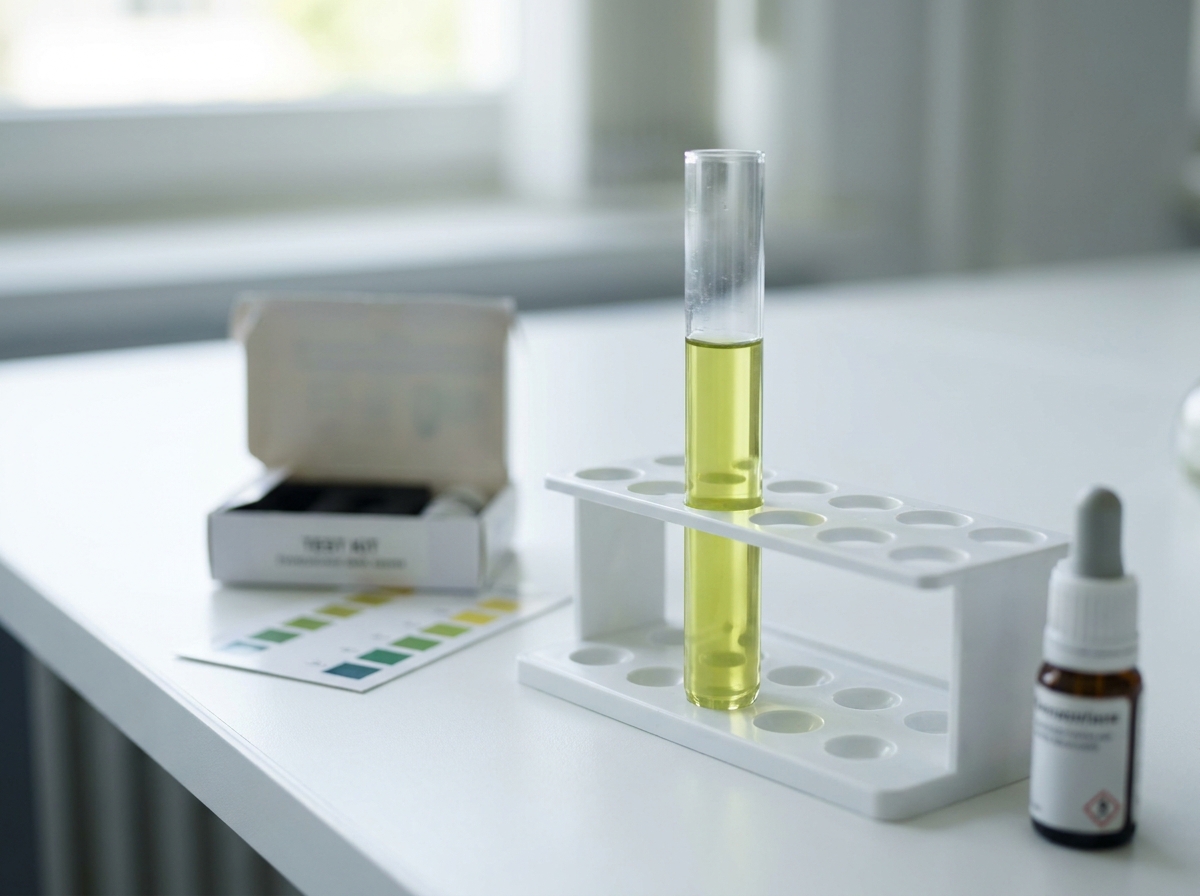
| Liquid test kit (NH₃/NO₂/NO₃) | Daily parameter measurement | API Freshwater Master Test Kit (≈USD 25), Red Sea Marine Care (also covers freshwater), NT Labs |
| Pure ammonia | Bacterial food | DrTim's Ammonium Chloride (purpose-made), ACE Hardware janitorial ammonia (must be surfactant-free — shake the bottle, if it foams, do not use it) |
| Water conditioner | Remove chlorine/chloramine that kills bacteria | Seachem Prime, API Tap Water Conditioner, Fritz Aquatics Complete |
| Bacteria starter (optional but recommended) | Seed AOB and NOB colonies | Seachem Stability, DrTim's One & Only, Tetra SafeStart Plus, FritzZyme 7 |
| Heater | Hold 27 °C | EHEIM Jager, Fluval E, Cobalt Aquatics Neo-Therm |
| Salt (NaCl or KCl) | Nitrite protection | Aquarium salt (API, Seachem) or potassium chloride (if planted) |
You do not need a bacteria starter to cycle a tank. The AOB and NOB are present in air, on your hands, on decor — they will colonise eventually. But a starter can shorten the cycle by 7–14 days and gives more predictable results. I dose Seachem Stability every other day for the first 21 days on every new setup I build.
Reading the test results
A typical healthy cycle looks like this in test numbers (API Freshwater Master Test Kit, mg/L or ppm):
| Day | Ammonia (NH₃/NH₄⁺) | Nitrite (NO₂⁻) | Nitrate (NO₃⁻) | What's happening |
|---|---|---|---|---|
| 0 | 2.0 | 0 | 0 | Dosed, no bacteria yet |
| 7 | 1.0 | 0.5 | 5 | AOB starting |
| 14 | 2.0 (re-dose) | 5.0 | 20 | AOB strong, NOB lagging |
| 21 | 2.0 (re-dose) | 2.0 | 40 | NOB catching up |
| 28 | 2.0 (re-dose) | 0.5 | 40 | Both colonies mature |
| 35 | 2.0 (re-dose) | 0.25 | 40 | Cycle nearly complete |
| 42 | 0 (no dose) | 0 | 20 | Cycle complete, do water change |
If you see the column for nitrite at day 35 still above 1.0 ppm, the cycle is not done. The most common reasons are:
- pH below 7.0 (AOB and NOB slow dramatically below 6.8)
- Temperature below 22 °C (NOB nearly stop below 20 °C)
- Chloramine or chloramine-derivative in the water (some conditioners do not fully neutralise chloramine without binding the ammonia; that ammonia is food, but it also spikes the test reading)
- Insufficient oxygen (AOB and NOB are aerobic; surface agitation and air stones help)
Common mistakes that stall the cycle
These five mistakes account for 90% of failed cycles I see:
1. Adding fish "to cycle the tank." This is "fish-in cycling," and it works, but it subjects the fish to weeks of measurable NH₃ and NO₂ exposure. Most of those fish develop gill damage, immune suppression, or die. Do not put fish in an uncycled tank. Period.
2. Underdosing ammonia. A common beginner assumption is that a "pinch" of food will cycle the tank. It will, but the resulting bacterial colony is sized for a pinch of food per day — not for fish. When you add fish, the colony is overwhelmed and you get an ammonia spike. Dose 2 ppm continuously to grow a colony sized for a real bioload.
3. Letting the pH crash. The nitrification reaction releases H⁺ (see the equation above). In a tank with low KH (carbonate hardness), the pH falls as the cycle progresses. Below 6.5, AOB and NOB nearly stop. Maintain KH ≥4 dKH with crushed coral, aragonite, or potassium bicarbonate dosing.
4. Filter media changes during cycling. Do not rinse or replace filter media during the 42-day cycle. The bacteria you are growing live on the media. If the media clogs, rinse it gently in tank water (not tap water — chlorine kills the bacteria) and put it back.
5. Over-cleaning. Do not do large water changes during the cycle. The ammonia you are dosing is the food. The nitrite and nitrate are progress markers, not problems to fix. Do not gravel-vacuum, do not rinse decor, do not replace filter media. Let the bacteria establish undisturbed.
Adding fish at the end of the cycle
When the tank can process 2 ppm ammonia to 0 ppm ammonia + 0 ppm nitrite within 24 hours, you are ready for fish. Add them slowly:
- Week 1: add 25% of the planned stocking (e.g., a 200 L tank planned for 40 neon tetras = add 10 this week)
- Week 2: add another 25%
- Week 3: add another 25%
- Week 4: add the final 25%
Test ammonia and nitrite every other day for the first 4 weeks of stocking. If you see ammonia above 0.25 ppm or nitrite above 0.5 ppm at any point, stop adding fish, do a 25% water change, and wait for the readings to drop before continuing.
The bottom line
The 42-day fishless cycle is the foundation of every healthy freshwater aquarium. The chemistry is straightforward: AOB convert NH₃ to NO₂⁻, NOB convert NO₂⁻ to NO₃⁻, both work best at pH 7.5–8.0 and 27–30 °C, and both grow slowly enough that the process takes 4–6 weeks under realistic conditions. The protocol is: dose 2 ppm ammonia, test daily, dose back up to 2 ppm as it drops, wait for nitrite to rise and then fall, confirm at day 42, water change, then add fish gradually. Brands that work reliably: API Master Test Kit for testing, Seachem Prime for dechlorination, DrTim's or Seachem Stability for bacteria seeding, and pure ammonium chloride or surfactant-free janitorial ammonia for the food source. Avoid the five common mistakes — adding fish, underdosing, pH crashes, media changes, over-cleaning — and the cycle will complete. The fish you add on day 42 will thank you for the next 5–10 years.
---
About the author: [Kenji Tanaka](../Kenji%20Tanaka.md) is a ZNA-certified koi judge with 25 years of freshwater ornamental fish research, and has served on the judging panel of the All Japan Nishikigoi Show on multiple occasions.