

The pack alpha theory: where it comes from, why it is wrong, and what to do instead
The pack alpha theory — the idea that dogs are constantly trying to "dominate" their owners, that the owner has to be the "alpha" to maintain control, and that misbehavior is a "dominance challenge" — is the most persistent myth in dog training. It is also the most harmful. The theory is based on a study of captive wolves from the 1940s that has been thoroughly debunked, but the theory is still taught by trainers who have not updated their knowledge and it is still applied by owners who have been told that their dog is "trying to dominate them." In this article I will walk through where the theory actually comes from, what the original researcher (Dr. L. David Mech) has said about it since, what wild wolf packs actually look like, and what the right framework for understanding dog behavior is.
Where the theory comes from
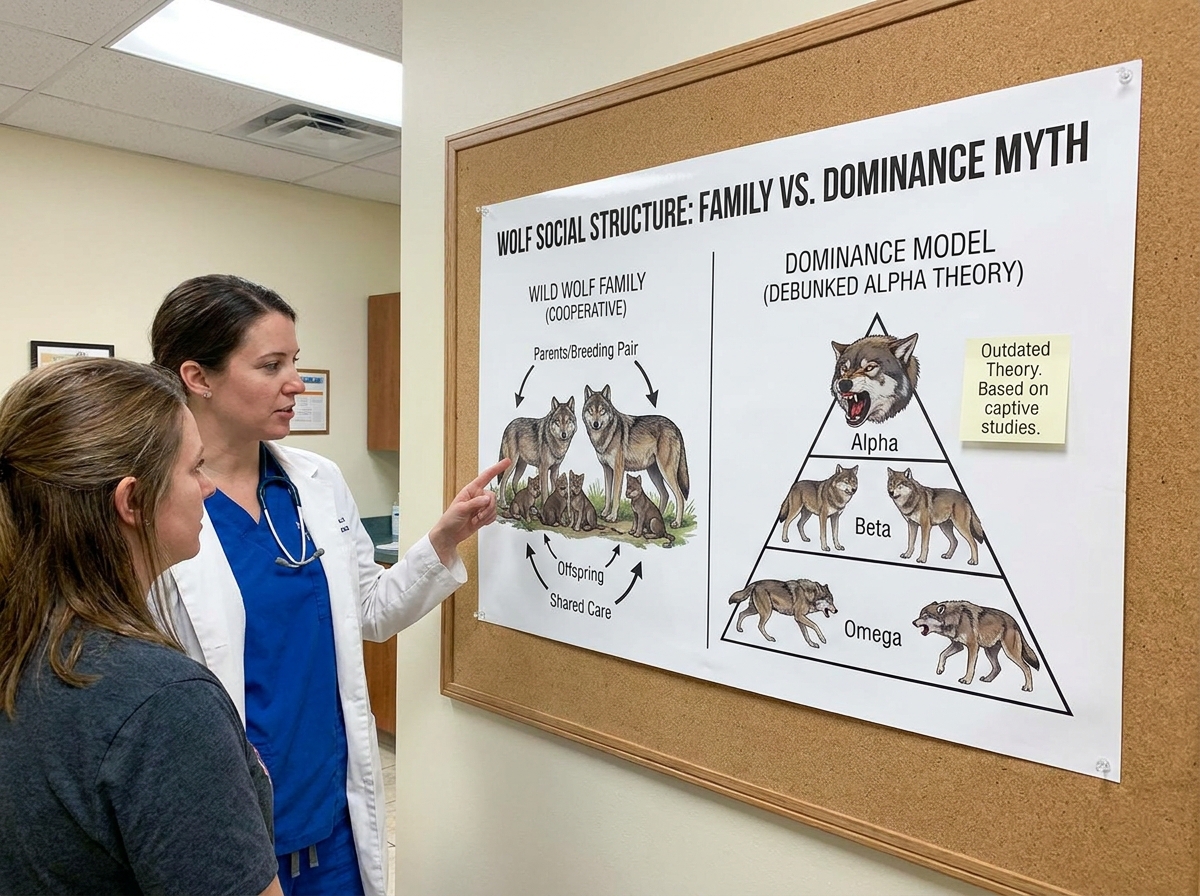
The pack alpha theory comes from a 1947 study by Dr. Rudolph Schenkel, published as "Expression Studies on Wolves: Captivity Observations." The study observed a group of wolves in the Basel Zoo in Switzerland. The wolves were unrelated — they had been placed together in an enclosure that was not their natural environment, and they formed a dominance hierarchy in which one wolf (the "alpha") controlled the others through aggression. The study was widely cited as describing wolf pack structure in the wild.
In 1999, Dr. L. David Mech — the world's leading wolf researcher and one of the most cited wildlife biologists in history — published a paper that directly contradicted the Schenkel study. Mech's research on wild wolf packs in Ellesmere Island (and replicated by multiple other researchers since) showed that wild wolf packs are not structured around alpha-wolf dominance. Wild wolf packs are families — a breeding pair and their offspring from previous years. The "alpha" is not a wolf that fought its way to the top; the "alpha" is the parent. The "subordinates" are not wolves that have submitted; they are the older offspring that are staying with the family to help raise the next litter.
Mech has spent the last 25 years asking the scientific community to stop using the term "alpha wolf" because it is incorrect. He has specifically asked dog trainers to stop applying the term to domestic dogs, because the application is even more incorrect. The trainer who is still teaching the pack alpha theory is teaching a theory that the original researcher himself has said is wrong.
What the theory got wrong
The theory got the wolf pack wrong. It also got the domestic dog wrong. The domestic dog is not a wolf — it is a separate species that diverged from the wolf 15,000-40,000 years ago, and the dog's social structure is not the wolf's social structure. Dogs are scavengers that have adapted to living alongside humans; they are not pack hunters in the wolf sense, and they do not form the family-style social structure that wild wolves do. The dog that is misbehaving in the home is not trying to "dominate" the owner; the dog is doing whatever the dog has learned to do to get what the dog wants.
The "dominance" framework leads to three specific training errors. The first is the "alpha roll" — physically forcing the dog onto its back to assert dominance. The alpha roll is not a wolf behavior; wolves do not roll each other. The alpha roll is a dominance-based technique that produces a dog that has either been physically overwhelmed (and may bite in self-defense) or has learned to fear the owner. The second is the "eat before your dog" rule — eating first to assert dominance. Wolves do not eat in order of rank; they eat when food is available. The "eat before your dog" rule is a misinterpretation of the original theory. The third is the "walk through the door first" rule — walking through the door first to assert rank. The dog that rushes the door is a dog that has not been taught an alternative behavior; the dog is not trying to "dominate" the owner.
What the right framework is
The right framework for understanding dog behavior is the operant conditioning framework, which is the framework that has 80 years of experimental support and that explains the actual mechanisms of dog behavior. The operant conditioning framework says: behavior is shaped by its consequences. Behavior that is rewarded is repeated. Behavior that is punished (in the technical sense — making the behavior less likely to happen) is decreased. The dog that is doing an unwanted behavior is a dog that has learned that the behavior produces a reward (attention, food, access to something the dog wants, escape from something the dog does not want). The dog that is doing a wanted behavior is a dog that has learned that the behavior produces a reward.
The framework is not about rank or dominance. The framework is about what the dog has learned. The dog that jumps on guests is a dog that has learned that jumping produces attention (even negative attention is a reward for a dog that is starved for attention). The dog that pulls on the leash is a dog that has learned that pulling produces forward movement. The dog that steals food from the counter is a dog that has learned that the counter is a source of high-value food. The owner who addresses the behavior as "the dog is trying to dominate" is an owner who is addressing the wrong cause. The owner who addresses the behavior as "the dog has learned that this behavior produces a reward" is an owner who is addressing the actual cause.
The framework is also not about being permissive. The framework is about being clear. The dog needs to know which behaviors are rewarded and which behaviors are not. The owner who is clear is the owner who rewards the wanted behaviors consistently and ignores or redirects the unwanted behaviors. The dog that is being raised with this clarity is the dog that is confident, secure, and well-behaved. The dog that is being raised with the "alpha" framework is the dog that is being subjected to inconsistent corrections based on a theory that is not true.
What the actual evidence says about dog-dog relationships
The dog that is misbehaving with other dogs is a dog that is not trying to "dominate" the other dog. The dog is doing what the dog has learned to do to get what the dog wants. The dog that resource-guards food is a dog that has learned that humans (and other dogs) take food away. The dog that is aggressive to other dogs on leash is a dog that has learned that other dogs at close range are a source of frustration. The dog that is aggressive to other dogs off-leash is a dog that has learned that aggression makes the other dog go away. Each of these behaviors has a learning history, and each can be addressed with a learning-based intervention.
The dog that is well-socialized with other dogs — exposed to a wide variety of well-behaved dogs during the 3-16 week socialization window, with positive experiences — is the dog that has friendly relationships with other dogs. The dog that is not well-socialized is the dog that has fearful or aggressive relationships. The cause of the dog's relationships with other dogs is not "dominance" — the cause is socialization and learning.
What to do with a trainer who still teaches the alpha theory
The trainer who is still teaching the alpha theory in 2025 is a trainer who has not updated their knowledge in 25+ years. The trainer who is teaching alpha rolls, eat-before-your-dog, and dominance-based corrections is a trainer who is teaching techniques that are based on a theory that has been debunked by the original researcher. The owner who is working with such a trainer has two options: ask the trainer to update their approach, or find a different trainer.
The trainer who is using positive reinforcement and operant conditioning is a trainer who is using techniques that are evidence-based and that produce results without the side effects of the dominance approach. The certification bodies that require evidence-based methods are the Certification Council for Professional Dog Trainers (CCPDT) and the International Association of Animal Behavior Consultants (IAABC). A trainer with one of these certifications is a trainer who is committed to evidence-based methods.
The one-page summary
The pack alpha theory is wrong. The original research was on captive wolves that had nothing to do with wild wolf packs, and the original researcher (Dr. L. David Mech) has spent 25 years asking the scientific community to stop using the term. The domestic dog is not a wolf; the dog's social structure is not the wolf's. The right framework for understanding dog behavior is operant conditioning — behavior is shaped by its consequences, and the dog is doing whatever the dog has learned to do. The owner who applies this framework is the owner who gets the right diagnosis of the behavior problem and the right intervention. The owner who applies the alpha framework is the owner who gets the wrong diagnosis and the wrong intervention. The science has been settled. The training community is catching up. The owner is the one who has to choose.

The honest summary
The pack alpha theory is 80 years out of date, was based on a study of captive wolves, has been debunked by the original researcher, and does not apply to domestic dogs. The right framework is operant conditioning. The right approach is positive reinforcement. The right certification is from an evidence-based body. The owner who knows this is the owner who is not going to be sold a 1990s dominance-based training package by a trainer who has not updated their knowledge.