
The pack alpha theory: where it comes from, why it's wrong, and what to actually do instead
The "you must be the alpha" advice is everywhere. Television trainers tell owners to "be the pack leader". YouTube videos teach dogs to "submit to the alpha". Dog training books sell the concept of dominating the dog. The advice has been repeated so many times that it feels like common sense. The dog is a wolf. The wolf pack has an alpha. The dog owner must be the alpha.
The theory is wrong. The original wolf research that gave rise to the alpha theory was on captive wolves who had been put together artificially, not on wild wolf packs. The wild wolf pack is a family — a breeding pair and their offspring — not a dominance hierarchy. The dog is not a wolf, and even if it were, the alpha model doesn't apply.
The good news: modern dog training has moved beyond the alpha model. The dogs that are trained with positive reinforcement are the dogs that thrive. The dogs that are trained with dominance and punishment are the dogs that develop fear, anxiety, and aggression.
This is the history of the alpha theory, the science that debunked it, and the practical training that actually works.
The origin: Rudolf Schenkel, 1947
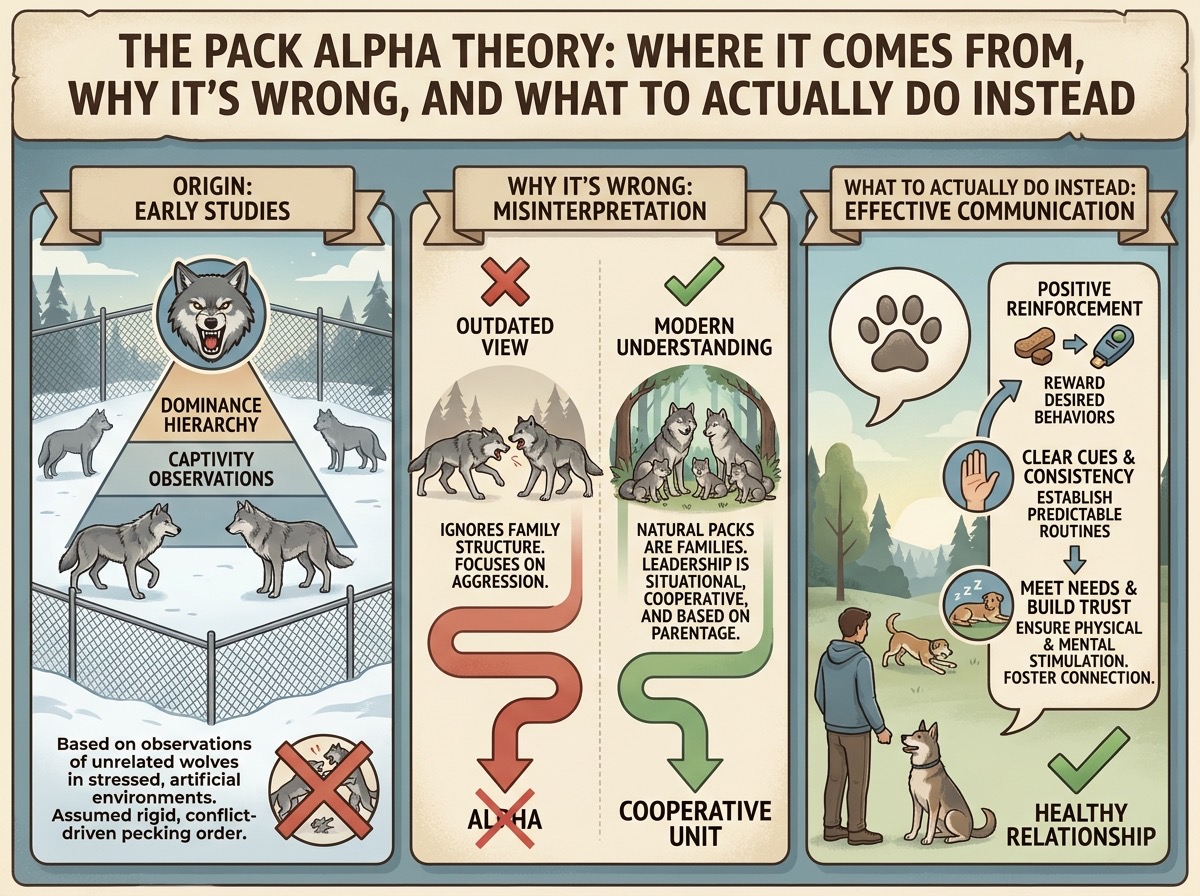
The alpha theory originated with Rudolf Schenkel, a Swiss animal behaviourist who published a paper in 1947 titled "Expressions Studies on Wolves" (Ausdrucks-Studien an Wölfen). The paper described the social behaviour of captive wolves in the Basel Zoo. Schenkel observed that the wolves in the zoo formed a hierarchy with a dominant "alpha" wolf at the top and subordinate wolves below.
The key word: captive. The wolves in the Basel Zoo were not a natural pack. They were unrelated wolves who had been put together in an enclosure. Their behaviour was not normal wolf pack behaviour — it was the behaviour of animals in an artificial social environment.
Schenkel observed dominance displays, food guarding, and ritualised aggression. He interpreted these as "pack structure". The interpretation was reasonable at the time, but the conclusion was wrong. The wolves were behaving abnormally because they were in an abnormal social environment.
The wolf research that changed everything: David Mech, 1999
David Mech is one of the world's leading wolf researchers. In the 1960s, he studied captive wolf packs and wrote the book "The Wolf: Ecology and Behavior of an Endangered Species" (1970), which cited Schenkel's work and reinforced the alpha model. The book became a standard reference.
But Mech's later research, beginning in the 1980s and culminating in his 1999 paper "Alpha Status, Dominance, and Division of Labor in Wolf Packs", changed his mind. Mech had been studying wild wolf packs on Ellesmere Island in the Canadian Arctic. The wild wolf packs were family units: a breeding pair (the parents) and their offspring (the pups of previous years). The "alpha" wolves were simply the parents. The pack wasn't a dominance hierarchy — it was a family.
Mech's later work explicitly disavowed the alpha model:
"The prevailing view of a wolf pack as a group of animals ever arranged in a linear dominance hierarchy with a clear 'alpha' wolf at the top is incorrect. Rather, a wolf pack is, in almost every case, a family, with a breeding pair at its head."
The alpha model was based on captive wolf studies, not wild wolf packs. The wolves in the wild are not in a dominance hierarchy. They are a family.
The science of the wolf pack
The modern understanding of the wild wolf pack, based on decades of field research:
- Pack size: typically 4-12 wolves. Larger packs are unusual
- Pack composition: a breeding pair (the parents), their offspring from previous years, and the current year's pups
- Breeding rights: only the dominant pair breeds. The subordinate wolves are the offspring from previous years, and they don't breed while in the pack
- Cooperation: pack members cooperate in hunting, pup-rearing, and territory defense
- Social bonds: the pack members are closely related (parents, offspring, siblings). The bonds are based on family, not on dominance
- Leadership: the breeding pair leads the pack during hunts and movements. The leadership is based on experience and pair-bonding, not on aggression or dominance
The "alpha" wolf is the parent. The "subordinate" wolves are the grown offspring. The pack is a family.
The application to dogs
The wolf-dog connection is often overstated. The dog (Canis lupus familiaris) is descended from the wolf, but the dog has been domesticated for 15,000-40,000 years. The dog is not a wolf. The dog's behaviour is different from the wolf's in many ways:
- Dogs are more tolerant of strangers (humans and other dogs)
- Dogs are more playful as adults
- Dogs have a longer juvenile period
- Dogs are more dependent on humans
- Dogs have different vocalisations
Even if the dog were a wolf, the alpha model would not apply, because wild wolf packs are not dominance hierarchies.
Even if the alpha model applied to wolves, it wouldn't apply to dogs.
The "dominance theory" of dog training
The dominance theory of dog training emerged in the 1970s-1980s, drawing on the alpha model. The theory:
- Dogs see the human owner as part of their "pack"
- The dog is constantly trying to become the "alpha"
- The owner must establish dominance over the dog
- The methods: alpha rolls, scruff shakes, eating before the dog, walking through doors first, sleeping in higher positions
These methods are widely taught, often by television personalities and old-school trainers. The methods are based on a model that has been discredited.
The dominance theory of dog training has been formally disavowed by the major veterinary behaviour organisations:
- AVSAB (American Veterinary Society of Animal Behavior) published a position statement in 2008 formally rejecting dominance theory
- APBC (Association of Pet Behaviour Counsellors) in the UK has published similar statements
- CAAB (Certified Applied Animal Behaviourists) and DACVB (board-certified veterinary behaviourists) all reject dominance-based training
The science is settled: dominance theory is wrong.
Why the dominance methods persist
The dominance theory persists despite the science. The reasons:
The "common sense" appeal
The theory sounds reasonable. The dog is a wolf. Wolves have alphas. The owner must be the alpha. The logic is simple. The owner wants a simple framework. The theory provides one.
The "results" that appear to work
The dominance methods sometimes appear to work in the short term. The owner pins the dog on its back (the "alpha roll") and the dog stops resisting. The owner eats before the dog, and the dog stops begging. The owner walks through the door first, and the dog stops pulling.
The "results" are not what they seem. The dog is not "submitting". The dog is freezing out of fear. The dog stops the unwanted behaviour because the dog is afraid. The fear-based compliance is not the same as the willing cooperation that the owner thinks they're seeing.
The owner who uses dominance methods is training a dog that is afraid of the owner. The dog may obey, but the dog is not happy. The dog may develop fear-based aggression (biting out of fear), anxiety, and stress behaviours.
The "echo chamber" effect
The dominance methods are taught by some trainers, endorsed by some celebrities, and reinforced in owner communities. The owner who hears the methods from multiple sources assumes they must be correct. The owner who questions the methods is told they are "making excuses for the dog" or "letting the dog walk all over them".
The echo chamber is hard to break. The owner who uses dominance methods is surrounded by other people who use dominance methods. The methods are reinforced by the community.
The "naturalness" appeal
The dominance methods are presented as "natural" — what wolves do in the wild. The naturalness appeal is powerful. The owner wants to do what's right for the dog. The owner thinks the dominance methods are natural.
But the methods are not natural. Wild wolf packs are families, not dominance hierarchies. The methods are based on a misreading of wolf behaviour and an outdated understanding of dog behaviour.
The "behaviour problems are not dominance problems"
A critical insight: most dog behaviour problems are not dominance problems. The behaviours that owners attribute to "the dog trying to be alpha" are usually:
Behaviour problem 1: pulling on the leash
Owner attribution: the dog is trying to lead the pack
Actual cause: the dog hasn't been taught to walk on a loose leash. Pulling is a self-reinforcing behaviour (the dog gets where it wants faster by pulling)
Solution: leash training with positive reinforcement. Reward the dog for walking on a loose leash. Don't pull back on the leash (pulling back reinforces the pulling)
Behaviour problem 2: jumping on guests
Owner attribution: the dog is dominant, greeting at the human level
Actual cause: the dog has been inadvertently rewarded for jumping (with attention, even negative attention)
Solution: reward the dog for sitting when guests arrive. Don't pet or push the dog when the dog is jumping. The jumping stops within 1-2 weeks
Behaviour problem 3: resource guarding
Owner attribution: the dog is dominant, claiming resources
Actual cause: the dog has learned that humans will take away the resource. The guarding is fear-based
Solution: counter-conditioning and desensitisation. Teach the dog that humans approaching the resource = good things happen (more food, not less). Don't take the resource away by force
Behaviour problem 4: not listening to commands
Owner attribution: the dog is being defiant, dominant
Actual cause: the dog hasn't learned the commands well, the distractions are too high, or the commands are not rewarding
Solution: train the commands in low-distraction environments first, then gradually increase distractions. Use high-value rewards. Make the commands rewarding for the dog
Behaviour problem 5: reactive to other dogs
Owner attribution: the dog is being dominant, asserting itself
Actual cause: the dog is afraid, anxious, or over-aroused. The behaviour is fear-based or frustration-based
Solution: behaviour modification with a positive reinforcement trainer. Counter-conditioning and desensitisation. Address the underlying anxiety, not the dominance
The training methods that work
The training methods that are supported by modern science:
Positive reinforcement
The most effective and humane training method. The dog is rewarded for the desired behaviour. The reward can be food, play, praise, or anything the dog finds reinforcing.
The principles:
- Reward the behaviour you want (the dog repeats the behaviour)
- Don't reward the behaviour you don't want (the behaviour decreases)
- Be consistent (the dog learns faster)
- Use high-value rewards for new behaviours (the dog is motivated)
Negative punishment (the removal of something the dog wants)
An effective method when used correctly. The dog is performing the unwanted behaviour, and the consequence is the removal of something the dog wants (attention, access to a resource, freedom to move).
The principles:
- Remove the reward for the unwanted behaviour
- Add a reward for the desired behaviour
- Be consistent (the dog learns faster)
Example: the dog jumps on guests. The guests turn away (remove attention) when the dog jumps. The dog sits. The guests turn back and pet the dog (add attention). The dog learns that sitting = attention, jumping = no attention.
Negative reinforcement (the removal of something the dog doesn't want)
Less commonly used alone. The dog is performing the behaviour to avoid the unpleasant stimulus. Examples: a head halter that tightens when the dog pulls (the dog stops pulling to avoid the tightening).
This method is controversial. It can be effective when used carefully, but it's often confused with positive punishment.
Positive punishment (the addition of something unpleasant)
The least effective and most harmful method. The dog is performing the behaviour, and the consequence is the addition of something unpleasant (a shock, a collar correction, a verbal reprimand, a physical correction).
The principles:
- Suppress the behaviour through fear or pain
- Side effects: fear, anxiety, aggression, broken trust
Most modern trainers and behaviourists strongly discourage positive punishment. The side effects are significant and the long-term outcomes are poor. Dogs trained with positive punishment can develop fear-based aggression (biting out of fear), anxiety, and a breakdown of the relationship with the owner.
The "alpha rolls" and other harmful methods
Specific methods to avoid:
Alpha rolls (force the dog onto its back)
The most common dominance-based method. The owner pins the dog on its back, in the "submission" position. The dog is forced into a vulnerable posture.
The reality: alpha rolls are not what wolves do. Wild wolves do not roll other wolves onto their backs to dominate them. Alpha rolls are based on a misreading of wolf behaviour.
The harm: alpha rolls are scary and painful to dogs. The dog may bite out of fear. The dog may develop aggression. The dog may shut down (stop responding to the owner at all). The dog does not "submit" — the dog freezes out of fear.
Scruff shakes (grab the dog by the scruff and shake)
The mother dog grabs puppies by the scruff to carry them. The dominance trainers extended this to adult dogs.
The reality: mother dogs stop scruff-grabbing puppies when the puppies are weaned. Adult dogs do not scruff-grab each other as a dominance display.
The harm: scruff shakes can cause neck injuries, fear, and aggression. Most trainers have abandoned this method.
Eating before the dog
The owner eats in front of the dog, then feeds the dog afterward. The theory: the owner is demonstrating access to the resource.
The reality: eating before the dog has no effect on the dog's behaviour. The dog doesn't connect the owner's meal with the dog's meal.
The harm: none directly, but it's a wasted effort that reflects a misunderstanding of dog behaviour.
Walking through doors first
The owner enters the door before the dog. The theory: the alpha enters first.
The reality: walking through doors first has no effect on the dog's behaviour.
The harm: none directly, but it's a wasted effort.
Sleeping in higher positions
The owner sleeps on the bed; the dog sleeps on the floor. The theory: the alpha sleeps higher than the subordinates.
The reality: sleeping position has no effect on the dog's behaviour. Many dogs sleep in elevated positions (chairs, couches, dog beds) without any "dominance" interpretation.
The harm: the dog is denied the comfort of sleeping near the owner. The dog may be more anxious, less bonded, more likely to develop behaviour problems.
Stare-downs (stare the dog into submission)
The owner stares at the dog until the dog looks away. The theory: the alpha uses eye contact to dominate.
The reality: staring at a dog is a threat. The dog may look away to avoid the threat, but the dog is also stressed, fearful, and potentially ready to bite.
The harm: staring can trigger fear-based aggression. The dog may bite to make the threat stop.
The "what to actually do" framework
For the owner who has been using dominance methods or who is starting fresh:
Step 1: drop the dominance framework
Stop thinking in terms of "alpha" and "submission". The dog is not trying to be alpha. The dog is a social animal that wants to be safe, comfortable, and connected to the owner.
Step 2: identify the actual cause of the behaviour problem
What is the dog trying to accomplish? What is the dog afraid of? What does the dog want? The behaviour problem usually has a rational cause from the dog's perspective.
Step 3: use positive reinforcement to teach the desired behaviour
Reward the dog for the desired behaviour. The dog repeats the behaviour. The unwanted behaviour decreases as the desired behaviour replaces it.
Step 4: avoid punishment-based methods
Positive punishment, dominance corrections, scruff shakes, alpha rolls — these are all harmful and ineffective in the long term. The science is clear. The relationships are damaged. The behaviours get worse, not better.
Step 5: consult a positive reinforcement trainer or behaviourist
For behaviour problems that don't resolve with self-training, consult a professional who uses positive reinforcement. A CAAB, a DACVB, or a CPDT-KA trainer with positive reinforcement methodology.
Step 6: be patient
The dog learns at its own pace. The dominant method produces quick but fragile changes. The positive reinforcement method produces slower but deeper changes. The investment in time pays back in a dog that is willing, not just compliant.
The bottom line
The alpha theory is wrong. The original wolf research was on captive wolves, not on wild wolf packs. The wild wolf pack is a family, not a dominance hierarchy. The dog is not a wolf, and the alpha model doesn't apply even if it were. The dominance theory of dog training has been discredited by the major veterinary behaviour organisations. The methods based on the theory (alpha rolls, scruff shakes, eating before the dog, etc.) are ineffective and harmful. The dogs that are trained with these methods develop fear, anxiety, and aggression. The dogs that are trained with positive reinforcement develop confidence, willingness, and trust. The owner who understands the science uses positive reinforcement. The owner who doesn't understand the science uses dominance and wonders why the dog bites. The science is settled. The methods are established. The result is a dog that wants to cooperate, not a dog that is forced to comply.
---
About the author: [Marcus Whitfield](../Marcus%20Whitfield.md) is a Certified Applied Animal Behaviourist (CABC) and MS in Animal Behaviour from the University of Edinburgh, with 16 years of clinical practice focused on canine fear, aggression, and anxiety disorders.