
Dog aggression: a danger-level classification and what to do at each tier
The dog growls at the postman. The dog lunges at other dogs. The dog bit the groomer. The dog bit the child. These are not the same problem, and they don't deserve the same response. Some aggression is normal canine communication. Some aggression is severe enough that the dog cannot safely live with people.
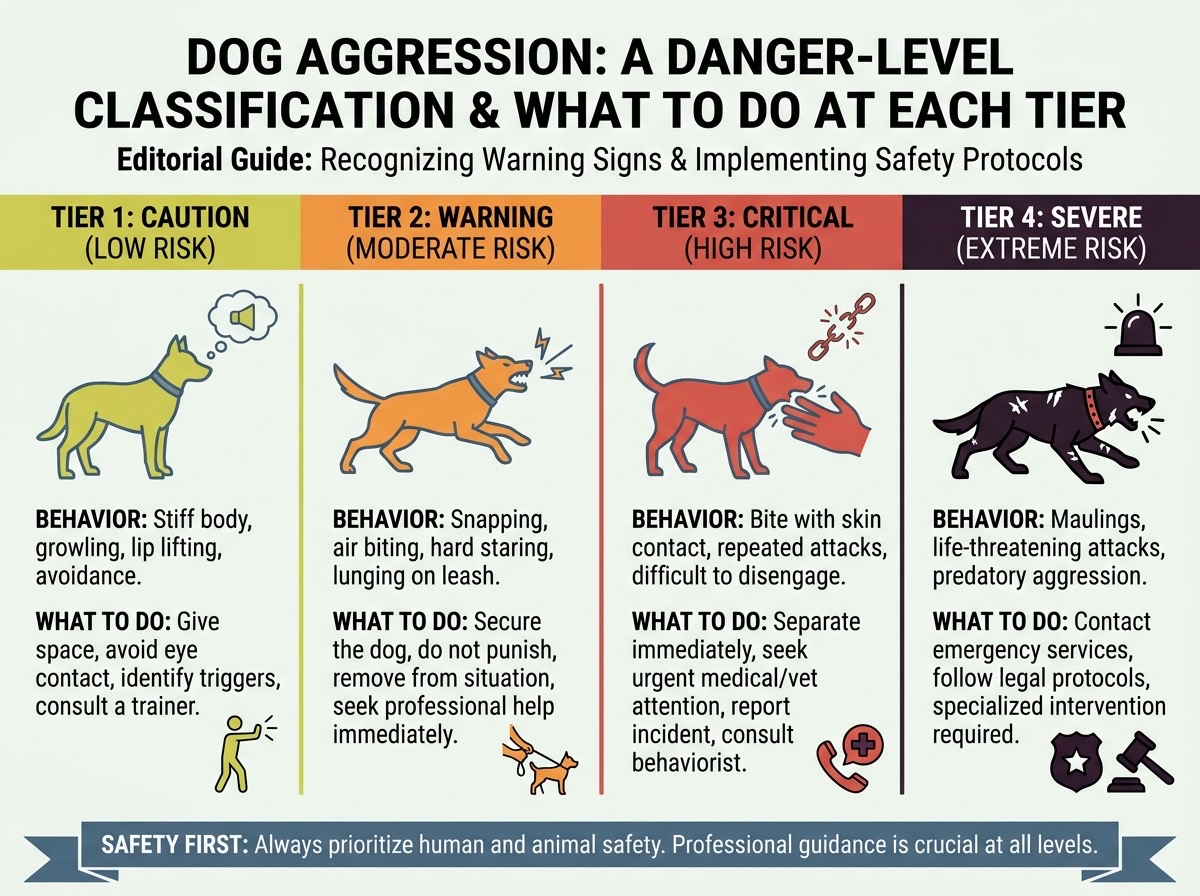
The bite-risk classification gives the owner a framework for understanding where the dog falls on the spectrum and what action is appropriate. The framework has five levels — green, yellow, orange, red, and black — each with a different combination of safety measures, behavioral interventions, and long-term outlook.
This is the framework, the warning signs at each level, and the practical action the owner should take.
Why the classification matters
The classification matters because the response varies dramatically. A dog that growls when approached while eating is communicating. The dog doesn't want to bite. The dog is willing to give a warning. The intervention is to respect the warning and manage the environment.
A dog that bites without warning is a different problem. The dog has skipped the communication phase and gone straight to the bite. The dog is unsafe. The intervention is aggressive: full management, professional intervention, and possibly rehoming or euthanasia.
The owner who treats all aggression the same — "let's just desensitise him" — is missing the warning signs. The owner who treats all aggression as "vicious dog, get rid of him" is missing the cases where intervention works.
The framework lets the owner match the response to the risk.
Level 1: Green — Normal canine communication
The signs
- Growling, but no contact attempted: the dog growls but doesn't lunge, snap, or bite
- Bared teeth, but no contact attempted: the dog shows teeth but doesn't close them on a target
- Stiff body, hard stare: the dog is communicating but not attacking
- Whale eye (showing whites of eyes): a warning sign
- Lip licking, yawning, panting: stress signals, possibly escalating
The interpretation
The dog is communicating. The dog doesn't want to bite. The dog is trying to de-escalate the situation. The communication is a gift — the dog is telling the owner or the target "back off" without biting.
The action
- Respect the warning: don't punish the growl (the growl is communication; punishing it suppresses the warning, leading to bite without warning)
- Identify the trigger: what's making the dog uncomfortable?
- Manage the environment: remove or avoid the trigger
- Don't approach, pet, or handle the dog in the situation that's causing the warning
- Behaviour modification: counter-conditioning and desensitisation to the trigger, with a positive reinforcement trainer
The prognosis
Excellent. Most green-level aggression is resolved with environmental management and appropriate training. The dog is not a bite risk when the warning is respected and the trigger is avoided.
Examples
- The dog growls when the owner approaches the food bowl. Respect the warning, teach the dog that approach means food will be added (not removed), and the growling stops
- The dog shows teeth when a child pets him roughly. The dog should not be exposed to rough handling. The child is taught appropriate handling
- The dog stiffens when approached by a stranger. The dog is given space. The owner asks strangers not to approach
Level 2: Yellow — Elevated warning with possible contact
The signs
- All green-level signs, plus:
- Snapping in the air (no contact): the dog snaps toward the target but doesn't connect
- Lunging (stopped before contact): the dog lunges but stops short
- Air-biting: the dog bites at the air near the target
- Increased intensity: harder stare, more rigid body
- Repeated warnings: the dog warns multiple times in quick succession
The interpretation
The dog is moving from communication to action. The dog may still be warning, but the warnings are more intense. The dog may be testing the limits — "how close can I get before they back off?" The dog may be one trigger away from contact.
The action
- Strict environmental management: avoid the triggers. The dog is not exposed to the situations that provoke the yellow-level behaviour
- Muzzle training: the dog is conditioned to wear a basket muzzle for any situation that might trigger the aggression
- Behaviour modification with a professional: a certified applied animal behaviourist (CAAB) or veterinary behaviourist
- Safety equipment: baby gates, crates, leashes, head halters. The dog is never off-leash in public
- Family education: all household members understand the triggers and the management plan
The prognosis
Moderate. Many yellow-level dogs can be managed safely and improve with professional intervention. Some yellow-level dogs escalate to orange or red if not addressed. The intervention must be aggressive — full environmental management plus behaviour modification.
Examples
- The dog lunges at other dogs on walks. The dog wears a basket muzzle and is walked in low-distraction areas. Behaviour modification with a positive reinforcement trainer
- The dog snaps at the groomer. The groomer uses a basket muzzle. The dog is conditioned to enjoy grooming at home
- The dog growls and lunges at the mailman. The dog is kept inside during mail delivery. The door is secured
Level 3: Orange — Single-bite history
The signs
- A history of one or more bites, but:
- Bites have been inhibited (didn't break skin or caused minor bruising)
- Bites were preceded by warnings (growl, snap, stiff body) that were ignored
- Bites were in predictable situations (the trigger is known)
- Bites did not require medical attention
The interpretation
The dog has bitten, but the bites have been controlled. The dog has bitten in response to a known trigger. The dog has given warnings that weren't respected. The dog is at the boundary of "warning" and "action."
This level is the most important classification point. The orange-level dog can be safely managed in many cases, but the management must be rigorous. The dog is one bad decision away from a red-level bite.
The action
- Behaviour modification with a veterinary behaviourist: a board-certified veterinary behaviourist (DACVB) is preferred over a general practice vet for this level
- Daily medication: most orange-level dogs benefit from medication (fluoxetine, clomipramine) to reduce the underlying anxiety or impulsivity
- Strict environmental management: the dog is never in the trigger situations. The household changes are non-negotiable
- Muzzle training: the dog wears a basket muzzle in any situation that might trigger
- Liability assessment: the owner must consider the legal implications. In many jurisdictions, a dog with a bite history is a "dangerous dog" under the law. The owner may face liability if the dog bites again
- Documentation: a written behaviour modification plan, signed by the owner and the behaviourist
- Consideration of rehoming: in some cases, the safest outcome is rehoming to a household without the trigger (e.g., a child-free household, a single-dog household)
The prognosis
Guarded. Orange-level dogs can be managed with professional intervention, but the bite risk remains elevated. The owner must commit to lifelong management. The dog may improve to yellow level with intervention. Some orange-level dogs progress to red if the management is inadequate.
Examples
- The dog has bitten one person in the past, with minor injuries. The dog is on fluoxetine and undergoes behaviour modification. The dog wears a muzzle in public. The household avoids the trigger
- The dog bit the vet tech during a nail trim. The vet tech uses a basket muzzle. The dog is conditioned to tolerate nail trims at home
- The dog has bitten other dogs in the past, with minor injuries. The dog is walked in low-distraction areas, on a leash, with a muzzle
Level 4: Red — Severe or repeated bites
The signs
- Multiple bite incidents, or
- Bites that required medical attention, or
- Bites with significant force (deep punctures, bruising, lacerations), or
- Bites in unpredictable situations, or
- Bites with minimal warning (no growl, no snap, just bite)
The interpretation
The dog is a serious bite risk. The dog may have skipped the communication phase. The dog may bite in situations that the owner cannot predict or control. The dog is dangerous to people, particularly children, the elderly, and other animals.
This level is the point where the owner must consider the dog's quality of life, the household's safety, and the community's safety. Behaviour modification is limited. Management is the primary intervention.
The action
- Behaviour modification with a veterinary behaviourist: aggressive intervention with medication
- Euthanasia consideration: this is the level where euthanasia is on the table. The owner and the behaviourist must make an honest assessment
- Strict confinement: the dog is kept in a secure enclosure when not supervised. The dog is never off-leash in public. The dog is never around children
- Surrender to a behaviour-specialised rescue: in some jurisdictions, the dog can be surrendered to a rescue that specialises in aggressive dogs. The rescue has the resources and the legal standing to manage the dog
- Legal compliance: many jurisdictions require that a dog with a serious bite history be euthanised. The owner must check local laws
The prognosis
Poor to grave. Red-level dogs rarely improve to yellow level. Most red-level dogs are managed for life or are euthanised. The decision to euthanise is one of the most difficult an owner makes.
Examples
- The dog has bitten multiple people, including the owner, with significant injuries. The dog is euthanised after the second serious bite
- The dog bit a child in the face, with no warning. The dog is euthanised. The family sues (in some jurisdictions)
- The dog has bitten three other dogs, with serious injuries. The dog is euthanised
Level 5: Black — Catastrophic or fatal incident
The signs
- A bite that caused death (human or another animal), or
- A bite that caused permanent, severe disfigurement, or
- Multiple unprovoked bites in a short period
The interpretation
The dog has crossed the line. The dog is a serious danger to the community. The intervention is euthanasia, often legally mandated. The owner has the right to a legal defence, but the outcome is typically the same.
The action
- Euthanasia: this is the standard intervention at this level. The dog is euthanised humanely. The owner has the right to grieve. The owner does not have the right to keep a dog that has killed or permanently injured someone
- Legal compliance: the owner may face criminal charges (in some jurisdictions, "vicious dog" charges are criminal). The owner should consult with an attorney
- Post-incident support: the family and the victim(s) need support. The owner may need grief counselling for the loss of the dog and the guilt of the incident
The prognosis
None. The dog is euthanised.
Examples
- The dog killed a child. The dog is euthanised. The owner is charged
- The dog killed another dog or cat. The dog is euthanised
- The dog caused permanent facial disfigurement. The dog is euthanised
The "level assessment" exercise
The owner who is concerned about their dog's aggression can do an informal level assessment:
- Has the dog ever bitten someone?
- No: green or yellow. Identify and avoid triggers. Consider professional consultation if any behaviour is concerning
- Yes (single, controlled): orange. Strict management. Professional consultation essential
- Yes (multiple or severe): red. Euthanasia consideration. Behaviour modification is unlikely to resolve
- Yes (fatal or catastrophic): black. Euthanasia is the answer
- Does the dog warn before biting?
- Yes (growl, snap, stiff body): the warning system is intact. Better prognosis for behaviour modification
- No (bite without warning): the warning system is impaired. Worse prognosis. More likely to escalate
- What triggers the aggression?
- Predictable triggers (resource guarding, specific situations): easier to manage
- Unpredictable triggers (random people, no warning): more difficult
- How long ago was the last bite?
- Recent (weeks-months): the aggression is current. Active intervention needed
- Long ago (years): may be a historical issue, but management should continue
The assessment is not a diagnosis. A veterinary behaviourist should make the formal assessment for orange, red, and black levels.
The "suppressing the growl" mistake
A critical mistake owners make: punishing the growl or warning. The owner sees the warning as "bad behaviour" and punishes it. The dog stops growling. The owner is satisfied. The dog is not satisfied — the dog is still stressed, but the dog has learned that warnings don't work. The next time the dog is stressed, the dog skips the warning and bites.
This is called "the suppressed warning." The dog goes from green (warning) to red (bite without warning) without passing through yellow. The bite risk is higher than before.
The correct response to a warning: respect the warning. Remove or manage the trigger. Don't punish the dog.
The "it's how he plays" rationalisation
A common rationalisation: "He doesn't bite. He's just playing. He gets excited." The dog bites, the owner laughs it off, the dog bites harder, the owner still laughs it off. The dog has a bite history by the time the owner acknowledges the issue.
The rule: biting is not play. The dog that bites is communicating, not playing. Even if the bite seems "soft," the dog is exercising a behaviour pattern that will become more intense.
The "I can handle him" fallacy
Another common rationalisation: "I know my dog. I can handle him." The owner who has been bitten, the owner who has scars, the owner who has a dog that lunges unpredictably. The owner's confidence is misplaced. The dog is dangerous, and the owner's confidence is a form of denial.
The honest assessment: the owner cannot handle a dog that has bitten. The owner needs professional help. The dog needs management or, in some cases, euthanasia.
The "rehoming" consideration
For orange and red level dogs, rehoming is sometimes considered. The considerations:
- Honesty: the owner must be honest with the rescue or the new owner about the bite history. The rescue or new owner can decline
- Compatibility: the new home must avoid the triggers. A dog-aggressive dog should not be rehomed to a multi-dog household. A child-aggressive dog should not be rehomed to a family with children
- Legal: in many jurisdictions, transferring a dog with a bite history requires disclosure. Failure to disclose can result in criminal liability if the dog bites in the new home
- Quality of life: rehoming can stress the dog, which can worsen aggression. A dog that is unstable in its current home may become more unstable in a new home
For most orange-level dogs, rehoming is not recommended. The management is better in the current home. For some red-level dogs, particularly those that have bitten unpredictably, euthanasia is preferable to rehoming.
The "when to seek help" checklist
The owner should seek professional help (a veterinary behaviourist) immediately if:
- The dog has bitten a person
- The dog has bitten another animal
- The dog has growled or snapped multiple times in the same situation
- The dog is escalating (green behaviour becoming yellow, yellow becoming orange)
- The dog has bitten the owner
- The dog has bitten a child
The owner should seek help urgently (within 24 hours) if:
- The dog has bitten a child in the face or head
- The dog has bitten with no warning
- The dog has bitten multiple people in a short time
- The dog is showing severe warning behaviour (deep growling, lunging with contact)
The bottom line
Aggression is on a spectrum. The green-level growling dog is communicating. The black-level biting dog is dangerous. The classification matters because the response varies. Most canine aggression is manageable with professional help and strict environmental management. Some is not. The owner who understands the level can make informed decisions about safety, intervention, and quality of life. The owner who ignores the level is gambling with the dog's life and the family's safety. The classification is not a verdict — it's a framework. The dog that is orange today can be yellow tomorrow with intervention. The dog that is red today may be at the end of its options. The honest assessment is the foundation. The professional help is the partner. The management is the daily work. The classification lets everyone — the owner, the vet, the behaviourist, the family — speak the same language about the dog's risk and the appropriate response. The dog deserves the honest assessment. The owner deserves the framework.
---
About the author: [Marcus Whitfield](../Marcus%20Whitfield.md) is a Certified Applied Animal Behaviourist (CABC) and MS in Animal Behaviour from the University of Edinburgh, with 16 years of clinical practice focused on canine fear, aggression, and anxiety disorders.