
Diabetic dog feeding schedules: how to sync meals, insulin, and glucose curves
A new diabetes diagnosis in a dog feels like three problems: a twice-daily injection, a strict diet, and a blood glucose testing routine. In practice it is one problem with three clocks, and the job of a nutrition referral is to make those clocks agree. When they do, the dog that presented with a 600 mg/dL fasting glucose and polyuria is often down a third of its insulin dose within four to six weeks. When they don't, no amount of titration stabilises the dog.
This article covers the schedule side of the protocol — the food, the timing, and the home glucose curves — not the insulin dosing algorithm, which your internist owns.
Why timing matters as much as content
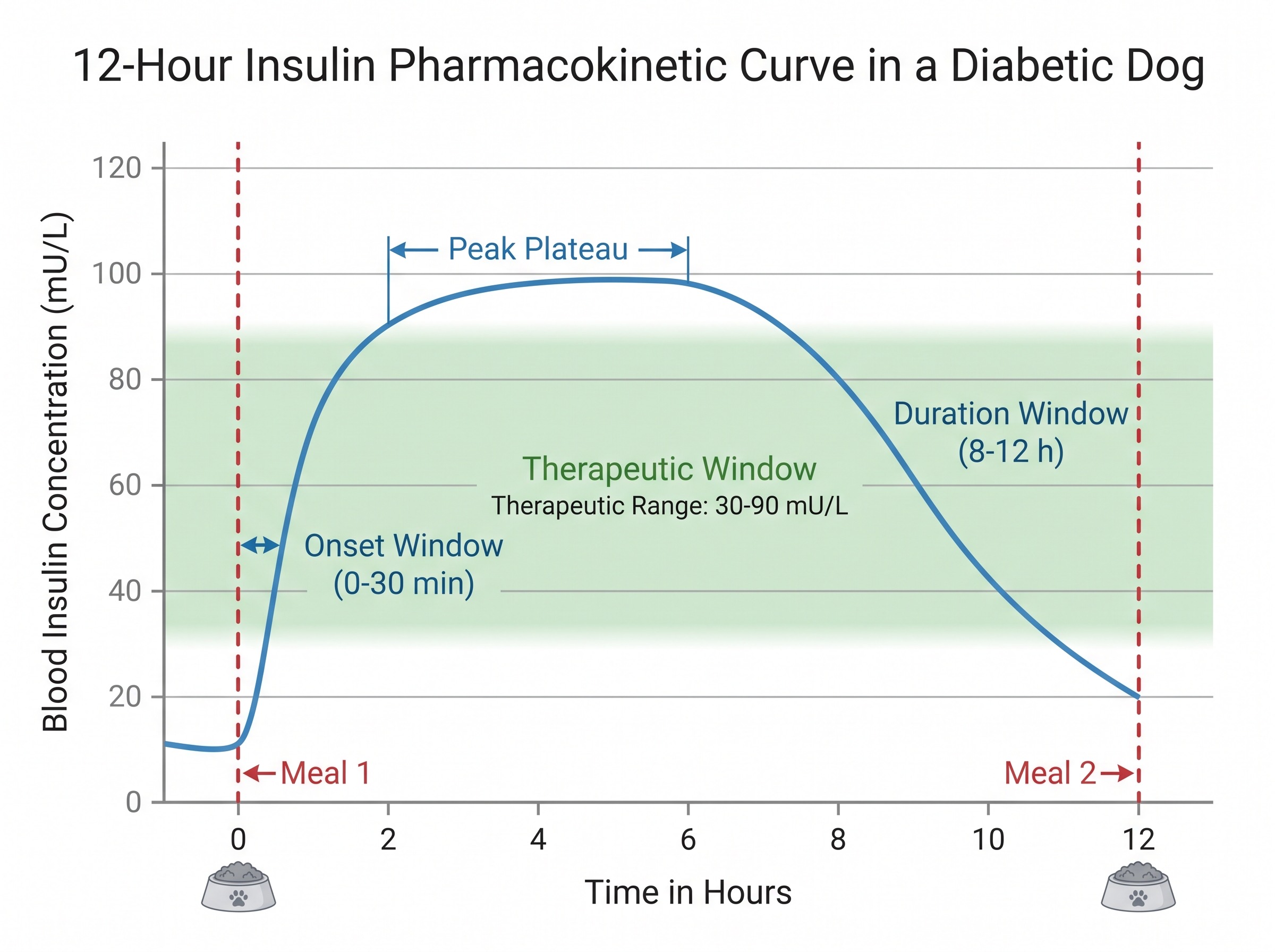
A diabetic dog's blood glucose is a wave, not a number. The wave has a peak, a trough, and a duration, and it is set by what the dog ate, when it ate, and when the insulin was given. The most common reason newly diagnosed dogs stay "unregulated" is that owners feed a perfectly good prescription diet on a schedule that fights the insulin.
Reference numbers I work to, drawn from the ACVIM 2018 canine diabetes consensus and the BSAVA nutrition guidelines:
- Pre-meal blood glucose target: 90–180 mg/dL (5–10 mmol/L)
- Peak post-prandial: 180–250 mg/dL, no higher
- Nadir (lowest point): 80–120 mg/dL
- Glucose curve duration: ideally 10–14 hours
You hit those numbers by matching meal timing to the insulin's onset-of-action window — and that is the part owners are rarely taught.
The two-meal insulin-synchronized baseline
Every stable diabetic dog in my caseload eats two equal meals, 12 hours apart, with the injection given at the start of the meal. There are variations, but this is the starting framework and it works for roughly 80% of dogs on twice-daily insulin.
Different insulins peak at different times, and the meal has to be in the gut when the insulin is peaking in the blood:
| Insulin | Onset | Peak | Duration | Feed the meal |
|---|---|---|---|---|
| Vetsulin (porcine lente) | 30 min | 2–6 h | 8–12 h | right after the injection |
| Humulin N (NPH) | 30–90 min | 2–8 h | 8–14 h | right after the injection |
| ProZinc (PZI) | 1–2 h | 4–10 h | 10–16 h | within 15 min of injection |
| Glargine (off-label, cats mostly) | 1–2 h | 6–12 h | 18–24 h | at injection, sometimes split if the dog is grazing |
Most diabetic dogs in the US are on Vetsulin (porcine lente zinc suspension, Merck) or Humulin N (NPH, Eli Lilly). A common mistake: owners give Vetsulin, then put the bowl down an hour later because the dog "wasn't hungry." By then the insulin has peaked, the meal hits an empty insulin trough, and the post-prandial curve spikes to 400+ mg/dL. The dog looks unregulated. The schedule is the cause.
Two rules:
- Inject at the start of the meal, not before. If the dog does not eat, do not inject. Hold the dose and call the clinic. Half-dosing without eating is dangerous.
- No food between meals for the first 4–6 weeks. A snack at 11 AM hits a fresh glucose spike that no insulin curve was built to cover. Once the dog is regulated and you have a flat curve on file, you can add a single mid-day training-treat portion — but only with the curve as proof.
Choosing a low-glycemic, high-fiber prescription kibble
The diet itself should do three things: slow glucose absorption, give the dog satiety on a controlled portion, and stay low in fat if the dog is a Miniature or Standard Schnauzer, where concurrent pancreatitis risk is high. Three prescription diets are my default shortlist:
- Royal Canin Glycobalance — 5.2% starch on a dry-matter basis, 14% crude fiber, 18% crude protein, 9% fat. Good first choice for Schnauzers and for dogs that need to lose 10%+ body weight.
- Hill's Prescription Diet w/d Multi-Benefit — fiber 16%, fat 7%. Slightly more calorie-dense per cup, useful for thin diabetics.
- Purina Pro Plan Veterinary Diets DM Diabetes Management — highest fiber at ~22%, starch 4%, strongest satiety signal. Good for the polyphagic dog that screams between meals.
If the dog refuses all three, the home-cooked fallback I document is roughly 60% lean cooked chicken breast, 20% cooked green beans, 10% cooked oatmeal (steel-cut, cooled to maximise resistant starch), 10% plain canned pumpkin, plus Balance It Canine premix. It is nutritionally complete but higher effort, and a lot of owners fall off within 90 days.

The 8-hour home glucose curve you can actually do
Every newly diagnosed diabetic should have a glucose curve within the first 14 days of insulin therapy, and every 3 months once stable. A home curve gives a truer picture than an in-hospital one because the dog is not stressed and cortisol is not artificially elevating the numbers. I teach owners to do a home curve on a Sunday, every 3 months, with a Zoetis alphaTRAK 3 handheld glucometer — the only over-the-counter glucometer validated for canine blood (human glucometers run 30–50% low in dogs, enough to cause insulin overdosing).
The protocol:
- Feed and inject at the usual time. This is a normal day.
- Measure glucose every 2 hours for 8 hours. Ear-poke prick, side of the paw pad, or inner lip — whichever the dog tolerates. Reward with a single piece of the prescription kibble.
- Record the values and the clock time. Plot on a grid or in the PetDialog app that pairs with the alphaTRAK 3.
- Send the chart to your internist within 24 hours. Do not adjust insulin yourself.
For owners willing to invest more, the Abbott FreeStyle Libre 3 is a 14-day continuous glucose monitor applied between the shoulder blades. It is a veterinary off-label use but well published; it samples every minute and gives 1,440 data points per day. The cost is roughly $80 per sensor, and one sensor covers a full curve plus two weeks of background data, catching nocturnal nadirs that an 8-hour home curve misses.

Treats, snacks, and the 5% rule
A diabetic dog's treat budget is half of a healthy dog's. The standard 10% rule tightens to 5%, and the treat has to be low-glycemic. Three options I hand out:
- Frozen green beans — 4 kcal per medium bean. Volume and crunch, no glucose response.
- Carrot coins — 6 kcal per coin.
- One or two kibbles of the prescription diet — already factored into the curve, so a small handful used as training reward is safe.
What never to give: deli meat, commercial jerky treats, peanut butter, and any treat with a syrup or honey coating. The dog does not need variety. The dog needs a stable curve.
Exercise, stress, and "Somogyi overswing" traps
A diabetic dog's curve changes with two non-food variables: exercise and stress. A 30-minute leash walk after the morning meal lowers the post-prandial peak by 30–50 mg/dL on average. A stressful event — a vet visit, a house full of guests, a thunderstorm — spikes cortisol and raises the curve for 4–6 hours.
Two patterns I watch for in the home curve:
- Somogyi overswing — a steep drop into the 60–80 mg/dL range, followed by a rebound to 350+ mg/dL. Looks like the insulin is "not working." It is the insulin working too well and the dog's counter-regulatory hormones overcorrecting. The fix is a lower insulin dose, not a higher one — the most common misread on home curves.
- Dawn phenomenon — a glucose rise between 6 and 8 AM even on an empty stomach. More common in cats than dogs, but it happens in Samoyeds on a once-daily intermediate insulin. The fix is moving to twice-daily dosing.
If a home curve shows either pattern, do not change anything on your own. The internist reads the curve as a whole.
When to call the vet (and the emergency red flags)
Stable diabetes is quiet. The dog eats well, drinks normally, has energy, and weighs what it weighed last month. Anything outside that is a signal to call. Four emergency red flags — same-day vet, not a wait-until-Monday:
- Refusing both meals in a 24-hour period while still on insulin.
- Lethargy, weakness, head tilt, or seizures — hypoglycaemia until proven otherwise. Offer a tablespoon of honey or maple syrup to the gums immediately, then go to the ER.
- Vomiting or diarrhoea for more than 12 hours — dehydration destabilises the curve and risks diabetic ketoacidosis (DKA).
- Fruity or acetone-smelling breath — ketosis heading toward DKA.
If you only remember one thing from this article, it is this: in a diabetic dog, the food clock, the insulin clock, and the testing clock have to agree. When they drift apart, no dose adjustment rescues the situation. The schedule is the treatment.
If your dog was diagnosed in the past 30 days, the conversation to have with your internist this week: confirm the insulin type and its peak window, ask whether your current meal timing lines up with that peak, and request a home curve or Libre placement before the next dose adjustment. Those three questions set the year up.