
Separation anxiety: 7 early warning signs and a step-by-step correction plan
It is the phone call I have taken more than any other in twenty years. The owner says, "My dog is destroying the house when I leave." Or: "She potties in the crate even though she is housebroken." Or, more quietly: "I cannot go to the grocery store anymore." What they are describing is almost never a training failure and almost never a revenge plot. It is a panic response, and the dog needs a plan, not a punishment.
In my experience, separation distress is the single most misdiagnosed behavior problem in domestic dogs. Owners get told the dog is "acting out" or "being stubborn", they buy a sterner crate, and the dog gets worse. The science here is that we are dealing with a dysregulated attachment system, not a disobedient one. The protocol below is the one I have used with more than 600 families. It is not fast, but it is reliable.
The seven early warning signs most owners miss
True separation anxiety rarely shows up as a single dramatic event. It is a cluster of small, easy-to-explain-away behaviors that begin weeks before the owner finally calls me. Watch for:
- Pre-departure agitation. The dog starts pacing, panting, or following you from room to room the moment you pick up your keys, put on your shoes, or grab your work bag. The behavior starts 5–15 minutes *before* you leave.
- Vocalization that is specifically tied to your exit. A bark or howl that begins within 60 seconds of the door closing and stops within minutes of your return. Neighbors often describe it as a "long, mournful" sound, not the alert barking of a watchdog.
- Drooling and self-soothing. Wet paw prints on the floor near the door, or a wet spot on the crate bedding where the dog has been licking their own forearm. Salivary cortisol is elevated in these dogs within the first fifteen minutes of solitude.
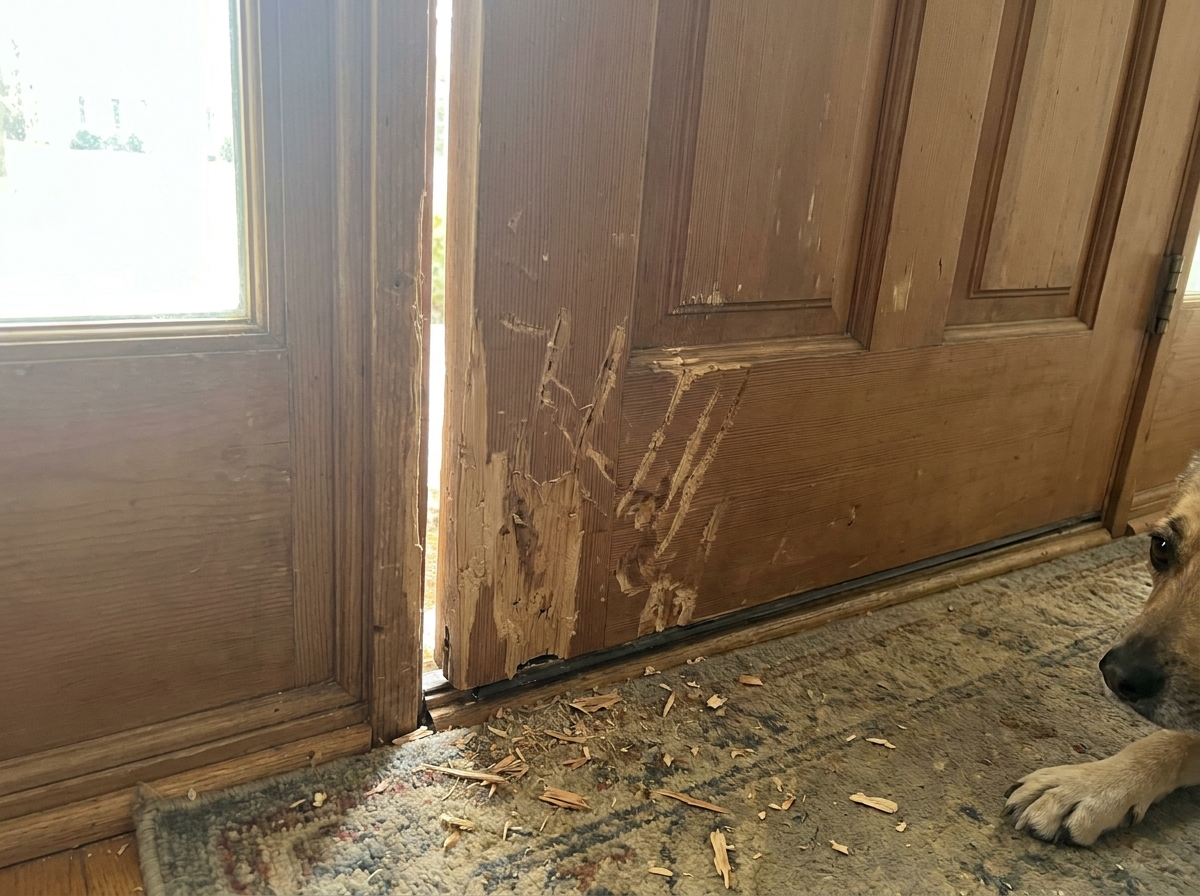
- Destruction focused on exit points. Chew marks and scratch marks clustered around the door frame, window sashes, the baby gate, or the crate door. The dog is not chewing a slipper out of boredom — they are chewing the *barrier*.
- Elimination in a housebroken dog. Urination or defecation within the first twenty minutes of alone time, in a dog who otherwise holds it for eight hours without issue. The puddles tend to be near the exit, not random.
- The "explosion reunion." You open the door and the dog behaves as if you have returned from war — full-body wriggle, whining, piddling, jumping, mouthing your hands. A dog who is merely happy you are home does not lose bladder control.
- Refusal of food or enrichment when alone. You leave a Kong, a Toppl, or a LickiMat smeared with peanut butter. You come home six hours later and it is untouched. A bored dog eats the Kong. A panicked dog cannot.
If your dog shows three or more of these signs, especially the pre-departure agitation and the exit-point destruction together, you are most likely looking at true separation anxiety rather than a training or boredom issue.
The three flavors of "home alone" — and why the distinction matters
Not every dog who struggles when left is suffering from the same disorder. Before I write a protocol, I always classify the problem into one of three buckets. Each has a different fix.
True separation anxiety (TSA). The dog's panic is specifically tied to the absence of the attachment figure — usually one primary person. The dog can be home with another family member and be fine. The science here is that the dog's attachment system has failed to habituate to predictable short absences, and the absence triggers a cortisol spike within minutes. This is the bucket that needs the protocol below.
Isolation distress. The dog panics whenever they are alone, regardless of who else is in the home. This is rarer, harder to treat, and often responds to a combination of the protocol below plus medication from a veterinary behaviorist. Clomipramine or fluoxetine, prescribed at a behavior-therapeutic dose (1–2 mg/kg for clomipramine), can reduce baseline panic enough to make the training stick.
Boredom / under-stimulation. The dog sleeps all day, gets minimal exercise, and shreds a pillow at hour six. There is no panic, no pre-departure agitation, no explosion reunion. This is not separation anxiety. This is a management problem, and the fix is more enrichment, more exercise, and a dog walker at midday. Punishing this dog or running the separation protocol on them will make them worse.
In my experience, about 60% of the cases I see are true TSA, 15% are isolation distress, and 25% are actually boredom that has been mislabeled. The protocol below is built for TSA. If your dog's pattern does not match, escalate to a certified consultant (CBCC-KA or CDBC) for a proper classification.
The toolkit: what to gather before you start
The protocol only works if your environment supports it. Pull these together before week one.
- A treat-dispensing camera with two-way audio. I use the Petcube Bites 2 in my own home and recommend the Furbo 360 as a close second. You need to see what your dog does in the first thirty minutes after you leave, not what they do at hour four. The two-way audio also lets you deliver a marker cue remotely — more on that below.
- A consistent marker word or remote clicker. Pick one. I prefer the word "yes" because it travels through a camera's audio better than a clicker.
- High-value, pea-sized soft treats. Ziwi Peak air-dried beef, Wellness CORE Pure Rewards, or any single-ingredient freeze-dried treat that takes less than half a second to swallow. You will be paying the dog in small bites many times per session.
- An Adaptil (CEVA) plug-in diffuser in the room where the dog settles when you are home. The synthetic analogue of the dog-appeasing pheromone reduces baseline arousal in roughly 70% of dogs in published trials, and it has no sedating effect.
- A Through a Dog's Ear playlist (or a Spotify "calm dog" playlist at 50–60 dB) playing at low volume during departures. The goal is to mask outside sounds and lower ambient arousal.
- A baby gate or a second crate so you can run "in-sight, out-of-reach" reps without leaving the house.
You do not need to spend a fortune. The camera and the treats are the two purchases that actually move the needle.
The six-week protocol
The shape of the work is systematic desensitization — repeated, sub-threshold exposures to the things that trigger panic, paired with counter-conditioning — building a new, positive association on top of the trigger. You are not "practicing being alone". You are teaching the dog that the cues that used to predict your departure now predict nothing in particular.
Week 1 — Build the baseline map
Set up the camera. Leave for two minutes, come back. Repeat five times across the day. Watch the footage. Note exactly when the dog starts to escalate (lip licking, panting, position shifts). That moment is your threshold. Everything you do for the next five weeks stays below that threshold.
Week 2 — Repeat the departures, slowly
Same two-minute absences. Increase to three minutes only when the dog has been below threshold for three consecutive sessions. You are not in a hurry. A dog who can handle fifteen minutes of calm alone is halfway to handling an eight-hour workday.
Week 3 — Add the pre-departure cues
This is the step most owners skip, and it is the one that fixes the pre-departure agitation. Pick up your keys, sit down, do not leave. Put on your shoes, take them off. Open the door, close it, stay inside. You are breaking the predictive link between the cue and the departure. The dog needs to learn that "keys" does not mean "gone for eight hours." Practice ten to fifteen reps per session, randomized, never departing more than 50% of the time you pick up the keys.
Week 4 — Layer in real-life absences
Begin real departures. Start with five minutes (drive around the block). Build to fifteen, thirty, sixty, ninety. The rule is the same: if the camera shows the dog going above threshold, the previous duration was too long. Drop back a step and stay there for three more sessions.
Week 5 — Add the camera-paid reps
When you are confident the dog is below threshold for sixty minutes, start using the camera's two-way audio to mark and pay for calm behavior while you are actually gone. Cue "yes" the moment the dog lies down on the mat, and a treat drops from the Petcube Bites 2 dispenser within two seconds. You are now reinforcing calm from across town.
Week 6 — Generalize and wean the supports
Practice departures in different orders. Leave the house and come back through a different door. Leave the car keys on the counter instead of taking them. The goal is a dog who can no longer predict when a real departure is real. As the dog holds calm for ninety minutes, begin tapering the Adaptil diffuser (turn it off in week 7, remove in week 8) and the music.
By the end of week six, most dogs in my caseload are handling two-hour absences with no escalation on camera. Full workday independence usually lands between weeks ten and fourteen. If your dog is not there by week eight, escalate.

Common mistakes that set the work back
- Coming back when the dog is barking. You have just taught the dog that barking makes you reappear. Wait for four to five seconds of quiet before you open the door, even on the first rep of the morning.
- Using a "calming" collar or thunder-shirt as the entire intervention. Pressure wraps and pheromone collars lower arousal by 1–2 points on a 10-point scale. They are scaffolding, not treatment. Without the protocol, they delay recovery.
- Skipping the camera. Guessing what your dog is doing when you leave is guessing. You need data. A $150 camera is cheaper than three more months of guessing.
- Adopting a second dog as the fix. For true TSA, a second dog is, at best, irrelevant. The dog's panic is tied to the human's absence, not to being alone in a species sense. At worst, the second dog learns the first dog's panic and you now have two anxious animals.
When to escalate
In my experience, the protocol works for about 70% of true separation anxiety cases when run consistently for eight weeks. There are times to stop and bring in a professional:
- The dog has broken teeth, broken nails, or broken skin from escape attempts. This is severe TSA. Bring in a CBCC-KA or CDBC, and ask your vet about a referral to a veterinary behaviorist (DACVB) for medication evaluation.
- The dog has bitten a household member during a panic episode. Redirected aggression during panic is real and dangerous. Get in-person help.
- The dog is losing weight, refusing food even when you are home, or showing other generalized anxiety signs. The line between separation anxiety and a broader anxiety disorder is fuzzy, and a vet should rule out medical contributors (thyroid, pain, sensory decline in seniors).
- You have done the protocol for eight weeks with no measurable change on camera. Either the diagnosis is wrong, or the dog needs pharmaceutical support to learn the new associations. Both require professional help.
Why this works
You are not asking the dog to be brave. You are asking their nervous system to stop firing the alarm at the sound of your keys. Every rep in the protocol is a small, sub-threshold exposure — too small to trigger panic — paired with something pleasant (a marker, a treat, your return). Over hundreds of reps, the dog's brain relearns what your departure cues actually mean: nothing in particular, and often, food.
The same pairing — predictable exposure plus positive reinforcement — is the backbone of exposure therapy for human panic disorder. The dog version is faster, partly because dogs do not have the cognitive layer of "what if this time it really is eight hours?" They live in the rep in front of them. Your job is to make that rep easy, boring, and well-paid. Do that for six weeks and most of them turn the corner.
---
About the author: [Marcus Whitfield](../Marcus%20Whitfield.md) is a Certified Canine Behavior Consultant (CBCC-KA) with over 20 years of practice and 3,000+ family consultations. Author of The Canine Mind: Understanding and Shaping Your Dog's Behavior and a long-time columnist for Whole Dog Journal and AKC Family Dog.