
Doorbell diving: how to teach a calm greeting
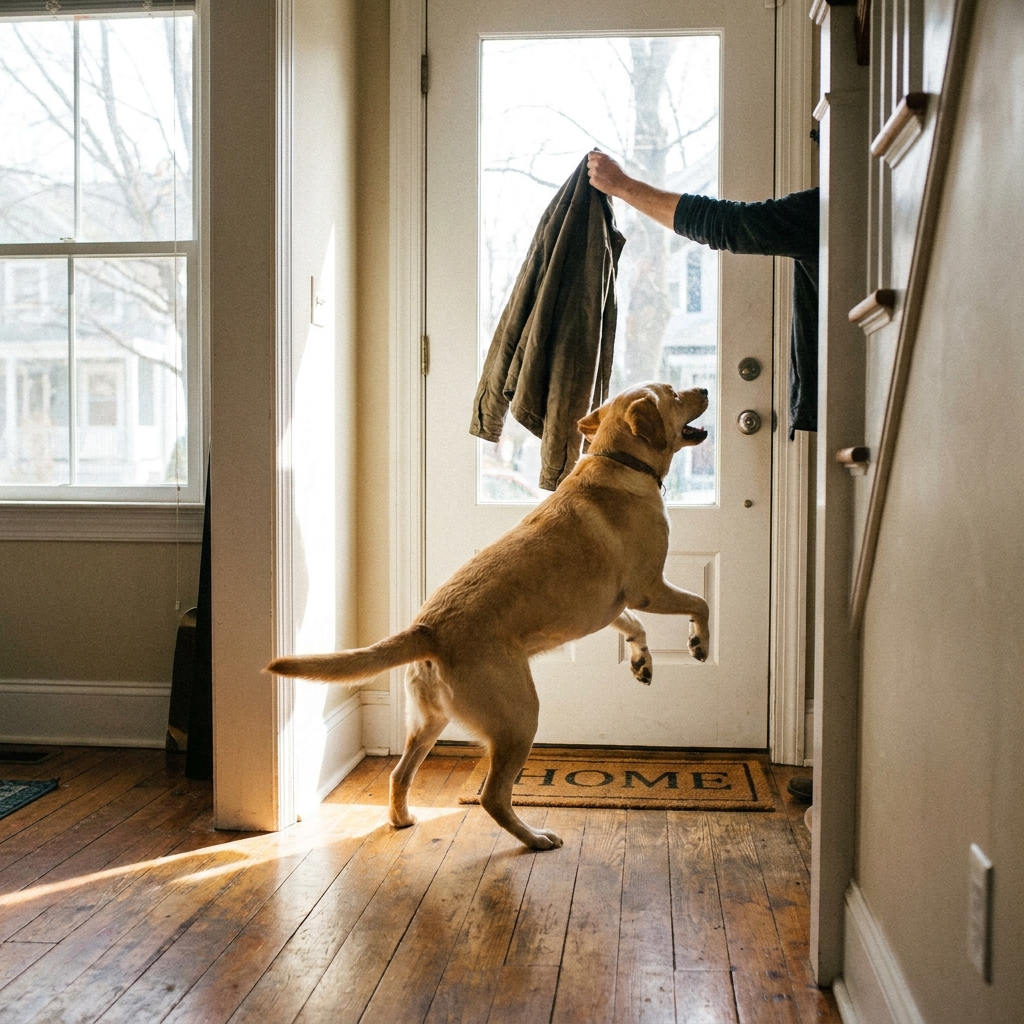
I get a version of this call every week. The doorbell rings, the dog explodes off the couch, hits the door at a dead run, knocks a toddler sideways, and the owner spends the next forty-five minutes apologizing to a guest who is now pinned against the wall being licked to death. The owner is exhausted. The dog is not "bad". The dog has simply been rewarded — accidentally — for the only behavior that has ever worked at the door.
The fix is not a stronger "no". The fix is a behavior swap, taught methodically, with the doorbell turned from a trigger into a cue.
What is actually happening in the dog's brain
When the bell rings, three things fire at once:
- A startle. The bell is an unpredictable, high-pitched acoustic event. The sympathetic nervous system activates in 200–400 milliseconds.
- An associative burst. Every past doorbell has ended with a person entering, talking in an excited voice, and petting the dog. The bell predicts reward.
- A motor plan. The fastest path to the door is also the path that has historically won the guest's attention first.
In my experience, what you are looking at is not a dominance play. It is a dog whose most practiced behavior in this context is a sprint. To change the behavior, you have to make a different behavior more practiced, more rewarding, and more reliable than the sprint.
The five tools you will need
Before you run a single rep, gather these:
- A clicker or a consistent marker word ("yes", "good", or "bingo" — pick one and never vary it)
- A treat pouch loaded with high-value, pea-sized soft treats — Ziwi Peak air-dried beef, Wellness CORE Pure Rewards, or any soft treat that takes less than half a second to swallow
- A leash, 4–6 feet long, non-retractable
- A floor mat or dog bed placed 6–8 feet from the door
- An assistant (a friend or family member) who can play "the doorbell" while you work the dog
You will also want to desensitize the bell itself. More on that below.
Step-by-step protocol: the four-week plan
Week 1 — Build the new default behavior on the mat
You are not touching the door yet. The goal this week is to teach the dog that the mat is the most rewarding place in the room when the doorbell is not ringing.
- Toss a treat on the mat. The moment all four paws land on it, click and pay.
- Add a cue word: "place" or "mat" — say it once, just before the dog steps onto the mat.
- Build duration in small bites — 2 seconds, then 5, then 10, then 30. Click and pay before the dog gets up.
- Add mild distractions: you walking past, a chair scraping, a phone ringing in another room.
By the end of week 1, your dog should be able to hold a sit or down on the mat for 30 seconds with you moving around the room.
Week 2 — Introduce the doorbell at low intensity
This is the heart of the work. Rushing this step is the most common mistake I see.
- Have your assistant ring the actual doorbell once, then wait. Do nothing. If your dog looks up, mark with "yes" and pay a treat *while the dog is still on the mat*.
- Repeat 8–12 times per session, with 30–60 seconds between rings.
- The moment the dog gets up, the bell has "won" and you have lost the rep. Reset quietly, lure back to the mat, and wait for the next ring.
- After three or four sessions, increase to two rings in a row, then three, with the same rule: mat gets paid, anything else gets ignored.
The science here is counter-conditioning. You are pairing the bell with food delivery on the mat, so the bell stops predicting a sprint and starts predicting a paycheck.
Week 3 — Add movement toward the door
Now we layer the harder part: a person actually approaching.
- Your assistant rings, walks to the door from outside, opens it, walks in, and ignores the dog completely.
- Your job: the dog is on the leash, you are holding the leash at floor level (no tension), and the dog has been sent to the mat *before* the door opens.
- The instant the guest is inside and seated, the guest then — and only then — invites the dog over for a calm pet.
The guest's behavior is critical. If the guest greets the dog while the dog is still wound up, you have undone the work. Use a release word like "okay" or "free" so the guest knows when the calm period has begun.
Week 4 — Generalize
Real life has doorbells, knocks, Amazon drivers, and kids screaming "MOM" from the porch. Train for that.
- Practice with knocks in addition to the bell — they are acoustically different and your dog may react to one but not the other
- Practice with the doorbell of a video doorbell app on your phone (Ring, Nest, Eufy) — they have a different chime and they trigger a phone buzz
- Practice with people entering without ringing — they are harder because you have no acoustic warning
- Practice with the dog on a different mat or no mat at all, just a "sit at a distance of your choosing" cue
By the end of week 4, a doorbell should produce a dog who trots to the mat and looks at you for the next instruction.
Common mistakes that set the work back
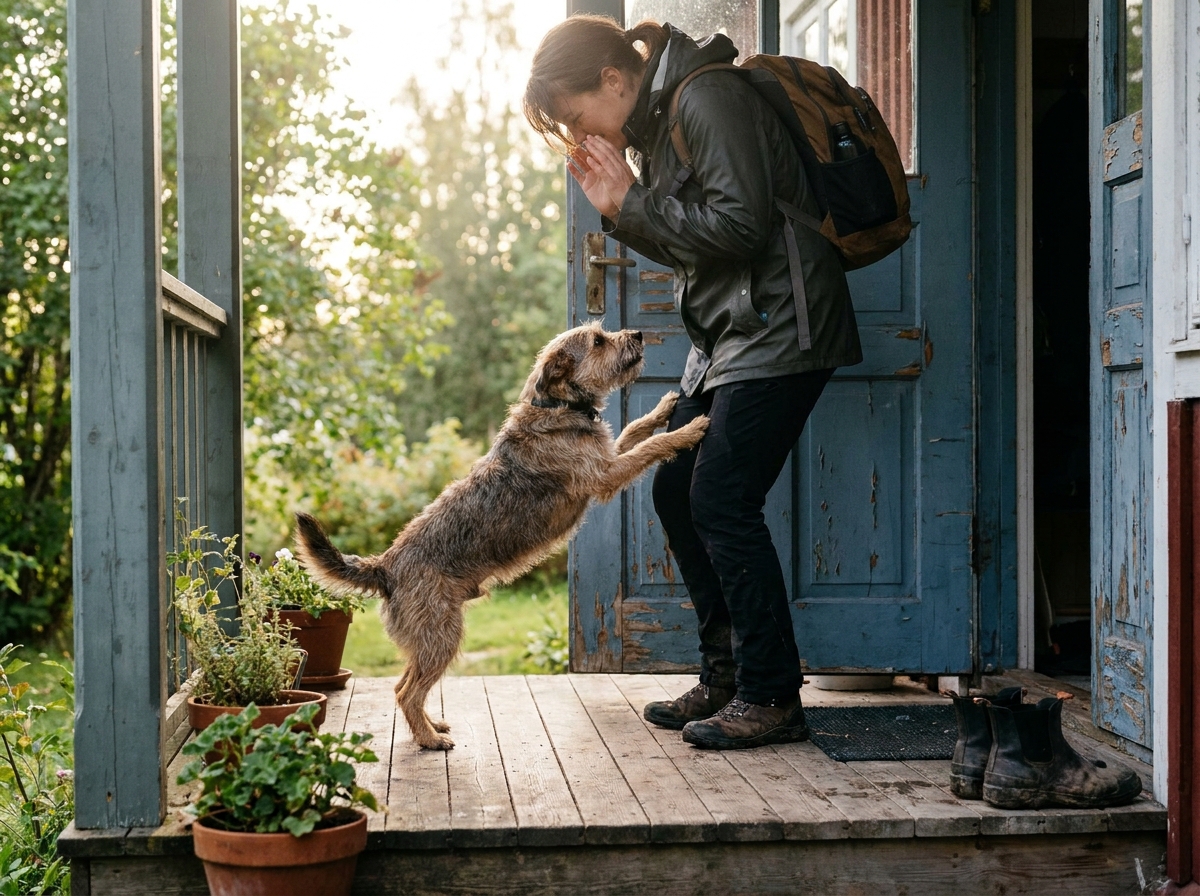
- Telling the dog "no" as the bell rings. Punishment at the moment of a startle does not teach the alternative behavior. It teaches that the bell predicts something unpleasant and the owner is a source of conflict. The dog bites or shuts down.
- Petting the dog to calm them. This is reward for the exact behavior you want to remove. Wait until the dog is on the mat and quiet for at least 3 seconds before paying.
- Skipping the leash. A retractable Flexi or a 30-foot long line gives the dog the freedom to fail. Use a 4–6 foot fixed leash for the first 3 weeks.
- Inconsistency between household members. Every person who walks through that door must follow the same protocol. The dog learns the rule that everyone enforces, not the rule you wish everyone enforced.
When to escalate
In my experience, the protocol works for 80–90% of doorbell-diving dogs within four weeks. There are cases that need more:
- The dog redirects aggression. If your dog snaps at a household member who tries to grab them on the way to the door, stop the at-home protocol and book a certified behavior consultant (CBCC-KA or CDBC) for an in-person assessment.
- The dog has bitten a guest. Same as above. This is now a safety issue, not a training issue.
- The dog has lost hearing or vision. Senior dogs sometimes startle more because they cannot localize the sound. The protocol still works but pace it slower, and rule out pain with your vet first — a dog who startles painfully may bite defensively.
- The dog is on anxiety medication or a recent diet change. These can shift threshold. Check with your vet before starting.
Why this works
You are not asking the dog to stop wanting to greet people. You are giving them a more reliable way to earn that greeting. From the dog's perspective, the rule of the new game is simple: bell rings, go to mat, get paid, get the guest. From the owner's perspective, the rule is also simple: I no longer manage the dog, I run the drill.
The combination of classical conditioning (bell → food on the mat) and operant conditioning (mat → click → treat → guest release) is the same pairing used in service-dog training for public-access manners. It is not exotic. It is just done consistently.
---
About the author: [Marcus Whitfield](../Marcus%20Whitfield.md) is a Certified Canine Behavior Consultant (CBCC-KA) with over 20 years of practice and 3,000+ family consultations. Author of The Canine Mind: Understanding and Shaping Your Dog's Behavior and a long-time columnist for Whole Dog Journal and AKC Family Dog.