
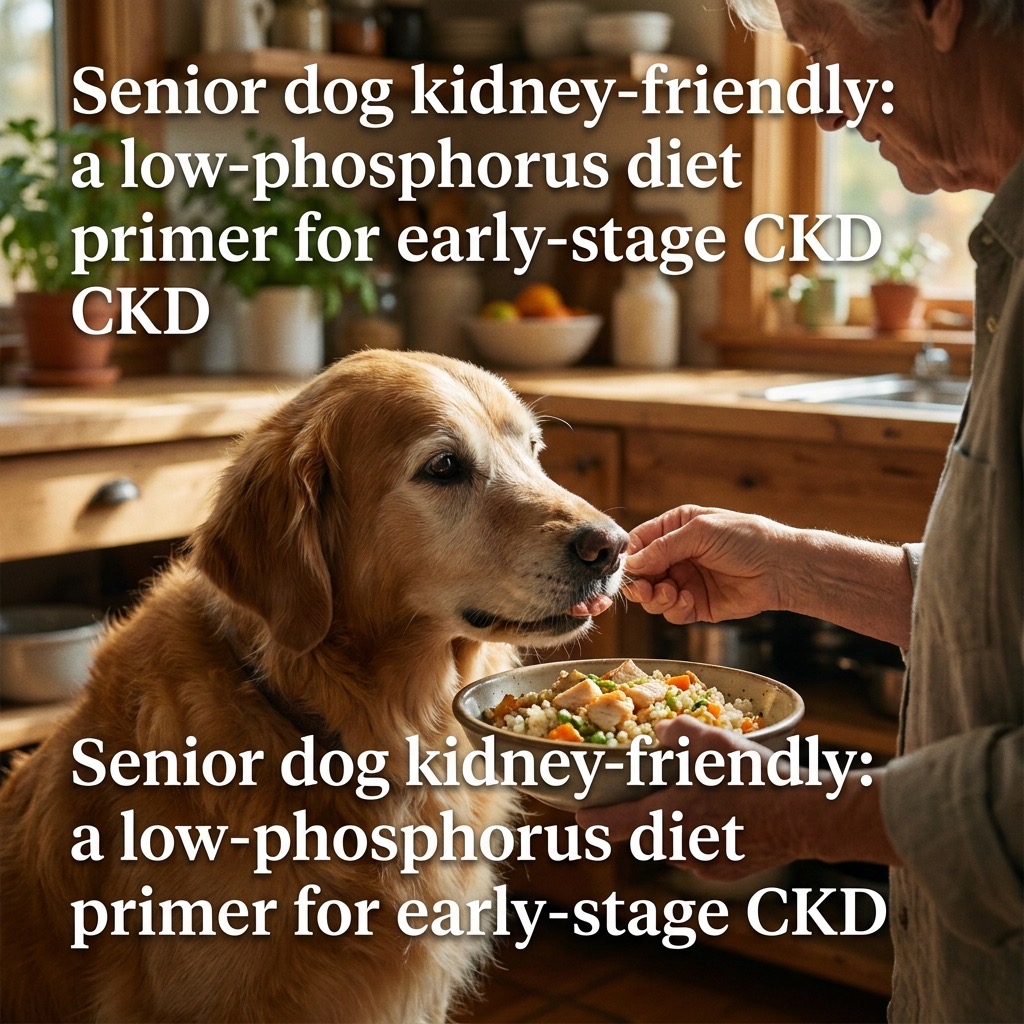
Senior dog kidney-friendly: a low-phosphorus diet primer for early-stage CKD
Chronic kidney disease (CKD) is one of the most common conditions in senior dogs. The kidney function declines gradually, often over years, and the clinical signs appear late. By the time the owner notices excessive thirst and weight loss, the kidney function may be down to 25% of normal. The dog is in stage 2-3 CKD, and the goal is to slow further decline.
The diet is one of the most powerful interventions. A kidney-friendly diet at the right stage extends survival by 2-4 years compared to a maintenance diet. The diet is also one of the most confusing, because the formulation depends on the stage of the disease, the dog's other conditions, and the dog's preferences. This is the primer.
The kidney function basics
The kidneys have multiple functions:
- Filtration: removing waste products from the blood (urea, creatinine, phosphorus)
- Fluid balance: regulating water and electrolyte balance
- Acid-base balance: maintaining blood pH
- Hormone production: erythropoietin (red blood cell production), calcitriol (active vitamin D), renin (blood pressure)
- Vitamin D activation: converting vitamin D to its active form
The kidney has significant functional reserve. The dog can lose 50-75% of kidney function before blood values change. This is why CKD is often diagnosed late — the disease progresses silently until the kidney is severely compromised.
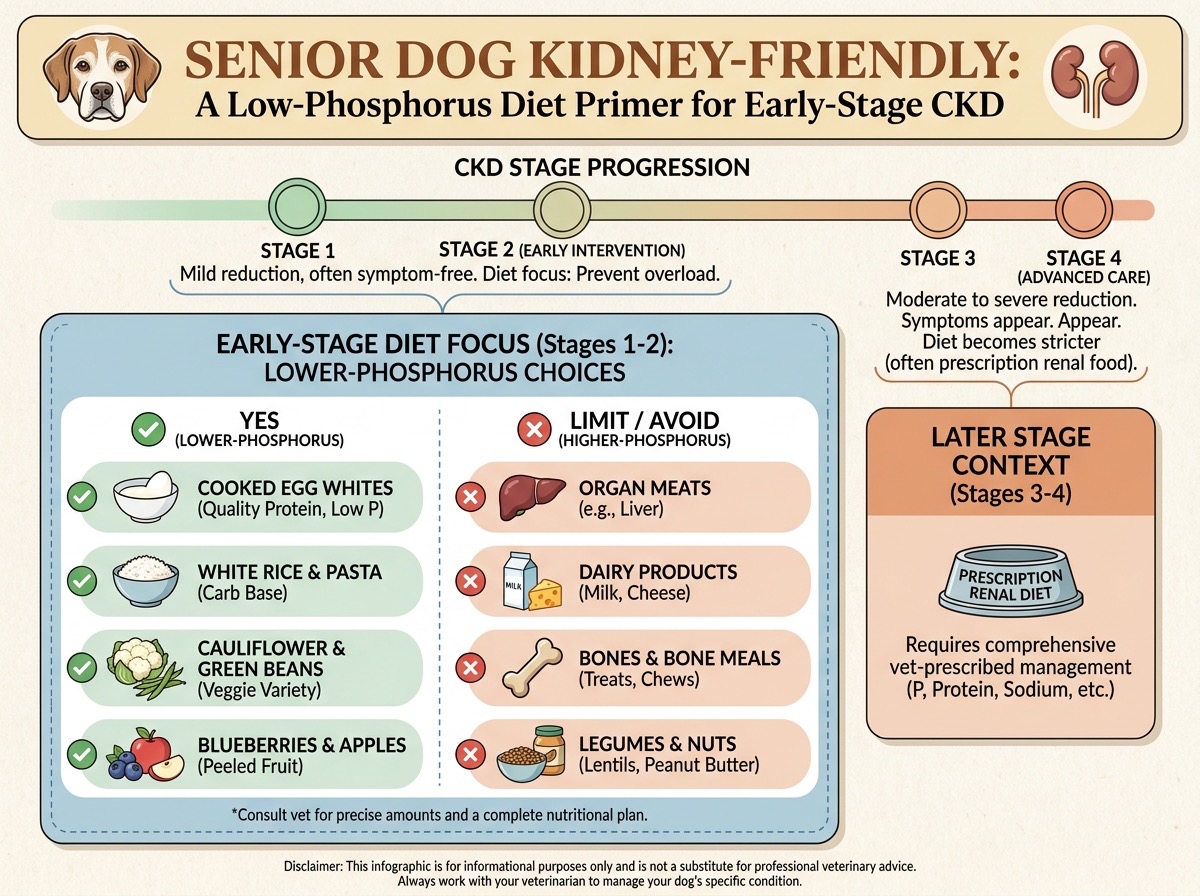
The stages of CKD
The International Renal Interest Society (IRIS) staging system categorises CKD by blood values:
Stage 1: normal or near-normal
- Creatinine: less than 1.4 mg/dL (dogs)
- SDMA: less than 18 μg/dL
- Symptoms: usually none. May have proteinuria or dilute urine
- Treatment: monitoring, possibly a kidney-protective diet
Stage 2: mild
- Creatinine: 1.4-2.0 mg/dL
- SDMA: 18-35 μg/dL
- Symptoms: mild PU/PD (drinking more, urinating more)
- Treatment: kidney diet, phosphate binders if needed
Stage 3: moderate
- Creatinine: 2.1-5.0 mg/dL
- SDMA: 36-54 μg/dL
- Symptoms: moderate PU/PD, weight loss, inappetence
- Treatment: kidney diet, phosphate binders, anti-nausea medication, ACE inhibitor
Stage 4: severe
- Creatinine: greater than 5.0 mg/dL
- SDMA: greater than 54 μg/dL
- Symptoms: severe PU/PD, vomiting, weight loss, lethargy
- Treatment: aggressive supportive care, possible hospitalisation
The earlier the stage, the more effective the diet. A dog started on a kidney diet at stage 2 lives significantly longer than a dog switched at stage 3.
The diet principles for CKD
The kidney diet is built on four principles:
1. Restricted phosphorus
The most important modification. Phosphorus accumulation in the blood (hyperphosphatemia) is a major driver of CKD progression. The phosphorus causes:
- Mineralisation of soft tissues: including the kidneys, accelerating damage
- Secondary hyperparathyroidism: the parathyroid glands respond to high phosphorus by producing PTH, which leaches calcium from the bones
- Itching: severe hyperphosphatemia causes pruritus
The phosphorus restriction is the cornerstone of the kidney diet. The restriction level depends on the stage:
- Stage 1: 0.6-1.0% phosphorus on a dry matter basis
- Stage 2: 0.4-0.8% phosphorus
- Stage 3-4: 0.2-0.5% phosphorus (with phosphate binders)
A kidney diet at stage 2 typically has 50-70% less phosphorus than a maintenance adult diet. The reduction is achieved by limiting high-phosphorus ingredients (meat, eggs, dairy) and using low-phosphorus ingredients (white rice, vegetables).
2. Moderate, high-quality protein
The old recommendation was severe protein restriction. The current recommendation is moderate restriction, with high-quality protein:
- Protein restriction: reduces nitrogenous waste products (urea, ammonia) that the kidney can't excrete
- High-quality protein: provides essential amino acids without excess waste
- Eggs, chicken, fish, whey: high biological value, lower waste per gram of protein
- Plant proteins: lower biological value but lower phosphorus
The current recommendation: 14-20% protein on a dry matter basis for stage 2-3 CKD. Higher in stage 1 (the protein restriction isn't needed until the kidney is significantly compromised). Lower in stage 4 (when the dog is uremic and needs minimal protein waste).
3. Reduced sodium
The sodium restriction helps control hypertension, which is common in CKD dogs. The restriction:
- Reduces fluid retention
- Lowers blood pressure
- Slows kidney damage
Most kidney diets have 0.2-0.4% sodium on a dry matter basis. Maintenance diets typically have 0.5-1.0%.
4. Increased omega-3 fatty acids (EPA/DHA)
The omega-3s have anti-inflammatory effects on the kidney and may slow progression. The sources:
- Fish oil (highest EPA/DHA per gram)
- Algal oil (plant-based, suitable for dogs with fish allergies)
- Flaxseed oil (less EPA/DHA, more ALA)
The recommended dose for CKD dogs: 50-100 mg/kg EPA+DHA per day. Higher than the general recommendation for healthy dogs.
5. Increased B vitamins
Water-soluble B vitamins (especially B12, folate, B6) are lost in the urine of CKD dogs. The increased loss contributes to:
- Poor appetite
- Anemia
- Neurological signs
A kidney diet should be supplemented with B vitamins, or the owner should give a B-complex supplement.
6. Added antioxidants
Vitamins C, E, and beta-carotene help reduce oxidative stress in the kidney. Most prescription kidney diets include enhanced antioxidants.
7. Increased fibre and reduced fat
Fibre helps reduce nitrogenous waste in the colon (the colonic bacteria use ammonia and other waste products). Reduced fat supports weight management.
The prescription kidney diets
The prescription kidney diets are formulated specifically for CKD dogs. The major brands:
Hill's Prescription Diet k/d (Kidney Care)
- Phosphorus: low (restricted)
- Protein: moderate, high-quality
- Sodium: low
- Omega-3s: enhanced
- Forms: dry, wet (multiple flavours)
- Stages: original k/d for stage 2-3, k/d early for stage 1-2, k/d + Mobility for combined kidney and joint issues
Hill's k/d is the most widely recommended prescription kidney diet. The clinical evidence for slowing CKD progression is strong. The palatability is generally good.
Royal Canin Renal Support
- Phosphorus: low
- Protein: moderate, high-quality
- Sodium: low
- Omega-3s: enhanced
- Forms: dry, wet (multiple flavours — A, F, S, T, D for different palatability preferences)
- Stages: Early Renal (stage 1-2), Renal (stage 2-3), Renal + Hypoallergenic (for dogs with food sensitivities)
Royal Canin's range is broader than Hill's. The Renal Support diets come in multiple flavours to accommodate picky CKD dogs.
Purina Pro Plan Veterinary Diets NF (Kidney Function)
- Phosphorus: low
- Protein: moderate
- Sodium: low
- Omega-3s: enhanced
- Forms: dry, wet
Purina NF is the third major option. The clinical evidence is strong.
The choice
For most dogs, the choice between Hill's, Royal Canin, and Purina is a matter of palatability preference. The formulations are similar in the key principles. The dog eats the prescription kidney diet that the dog will actually eat. A prescription diet that the dog refuses is useless.
The owner should try multiple options to find the one the dog prefers. The flavours, textures, and formulations vary. The owner should not give up if the first diet is refused.
The transition to a kidney diet
The transition is gradual. CKD dogs often have reduced appetite, and a sudden diet change can cause food refusal.
The transition protocol (over 7-14 days)
- Days 1-3: 75% current diet, 25% kidney diet
- Days 4-6: 50/50
- Days 7-9: 25% current diet, 75% kidney diet
- Day 10+: 100% kidney diet
Watch for:
- Refusal to eat: slow the transition
- Vomiting or diarrhea: slow the transition or stop temporarily
- Decreased appetite: try a different flavour or texture
For picky CKD dogs:
- Warm the food slightly (to body temperature) to enhance smell
- Add a small amount of warm water to the dry food (softens the kibble, releases aroma)
- Try multiple flavours
- Try wet food if the dog refuses dry food
- Don't leave food out for extended periods (refresh the food 2-3 times per day)
The phosphate binders
In addition to the diet, phosphate binders are often prescribed for CKD dogs. The binders:
- Bind phosphorus in the intestines, preventing absorption
- Lower blood phosphorus further than diet alone
- Allow more flexibility in the diet (the owner can use a less aggressive phosphorus-restricted diet and add binders)
The common phosphate binders:
- Aluminum hydroxide: the most common. Effective and inexpensive. Can cause constipation (use with a stool softener)
- Calcium carbonate (Tums): less effective than aluminum hydroxide but readily available
- Lanthanum carbonate (Renalzin): newer, well-tolerated, more expensive
- Sevelamer (Renagel): a polymer-based binder, used in human medicine, sometimes used in dogs
The binder is mixed with food. The dose is adjusted based on blood phosphorus levels.
The protein quality considerations
The kidney diet restricts the overall protein amount. But the protein should be high-quality:
- High biological value: proteins that provide all essential amino acids without excess waste
- Eggs, chicken, fish, whey: high biological value
- Plant proteins: lower biological value but lower phosphorus
In commercial kidney diets, the protein source is carefully selected to maximise biological value. The owner who feeds a home-cooked kidney diet should work with a veterinary nutritionist to ensure the protein is high-quality and the overall formulation is correct.
The home-cooked kidney diet
A home-cooked kidney diet is appropriate for dogs that refuse commercial kidney diets or that have multiple dietary needs. The home-cooked diet must be formulated by a veterinary nutritionist (DACVN) — not by a blog, a book, or a pet food manufacturer's marketing.
The home-cooked kidney diet typically includes:
- A high-quality protein source (egg whites, chicken breast, lean meat), at a controlled amount
- A low-phosphorus carbohydrate (white rice, pasta, potato)
- Vegetables (green beans, zucchini, carrots, squash)
- A calcium supplement (calcium carbonate or bone meal) — the calcium binds phosphorus in the gut
- An omega-3 supplement (fish oil)
- A B-vitamin supplement
- A phosphorus-free salt substitute (potassium chloride)
The home-cooked diet must be balanced for the specific dog's stage, body weight, and other conditions. A generic "low phosphorus" recipe is not adequate.
The treats
The treats must also fit the kidney diet principles:
- Low phosphorus: avoid dairy, treats with meat/bone meal, treats with added minerals
- Moderate protein: avoid high-protein treats
- Low sodium: avoid commercial treats with added salt
- Safe treats: apple slices, banana, blueberries, watermelon, green beans, carrots (all in moderation)
The owner who gives the dog a cheese stick, a jerky treat, or a commercial biscuit is undoing the kidney diet. The treats should be coordinated with the vet and the nutritionist.
The "early stage" protocol
For dogs in early CKD (IRIS stage 1-2):
- Annual or bi-annual bloodwork to monitor progression
- Switch to a kidney-supportive diet (Hill's k/d early, Royal Canin Early Renal)
- Omega-3 supplementation (fish oil)
- Phosphorus monitoring (blood phosphorus every 6 months)
- Blood pressure monitoring (every 6 months)
- Watch for PU/PD changes at home
At this stage, the goal is to slow progression. The diet change is the most powerful intervention.
The "moderate stage" protocol
For dogs in moderate CKD (IRIS stage 3):
- Bloodwork every 3-6 months
- Prescription kidney diet (Hill's k/d, Royal Canin Renal)
- Phosphate binders if blood phosphorus is high
- ACE inhibitor (benazepril, enalapril) to reduce proteinuria
- Anti-nausea medication (maropitant) if appetite is poor
- Subcutaneous fluids if dehydration is present
- Appetite stimulant (mirtazapine) if appetite is poor
At this stage, the goal is to manage the clinical signs and slow further progression. Quality of life is the focus.
The "severe stage" protocol
For dogs in severe CKD (IRIS stage 4):
- Frequent bloodwork (every 1-3 months)
- Aggressive supportive care
- Prescription kidney diet (continued)
- Phosphate binders
- Anti-nausea medication
- Subcutaneous fluids (often daily)
- Appetite stimulant
- Possible hospitalisation for crisis management
- Quality-of-life assessment
At this stage, the goal is to maintain quality of life for as long as possible. The owner's commitment and the dog's response to treatment determine the timeline.
The "renal crisis" emergency
A renal crisis is an acute worsening of CKD. The triggers:
- Dehydration (especially from vomiting, diarrhea, or inadequate water intake)
- Infection (UTI is common in CKD)
- Medication reaction
- Stress
The signs:
- Sudden lethargy, inappetence, vomiting
- Acute worsening of PU/PD
- Severe dehydration
The action: immediate vet care. The dog may need IV fluids, hospitalisation, and supportive care. The renal crisis is reversible with prompt treatment. Without treatment, the dog may progress to stage 4 or die.
The "picky CKD dog"
CKD dogs are often picky eaters. The reduced appetite is caused by:
- Uremic nausea: elevated urea causes nausea
- Oral ulcers: uremic ulcers in the mouth make eating painful
- Diet change: the new kidney diet is unfamiliar
- Reduced smell: the dog's ability to smell food is reduced
The solutions:
- Anti-nausea medication: maropitant (Cerenia) or ondansetron. Given daily, the medication can dramatically improve appetite
- Wet food: warming the food enhances smell. Multiple small meals per day
- Multiple flavours: try different kidney diet options. Some dogs prefer one flavour, some prefer another
- Appetite stimulant: mirtazapine (a human antidepressant that stimulates appetite in dogs)
- Feeding tube: for dogs with persistent inappetence, an oesophageal feeding tube can provide nutrition without the stress of oral eating
The "end stage" considerations
For dogs approaching end-stage CKD:
- Quality-of-life assessment using the HHHHHMM scale
- Consideration of euthanasia when the quality of life is poor
- Palliative care: pain management, anti-nausea, fluids, comfort
- The owner's role: providing comfort, monitoring, and making the difficult decision
The dog in end-stage CKD is not in pain (the kidney itself is not painful), but the dog has clinical signs (nausea, lethargy, inappetence) that reduce quality of life. The quality-of-life assessment guides the decision.
The bottom line
CKD is a common, manageable condition in senior dogs. The diet is the most powerful intervention, particularly when started at stage 1-2. The prescription kidney diets (Hill's k/d, Royal Canin Renal, Purina NF) are formulated specifically for CKD dogs and have clinical evidence supporting their use. The phosphorus restriction, the moderate high-quality protein, the reduced sodium, and the enhanced omega-3s work together to slow progression and extend survival. The transition is gradual, the treats must fit, and the picky CKD dog may need anti-nausea medication and appetite stimulants. The dog started on the kidney diet at stage 2 lives 2-4 years longer than the dog switched at stage 3. The earlier, the better. The diet is the foundation. The medication, the binders, and the supportive care build on the foundation. The dog that is well-managed lives a full, good life. The owner that invests in the diet has more years with the dog. The science is clear, the products are available, the result is significant.
---
About the author: [Sarah Chen](../Sarah%20Chen.md) holds a DVM from Cornell and a PhD in Animal Nutrition from UC Davis, with 12 years of clinical nutrition consulting, board certification by the American College of Veterinary Nutrition, and over 30 peer-reviewed publications.