
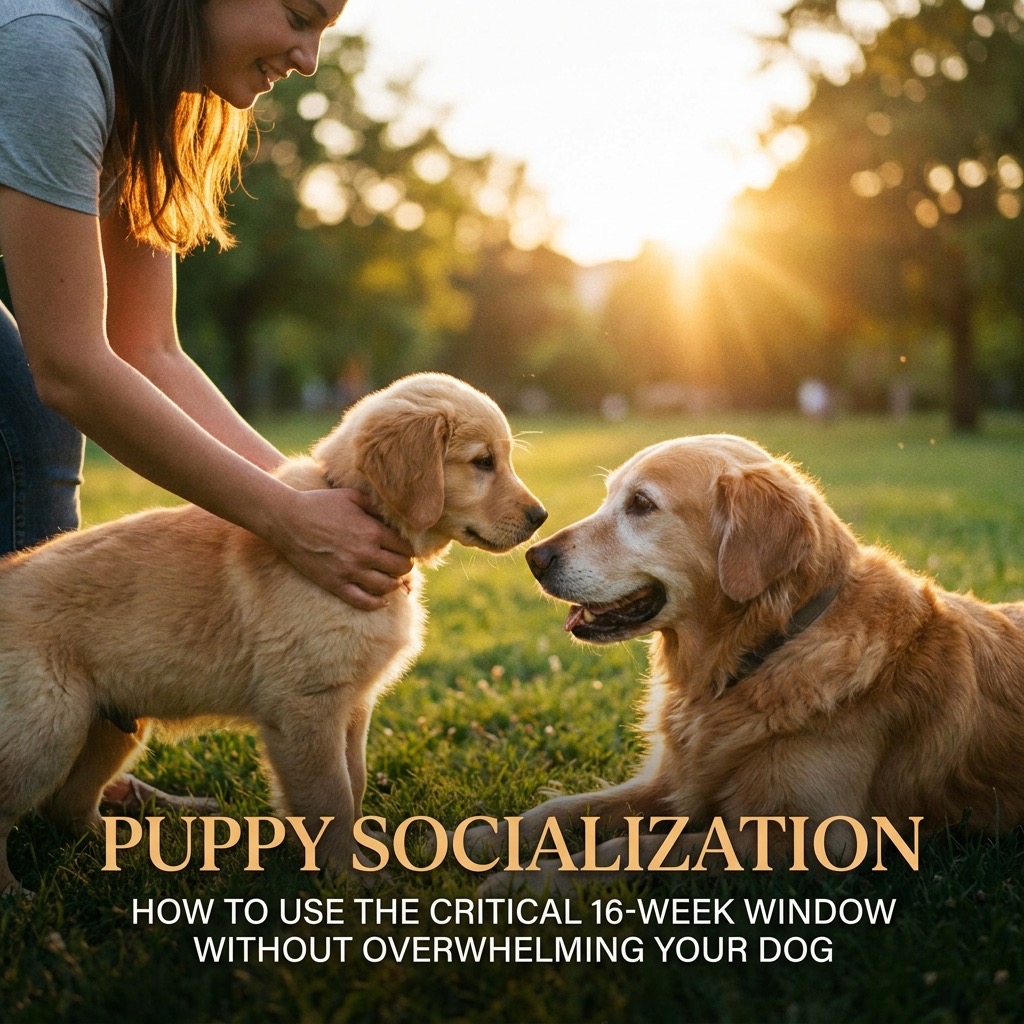
Puppy socialization: how to use the critical 16-week window without overwhelming your dog
Every dog trainer talks about socialization. Most puppy owners think they are doing it. The dogs I see at 18 months for reactivity consultations almost always have the same story: the owner thought they had socialized the puppy, but what they actually did was the wrong thing at the wrong intensity at the wrong age.
A socialized dog is not a dog that has met a lot of other dogs. A socialized dog is a dog that has had positive, controlled exposure to the full range of stimuli it will encounter as an adult — and has learned that novel things are not threats. That requires a specific protocol, used in a specific window, with specific attention to the puppy's emotional state.
This is the protocol that produces confident, stable adult dogs, broken down week by week.
Why the 16-week window matters
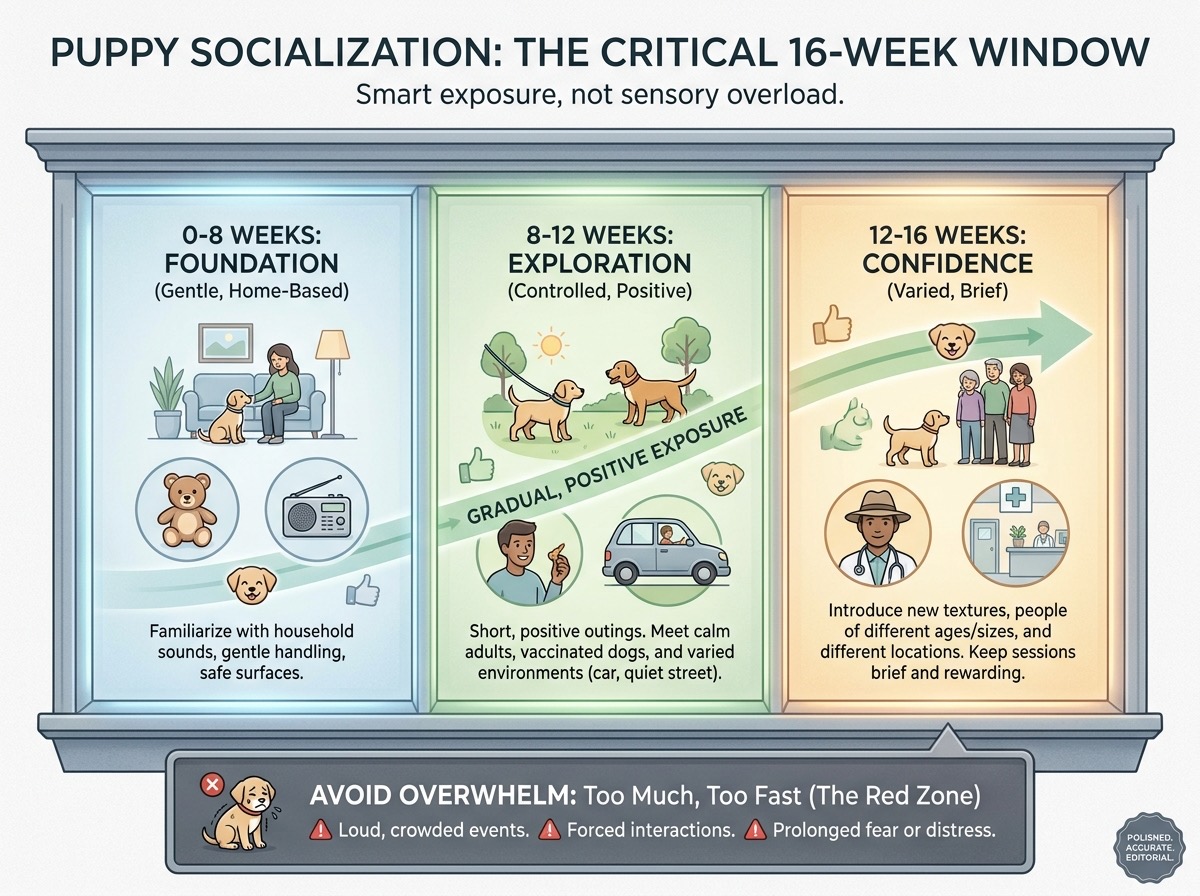
The primary socialisation period in dogs runs from approximately 3 weeks to 12-16 weeks of age. During this window:
- The puppy's brain is maximally receptive to forming positive associations with novel stimuli
- The amygdala (fear centre) is still developing, and the puppy's fear response to novel stimuli is muted
- After about 12-14 weeks, the window begins to close, and novel stimuli are increasingly processed through a fear framework rather than a curiosity framework
This is not a guess or a theoretical framework. The research — including the landmark work by John Paul Scott and John Fuller in the 1960s, and subsequent work by Michael Fox, Ian Dunbar, and others — is consistent. Puppies isolated from novel stimuli during this window become neophobic adults. Puppies exposed to a wide range of positive stimuli during this window become confident adults.
The 16-week cutoff is the upper bound. By 12 weeks, the window is well into its closing phase. By 16 weeks, it's essentially closed. From 16 weeks on, socialisation becomes "behaviour modification" — slower, harder, less reliable.
This is why timing matters more than volume. A puppy that meets 100 dogs between 8 and 12 weeks is in worse shape than a puppy that meets 20 dogs in well-managed sessions between 8 and 12 weeks.
The four categories of socialisation
Socialisation is not just "meet other dogs". It's exposure to four distinct categories of stimulus:
1. Intraspecific — other dogs
Meeting other friendly, healthy, vaccinated dogs of various sizes, ages, breeds, and play styles. Puppies need to learn dog body language, bite inhibition, and play skills from other dogs.
2. Interspecific — other species
Cats, other household pets, livestock (for farm dogs), and people of all kinds. The puppy needs to learn that humans, cats, birds, and other creatures are part of normal life.
3. Environmental — novel surfaces, places, sounds
Different floorings (wood, tile, grass, gravel, metal grates, wobble boards), different locations (vet clinic, pet store, friend's house, car, elevator), different sounds (thunder, fireworks, vacuum, hair dryer, sirens, construction).
4. Human — different types of people
Men, women, children, babies, elderly people, people in hats, people with beards, people in uniforms, people using mobility aids, people of different ethnicities, people carrying bags, people on bikes. The more variety, the better.
A common mistake: owners socialise category 1 (other dogs) and ignore categories 2-4. Adult reactivity is rarely dog-dog reactivity alone. It's usually dog-environment, dog-stranger, or dog-sound reactivity. These come from missed categories 2-4.
The fear imprint period: 8-11 weeks
Within the larger 16-week window, there is a sub-period of heightened fear sensitivity at 8-11 weeks. During this period, single negative experiences can have an outsized effect on the puppy's long-term behaviour.
This is the period when:
- A puppy that gets attacked at a dog park can become dog-reactive for life
- A puppy that experiences a thunderstorm can become noise-phobic
- A puppy that has a painful vet visit can become vet-phobic
The fear imprint period is not a reason to avoid socialisation. It's a reason to do it carefully, with attention to the puppy's emotional state, and to choose controlled, positive experiences over chaotic ones.
In practical terms: this is the period to avoid dog parks, pet stores during peak hours, large parties, and any situation where the puppy is likely to be overwhelmed. The puppy should still meet new people, see new places, and hear new sounds — but at a low, controlled intensity.
The week-by-week protocol
Weeks 3-5 (breeder phase)
If you're getting the puppy from a breeder, the socialisation that happens at the breeder's home in weeks 3-5 is the foundation. Look for a breeder who:
- Handles the puppies daily, including gently touching paws, ears, mouth, and tail (preparing for vet exams and grooming)
- Exposes puppies to household sounds (TV, vacuum, kitchen noises)
- Allows puppies to see and smell household cats and other pets
- Has a variety of surfaces in the whelping area (carpet, tile, newspaper, grass)
- Begins potty training exposure
You can't control what happens at the breeder's, but you can choose a breeder who takes this seriously. The difference between a well-socialised 8-week-old and a poorly-socialised 8-week-old is largely determined by the breeder's protocol.
Week 8 (homecoming week)
The puppy arrives at your home. The first week is for decompression. The puppy has just left its mother and littermates, and is in a new environment. The goal is to:
- Establish a quiet, predictable routine
- Let the puppy explore its new home at its own pace
- Begin crate training, name recognition, and basic handling
- Limit exposure to novel stimuli to the home environment
Do NOT bring the puppy to the dog park, pet store, or a busy street in week 8. Let the puppy settle in.
Weeks 8-12 (the critical socialisation period)
The four most important weeks of the puppy's life for socialisation. The goal is to introduce the puppy to 7-10 new positive experiences per week across all four categories. Track them in a journal.
Examples of weekly experiences:
- Week 9: meet a calm adult dog (friend's dog, vaccinated); walk on a new surface (gravel); meet 2-3 new people (including a child); hear a vacuum cleaner at distance; ride in a car to a quiet location
- Week 10: meet 2 new dogs; walk on grass, then on pavement; meet a person with a hat; visit a quiet pet store; hear a hair dryer; experience an elevator
- Week 11: meet a calm puppy; walk on a wobble board or unstable surface; meet a person in a uniform; visit a friend's house with a cat (controlled); hear a thunder recording at low volume; ride a bus or train
- Week 12: meet a small dog and a large dog; walk on metal grates; meet an elderly person with a cane; visit the vet for a happy visit (no needles); hear a siren; walk in a busy area at distance
Each experience should be paired with high-value food and play, and the puppy should be allowed to retreat if it wants to. The puppy's emotional state — relaxed, curious, or fearful — is more important than completing the checklist.
Weeks 12-16 (the closing window)
The window is closing, but it's not closed. The intensity of socialisation can increase:
- More challenging environments (busier streets, longer outings)
- More diverse dog interactions
- Beginning of structured puppy classes
- Car rides to different locations
- New people in more varied contexts
The fear imprint period is fading. The puppy can handle more novel experiences, but the owner should still watch for signs of stress (whale eye, lip licking, yawning, tucked tail, hiding).
What "positive" actually means
The single most important concept in puppy socialisation: it's not enough to expose the puppy to a stimulus. The puppy must form a positive association with the stimulus. The technical term is "counter-conditioning and desensitisation" — but in plain English, the puppy needs to like, or at least feel neutral about, what it's experiencing.
A puppy that meets 30 other dogs but is knocked over by rude dogs is not socialised — it's overwhelmed. A puppy that goes to a busy pet store but is trampled by children is not socialised — it's terrified. A puppy that hears a vacuum cleaner at full volume is not socialised — it's noise-phobic.
The protocol for ensuring positive associations:
Body language check
Before, during, and after each exposure, watch the puppy for:
- Relaxed: soft body, wagging tail, exploratory behaviour, willingness to take treats
- Curious: ears forward, sniffing, approach-retreat behaviour, willing to investigate
- Stressed: tucked tail, lowered body, ears back, lip licking, whale eye (showing whites of eyes), yawning, panting
- Fearful: hiding, trembling, refusing treats, vocalising, urinating
If the puppy shows stress, increase distance from the stimulus, decrease intensity, or end the session. Pushing through fear doesn't socialise — it sensitises.
Food pairing
Bring high-value treats (freeze-dried chicken, cheese, hot dogs) on every socialisation outing. Each new experience is paired with treats. The puppy learns: new thing = treats appear. The new thing becomes a predictor of good things.
Choice and control
Allow the puppy to approach new stimuli at its own pace. Don't drag the puppy toward a child or another dog. If the puppy wants to retreat, let it. The act of choosing to investigate is what builds confidence.
Short sessions
A 5-minute positive exposure is more socialisation than a 30-minute overwhelming one. Multiple short exposures across a week are better than one long outing.
The "puppy class" question
A well-run puppy class is one of the most efficient socialisation tools. The puppy:
- Meets other puppies of similar age in a controlled environment
- Learns bite inhibition from feedback
- Experiences novel surfaces, sounds, and people
- Learns basic cues (sit, down, come, focus)
- Is exposed to handling (vet exam simulations, grooming simulations)
What makes a puppy class good:
- Puppies are 8-16 weeks old (within the socialisation window)
- All puppies are health-checked and have started vaccinations
- The class is small (under 8 puppies)
- The instructor uses positive reinforcement only
- Off-leash play is supervised and short (5-10 minutes max per session)
- The focus is on socialisation, not obedience
- The instructor intervenes when play gets too rough
What makes a puppy class bad:
- Puppies are over 16 weeks
- Puppies are unvaccinated
- The class is large (over 10 puppies)
- The instructor uses corrections, choke chains, or prong collars
- Off-leash play is unstructured and extends for the full hour
- The focus is on obedience (sit, down, stay) at the expense of socialisation
A great puppy class is worth more than months of "socialisation" at the dog park. A bad puppy class is worse than no class at all.
Common mistakes that produce reactive dogs
A list of well-intentioned but counterproductive actions:
"I waited until he had all his shots"
Vaccinations are complete at 16 weeks. The socialisation window closes at 16 weeks. Waiting until vaccinations are complete means socialisation never happens. The risk of behavioural euthanasia at 18 months (for an undersocialised, reactive dog) is far higher than the risk of contracting parvovirus in a controlled puppy class.
The AVSAB (American Veterinary Society of Animal Behaviour) and most modern veterinary behaviourists recommend starting socialisation at 7-8 weeks, with appropriate precautions (avoid dog parks, pet stores with unknown dogs, areas with high parvo exposure; choose clean puppy classes with vaccinated puppies).
"We go to the dog park every day"
Dog parks are not appropriate for puppies under 16 weeks. The play is unstructured, the dogs are often rude or aggressive, and the puppy is likely to be overwhelmed. The dog park is a venue for well-socialised adult dogs to exercise. It is not a socialisation venue for puppies.
"He loves people, so I don't worry about other dogs"
The puppy that loves people but has never met other dogs is the puppy that becomes dog-reactive at maturity. The puppy that loves dogs but has never met people with hats is the puppy that barks at every person in a hat for life. Socialisation is across all four categories.
"I took him to a parade on the 4th of July"
Fireworks, parades, and large gatherings are exactly the wrong socialisation experiences for puppies. The puppy that experiences a loud, chaotic event during the fear imprint period can develop lifelong phobias. If the puppy is in the home during fireworks, keep it inside with white noise, treats, and comfort. Don't take a 10-week-old puppy to a parade.
"We socialised him with the neighbour's dog"
One dog is not socialisation. The puppy that meets one dog every day meets the same dog, in the same context, with the same play style. The puppy learns to love that one dog, but it doesn't learn to handle novel dogs. Socialisation means a variety of dogs.
"He's shy, so we don't push him"
The shy puppy needs more socialisation, not less. The shy puppy needs well-managed, positive exposures to a variety of stimuli, paired with food and at a pace the puppy can handle. Avoiding socialisation because the puppy is shy is the surest path to a fearful adult dog.
What to do if you get the puppy late
If you adopt a puppy at 14 weeks or later, the socialisation window is partly closed but not entirely. The protocol is the same, with adjustments:
- Even more attention to body language and emotional state
- Higher-value treats
- Smaller, more controlled exposures
- Possibly a behaviourist consult for a structured plan
A late-socialised puppy will never be as confident as an early-socialised one, but with work, it can be a stable, manageable adult. The window doesn't slam shut at 16 weeks — it gradually closes over weeks 12-20. The earlier the work starts, the better the outcome.
What to do if you get an undersocialised adult dog
For an undersocialised adult dog (rescue, rehomed, or simply not socialised as a puppy):
- The work is behaviour modification, not socialisation
- The protocol is similar but slower
- A veterinary behaviourist or experienced positive-reinforcement trainer is essential
- The dog may never be "socialised" in the puppy sense, but it can learn to cope with novel stimuli
- Medication may be part of the plan (fluoxetine, clomipramine) for severe cases
Don't attempt to "socialise" an undersocialised adult dog by throwing it into novel situations. This is the fastest path to a bite. Work with a professional.
The bottom line
Puppy socialisation is the highest-leverage thing you'll do for your dog in its lifetime. Done right in the 8-16 week window, it produces a confident, stable adult. Done wrong — late, with negative experiences, or only in one category — it produces a reactive adult that's a candidate for behavioural euthanasia at 18 months. The protocol isn't complicated: 7-10 positive exposures per week across all four categories, with attention to the puppy's emotional state, food pairing, and short sessions. The cost is a few hours a week. The benefit is a dog that fits into your life for the next 12-15 years.
---
About the author: [Marcus Whitfield](../Marcus%20Whitfield.md) is a Certified Applied Animal Behaviourist (CABC) and MS in Animal Behaviour from the University of Edinburgh, with 16 years of clinical practice focused on canine fear, aggression, and anxiety disorders.