
Obedience foundations: the marker-word + reward mechanic that makes everything else possible
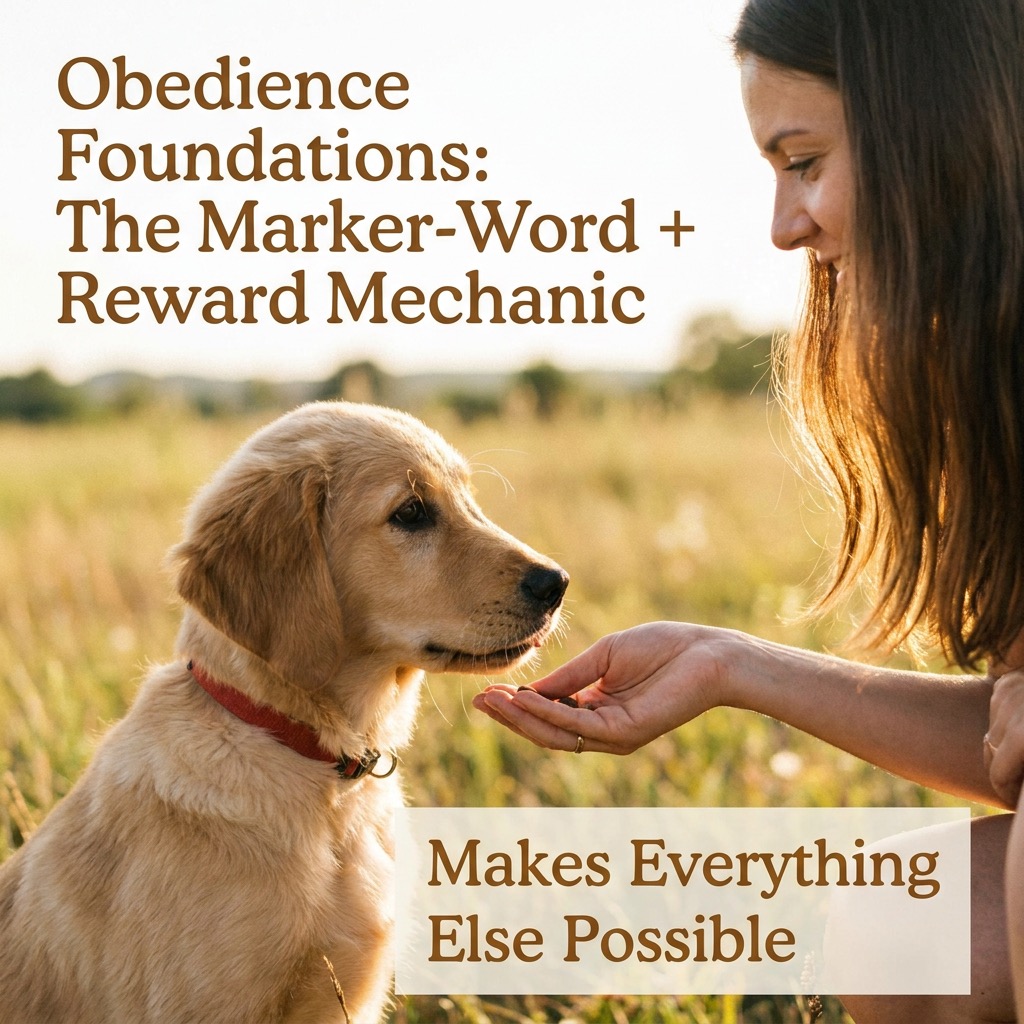
If there is one mechanic that explains why some owners can teach their dogs dozens of behaviours and others cannot teach "sit", it is the marker + reward mechanic. Get it right and every other training technique — luring, shaping, capturing, chaining — becomes dramatically easier. Get it wrong and you will be confused about why your dog "doesn't listen" for the rest of your life together.
This is the mechanic, and the protocol for teaching it to your dog in three sessions.
What the marker + reward actually is
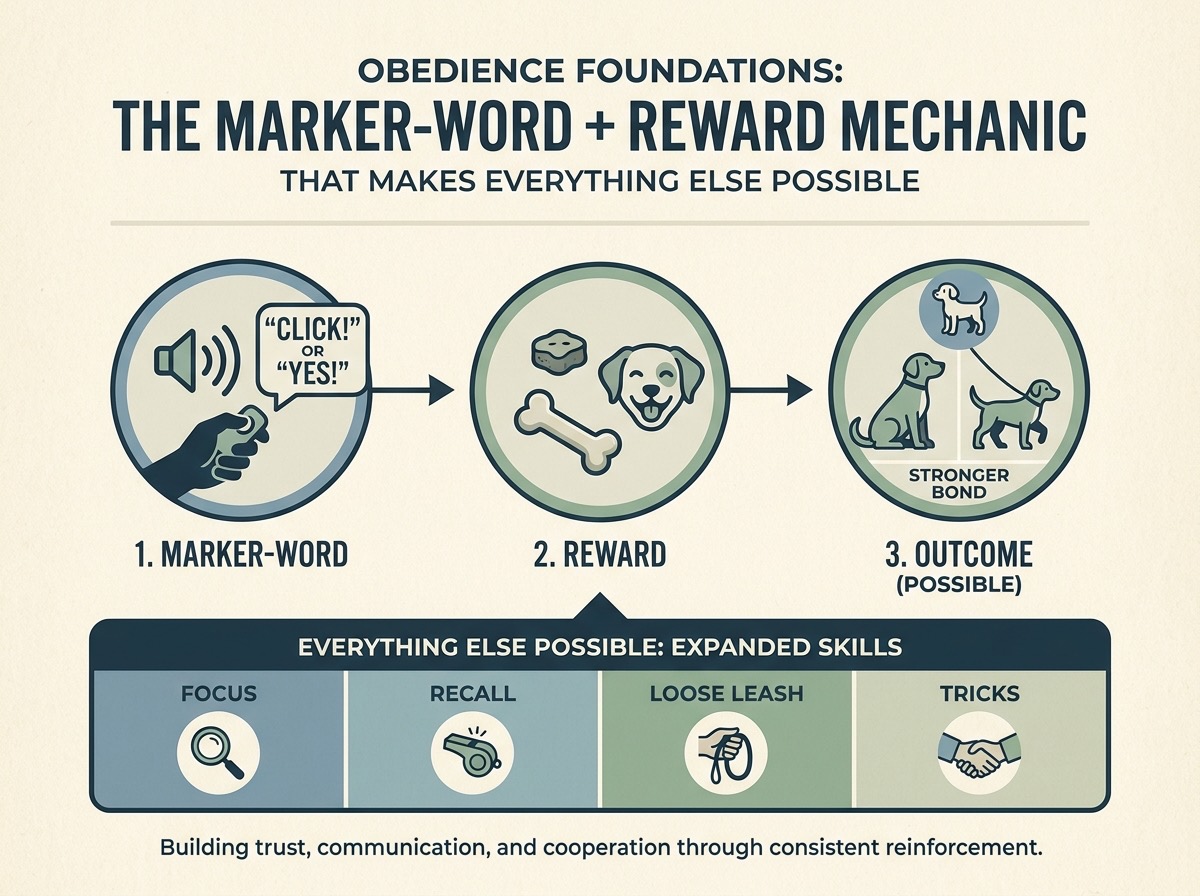
The mechanic has three parts:
- The behaviour: the dog does something you want (looks at you, sits, lies down, comes toward you)
- The marker: a precise signal that tells the dog "what you just did is exactly right, and a reward is coming"
- The reward: the actual treat, delivered within 1–2 seconds of the marker
The marker is the missing piece most owners never develop. They say "good boy" sometimes when the dog does something they like, and they give a treat sometimes when the dog is nearby. The dog has no way to connect the two events reliably. The marker + reward mechanic replaces this with a precise, repeatable communication system.
The marker can be:
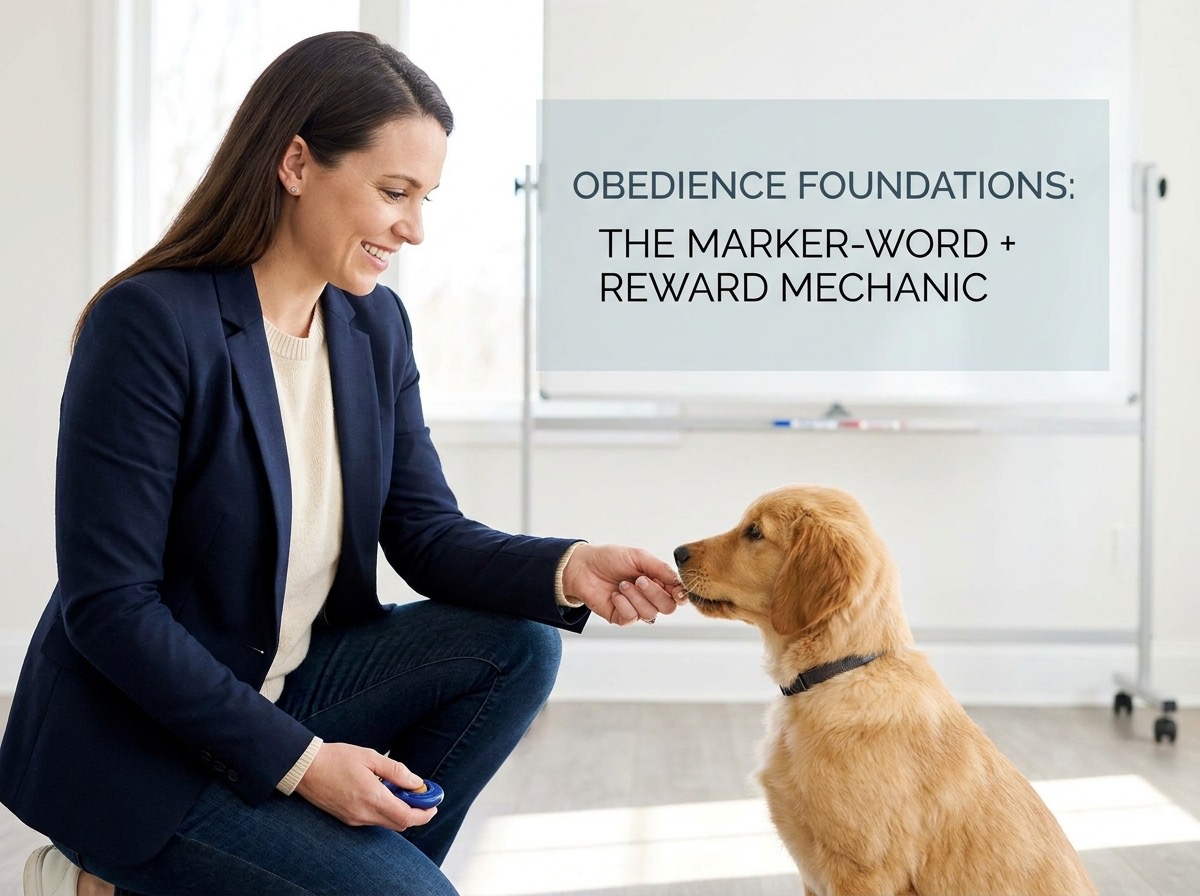
- A clicker: a small plastic device that makes a distinctive "click" sound. Most precise because the sound is consistent and brief
- A verbal marker: a single short word said in the same tone every time. "Yes!" works well. "Good" works. "Click" works (if you always say it the same way). Avoid phrases like "good boy" — too many syllables, too slow
- A hand signal: less common, but works for deaf dogs or specific situations
The reward should be:
- Immediate: within 1–2 seconds of the marker. The marker tells the dog "the reward is coming", and the delivery confirms it. The longer the gap between behaviour and reward, the less reliable the learning
- High-value: for foundational training, use real meat (chicken, hot dog, cheese), not kibble
- Small: pea-sized. The dog needs to eat it quickly to be ready for the next repetition
- Variable: vary the reward across training. Sometimes a treat, sometimes a quick play moment, sometimes verbal praise. The variability keeps the dog engaged
Why the marker is essential
Two reasons, both important.
1. Timing
You cannot deliver a treat at the exact moment the dog does the right behaviour. By the time your hand reaches the treat bag, opens it, finds a treat, and delivers it, the dog has likely done three other behaviours. The marker tells the dog "THAT one" with sub-second precision.
The clicker is so effective because it can be pressed in under 50 milliseconds. No verbal marker is faster than a clicker for precise timing.
2. Clarity
Without a marker, the dog has to guess which behaviour earned the reward. With a marker, the dog knows exactly which behaviour caused the reward. The learning is faster and cleaner.
The protocol: teaching the marker in 3 sessions
Session 1 (10 minutes): the click = treat
Goal: the dog learns that the click sound predicts food.
Setup:
- Clicker in one hand, treat pouch on the other side
- Dog in front of you, no distractions
- Quiet room
Procedure:
- Click.
- Immediately (within 1 second) deliver a treat from the other hand.
- Pause 3–5 seconds.
- Click.
- Immediately deliver a treat.
- Repeat 15–20 times in 5 minutes.
What you are teaching: "Click means food."
After 15–20 repetitions in the first session, you should see the dog's ears prick or eyes widen at the click sound. They have made the connection.
Session 2 (15 minutes): click = treat in different contexts
Goal: the dog learns that the click = treat rule applies anywhere, not just the training room.
Do session 1 in:
- Living room
- Kitchen
- Backyard (if quiet and fenced)
- A different room in the house
The dog should respond to the click by orienting toward you (anticipating the treat) in each new location.
Session 3 (15 minutes): click = treat with mild distractions
Goal: the dog learns that the click = treat rule still works when there are other things competing for attention.
Add mild distractions:
- Another person in the room (just sitting, not interacting with the dog)
- A toy on the floor
- Sounds from another room
The dog should still respond to the click. If the dog becomes too distracted to notice the click, you have added too much distraction. Drop back to a calmer environment.
After session 3, your dog is "marker-trained". Every future training session can use the clicker as a precision communication tool.
Using the marker to teach specific behaviours
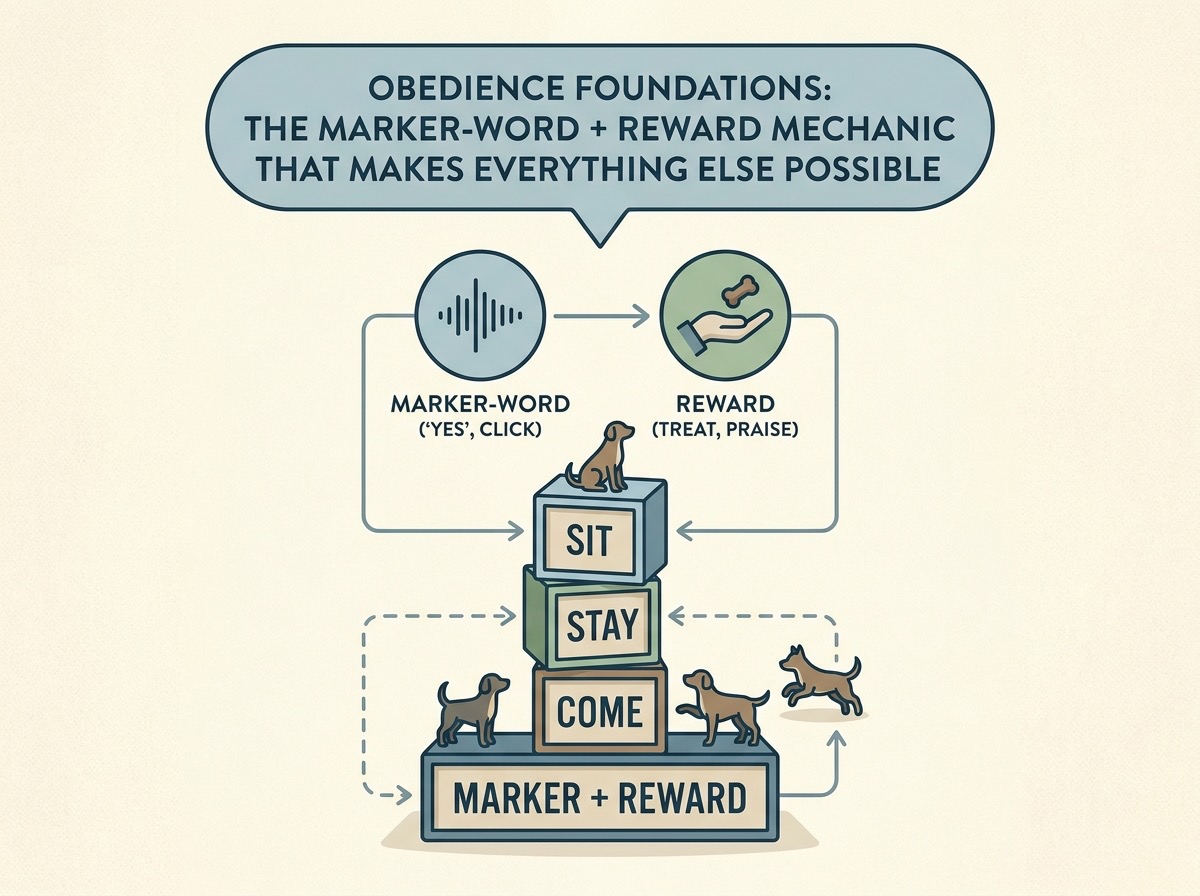
Once the marker is established, teaching any behaviour follows the same basic protocol:
Luring
Use a treat in your hand to guide the dog into the desired position. The instant the dog is in position:
- Click.
- Deliver the treat.
Example for "sit":
- Hold a treat near the dog's nose
- Move the treat slowly up and back over the dog's head
- The dog's nose follows the treat up, and as their head goes up, their hindquarters go down into a sit
- The instant their bum touches the floor: click, treat
After 5–10 successful repetitions, the dog is sitting in response to the hand signal. Then:
- Add the verbal cue "sit" just before you lure
- The dog hears "sit", then the lure guides the position
- After more repetitions, fade the lure (use a hand signal without a treat visible)
- Eventually, the dog sits on the verbal cue alone
Shaping
For behaviours you can't lure (a trick, a sequence), you click and treat successive approximations of the final behaviour.
Example for "spin":
- Click and treat any head turn to the side
- Then any head turn further (90°, 180°)
- Then any step in the direction of the turn
- Then any step further
- Then any step further
- Then a complete spin
The dog learns that each small movement toward the final behaviour is rewarded. The trainer shapes the final behaviour by clicking the right moments.
Shaping is more advanced than luring but is essential for teaching behaviours the dog wouldn't naturally offer.
Capturing
For behaviours the dog does naturally (lying down, barking, picking up a toy), you can click and treat the moment the behaviour happens.
Example for "down":
- Wait for the dog to lie down on their own (which happens eventually in a calm environment)
- The instant the dog's elbows touch the floor: click, treat
- After several repetitions, add the verbal cue "down" just before you predict the dog will lie down
Capturing is the simplest training mechanic but requires patience. The dog has to do the behaviour first; you can only reinforce what already exists.
Chaining
For sequences (go to your bed, then lie down), you build a chain by clicking the last behaviour first, then adding the previous one, and so on.
Example for "go to bed":
- Click and treat the dog for lying on their bed
- Then click and treat the dog for walking toward the bed
- Then click and treat the dog for walking to the bed from a few feet away
- Then click and treat the dog for going to the bed from across the room
- Then click and treat the dog for going to bed on the verbal cue
The chain is built from the end backward. Each link is a clickable, rewardable behaviour.
Common mistakes with the marker
1. Clicking without treating
The marker is a promise of a reward. If you click and don't deliver, the promise is broken and the dog's trust in the marker erodes. If you accidentally click, give a treat anyway ("reset the promise").
2. Treating without clicking
Treating without clicking is just feeding the dog. It doesn't teach anything because the dog doesn't know which behaviour earned the treat.
3. Late timing
Clicking 2–3 seconds after the behaviour is too late. The dog has already done several other things and doesn't know which behaviour was the right one. The click must be at the precise moment of the behaviour.
4. Clicking multiple times
One click per behaviour, then treat. Clicking twice in a row confuses the dog about which click matters.
5. Using the clicker to call the dog
The clicker is not a recall signal. It is a marker for behaviour. If you click and the dog doesn't come, you have not failed at training — you have used the marker in the wrong context.
6. "Charging" the clicker takes too long
Some owners drag the clicker-charging process out for weeks. Three sessions of 5–15 minutes is enough. If your dog is not responding to the click after 30–50 total repetitions, something else is wrong (distractions too high, treats not valuable enough, etc.).
What the marker cannot do
The marker + reward mechanic is powerful, but it has limits:
- Cannot eliminate fear-based behaviours: a fearful dog needs desensitization and counter-conditioning first, not clicker training
- Cannot suppress aggression without addressing the underlying cause: a marker can redirect, but a dog that bites out of fear needs behaviour work, not treats
- Cannot overcome physical limitations: a dog with hip dysplasia cannot be clicker-trained to jump higher
- Cannot teach behaviours the dog cannot physically do: anatomical limits exist
For these cases, the marker is one tool among many, not the entire solution.
The marker + reward and the rest of training
Once the marker is established, every other training technique becomes easier:
- Recall: click and treat the instant the dog turns toward you when called
- Leash walking: click and treat every step the dog walks on a loose leash
- Crate training: click and treat the instant the dog enters the crate
- Doorbell diving (the article I wrote about this): click and treat the dog for staying calm on the bed when the doorbell sounds
- Resource guarding prevention: click and treat the dog for being near you while they have a valuable resource
The marker + reward is the underlying mechanic. The behaviours are the application.
The bottom line
The marker + reward mechanic is the single most important training concept to teach your dog. It is the foundation under every other training technique. Three sessions of 5–15 minutes is enough to establish it. After that, every behaviour you want to teach becomes a structured application of click + treat + build to fluency. Dogs that have a strong marker + reward mechanic learn faster, communicate better with their owners, and have more reliable behaviour in distracting environments. Dogs without it are stuck in the guessing game of "did I do the right thing?". Establish the marker first. Everything else follows.
---
About the author: [Marcus Whitfield](../Marcus%20Whitfield.md) is a Certified Canine Behavior Consultant (CBCC-KA) with 20+ years of practice, and a member of the American Society for Animal Behavior. He has supported more than 3,000 families with canine behaviour challenges.