
Prescription diets: the hydrolyzed protein principle and why it works
When a dog has a confirmed cutaneous adverse food reaction (CAFR), the question is no longer "what protein should I try next." The question is "how do I take the protein out of the equation entirely so the immune system has nothing left to react to." The answer that has the strongest evidence behind it is hydrolyzed protein. In this article I will walk through what hydrolysis actually does at the molecular level, why it bypasses the immune system in a way that simply switching to a "novel" protein cannot, and which commercial prescription diets actually deliver a true hydrolyzate versus those that are just marketing. I will also cover the most common protocol errors I see in practice and what to do when the hydrolyzed diet does not appear to work.
What hydrolysis does to a protein
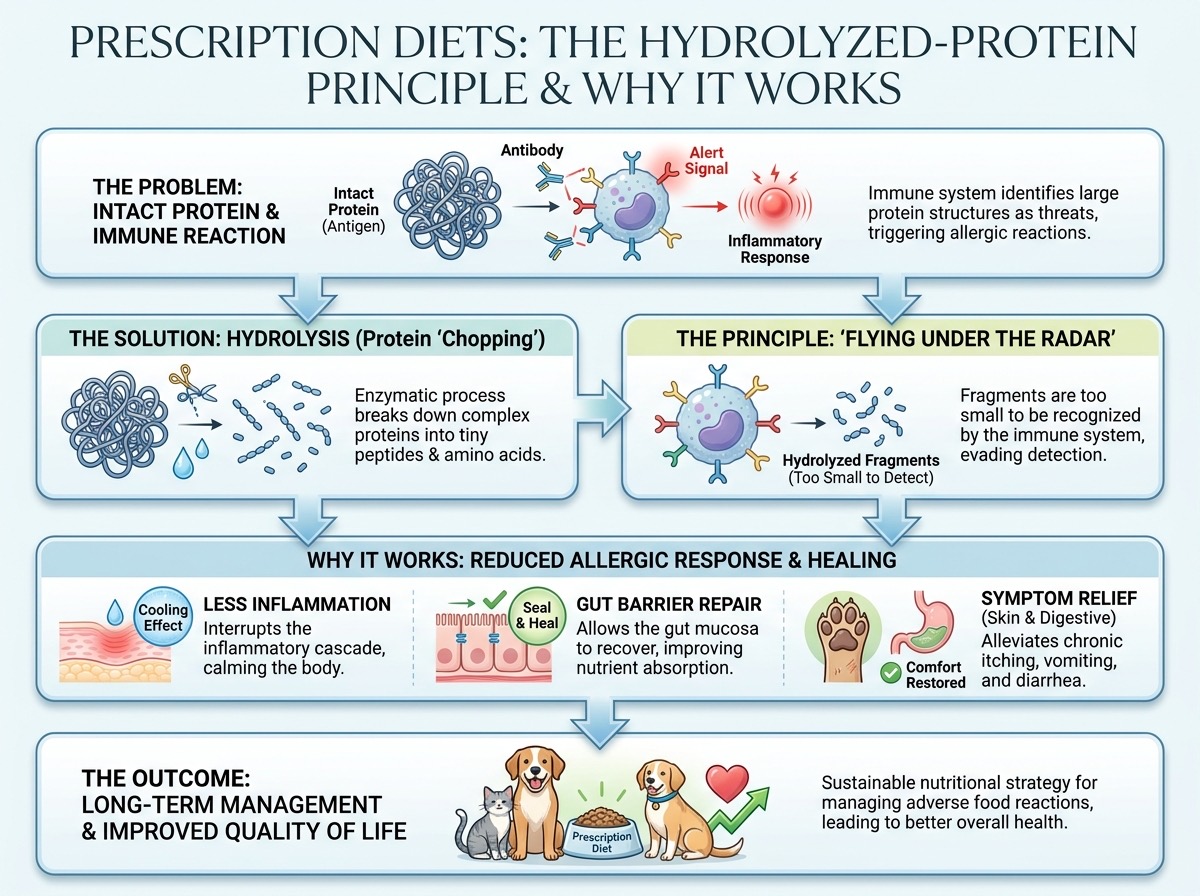
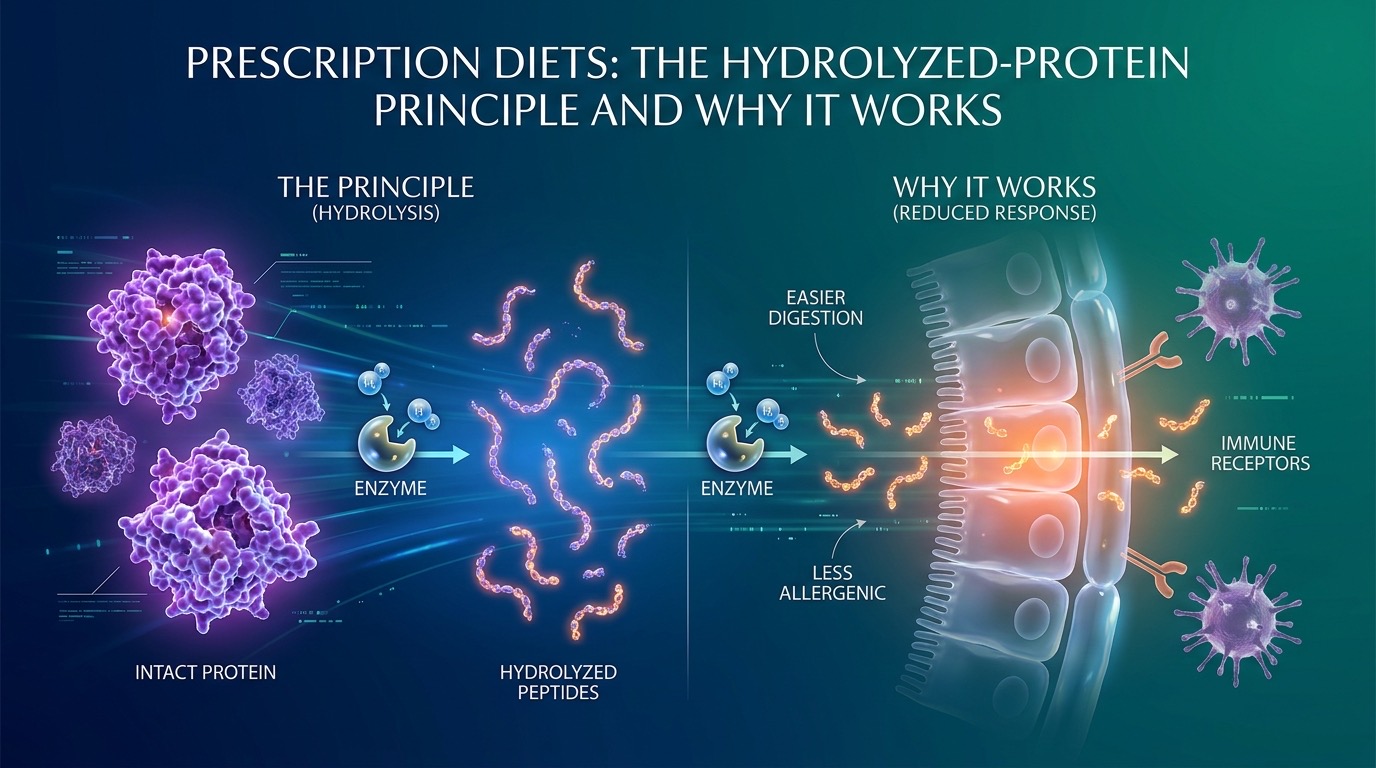
A protein is a chain of amino acids. The chain has a specific sequence and a specific 3D shape. The immune system does not recognize whole proteins — it recognizes short fragments of the chain, called epitopes, usually 8-15 amino acids long. A dog that is allergic to chicken is not allergic to the entire chicken protein; the dog is allergic to a specific epitope within the chicken protein. When the dog eats chicken, the digestive system breaks the protein into fragments, those fragments are absorbed through the gut, and the immune system recognizes the specific epitope and mounts an allergic response.
Hydrolysis takes that protein and breaks it apart before the dog eats it. The protein source (chicken, soy, salmon, whatever) is processed with enzymes that cleave the chain into very small fragments — typically less than 1 kilodalton in molecular weight, or roughly 3-10 amino acids long. A fragment that small is below the threshold at which the immune system can recognize it as an antigen. The immune system cannot bind to a 4-amino-acid fragment, and so the allergic response does not happen. The dog is still eating the chicken (or whatever source the hydrolyzate was made from), and the dog is still getting all of the amino acids the chicken provides, but the dog is not being exposed to the specific epitope that triggered the allergy.
Why "novel protein" is not the same thing
Switching a dog from chicken to venison is the older, simpler approach to food allergy. The rationale: if the dog has never eaten venison, the dog cannot be allergic to venison. The mechanism is correct, and the approach works for some dogs. The problem is that the immune system often cross-reacts between proteins that share similar epitopes. A dog that is allergic to chicken may also react to turkey, because chicken and turkey share a high percentage of their protein structure. A dog allergic to beef may also react to lamb, or to venison, or to bison. The list of truly novel proteins is shrinking as the pet food industry has cycled through them, and the dog that has been through three "novel" protein diets is now a dog that has been exposed to most of the proteins the pet food market has to offer.
Hydrolysis side-steps the cross-reactivity problem. A hydrolyzed chicken protein and a hydrolyzed soy protein are functionally similar to the immune system, because the epitopes that the immune system would recognize have been cut to a size the immune system cannot bind. That is why a hydrolyzed diet can use a "common" protein source like chicken or soy as the base — the immune system is exposed to the amino acids, not to the allergenic epitopes. Hydrolysis also explains why a hydrolyzed diet can be fed to a dog whose allergen has never been identified: it does not matter what the dog is allergic to if every protein in the food has been broken below the recognition threshold.
The four criteria a hydrolyzed diet must meet
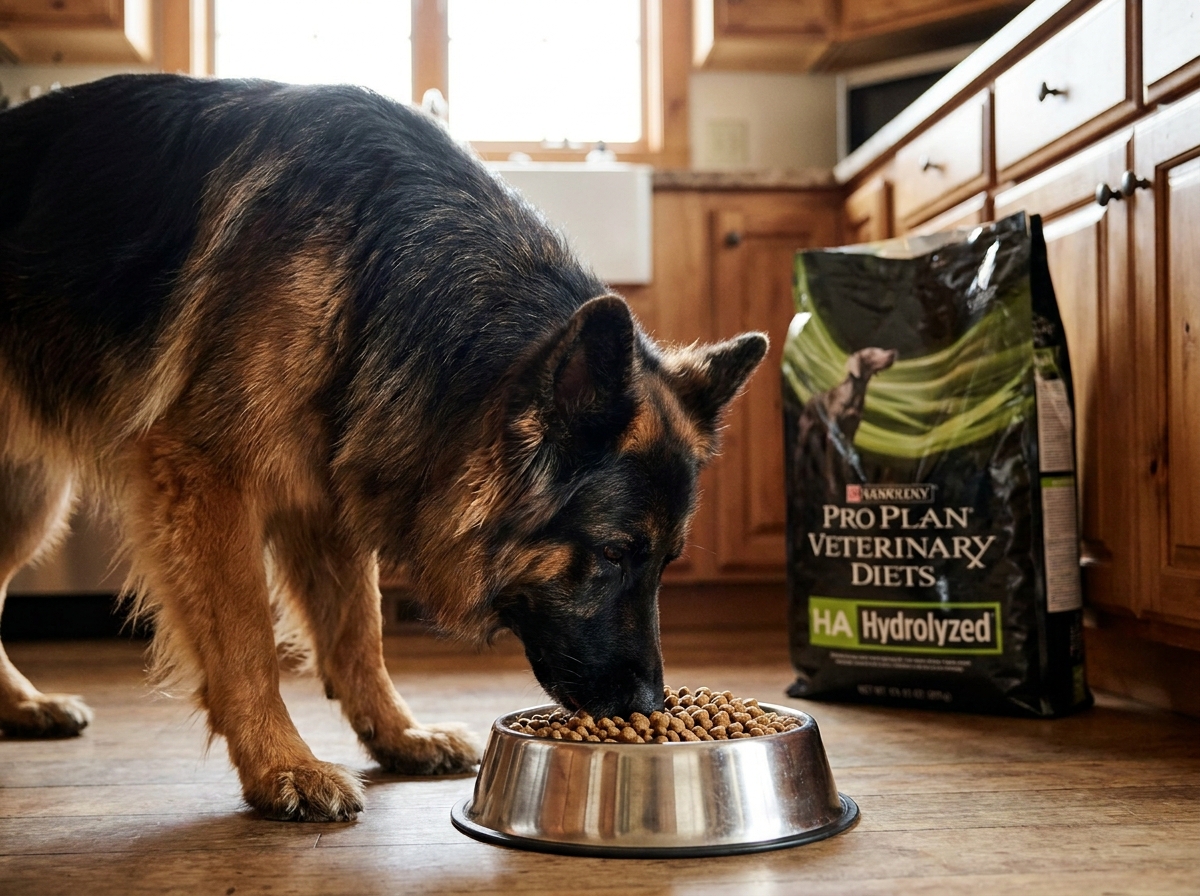
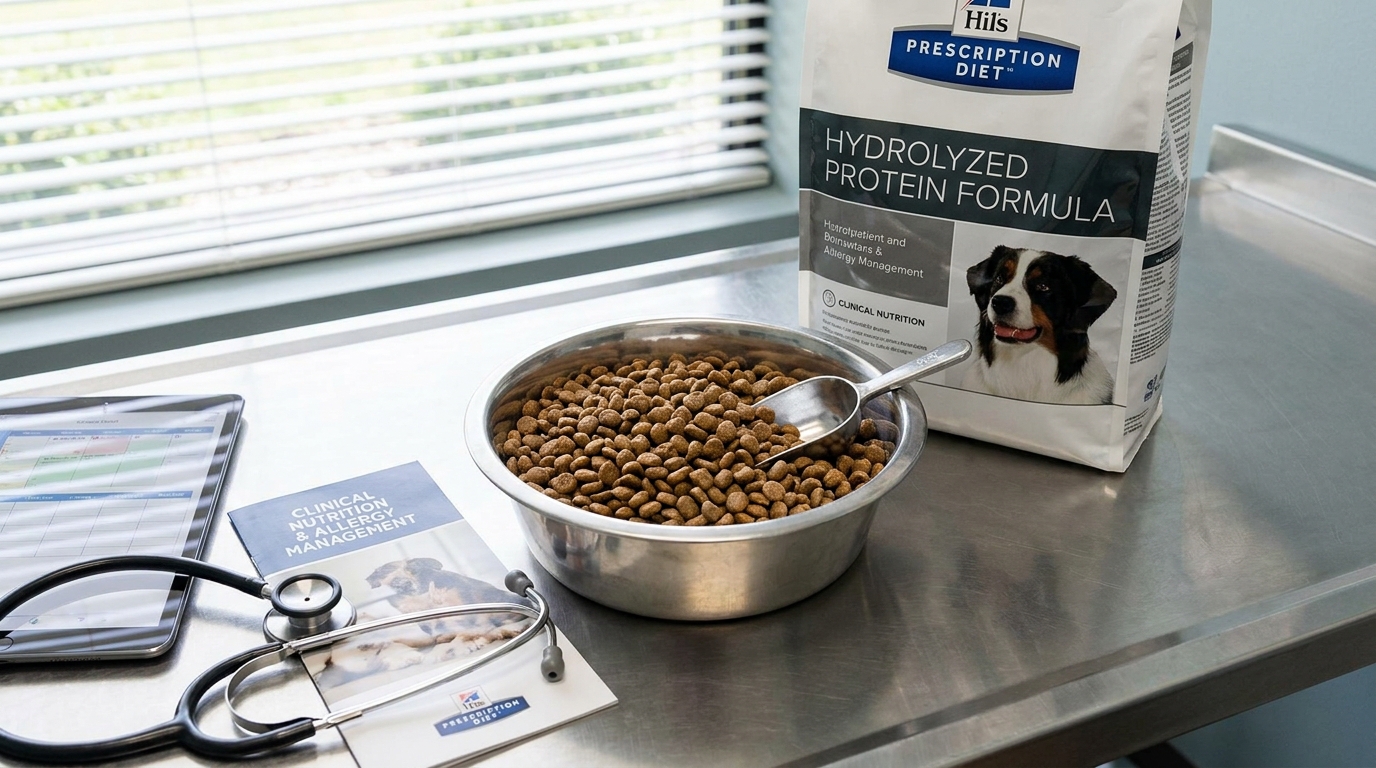
Not every diet that calls itself hydrolyzed actually delivers a true hydrolyzate. Four criteria separate a true prescription hydrolyzed diet from a marketing claim. First, the molecular weight of the peptide fragments. A true hydrolyzate has an average peptide weight of less than 1 kilodalton, and a significant fraction of the fragments are single amino acids or dipeptides. The pet food label does not list this, so the consumer has to trust the manufacturer's published technical data or ask the prescribing vet. Second, the protein source. Chicken, soy, salmon, and rice are the most common hydrolyzate sources. The protein source matters because of palatability and because the manufacturing process differs by source. Third, the rest of the formulation. A hydrolyzed protein in a kibble matrix full of intact beef or chicken meal is not a hydrolyzed diet — the intact protein in the matrix will trigger the allergy. The full ingredient list has to be reviewed, not just the protein source. Fourth, the manufacturing. Hydrolyzates are made under specific enzymatic processes; the kibble has to be made in a facility that does not also produce non-hydrolyzed diets, or the cross-contamination will undo the entire point. The major veterinary diet manufacturers (Royal Canin, Hill's Prescription Diet, Purina Pro Plan Veterinary Diets) all meet these criteria. The boutique and grain-free brands generally do not.
The 8-12 week trial: the only way to know
Hydrolyzed diets do not work overnight. The reason is the lifecycle of the allergic response. The dog has been eating a food that triggered the immune response. The immune system has memory cells, inflammatory cells, and skin changes that do not reset the moment the new food hits the bowl. The skin changes from chronic inflammation take 8-12 weeks to resolve, even after the trigger is removed. The owner who switches to a hydrolyzed diet and sees no improvement at 2 weeks is not seeing the diet fail; the owner is seeing the natural resolution time of the previous inflammation.
The trial protocol is the same as the elimination diet trial, and I will not repeat the full protocol here — the previous article on the 8-week elimination diet covers it in detail. The only difference is that with a hydrolyzed diet, the protein is already known to be below the recognition threshold, so the trial is testing whether the dog's symptoms are actually food-related (and not, say, environmental allergy) rather than testing which protein the dog can tolerate. The 8-12 week clock starts the moment the new food is the only food, and ends when the dog has been on the new food exclusively and treats exclusively for 8-12 weeks. At that point, a challenge with the original food should produce a relapse if the food was the trigger.
When a hydrolyzed diet does not work
Three situations. The first is non-compliance. The owner is feeding the hydrolyzed kibble but also feeding table scraps, training treats, dental chews, flavored medications, or other pets' food. Any of these can contain the trigger protein. The fix is a hard audit of everything that enters the dog's mouth, including the peanut butter used to hide pills. The second is misdiagnosis. The dog does not have a food allergy; the dog has atopic dermatitis, a flea allergy, a sarcoptic mange infestation, or a yeast overgrowth. None of these respond to a hydrolyzed diet. The fix is a proper diagnostic workup, not another food trial. The third is a secondary problem. The food allergy triggered the itch, the itch led to skin trauma, the skin trauma led to a bacterial or yeast infection, and the infection is now driving the itch on its own. A hydrolyzed diet treats the food allergy but not the secondary infection. The infection needs its own treatment — usually a course of antibiotics or antifungal therapy — and the skin needs 4-6 weeks of recovery on top of the food trial.
The role of hydrolyzed diets beyond allergy
Two other uses are now well supported. The first is in the early workup of chronic diarrhea. A dog with chronic small bowel diarrhea that has not responded to diet trials and empirical antibiotics is often a candidate for a hydrolyzed diet trial, both as a diagnostic and a therapeutic. The second is in inflammatory bowel disease, where hydrolyzed diets are part of the standard management alongside immunosuppressive medication. The mechanism is the same: reducing the antigenic load on the gut immune system.
A practical summary
If your dog has been diagnosed with a cutaneous adverse food reaction, the hydrolyzed diet is the most evidence-supported first choice. The 8-12 week trial is the test. The compliance rules are strict: nothing else enters the dog's mouth for the duration. The dog that improves on the hydrolyzed diet and relapses on a challenge with the original food has confirmed the diagnosis. The dog that does not improve is a dog that needs a different diagnostic, not a different hydrolyzed diet. The hydrolyzed diet is a tool, not a destination.