
Prescription diets: the hydrolyzed-protein principle and why it works
Hydrolyzed protein diets are the most evidence-backed dietary intervention for cutaneous adverse food reactions in dogs and cats. They are also one of the most misunderstood. Owners hear "hydrolyzed" and assume something artificial or unnatural. In fact, hydrolysis is the same process the body uses during normal digestion — the prescription diets just take it further, breaking dietary proteins into fragments too small for the immune system to recognise.
This is the mechanism, the evidence, and the practical use.
The basic immunology
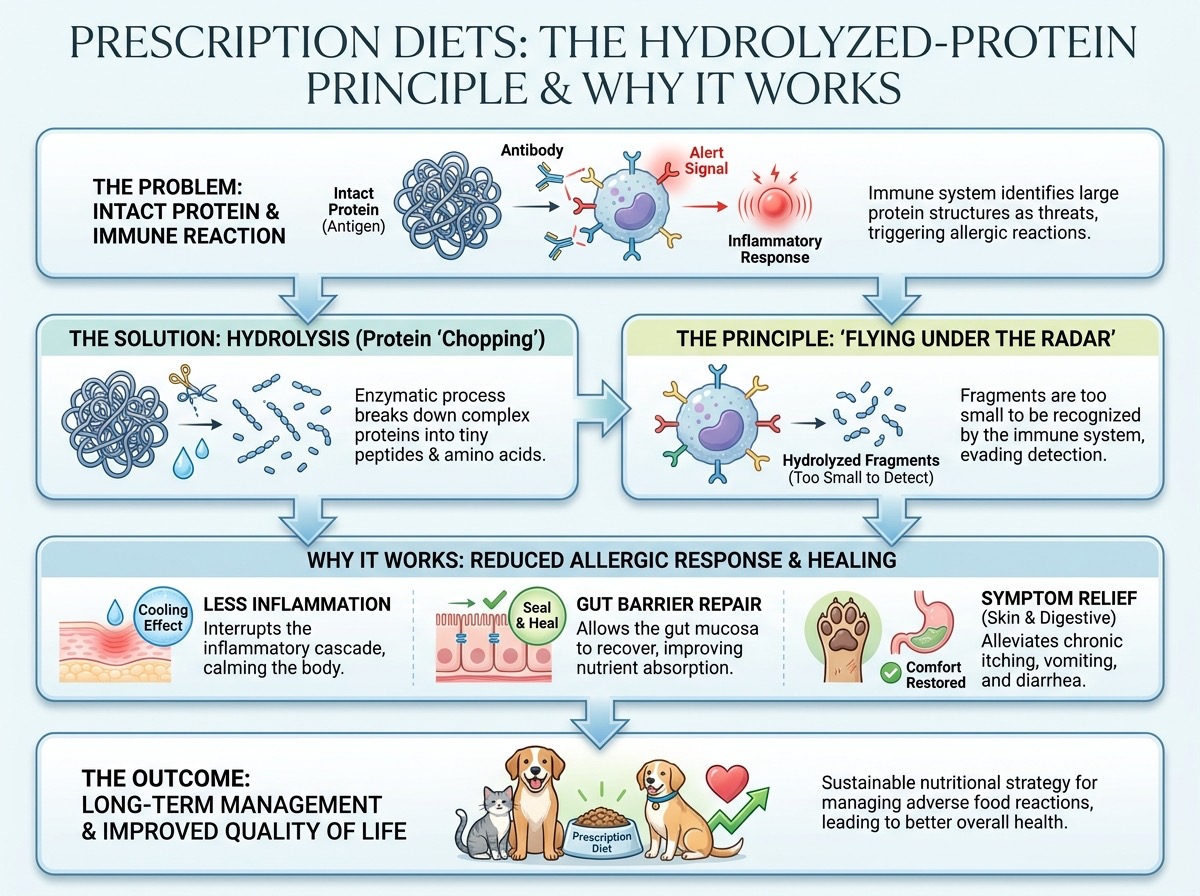
A food allergy is an immune response to a specific dietary protein. The immune system mistakes a food protein for a threat (an allergen) and mounts a defence: IgE antibodies, T-cell activation, histamine release, inflammation. The result is the itching, ear infections, skin lesions, and GI signs that characterise food allergy.
The immune system recognises allergens by their shape. Specific regions of the protein (called epitopes) fit into specific receptors on immune cells (B cells, T cells). The fit is structural — like a key in a lock. If the shape of the protein changes, the receptor no longer fits, and the immune system does not activate.
This is where hydrolysis comes in.
What hydrolysis does
Hydrolysis is the enzymatic or chemical breakdown of proteins into smaller fragments called peptides or free amino acids. Different hydrolysis processes produce different fragment sizes:
| Hydrolysis level | Fragment size (Daltons) | Immune recognition |
|---|---|---|
| Intact protein | >10,000 Da | Yes — full epitopes present |
| Partially hydrolysed | 3,000–10,000 Da | Some epitopes still present |
| Extensively hydrolysed | <3,000 Da | Most epitopes destroyed |
| Fully hydrolysed (free amino acids) | <500 Da | No epitopes |
The key threshold for immune recognition is generally 10 kDa (10,000 Daltons). Proteins broken into fragments smaller than 10 kDa are usually too small to be recognised by the immune system. Hydrolyzed diets aim for fragments well below this threshold.
The chemistry: how the hydrolysis is done
There are two main hydrolysis methods:
Enzymatic hydrolysis
Specific enzymes (proteases like trypsin, chymotrypsin, papain, bromelain) break peptide bonds at specific positions. The process:
- Source protein (chicken, soy, fish) is heated and denatured
- Protease enzymes are added
- Incubation at controlled temperature and pH for hours
- Filtration removes larger fragments
- Spray-drying or canning produces the final diet
The result: a mixture of small peptides and free amino acids.
Acid hydrolysis
Strong acid (typically HCl) breaks peptide bonds non-specifically. Used less commonly for pet foods because the harsh conditions can destroy some amino acids (especially tryptophan) and produce unwanted side products.
Commercial veterinary hydrolyzed diets almost universally use enzymatic hydrolysis. Examples:
- Hill's z/d Original / z/d Skin/Food Sensitivities: hydrolyzed chicken liver, soy
- Royal Canin Hypoallergenic / Anallergenic: hydrolyzed soy (Anallergenic uses feather protein)
- Purina Pro Plan HA: hydrolyzed soy
- Royal Canin Vegetarian: hydrolyzed soy + rice
Why hydrolyzed diets work when novel protein diets sometimes don't
A dog with confirmed food allergy reacts to a specific protein. The classic recommendation is to switch to a "novel protein" — a protein the dog has never eaten before (rabbit, venison, alligator). The mechanism: if the immune system has never been exposed to the protein, it cannot have developed an allergy to it.
This works in theory. In practice, novel protein diets often fail because:
- The protein is not actually novel: many "novel" proteins (venison, duck, rabbit) have been in commercial diets for years. A dog that has eaten one of these diets has been exposed
- Cross-reactivity: some proteins share epitopes. A dog allergic to chicken may also react to turkey (related species)
- Hidden ingredients: the novel protein kibble may contain rendered fat or meal from other protein sources
Hydrolyzed diets bypass all three problems. The protein fragments are too small for immune recognition regardless of:
- Whether the dog has been exposed to the source protein
- Whether the source protein is structurally related to other dietary proteins
- Whether trace amounts of other proteins are present
The only failure mode is when the hydrolysis is insufficient — when fragments are larger than 10 kDa and still contain intact epitopes. This is why brand quality matters.
The hierarchy of hydrolyzed diets
Not all hydrolyzed diets are equally hydrolyzed. The molecular weight distribution of fragments varies:
| Diet | Source protein | Hydrolysis level | Median fragment size |
|---|---|---|---|
| Hill's z/d Original | Chicken liver | Extensive | ~1,500 Da |
| Royal Canin Hypoallergenic | Soy | Extensive | ~2,000 Da |
| Purina Pro Plan HA | Soy | Extensive | ~2,000 Da |
| Royal Canin Anallergenic | Hydrolyzed feather | Very extensive | ~600 Da |
The Royal Canin Anallergenic is the most extensively hydrolyzed commercial diet available. It is the go-to for severe or refractory cases. Its disadvantage: cost (typically 30–50% more than standard hydrolyzed diets).
When to use hydrolyzed vs novel protein
The decision depends on the case:
Novel protein diet is appropriate when:
- The dog has a clear dietary history showing no prior exposure to the proposed novel protein
- The allergy is mild (seasonal ear infections, mild pruritus)
- Cost is a major concern (novel protein diets are typically cheaper)
- The owner prefers a "natural" protein source
Hydrolyzed diet is appropriate when:
- The dietary history is unknown (rescue dog, multiple previous diets)
- The dog failed a novel protein diet trial
- The allergy is severe (year-round pruritus, recurrent skin infections)
- The dog is suspected of having multiple food allergies
- The owner wants the highest-confidence option
In practice, most dermatologists default to hydrolyzed for the initial trial. If the dog responds well, the option to test novel proteins later remains open.
How to feed a hydrolyzed diet
Strict trial (8 weeks)
The 8-week trial is the same as for any elimination diet:
- Feed only the hydrolyzed diet for 8 weeks
- No treats, table food, flavoured medications, dental chews, or supplements (unless cleared by vet)
- Watch for improvement in clinical signs: pruritus score, ear inflammation, skin lesions, stool quality
- If no improvement at 8 weeks: food is unlikely the cause
After the trial: identification
If clinical signs improve during the 8-week trial, the next step is provocation to identify the specific allergen:
- Add one common allergen back into the diet at a time (chicken, beef, dairy, wheat)
- 7 days per provocation
- A flare within 7 days = that protein is an allergen
- Continue provocations until common allergens are ruled out
The provocation phase tells you what to avoid long-term.
Long-term management
Many dogs with confirmed food allergy remain on the hydrolyzed diet long-term. The cost is justified by:
- Reliable avoidance of allergens
- Nutritional completeness (formulated to AAFCO standards)
- Reduced pruritus and infections
- Better quality of life
Some dogs, after provocation identifies specific allergens, can transition to a non-hydrolyzed diet that simply avoids those specific ingredients. This requires confidence that no other allergens are present.
Common mistakes
1. "Hydrolyzed" in treats
Many treats are labeled "hypoallergenic" but are not hydrolyzed. They are simply made with novel proteins. A dog that responds well to a hydrolyzed main diet can still react to a "novel protein" treat if the underlying allergy is to a related protein or if the treat contains trace allergens.
Rule: the treats during the trial should be the hydrolyzed diet itself (kibble from the daily ration) or specifically formulated hydrolyzed treats (Hill's Hypoallergenic Treats, Royal Canin Hypoallergenic Treats). No other treats.
2. Topical hydrolyzed products
There are hydrolyzed protein shampoos and topical sprays. These are useful for atopic dermatitis with skin barrier dysfunction, but they do not address food allergy. Topical use does not allow owners to skip the dietary trial.
3. "Limited ingredient" vs "hydrolyzed"
Many "limited ingredient" diets are not hydrolyzed. They are made with a single protein source but the protein is intact (not broken down). A dog allergic to the protein in the "limited ingredient" diet will react.
If you want truly hydrolyzed, look for the words "hydrolyzed protein" on the ingredient list, or specifically branded hydrolyzed diets.
4. Stopping the diet too early
Improvements in pruritus often take 4–6 weeks to become apparent. Owners who stop the hydrolyzed diet at week 3 because they see no change often miss a real benefit. The 8-week trial is the minimum.
5. Assuming hydrolyzed = low allergen
Hydrolyzed diets are not allergen-free. They contain small fragments that, while unlikely to trigger most immune responses, can still trigger in some dogs. A small percentage of dogs (estimated 5–15%) do not respond even to extensively hydrolyzed diets.
If a strict 8-week trial with hydrolyzed diet shows no improvement, the cause is either:
- Not food allergy (environmental allergy or other cause)
- Very rare hypersensitivity to even the hydrolyzed fragments
- Concurrent condition requiring additional treatment
Hydrolyzed diets vs home-cooked elimination diets
The home-cooked novel protein diet is the gold standard for food allergy diagnosis. It allows precise control of ingredients and provides a definitive answer.
The hydrolyzed diet is the practical alternative. It is nutritionally complete (formulated to AAFCO standards) without the cost and complexity of a veterinary nutritionist-formulated home-cooked diet.
For most home situations, the hydrolyzed diet is the better choice. The home-cooked diet is reserved for cases where:
- The dog does not respond to hydrolyzed diet (rare)
- The owner strongly prefers home-cooked
- The dog has multiple concurrent conditions requiring custom nutrition
The bottom line
Hydrolyzed protein diets bypass food allergy by breaking dietary proteins into fragments too small for immune recognition. The threshold is generally 10 kDa; commercial hydrolyzed diets aim for median fragment sizes of 1,000–2,000 Da, well below the threshold. The mechanism is the same as normal digestion, just taken further. The evidence base is strong: hydrolyzed diets produce significant improvement in 70–80% of dogs with confirmed food allergy. The trial takes 8 weeks. The treats during the trial must also be hydrolyzed or skipped. The long-term diet can be the hydrolyzed diet indefinitely, or — after provocation testing — a non-hydrolyzed diet that avoids the identified allergens. Either way, hydrolyzed diets remain the most reliable prescription option for food-allergic dogs.
---
About the author: [Dr. Hannah Kim](../Hannah%20Kim.md), DVM, Cert. VD, is a Seoul National University-trained dermatologist with 11 years of practice, and currently the director of Pacific Pet Dermatology in Vancouver.