
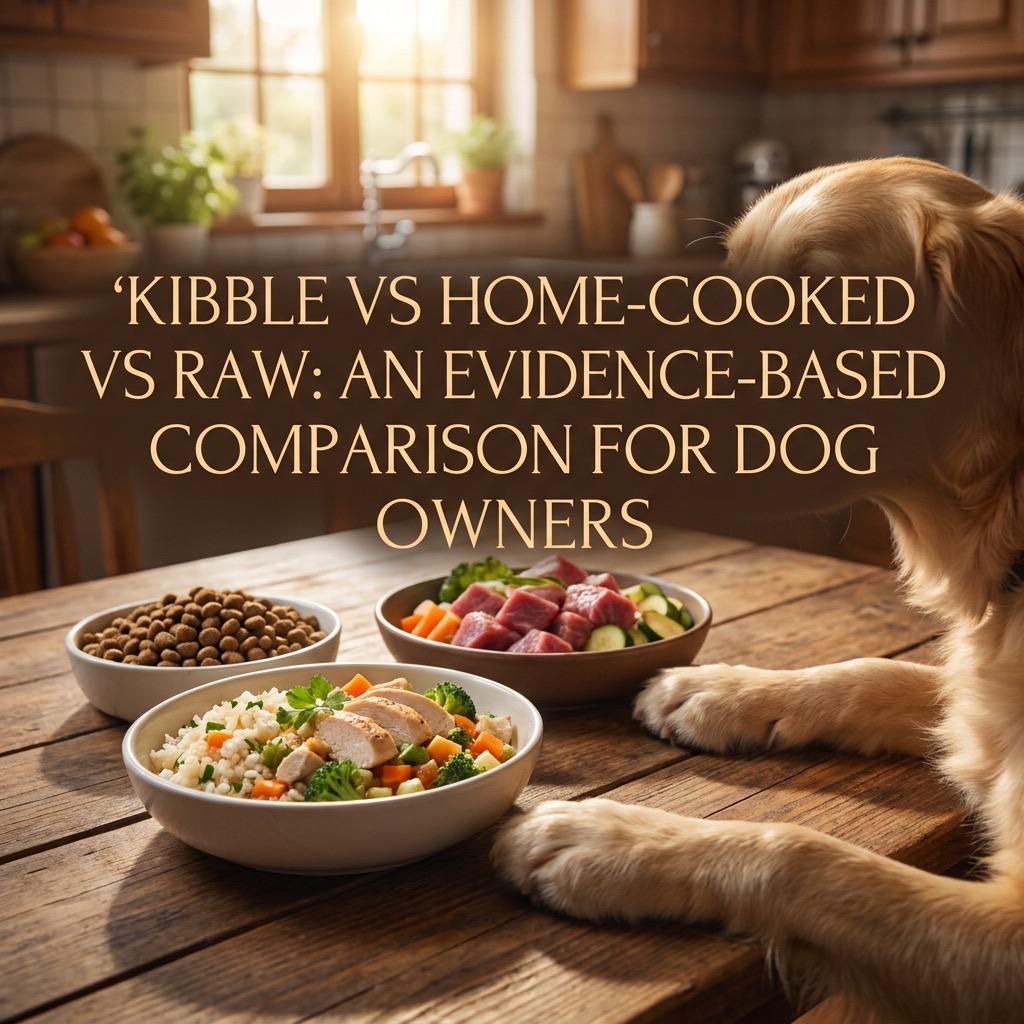
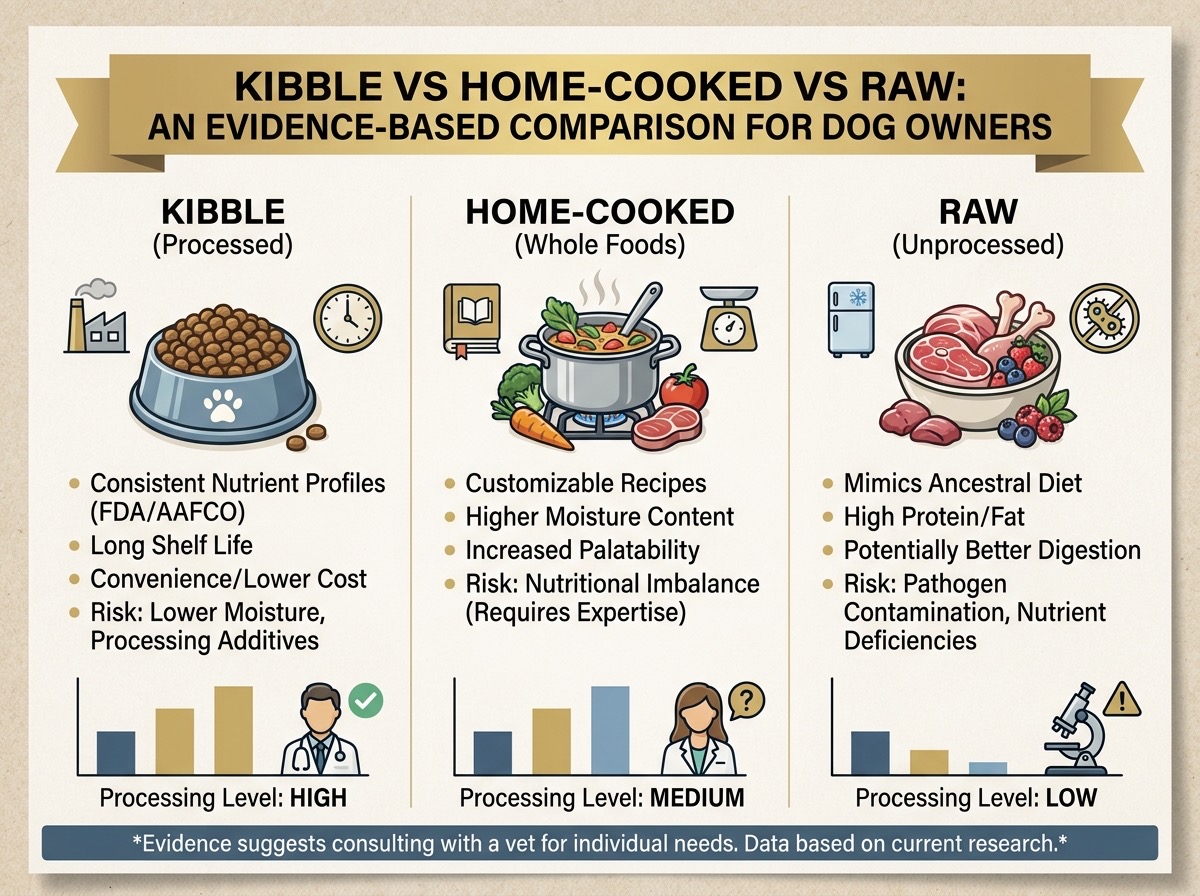
Kibble vs home-cooked vs raw: an evidence-based comparison for dog owners
The dog food debate is one of the most contentious in pet care. Owners have strong opinions, social media amplifies the loudest voices, and the marketing budgets of pet food companies dwarf the actual research budget. Most of what owners believe about dog food is marketing, anecdote, or ideology — not evidence.
This is the evidence-based comparison of the three main diet types: kibble, home-cooked, and raw. The goal isn't to declare a winner. The goal is to give the owner the information to choose the right diet for their specific dog, their specific household, and their specific capabilities.
The comparison framework
Each diet is evaluated against the same criteria:
- Nutritional adequacy: does the diet meet the dog's nutritional needs when prepared correctly?
- Convenience: how much time and effort does the diet require?
- Cost: how much does the diet cost per day or per month?
- Safety: what are the risks of the diet (contamination, nutritional deficiency, etc.)?
- Palatability: how readily does the dog eat the diet?
- Digestibility: how well does the dog digest the diet (stool quality, gas, etc.)?
- Long-term health outcomes: what does the evidence say about health outcomes over years?
- Owner compliance: how reliably can the owner follow the protocol?
No single diet wins on every criterion. The choice is about which trade-offs the owner is willing to make.
Kibble: the standard, the baseline, the misunderstood
Kibble is the most common diet for dogs in most developed countries. About 70% of dogs in the US eat kibble as their primary diet. Kibble is processed dry food, typically formed by extruding a mixture of proteins, carbohydrates, fats, vitamins, and minerals through a die and drying it.
The nutritional adequacy
A high-quality kibble that meets AAFCO standards for the dog's life stage is nutritionally complete and balanced. The formulation has been verified by feeding trials, and the dog receives all required nutrients in the correct proportions when fed at the recommended amount.
The AAFCO statement on the bag is the key marker:
- "Complete and balanced" means the food meets AAFCO's nutritional profiles for the life stage
- "Animal feeding tests using AAFCO procedures" means the food has been tested in actual dogs
- "Formulated to meet AAFCO nutrient profiles" means the food has been calculated to meet the profiles but not feeding-tested
The gold standard is a food that has passed AAFCO feeding trials. The second-best is a food formulated to meet AAFCO profiles. Both are nutritionally adequate.
The convenience
Kibble is the most convenient option:
- No preparation: scoop and serve
- Long shelf life: months in a sealed bag
- Easy to measure: by the cup or by weight
- Easy to store: in a cool, dry place
- Easy to travel: pour into a bag and go
- Easy to automate: automatic feeders work with kibble
For most owners, kibble is the only diet they can reliably maintain for 10-15 years. The convenience is not a minor consideration.
The cost
Kibble costs $0.50-3.00 per day, depending on quality. Premium kibbles (Orijen, Acana, Hill's Science Diet, Royal Canin) cost more. Budget kibbles (store brands, low-quality mass-market foods) cost less but may not be nutritionally complete.
For a 30-pound dog, expect to pay $30-100 per month for kibble, depending on quality.
The safety
Kibble is the safest option in terms of bacterial contamination. The cooking and drying process kills most pathogens. There have been recalls for Salmonella and other contaminants, but the rate is low compared to raw diets.
The risk of nutritional deficiency is also low with a quality kibble that meets AAFCO standards. The food is formulated to be complete, and the feeding trials confirm it.
The risk of nutritional excess is real with some kibbles. Some lower-quality kibbles have excessive calcium (problematic for large-breed puppies), excessive vitamin D (linked to heart issues), or excessive fat (contributes to obesity).
The palatability
Kibble is moderately palatable for most dogs. The fat coating (added for palatability) and the aroma attract most dogs. Some dogs are "kibble shy" and prefer wet food or fresh food.
Kibble can become boring for the dog over years. Owners who feed the same kibble for 10+ years may see a decline in appetite or interest. Rotation of protein sources (chicken to fish to lamb) within the same brand can help.
The digestibility
Kibble digestibility varies by formulation. Higher-quality kibbles with named meat meals, moderate fibre, and balanced fat content produce smaller, firmer stools. Lower-quality kibbles with high amounts of grain fillers produce larger, looser stools.
Most dogs digest kibble well. Some dogs with sensitive stomachs do better on limited-ingredient diets, prescription diets, or fresh food.
The long-term health outcomes
The evidence for kibble's long-term health outcomes is mixed:
- Life span: no evidence that kibble-fed dogs live shorter lives than raw- or home-cooked-fed dogs
- Obesity: kibble is associated with higher rates of obesity, partly because it's easy to overfeed and calorie-dense
- Dental health: kibble does not clean teeth (despite the marketing). The dental benefit of kibble is essentially zero
- Cancer risk: the 2007 study by Lisa Freeman (Tufts) found a correlation between some kibble ingredients and cancer risk. Subsequent studies have not confirmed the link conclusively
- Specific conditions: kibble is associated with higher rates of certain conditions (e.g., urinary issues in cats), but the cause is usually moisture content rather than kibble itself
The bottom line: kibble is a reasonable default diet. Most dogs do well on it for their entire lives. The evidence does not support the claim that kibble is "bad" or that fresh diets are categorically better.
Who kibble is right for
- Owners with limited time or budget
- Owners who travel with their dogs
- Owners who use automatic feeders
- Households with multiple dogs (consistent feeding)
- Dogs that do well on kibble (most dogs)
Home-cooked: the labour-intensive middle path
Home-cooked diets are prepared at home from individual ingredients, typically following a veterinary nutritionist's recipe. The diet is cooked before serving.
The nutritional adequacy
The nutritional adequacy of home-cooked diets depends entirely on the recipe. A recipe from a board-certified veterinary nutritionist (DACVN) that is followed precisely is nutritionally complete. A recipe from a blog, a book, or a pet food company's marketing is almost certainly nutritionally inadequate.
The most common deficiencies in home-cooked diets:
- Calcium: the most common deficiency. Recipes that include meat without bones are calcium-deficient. The dog develops severe bone issues within 6-12 months
- Zinc: often inadequate in home-cooked diets
- Copper: often inadequate
- Iodine: often inadequate
- Vitamin D: often inadequate, particularly in indoor dogs
- Vitamin E: often inadequate
- Omega-3 fatty acids: often inadequate
These deficiencies don't show up immediately. The dog appears healthy for months, then develops a chronic condition that takes the owner by surprise.
A complete home-cooked diet requires:
- A recipe from a DACVN
- A source of calcium (bone meal, calcium carbonate)
- A complete vitamin-mineral supplement (designed for the specific recipe)
- A source of omega-3s
- A consistent preparation routine
The "I feed my dog chicken and rice" approach is nutritionally inadequate. The dog may survive for years, but the dog is not thriving.
The convenience
Home-cooked diets are labour-intensive:
- 1-2 hours of preparation per week for a single dog
- Multiple ingredients, often in small quantities
- Storage of prepared food in the refrigerator or freezer
- Daily portioning
- Daily cleanup
For most owners, home-cooked diets are not sustainable long-term. The owner starts strong, then the work becomes burdensome, then the owner slips to "mostly home-cooked with some kibble" and the consistency of the diet is lost.
The cost
Home-cooked diets cost more than kibble:
- $2-5 per day for ingredients
- $20-50 per month for the vitamin-mineral supplement
- Total: $80-200 per month for a 30-pound dog
The cost is higher than kibble but lower than some premium raw diets.
The safety
The safety of home-cooked diets is good in terms of bacterial contamination (the cooking kills most pathogens), but variable in terms of nutritional adequacy. A recipe that is followed precisely is safe. A recipe that is modified by the owner "to make it more balanced" may not be.
The most common safety issue: the owner substitutes ingredients. "My dog doesn't like sweet potato, so I'll use white potato" — but the recipe was formulated for sweet potato, and the substitution changes the nutrient profile. Over time, the substitution creates a deficiency.
The palatability
Home-cooked diets are very palatable. The dog eats willingly. The owner enjoys preparing the food (initially). The novelty of home-cooked food can encourage picky eaters to eat.
The digestibility
Home-cooked diets are highly digestible. The cooking breaks down proteins and starches, and the dog absorbs more nutrients. Stools are typically smaller and firmer than on kibble.
The long-term health outcomes
There is limited evidence on long-term outcomes of home-cooked diets. The few studies that exist suggest home-cooked diets can produce good outcomes when properly formulated, but the studies are small and not generalisable.
The most common health issues from home-cooked diets: nutritional deficiencies that present as chronic conditions (skin, coat, bone, immune). These conditions are reversible if the diet is corrected, but the owner often doesn't realise the diet is the cause.
Who home-cooked is right for
- Owners with the time and commitment to prepare food consistently
- Dogs with specific dietary needs that commercial foods don't address
- Owners who enjoy cooking and want to be involved
- Households where the dog is a priority and the cost is acceptable
Raw: the most controversial
Raw diets (BARF, prey model, etc.) are uncooked diets based on raw meat, bones, organs, and sometimes vegetables. The diet is typically frozen and thawed before serving.
The nutritional adequacy
The nutritional adequacy of raw diets depends on the formulation. A raw diet formulated by a DACVN with appropriate supplementation is nutritionally complete. A raw diet from a commercial supplier varies widely in quality.
The most common deficiencies in raw diets:
- Calcium and phosphorus imbalance: if the bones are not in the right proportion, the calcium:phosphorus ratio is wrong
- Iodine: rarely adequate without supplementation
- Zinc: often inadequate
- Vitamin D: often inadequate
- Vitamin E: often inadequate
The most common excesses:
- Vitamin A: from too much liver
- Fat: from too much fatty meat
- Phosphorus: from too much bone
A complete raw diet requires careful formulation, often with the help of a DACVN. The "raw meat and bones" approach without supplementation is not nutritionally complete.
The convenience
Raw diets are moderately convenient:
- Pre-made raw diets (commercial frozen) require thawing and serving
- Homemade raw diets require sourcing ingredients, portioning, and storage
- Some raw feeding requires grinding (for whole prey feeding or for small dogs)
- Bones must be appropriate (raw, not cooked, appropriate size)
For most owners, raw diets are less convenient than kibble but more convenient than home-cooked.
The cost
Raw diets cost more than kibble and home-cooked:
- $3-8 per day for a 30-pound dog
- $100-250 per month
Premium commercial raw diets (Primal, Stella & Chewy's, Northwest Naturals) are the most expensive. Homemade raw diets are cheaper but require the time to source and prepare.
The safety
The safety of raw diets is the most debated aspect. The concerns:
- Bacterial contamination: raw meat carries Salmonella, E. coli, Campylobacter, Listeria, and other pathogens. A 2008 study found 30-50% of commercial raw diets tested positive for Salmonella. A 2012 study found similar results
- Pathogen transmission to humans: handling raw meat risks pathogen transmission. The dog's mouth becomes a vector after eating contaminated raw
- Nutritional deficiency/excess: poorly formulated raw diets create nutritional issues
- Bone-related injuries: raw bones can fracture teeth, cause intestinal perforation (rare, but reported), or cause constipation
The American Veterinary Medical Association (AVMA), the American Animal Hospital Association (AAHA), and the CDC all advise against raw diets, citing the public health and nutritional concerns.
The counterargument: dogs have evolved to eat raw. The dog's stomach is more acidic than the human's, and the dog has a shorter GI tract. The bacterial risk to the dog is lower than to the human. The risk to humans is mitigated by careful handling.
The evidence: there are documented cases of Salmonella transmission from raw-fed dogs to humans, particularly children, elderly, and immunocompromised individuals. There are also documented cases of nutritional deficiency in raw-fed dogs. The risks are real.
The palatability
Raw diets are highly palatable. Most dogs prefer raw to kibble. The high fat content, the strong aroma, and the natural texture make raw the "natural" choice for dogs.
The digestibility
Raw diets are highly digestible. The dog absorbs more nutrients, and the stools are typically smaller and firmer. Some dogs with chronic GI issues improve on raw diets.
The long-term health outcomes
The evidence for long-term outcomes of raw diets is limited and conflicting:
- Some studies show improved coat, energy, and weight management on raw diets
- Other studies show no difference between raw and kibble
- The studies are often small, non-randomised, and conducted by parties with a stake in the outcome
The strong claims from raw diet advocates (raw prevents cancer, raw extends lifespan, raw is the "natural" diet) are not supported by high-quality evidence. The marketing of raw diets is heavy, and the evidence base is thin.
Who raw is right for
- Owners who understand the risks and are willing to handle raw meat safely
- Owners with the time to source, prepare, and store raw food
- Households without young children, elderly, or immunocompromised individuals
- Dogs that thrive on raw (some, not all)
- Owners willing to work with a DACVN on formulation
The decision: which diet is right for your dog
A framework for the decision:
Start with the dog
- Does the dog have any specific dietary needs (allergies, sensitivities, medical conditions)?
- How does the dog respond to each diet (digestibility, stool quality, energy, coat)?
- Does the dog have a preference?
The dog's response is the most important input. A dog that does well on kibble and poorly on raw should eat kibble. A dog with chronic GI issues that improves on raw should eat raw.
Then the owner
- How much time can the owner reliably invest?
- What's the budget?
- Is the owner willing to handle raw meat?
- Can the owner follow a recipe precisely for years?
The owner's capabilities and constraints matter. A diet the owner can't sustain is a bad diet, regardless of its theoretical merits.
Then the household
- Are there young children, elderly, or immunocompromised individuals?
- Is the household comfortable with raw meat storage and handling?
- Does anyone in the household have a strong preference?
A household with an immunocompromised member should avoid raw diets. A household with no such concerns has more flexibility.
Then the diet
If the dog, owner, and household are flexible, the diet choice can be based on the evidence:
- For most dogs and most households, a high-quality kibble is the most reliable, sustainable, and evidence-based choice
- For dogs with specific needs (medical conditions, severe allergies) that kibble doesn't address, home-cooked or raw with DACVN formulation is appropriate
- For owners with the time and commitment, home-cooked or raw can produce good outcomes, but the formulation must be correct
What to avoid
A list of approaches to avoid:
- Vegan diets (without DACVN formulation): nutritionally risky, particularly for cats. Dogs can do well on a vegan diet if formulated by a DACVN, but it's not a default choice
- Grain-free diets (without a specific reason): the FDA has linked some grain-free diets to dilated cardiomyopathy (DCM) in dogs. The risk is small but real. Grain-free diets should be chosen for a specific reason (allergy), not as a default
- High-meat, low-nutrient commercial diets: marketing-heavy foods that look premium but are nutritionally questionable
- "Natural" or "holistic" labels: not regulated. The terms are marketing
- Raw diets without a DACVN formulation: high risk of nutritional deficiency or excess
- Home-cooked diets without a DACVN recipe: high risk of nutritional deficiency
- Single-ingredient diets (all chicken, all beef): nutritionally incomplete
The bottom line
Kibble, home-cooked, and raw are all reasonable diet options when done correctly. The right choice depends on the dog, the owner, the household, and the evidence. Most dogs do well on a high-quality kibble. Some dogs do better on home-cooked or raw. The owner's commitment to the chosen diet is the most important factor — a poorly-formulated raw diet is worse than a high-quality kibble. The diet that the owner can sustain for 10-15 years, that the dog thrives on, and that meets the nutritional standards established by veterinary nutritionists is the right diet. The marketing claims, the social media arguments, and the breed-specific recommendations are less important than the actual nutritional adequacy and the dog's response. Choose the diet that fits the dog's needs, the owner's capabilities, and the household's constraints. The choice is not a moral statement. It's a feeding decision.
---
About the author: [Sarah Chen](../Sarah%20Chen.md) holds a DVM from Cornell and a PhD in Animal Nutrition from UC Davis, with 12 years of clinical nutrition consulting, board certification by the American College of Veterinary Nutrition, and over 30 peer-reviewed publications.