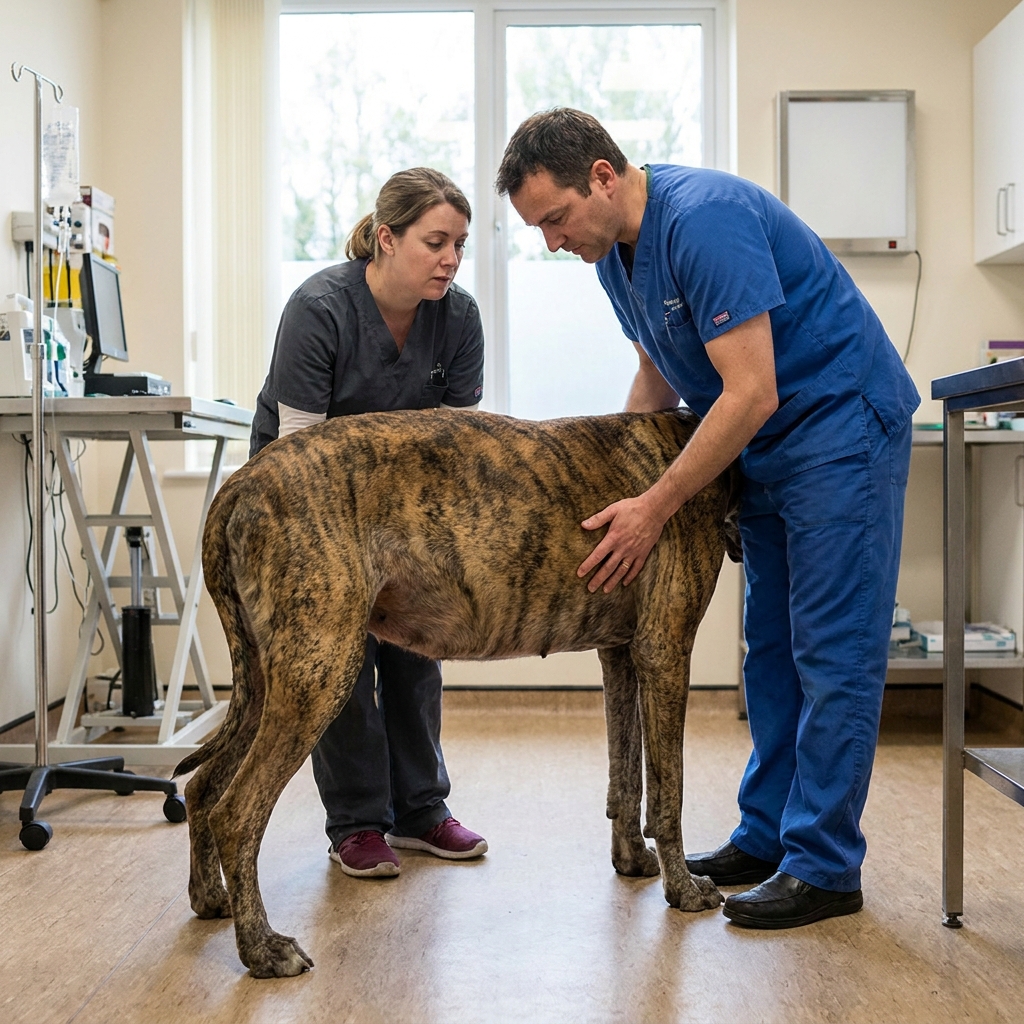


Feeding frequency: twice daily vs free choice, and what the evidence says
The "feed your dog twice a day" advice is so universal that most owners don't question it. Twice a day is the default, free choice is "wrong", once a day is "cruel". The evidence, however, is more nuanced. The feeding frequency that works for one dog may not work for another. The decision depends on the dog's age, the dog's weight, the dog's health, and the household's schedule.
This is the evidence, the trade-offs, and how to choose the right frequency for the individual dog.
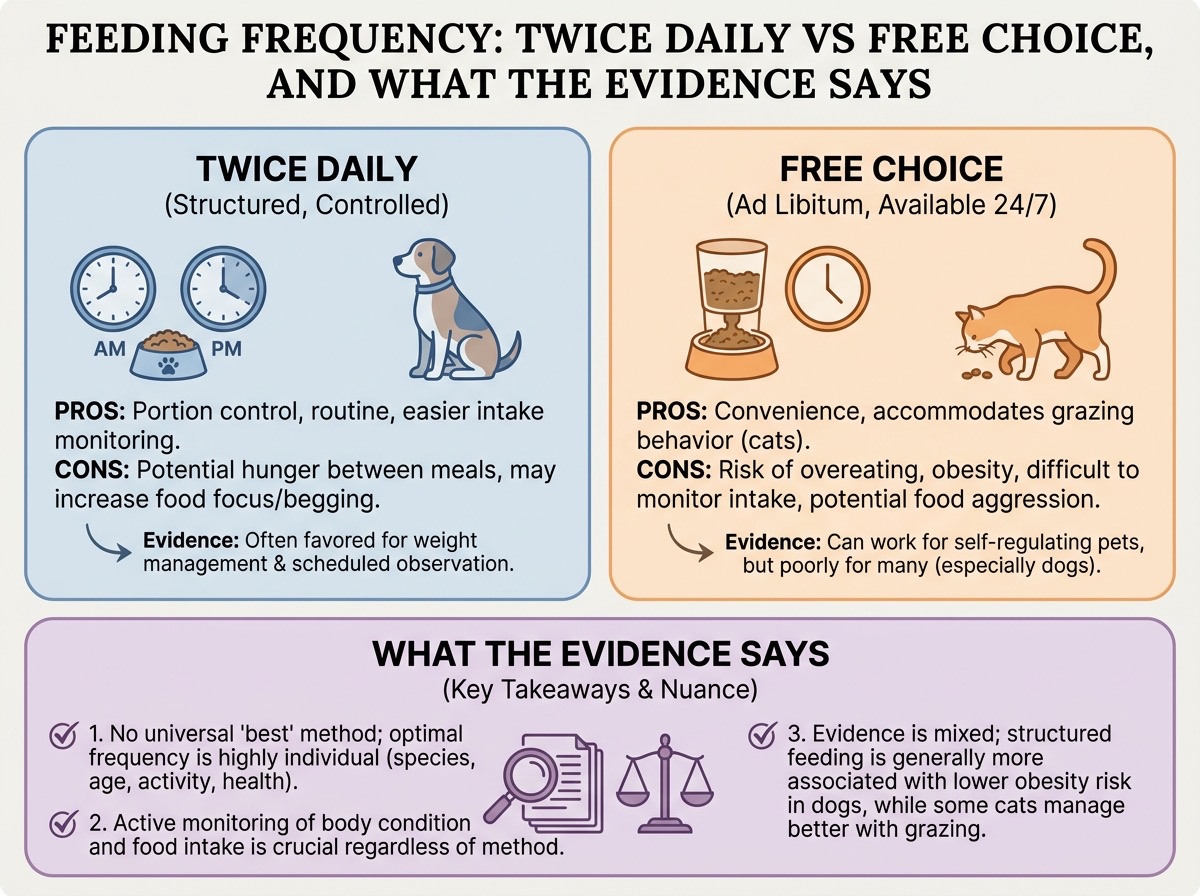
The three main feeding frequencies
Twice daily (the standard)
Two meals per day, typically 8-12 hours apart. This is the most common recommendation from veterinarians and pet food companies.
Once daily
One meal per day, typically at the same time each day. Less common in modern recommendations, but has some recent evidence in its favour for certain dogs.
Free choice (ad libitum)
Food available at all times. The dog eats whenever it wants, as much as it wants. Common in some households but discouraged by most veterinarians.
The physiology: how feeding frequency affects the dog
The digestive physiology
The dog's digestive system is adapted to eat, digest, and have a period of rest before the next meal. The wild canid eats large meals intermittently (a successful hunt every few days) and digests them in 8-24 hours. The domestic dog, fed twice daily, has a similar pattern: eat, digest, rest, eat, digest, rest.
The digestive effects of feeding frequency:
- Meal size: more frequent meals = smaller individual meals. Larger meals stretch the stomach and can cause bloat in susceptible dogs
- Gastric pH: each meal stimulates acid production. More frequent meals = more consistent gastric pH
- Nutrient absorption: smaller, more frequent meals may improve absorption of some nutrients. Larger, less frequent meals may improve absorption of others
- Stool quality: more frequent meals typically produce more consistent stool. Free choice often produces looser, more variable stool
The metabolic physiology
The metabolic effects of feeding frequency:
- Resting metabolic rate: more frequent meals may slightly increase the metabolic rate, but the effect is small
- Hunger hormones: more frequent meals produce more consistent levels of ghrelin (hunger hormone) and leptin (satiety hormone). Less frequent meals produce larger swings
- Insulin response: more frequent meals produce smaller, more frequent insulin spikes. Less frequent meals produce larger, less frequent spikes
- Fat storage: more frequent meals may slightly reduce fat storage, but the effect is small compared to total calorie intake
- Muscle preservation: more frequent meals may slightly improve muscle preservation during weight loss, but the effect is small
The behavioural physiology
The behavioural effects of feeding frequency:
- Food-related anxiety: more frequent meals reduce food-related anxiety in some dogs. Less frequent meals may increase it
- Resource guarding: free choice may reduce resource guarding (food is always available). Scheduled meals may increase resource guarding in some dogs
- Predictability: scheduled meals provide a predictable routine. Most dogs respond well to predictability
- Boredom: free choice reduces food-motivated behaviour. Scheduled meals may increase begging, food-seeking, and counter-surfing
- Mental stimulation: puzzle feeders, snuffle mats, and training treats can add mental stimulation that scheduled meals alone don't provide
The evidence: what the research shows
The weight studies
The most common question about feeding frequency: which frequency produces the leanest body condition?
A 2011 study by German et al. (University of Liverpool) followed 39 dogs for 12 weeks:
- Free choice group: 8 of 18 dogs gained weight. The dogs with the highest body condition scores gained the most
- Twice-daily group: 1 of 21 dogs gained weight
The twice-daily group had significantly better weight control.
The reason: free choice allows the dog to overeat. Most dogs will eat more than their calorie needs when food is freely available. The twice-daily meal provides a structured calorie amount that the dog cannot exceed.
A 2016 meta-analysis (Bland et al.) reviewed multiple studies on feeding frequency in dogs:
- The pooled evidence suggests that twice-daily feeding produces better weight control than free choice
- The evidence is strongest for adult, healthy dogs
- The evidence is less clear for puppies, senior dogs, and dogs with medical conditions
A 2019 study by Tvarijonaviciute et al. found that twice-daily feeding produced lower post-meal insulin spikes and more consistent blood glucose than once-daily or free choice.
The digestive studies
The digestive effects of feeding frequency:
- A 2017 study found that twice-daily feeding produced more consistent stool quality than free choice
- A 2014 study found that twice-daily feeding reduced the risk of bloat in large-breed dogs (the study was specific to breeds at high risk of GDV)
- A 2012 study found that more frequent meals (3-4 per day) reduced the risk of bloat in susceptible breeds
The bloat finding is important. Large-breed dogs at high risk of gastric dilatation-volvulus (GDV) may benefit from more frequent, smaller meals rather than one large meal per day.
The behavioural studies
The behavioural effects of feeding frequency are less well studied:
- Anecdotal evidence suggests that twice-daily feeding reduces food-related anxiety in some dogs
- Free choice may reduce resource guarding in some dogs
- Scheduled meals produce more predictable behaviour around food (the dog knows when food is coming)
The evidence is mixed. The behavioural effect depends on the individual dog.
The once-daily feeding: a recent reconsideration
A 2021 study by Emily Cross and colleagues at the University of Cambridge found that wolves in the wild eat intermittently (every few days when prey is available). The study suggested that once-daily feeding may be more aligned with the dog's evolutionary feeding pattern.
A 2022 review paper suggested that once-daily feeding may have benefits for some adult dogs:
- Increased satiety between meals
- Reduced begging behaviour
- Possible improvements in insulin sensitivity
The once-daily feeding is not the right choice for all dogs, but it's a reasonable option for some adult dogs. Puppies, senior dogs, and dogs with medical conditions typically need more frequent meals.
The recommendations by life stage
Puppies (8 weeks to 6 months)
Puppies need frequent meals. Their stomachs are small, their calorie needs are high (per kg of body weight), and their blood sugar regulation is less stable than adults.
- 8-12 weeks: 4 meals per day
- 3-4 months: 3 meals per day
- 5-6 months: 2-3 meals per day
The transition from 4 to 3 to 2 meals is gradual. The puppy's appetite and body condition guide the transition.
Adolescent dogs (6-12 months)
Adolescent dogs can be transitioned to twice-daily feeding. The transition is usually complete by 9-12 months.
- 6-9 months: 2-3 meals per day
- 9-12 months: 2 meals per day
Adult dogs (1-7 years)
The default is twice-daily feeding. Once-daily is an option for some adult dogs. Free choice is generally discouraged.
- Standard: 2 meals per day
- Optional: 1 meal per day for adult dogs without medical conditions
- Avoid: free choice (weight gain risk)
Senior dogs (7+ years)
Senior dogs may benefit from more frequent, smaller meals. The reasons:
- Reduced digestive efficiency
- Reduced appetite
- More consistent energy levels
- Easier on the digestive system
- 2-3 meals per day
Pregnant and lactating bitches
Pregnant bitches (last 3 weeks) and lactating bitches (especially weeks 2-4 of lactation) need more frequent meals.
- 2-3 meals per day for pregnant bitches
- 3-4 meals per day for lactating bitches, or free choice in late lactation
The recommendations by medical condition
Diabetes
Dogs with diabetes benefit from consistent, twice-daily meals coordinated with insulin injections. The meal and the insulin are given at the same time each day, and the calories are consistent.
- 2 meals per day, coordinated with insulin
Obesity (weight loss)
Dogs on weight loss programs benefit from twice-daily feeding. The structured meal provides a measured calorie amount.
- 2 meals per day, measured
Gastrointestinal disease
Dogs with chronic GI disease (IBD, food allergies, sensitive stomach) often do better with more frequent, smaller meals.
- 2-3 meals per day, or more
Bloat (GDV) susceptibility
Large-breed dogs at risk of bloat benefit from more frequent, smaller meals. The stomach is less likely to be distended.
- 2-3 meals per day, smaller portions
Pancreatitis
Dogs with a history of pancreatitis benefit from lower-fat, more frequent meals.
- 2-3 meals per day, low-fat
The once-daily option: when it works
The once-daily feeding is a reasonable option for:
- Healthy adult dogs
- Dogs that are at a healthy weight
- Dogs without medical conditions
- Owners who can commit to a consistent schedule
- Dogs that don't experience hunger-related behaviour issues
The once-daily feeding is not appropriate for:
- Puppies
- Pregnant or lactating bitches
- Senior dogs
- Dogs with diabetes
- Dogs prone to bloat
- Dogs with GI disease
The once-daily feeding has some specific considerations:
- The meal should be fed at the same time each day
- The dog should be observed for signs of hunger or stress between meals
- If the dog is anxious, vomiting bile, or scavenging, twice-daily is preferable
- The dog should still have access to fresh water at all times
The free choice option: when it works (rarely)
Free choice feeding is the right choice for:
- Pregnant or lactating bitches in late lactation
- Some working dogs (e.g., sled dogs in heavy training)
- Some dogs that self-regulate their intake (rare)
Free choice is the wrong choice for:
- Most adult dogs (weight gain risk)
- Households with multiple dogs (one dog eats more than its share)
- Dogs that don't self-regulate (most dogs)
The dog that self-regulates its intake is rare. Most dogs eat when food is available, regardless of their actual energy needs. Free choice produces overweight dogs in most households.
The multi-dog household
In a multi-dog household, feeding frequency matters even more:
- Each dog should be fed individually, in a separate area, to prevent food stealing
- Twice-daily feeding makes individual feeding easier (the owner controls the timing and the location)
- Free choice in a multi-dog household almost always produces an overweight dog (the dominant dog eats more than its share)
- Microchip-activated feeders can manage individual meals in a multi-dog household
The "schedule" principle
Regardless of the frequency, the schedule matters:
- Feed at the same time(s) each day
- The dog learns when food is coming
- The dog's digestive system adapts to the schedule
- The household routine becomes predictable
The owner who feeds at 7 AM and 6 PM one day, 9 AM and 8 PM the next, and 11 AM and 5 PM the third day is creating an inconsistent schedule. The dog is unable to predict when food is coming, and food-related anxiety increases.
The portion size
The portion size per meal is determined by the total daily calorie need, divided by the number of meals:
- 1,000 kcal per day, twice daily: 500 kcal per meal
- 1,000 kcal per day, three times daily: 333 kcal per meal
- 1,000 kcal per day, free choice: as much as the dog wants (usually 1,200-1,500 kcal)
For a dog that is overweight, the total daily calories are reduced. The number of meals doesn't change the calorie count. A 1,000 kcal daily allowance is the same whether the dog eats it in one, two, or three meals.
The "treat" consideration
The treats count toward the daily calorie total. The general rule: treats should be 10% or less of daily calories.
For a dog that is fed twice daily and receives treats throughout the day:
- 1,000 kcal daily: 900 kcal from meals (450 kcal per meal), 100 kcal from treats
The owner should account for treats when calculating the meal sizes. Otherwise, the dog is overfed by the treat amount.
The water schedule
Fresh water should be available at all times, regardless of feeding frequency. The water bowl is not part of the meal schedule.
Some dogs drink more water around meal times. This is normal. Some dogs gulp water after meals, which can contribute to bloat in susceptible breeds. For bloat-prone breeds, the owner should:
- Restrict water for 1 hour before and after meals
- Feed smaller, more frequent meals
- Slow the dog's eating (use a slow feeder bowl)
The puppy's specific needs
Puppies need more frequent meals than adult dogs. The reasons:
- Small stomach capacity
- High calorie needs per kg of body weight
- Less stable blood sugar regulation
- Faster metabolism
A 4-meal-per-day schedule for an 8-12 week puppy is non-negotiable. A 3-meal-per-day schedule for a 3-4 month puppy is the standard. A 2-meal-per-day schedule for a 5-6 month puppy is the goal.
The owner who feeds a 10-week-old puppy twice a day (because the adult-dog twice-daily advice was heard but the puppy context was missed) creates a hypoglycemic puppy. The puppy has a small stomach, can't take in enough food in two meals, and the blood sugar drops between meals.
The senior dog's specific needs
Senior dogs may benefit from more frequent meals. The reasons:
- Reduced appetite
- Reduced digestive efficiency
- More consistent energy levels
- Easier on the digestive system
A 2-3 meal schedule for a senior dog is often better than a once-daily or twice-daily schedule. The senior dog eats smaller amounts, more often, and absorbs the nutrients more efficiently.
The bottom line
Feeding frequency is not a one-size-fits-all decision. The default for adult dogs is twice daily. Puppies need 3-4 meals per day. Senior dogs often benefit from 2-3 meals. Free choice is the wrong choice for most dogs. Once daily is an option for some adult dogs without medical conditions. The evidence supports twice-daily as the best default for weight control. The schedule should be consistent. The portion size should be measured. The treats should count. The water should be available. The dog that has a consistent feeding schedule, with measured portions, in the right frequency for its life stage and health status, has better weight control, better digestion, and better behaviour around food. The owner who chooses the right frequency for the individual dog and sticks to the schedule has a healthier, happier dog.
---
About the author: [Sarah Chen](../Sarah%20Chen.md) holds a DVM from Cornell and a PhD in Animal Nutrition from UC Davis, with 12 years of clinical nutrition consulting, board certification by the American College of Veterinary Nutrition, and over 30 peer-reviewed publications.