
Fish disease prevention: setting up a quarantine tank that actually catches problems
Every fish you add to an established tank is a disease risk. The fish may look healthy at the pet shop or breeder — most pathogens have incubation periods of days to weeks before symptoms appear. By the time the new fish is showing signs, the pathogen has often already spread to the existing tank.
This is why quarantine exists. A proper quarantine tank catches the problem before it reaches your display, and gives you the time to treat the new fish without risking the established population.
What quarantine actually prevents
The diseases that new fish carry but don't show symptoms for:
- Ich (Ichthyophthirius multifiliis): 3–7 days from exposure to symptoms. Most common aquarium disease. Highly contagious to existing fish.
- Velvet (Piscinoodinium): 7–14 days. Often fatal if not caught early.
- Flukes (Dactylogyrus, Gyrodactylus): 7–21 days. Skin and gill parasites.
- Internal parasites (Hexamita, Capillaria): weeks to months. Often invisible until advanced.
- Bacterial infections (Columnaris, Aeromonas): variable. Stress of transport triggers.
- Mycobacterium marinum (fish tuberculosis): months. Zoonotic — humans can catch it through open wounds.
Most of these are not detectable by visual inspection of a fish at the store. Quarantine is the only reliable way to filter them out.
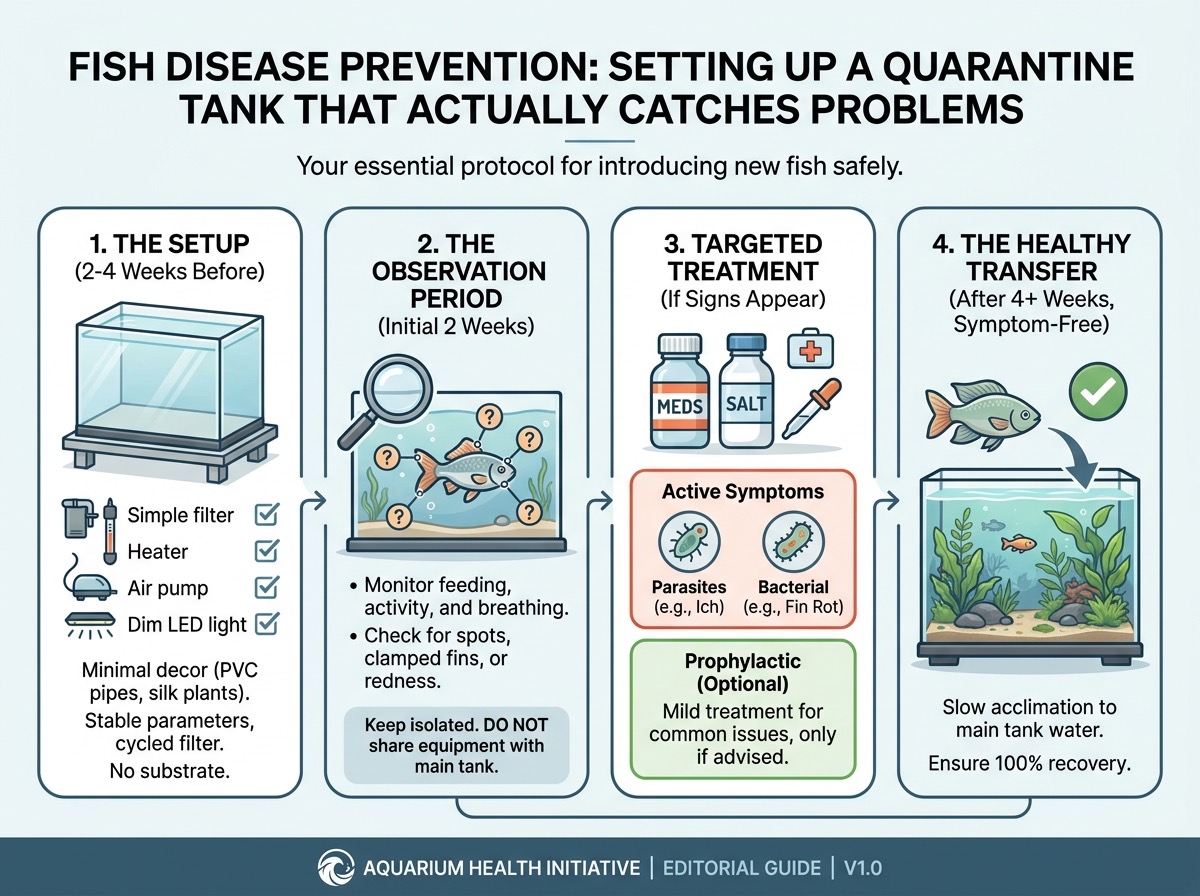
The minimum effective quarantine setup
You do not need an elaborate setup. You need:
Tank size
- 10–20 gallons (40–75 L) for most freshwater community fish
- 20–30 gallons (75–115 L) for larger or more active species
- Bare-bottom (no substrate) — easier to clean, easier to see parasites on the floor
A larger quarantine tank is not better. A smaller tank with more frequent water changes is easier to manage and easier to clean.
Equipment
- Filter: sponge filter or small hang-on-back. Both are easy to clean
- Heater: match the temperature to the species being quarantined
- Light: simple LED, on a timer (10–12 hours). Not too bright — bright lights stress new fish
- Air pump: optional but helpful for oxygenation and water movement
- Thermometer: to verify the heater is working
- Hiding places: PVC pipe fittings, terracotta pots, plastic plants. Real plants are nice but harder to disinfect between batches
Water
- Aged, dechlorinated water matching the species' requirements
- No live rock or live substrate in freshwater quarantine (can harbour pathogens that survive treatment)
- Match temperature within 1°C of the source water to avoid thermal shock when the fish arrives
Quarantine duration
- Minimum: 21 days for most freshwater community fish
- 28 days for saltwater/marine fish (longer pathogen incubation periods)
- 45 days for wild-caught fish (higher disease risk)
- 60 days for high-value specimens (worth the extra time)
The quarantine clock starts when the fish arrives, not when symptoms develop. The 21-day minimum is not arbitrary — it covers most common pathogen incubation periods.
The quarantine protocol
Day 1: arrival
- Acclimate the fish to quarantine water temperature and chemistry. Float the bag for 15–20 minutes, then add small amounts of quarantine water to the bag over 30–45 minutes before releasing the fish
- Observe the fish closely for the first 2 hours. Many fish show symptoms of transport stress immediately
- Do not feed for the first 24 hours if the fish is showing stress (helps the gut recover from fasting during shipping)
- Test water quality in the quarantine tank: ammonia, nitrite, pH
Days 2–7: observation
- Feed lightly once or twice daily
- Observe daily for any signs of disease: spots, flashing (rubbing against objects), rapid breathing, clamped fins, abnormal swimming
- Test water weekly for ammonia, nitrite, pH
- Do not treat prophylactically: do not add medications "just in case". Treatments stress fish and can mask symptoms
- Photograph any abnormalities so you can compare day-to-day or show to a vet
Days 8–21: continued observation
- Watch for late-blooming diseases: ich, flukes, internal parasites
- Continue water testing weekly
- If symptoms appear: identify the disease and treat
- If no symptoms by day 21: fish is likely safe to introduce to the display
Day 21 (or 28 for marine): introduction
- Move the fish to the display tank
- Acclimate to display water chemistry (especially important if display water differs significantly from quarantine water)
- Monitor for 48 hours for any signs of stress or disease
Diseases that emerge during quarantine
Ich (white spot)
Small white spots on fins and body. The fish may flash (scrape against objects). Treatable with:
- Heat treatment (freshwater only): raise temperature to 28–30°C over 24 hours, hold for 10–14 days. Speeds up the ich life cycle, killing the free-swimming stage
- Copper-based medication: copper sulphate, copperSafe. Follow dosage carefully — copper is toxic to invertebrates and some fish species (snails, scaleless fish, elephant nose)
- Malachite green + formalin: traditional, effective, but stains silicone and stresses some species
- Salt: at 2–3 ppt, effective for many freshwater species. Less effective for soft-water fish
Velvet (gold dust disease)
Fine gold or rust-coloured dust on the body. Often appears in conjunction with clamped fins and rapid breathing. More serious than ich.
Treat with:
- Copper-based medication: same as ich, slightly higher dose
- Dim lights: the velvet parasite is photosynthetic, dim lighting weakens it
- Heat treatment (where appropriate)
Flukes
The fish flashes against objects, breathes rapidly, may have visible mucus or redness on gills. Often hard to see without a microscope.
Treat with:
- Praziquantel (PraziPro): the standard freshwater fluke treatment. 1 dose, repeat in 5–7 days
- Formalin: effective but stressful
- Freshwater dip: brief (3–5 minute) dip in dechlorinated freshwater can dislodge some flukes
Internal parasites (Hexamita, Capillaria)
Weight loss despite eating, white stringy faeces, lethargy. Often requires multiple treatments.
Treat with:
- Metronidazole: in food (best) or in water. Treats Hexamita
- Levamisole: treats Capillaria. Dose carefully — narrow therapeutic window
- Fenbendazole: treats both. Can be added to food
Common quarantine mistakes
1. Too short a quarantine
7 days is not enough. Many pathogens have longer incubation periods. 21 days is the minimum for freshwater. 28 for marine.
2. Sharing equipment between quarantine and display
Net, siphon, bucket, water testing equipment — all of these can carry pathogens from quarantine to display. Either:
- Have separate equipment for quarantine
- Disinfect between uses (10% bleach solution, 10 minutes, rinse thoroughly)
- Use disposable equipment for single use
3. Treating prophylactically
"Don't treat prophylactically" is the rule. Treating without diagnosis stresses the fish, can mask symptoms, and may select for resistant pathogens.
The exception: deworming at the end of quarantine with praziquantel or fenbendazole is reasonable for wild-caught fish or fish from sources with unknown health history.
4. Quarantine in the same room as the display
Airborne transmission is rare for most fish pathogens, but shared hands, equipment, and water splashes can transmit pathogens. Ideally, quarantine is in a separate room.
If separate rooms are not possible:
- Keep quarantine far from the display
- Do all display work first, then quarantine work (so pathogens don't transfer from quarantine to display on your hands or equipment)
- Wash hands and disinfect equipment between tanks
5. Quarantine in uncycled water
A quarantine tank must be cycled (or use frequent water changes to compensate for the lack of cycling). Ammonia and nitrite spikes in quarantine will stress the fish, making them more susceptible to the very pathogens you are trying to prevent.
Options:
- Cycle the quarantine tank before adding fish. Run it empty with ammonia for 2–4 weeks before fish arrive. Tedious but effective
- Use seeded media from an established tank. Move a cup of established filter media to the quarantine filter to seed it
- Daily water changes: 25–50% daily in an uncycled quarantine. Removes ammonia and nitrite before they reach toxic levels
- Add bottled bacteria (Seachem Stability, API Quick Start) at startup. Speeds cycling but doesn't replace real cycling
6. Quarantine in a stressful environment
High traffic, loud noises, vibration, bright light, near a heater or AC vent — all stress fish in quarantine. A stressed fish is more susceptible to the diseases you are trying to prevent. Quarantine in a calm, dim, low-traffic location.
When to skip quarantine
There are a few situations where quarantine is not strictly necessary:
- Fish from a trusted local breeder with known health history and no recent illness
- Tissue-cultured plants (no, plants don't get quarantined; just dip them)
- Invertebrates from a known clean source (snails, shrimp can still carry parasites but the protocol is different)
- Adding fish to a tank that has no existing livestock (the new fish can't spread disease to anything if the display is empty)
For most home aquarists with established displays, quarantine is non-negotiable.
The hospital tank as a related concept
If a fish in your display becomes sick, the right move is often to move it to a hospital tank (which is essentially a quarantine tank with medication). The hospital tank:
- Has the same setup as a quarantine tank
- Should be cycled (a sudden move of a sick fish to an uncycled hospital tank adds stress)
- Often has medications dosed into the water
The downside of the hospital tank: the fish you move is now isolated, but any pathogens it has are still in the display tank. Treat the display tank at lower doses (medication-tolerant fish only) or accept that the pathogens are now established.
This is why prevention (quarantine on new arrivals) is so much better than treatment (hospital tank on display-tank infections).
The bottom line
Quarantine is the single most effective disease prevention tool in the aquarium hobby. Twenty-one days in a separate tank, with daily observation and weekly water testing, catches the vast majority of pathogens that new fish carry but do not show. The setup is minimal — 10–20 gallons, sponge filter, heater, light, hiding places. The discipline is what matters: don't share equipment, don't treat prophylactically, don't shorten the duration. The fish that survives quarantine and then enters the display is a fish with a dramatically lower risk of bringing pathogens to your established population. The few hours of setup and the three weeks of patience are worth it many times over in prevented tank crashes.
---
About the author: [Kenji Tanaka](../Kenji%20Tanaka.md) is a ZNA-certified koi judge with 25 years of freshwater ornamental fish research, and has served on the judging panel of the All Japan Nishikigoi Show on multiple occasions.