
Doorbell diving: how to teach a calm greeting that doesn't involve a stranger's lap
The dog that launches itself at the front door when the doorbell rings is, in my experience, the single most common precursor to a serious bite incident in family homes. Not because the dog is aggressive — usually the opposite. The dog is so excited to see the visitor that it jumps, paws, and mouth-nudges in a way that knocks the visitor over, scratches them, or scares a child. The visitor reacts. The dog reads the reaction as a successful greeting (or, in some cases, as aggression). Either way, the behaviour gets rehearsed.
This is the 4-week protocol I run on doorbell divers. It produces four-on-the-floor greetings in most dogs within 4–6 weeks.
Why the doorbell is a high-stakes moment
Three things make the doorbell different from any other training scenario:
- It's intermittent and unpredictable — the dog cannot predict when it will happen, so the behaviour cannot be cued in advance
- It's self-reinforcing — every time the dog jumps and a visitor arrives, the dog's brain registers "jumping = guest appears". The behaviour pays off unpredictably, which makes it harder to extinguish than a continuous-reward behaviour
- The reward is the visitor themselves — even if you do nothing, the dog gets the social reward of meeting the person. This is the hardest reinforcer to compete with in any training plan
The protocol has to address all three. We add predictability (cue the doorbell), remove the self-reinforcement (jumping never again produces a greeting), and replace the reward (four-on-the-floor = greeting happens).
The training tools
You need:
- A doorbell cue you control — a wireless doorbell button (the kind you can buy for £10–20), a recorded doorbell sound played from your phone, or even a knock on a specific surface. Anything that you can trigger at will during training.
- High-value treats — soft, smelly, pea-sized. Cheese, hot dog, freeze-dried chicken.
- A designated "place" — a dog bed, mat, or rug near (not at) the front door, ideally 2–4 metres away from the door itself.
- A helper (for weeks 3–4) — someone the dog knows and likes who can play the role of "visitor".
- A clicker or verbal marker (optional but helpful) — "yes!" in the same tone every time.
Week 1: the doorbell stops meaning anything
The goal of week 1 is to break the association between the doorbell and a visitor arriving. The dog should hear the doorbell many times per day without a visitor appearing.
How to do it:
- Choose your doorbell cue (wireless button, recorded sound, knock)
- During a quiet time of day (mid-morning, mid-afternoon), trigger the cue 5–10 times over the course of an hour
- The dog will initially react — look up, get up, walk to the door
- Do nothing. No treat, no attention, no response
- The cue stops being a predictor of anything. The dog habituates
Repeat this exercise 3–4 times per day for the first week. By the end of the week, the dog should look up briefly when the cue sounds, then go back to what it was doing.
If the dog is still running to the door at the end of week 1, you have not repeated the cue often enough. Bump it to 15–20 cues per session, 5 sessions per day.
Week 2: doorbell predicts something good (away from the door)
Now the cue becomes a predictor of treats — but delivered at the dog's "place", not at the door.
Setup:
- Dog on the place bed, 2–4 metres from the door
- You are near the dog (within arm's reach)
- Trigger the doorbell cue
- Immediately toss 3–5 high-value treats onto the place bed
- The dog eats them
- Trigger the cue again 10–15 seconds later
- Toss more treats
What the dog learns: "Doorbell sound = treats appear on my bed. I want to be on my bed when I hear it."
After 30–50 repetitions in week 2, the dog should be looking at the place bed when the cue sounds, not the door.
Week 3: doorbell plus visitor
Now add the visitor element back, but in a controlled sequence.
Setup:
- Helper outside the door, ringing the cue
- Dog on the place bed
- Trigger cue
- Toss treats on bed
- Helper enters the door slowly, and only after the dog has eaten the treats and is calm
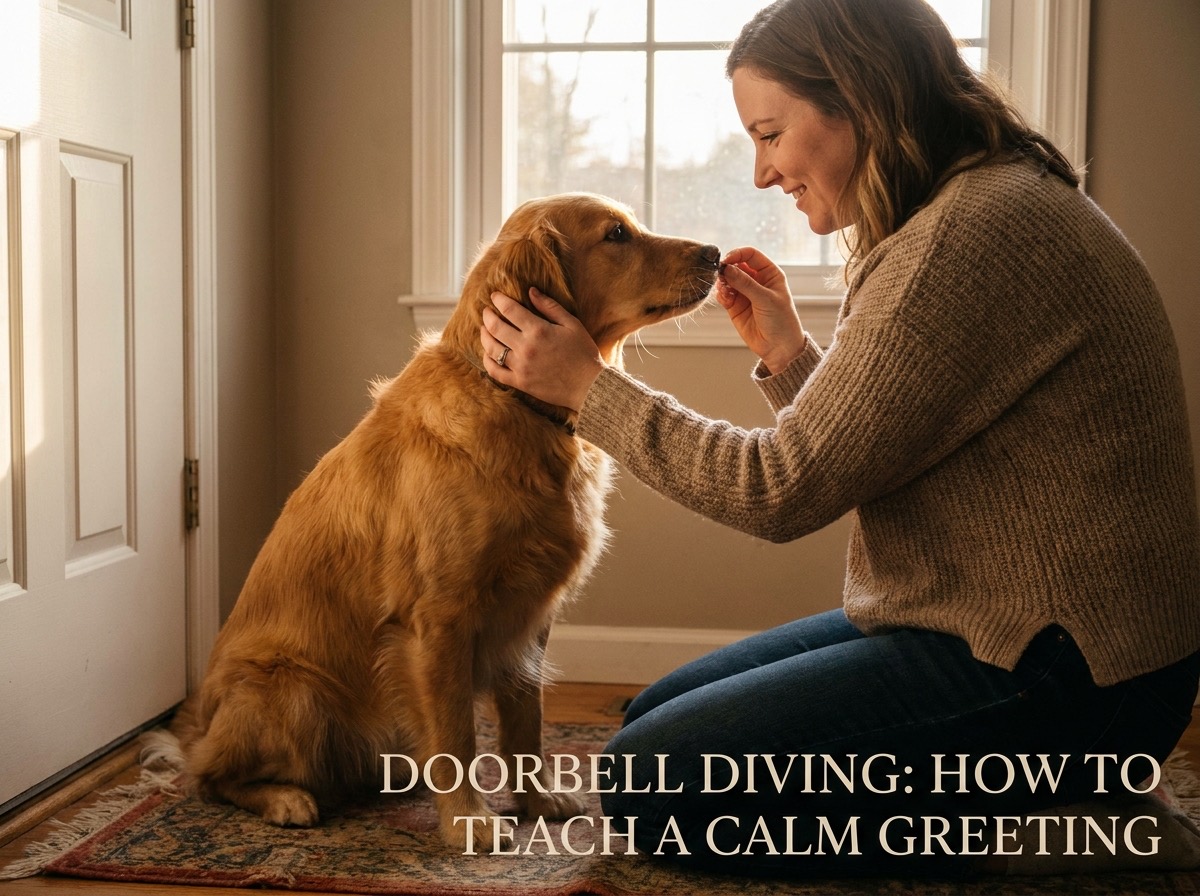
- Helper walks toward the dog without making eye contact, offers a treat from their hand at dog's nose level (not above — this prevents jumping)
- You mark the calm behaviour with a "yes!" or click
If at any point the dog jumps:
- Helper immediately turns around and walks back out the door
- No verbal correction, no eye contact
- Reset, try again
The critical rule: jumping never produces a greeting. Calm on the bed produces a greeting. The dog learns which behaviour pays off.
Week 4: real visitors
Now it's time to apply the protocol to actual visitors. The setup:
- Visitors are pre-briefed: "Please do not engage with the dog until the dog is calm. If the dog jumps, immediately turn away."
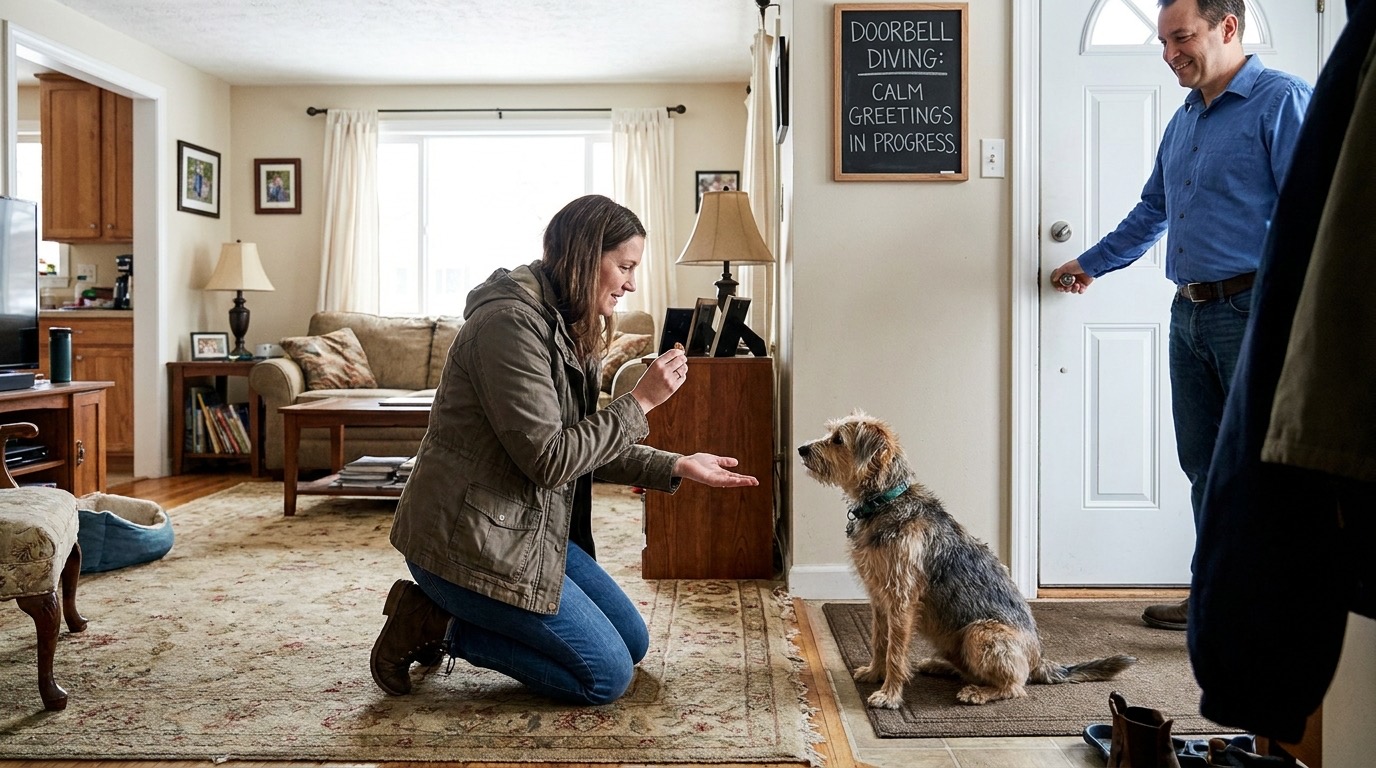
- The dog is placed on the bed before the door is opened
- The doorbell rings naturally (or you trigger the cue)
- Dog eats the treats on the bed
- Door opens, visitor enters, walks to dog only if dog is calm
- If dog jumps: visitor turns away. No interaction. Try again after 30 seconds.
The first few real visitors are usually messy. Expect 2–3 false starts before the dog catches on. Be patient — the protocol works, but consistency from every visitor matters.
Common mistakes
1. Letting visitors "say hi" before the dog is calm
"This is my friend, she doesn't mind if he jumps." Yes she does. She might say she doesn't mind, but she will remember the muddy paw prints on her white jeans. More importantly, every "she doesn't mind" greeting is a rehearsal of the jumping behaviour.
Solution: brief all visitors. Have a sign on the door if needed: "Please wait for the dog to sit before saying hello."
2. Giving up too early
The protocol takes 4 weeks for most dogs. Some take 6–8. If you give up after 2 weeks, the dog learns that the jumping eventually works again.
Solution: plan for 4 weeks minimum. Tell your household: "No greeting the dog for 4 weeks."
3. Inconsistent cues
If the dog hears the doorbell in training but the visitor doesn't arrive, but then hears the doorbell in real life and a visitor arrives, the cue becomes unreliable again.
Solution: in early weeks, the cue ALWAYS predicts treats OR a visitor. Never both unpredictably. Once the dog has the pattern, real life can be more variable.
4. The dog is still jumping 4 weeks in
The protocol fails for a reason. Most common:
- The helper is letting the dog greet them before the dog is calm
- The family is still greeting the dog at the door when they come home
- The treats are not high enough value — try real meat instead of kibble
- The dog has an underlying anxiety component — the doorbell predicts something scary, not just exciting. A behaviour consultant can help.
What if the dog also barks at the doorbell?
The barking is part of the same behaviour complex. The protocol addresses it because:
- Week 1 (habituation) reduces the startle response that triggers barking
- Week 2 (treats on the bed) gives the dog an alternative behaviour to barking
For a dog that barks intensely, add a "quiet" cue during week 2: when the dog is silent for 3 seconds on the bed after a doorbell cue, mark with "yes!" and treat. The dog learns that silence on the bed is what pays.
If the barking is severe (over 30 seconds of sustained barking), the underlying issue is often territorial anxiety or alert behaviour, not just excitement. A behaviour consultant should be involved.
The bottom line
A doorbell-diving dog is usually an over-excited greeter, not an aggressive dog. The fix is a 4-week protocol: desensitise the doorbell cue, then pair it with treats on a designated place, then add visitors who only engage with calm dogs. The hardest part is consistency — every visitor must follow the rule, every cue must predict the same outcome, for 4 weeks minimum. Once the dog has the new pattern, the jumping fades within weeks and stays gone.
---
About the author: [Marcus Whitfield](../Marcus%20Whitfield.md) is a Certified Canine Behavior Consultant (CBCC-KA) with 20+ years of practice, and a member of the American Society for Animal Behavior. He has supported more than 3,000 families with canine behaviour challenges.