
The 4-month puppy biting phase: why it happens and what to do
If you have a puppy between 3 and 5 months old and you are reading this with band-aids on your hands and ankles, welcome to the 4-month biting phase. You are not alone. You are not failing. Your puppy is not aggressive. This is a developmental stage that every puppy goes through, and there is a clear protocol to get through it without anyone — human or canine — losing trust in the other.
This is that protocol.
Why puppies bite (so much)
Three reasons, all of them normal:
1. Teething
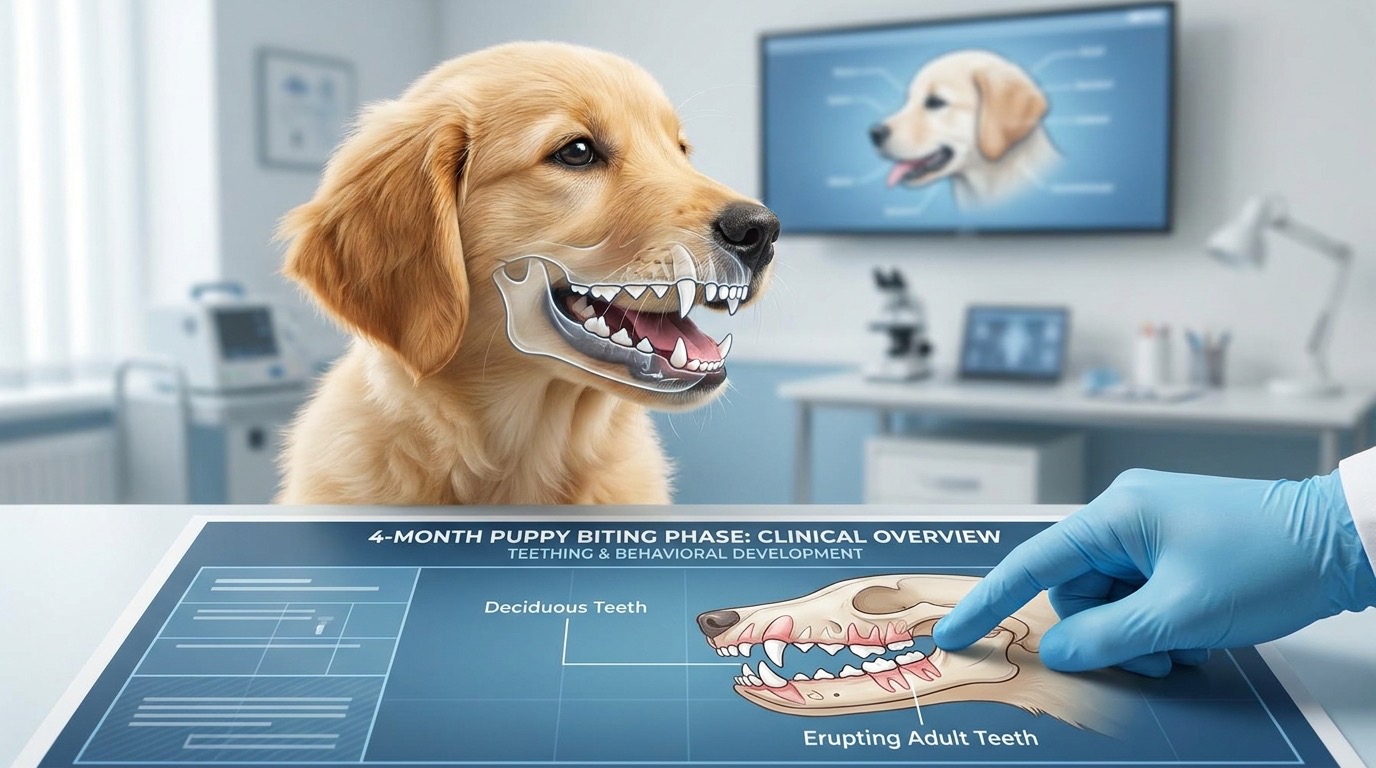
The adult teeth are erupting through the gums between 3 and 6 months of age. The gums are sore, sometimes inflamed. Chewing and biting relieve the pressure. This is the most common cause of the 4-month surge in mouthing.
2. Bite inhibition learning
Puppies need to learn how hard is too hard when biting. They do this through play with littermates and with their mother — when a puppy bites too hard, the other puppy yelps and stops playing. The puppy learns: "that pressure caused play to stop. I should not use that pressure again." A puppy removed from the litter before 8 weeks (most pet shop puppies, sadly) often arrives without completing this learning.
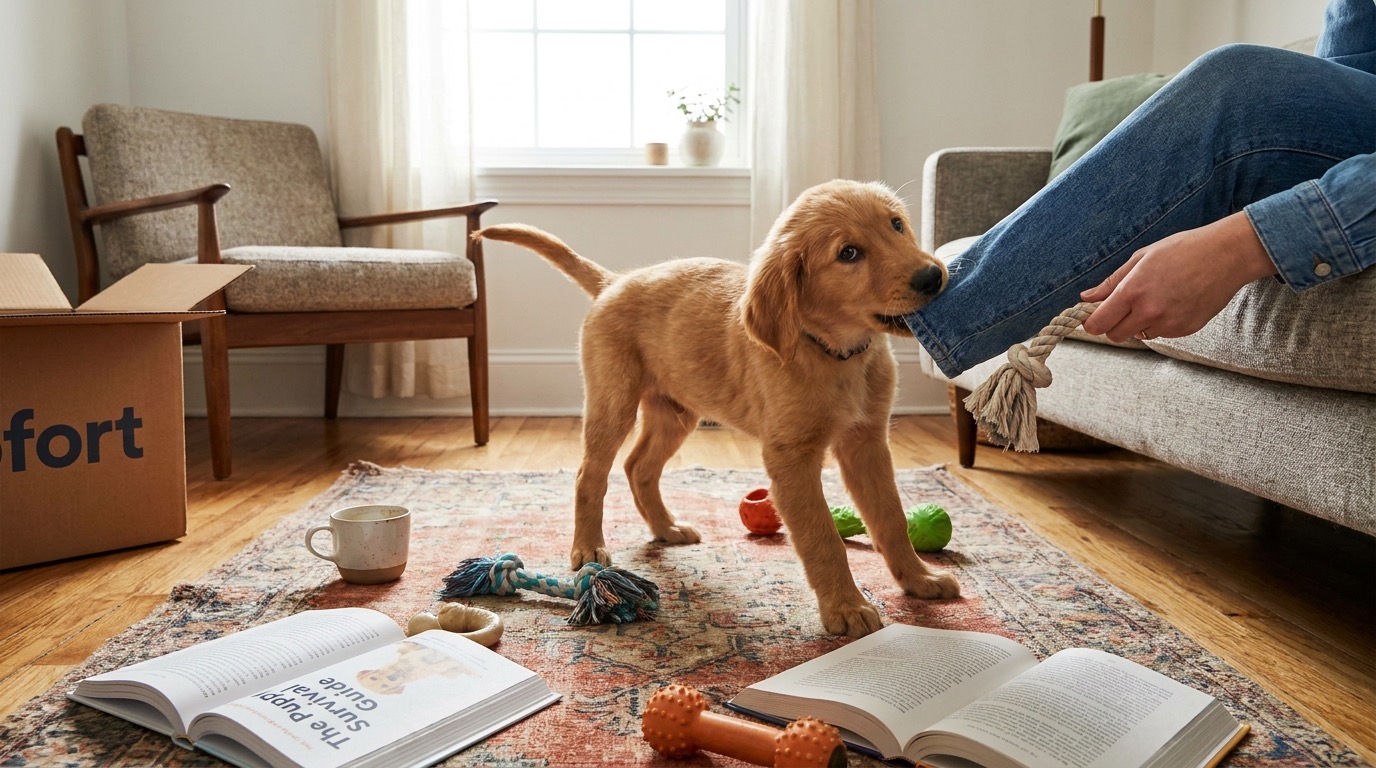
In the new home, the puppy uses human hands and ankles as substitute littermates. The biting is the same learning process. The puppy is doing exactly what it should be doing, just with the wrong target.
3. Overstimulation and frustration
Puppies have poor impulse control. When they get excited, tired, or frustrated, the biting intensifies. The 4-month surge often coincides with the puppy being more active, more curious, and more easily overstimulated than at 2 months.
What not to do
The instinct is to react to biting with force: hold the muzzle, scruff the puppy, roll the puppy, spray with water, yell "NO". None of these work, and several make things worse.
- "No bite" verbal corrections — the puppy does not connect "no" with the bite, because the biting feels good to the puppy. The puppy learns that the human makes loud noises when the puppy is excited, which actually increases excitement.
- Holding the muzzle closed — causes fear and defensive biting, especially in puppies that arrived fearful or undersocialised. The puppy learns that hands near the face mean restraint.
- Scruffing or alpha rolls — same problem. Increases fear, damages trust, can cause defensive aggression later.
- Spray bottles or shaking cans — produces a brief pause, not learning. The puppy will resume biting as soon as the aversive stops.
- Physical punishment — none of it works. The puppy gets more aroused, not less, and the biting often intensifies.
The protocol that works
The protocol is built on one principle: the biting stops producing what the puppy wants, and an alternative behaviour produces what the puppy wants.
Step 1: Have appropriate chew outlets
Puppies need to chew. Provide it.
What works:
- Frozen Kong with kibble or peanut butter inside, frozen for 4+ hours. The cold numbs sore gums and the chewing exhausts the puppy
- Frozen wet washcloth twisted into a knot, frozen. Cheap, safe, effective
- Rubber chew toys: Kong Puppy, Nylabone Puppy, Benebone Puppy
- Soft plush toys: puppy-specific plush toys from Kong, Outward Hound, or ZippyPaws
- Edible chews: bully sticks (supervised only), frozen carrots, frozen banana slices
Have at least 5–6 chew options available at any time. Rotate them daily so the puppy does not get bored.
Step 2: The "ouch and withdraw" response
When the puppy bites you hard enough to feel teeth (this is the threshold, not the lightest mouthing):
- Say "ouch" in a high, sharp voice — the same tone a littermate would yelp
- Immediately withdraw your hand (or foot, or whatever was bitten)
- Stop interacting with the puppy for 5–15 seconds
- Resume interaction
This mimics the littermate response. The puppy learns: "That pressure caused the human to leave. I should not use that pressure again."
The key is immediate withdrawal. If you keep playing while the puppy is biting, you are rewarding the biting. If you withdraw for 2–3 seconds, the puppy does not learn. 5–15 seconds is enough to make the connection.
Step 3: Redirect to a chew
After the "ouch and withdraw", offer the puppy an appropriate chew:
- Hold out the frozen Kong or rubber toy
- The puppy, looking for something to chew, takes the toy instead of your hand
- Praise and reward the chew ("good chew!")
The redirect is critical. Without it, the puppy learns that biting makes the human leave, but does not learn what to do instead. With the redirect, the puppy learns: bite hand → human leaves, bite toy → human stays and gives praise.
Step 4: Manage arousal
The puppy that is overstimulated will bite harder and more often. Recognise the signs of building arousal:
- Body tension, "whale eye" (showing the whites of the eyes)
- Faster breathing
- Jumping, grabbing clothing, barking
- Increased mouthing intensity
When you see these signs, the puppy needs a time-out, not more training. Place the puppy in a crate or pen for 10–15 minutes. The puppy will fall asleep or calm down. Resume interaction after the break.
The 4-month-old puppy needs 16–18 hours of sleep per day. Most "biting" issues in 4-month-old puppies are actually overtiredness biting. If the puppy has been awake for more than 2 hours, it needs a nap, not more stimulation.
Step 5: Teach bite pressure thresholds progressively
The goal is for the puppy to learn that human skin requires a softer mouth than, say, a chew toy.
Three pressure thresholds to teach in sequence:
Threshold 1: no teeth at all on skin (week 1–2)
Reward the puppy for licking or soft mouthing (no teeth contact). When teeth touch skin → "ouch" and withdraw.
Threshold 2: soft mouthing only (week 3–4)
Allow gentle mouthing with soft pressure (no pain). Any pressure that causes discomfort → "ouch" and withdraw.
Threshold 3: mouth only on toys (week 5+)
By this age, the puppy should understand: hands and clothing are not for mouthing. Toys and chews are.
A typical day with a 4-month-old biter
| Time | Activity |
|---|---|
| 07:00 | Wake, toilet, breakfast in Kong (frozen, lasts 20 min) |
| 07:30 | Short training session (5 min) — sit, name recognition |
| 08:00 | Out for a sniff walk (15 min) |
| 08:30 | Play with you + chew toys (15 min) |
| 09:00 | Crate nap (1.5–2 hours) |
| 11:00 | Out, toilet, training session (5 min) |
| 11:30 | Chewing session with bully stick (10 min, supervised) |
| 12:00 | Crate nap (1.5–2 hours) |
| 14:00 | Socialisation outing (15 min) — different surfaces, sounds |
| 14:30 | Crate nap |
| 16:30 | Training (5 min) + play (15 min) |
| 17:00 | Crate nap |
| 18:30 | Dinner in slow-feeder bowl |
| 19:00 | Family time, gentle play |
| 20:00 | Toilet, then overnight sleep (10–11 hours) |
The total awake time is 2–3 hours across the day. The puppy sleeps the rest. The biting issues drop dramatically when the awake time is properly managed.
When to call a professional
Most 4-month-old puppies work through the biting phase within 4–6 weeks of consistent protocol. If after 6 weeks the biting is still severe, consider:
- Puppy class with a force-free, reward-based trainer — peer play teaches bite inhibition faster than human play
- Behaviour consultant for one-on-one work if the puppy is responding with fear or aggression to the protocol
- Veterinary check to rule out pain (teeth erupting unusually, ear infection, GI discomfort) that is contributing to the biting
Avoid trainers who recommend:
- Alpha rolls or scruffing
- Spray bottles or shaker cans
- "Cesar Milan style" dominance techniques
- Punishing the puppy for biting
These methods damage trust and increase the risk of fear-based aggression later.
The bottom line
The 4-month biting phase is biology, not misbehaviour. The puppy is learning bite inhibition, dealing with teething, and struggling with impulse control. The protocol: provide appropriate chews, respond to hard bites with "ouch and withdraw", redirect to a chew, manage arousal and ensure adequate sleep, and teach pressure thresholds progressively. Within 4–6 weeks of consistent application, most puppies are mouthing softly or not at all. The puppies that take longer usually need more sleep, more appropriate chews, or more bite-inhibition practice with peer puppies in a class.
---
About the author: [Marcus Whitfield](../Marcus%20Whitfield.md) is a Certified Canine Behavior Consultant (CBCC-KA) with 20+ years of practice, and a member of the American Society for Animal Behavior. He has supported more than 3,000 families with canine behaviour challenges.