
Crate training: the 5-step progression that works for any dog
The crate is the single most useful tool in dog training. It is the foundation of house training, the safety net for separation work, the management tool that prevents adolescent destruction, and the recovery space for sick or post-surgical dogs. A dog that is comfortable in a crate is a dog that is easier to train, easier to travel with, easier to board, and easier to live with in a rental or shared housing.
The bad news: most owners try to skip steps. The good news: the five-step progression below is reliable. It works for 8-week-old puppies, for 8-year-old rescue dogs, and for every age in between. The progression is slow. The progression works.
Picking the right crate
Before starting, the crate itself has to be correct. Three rules:
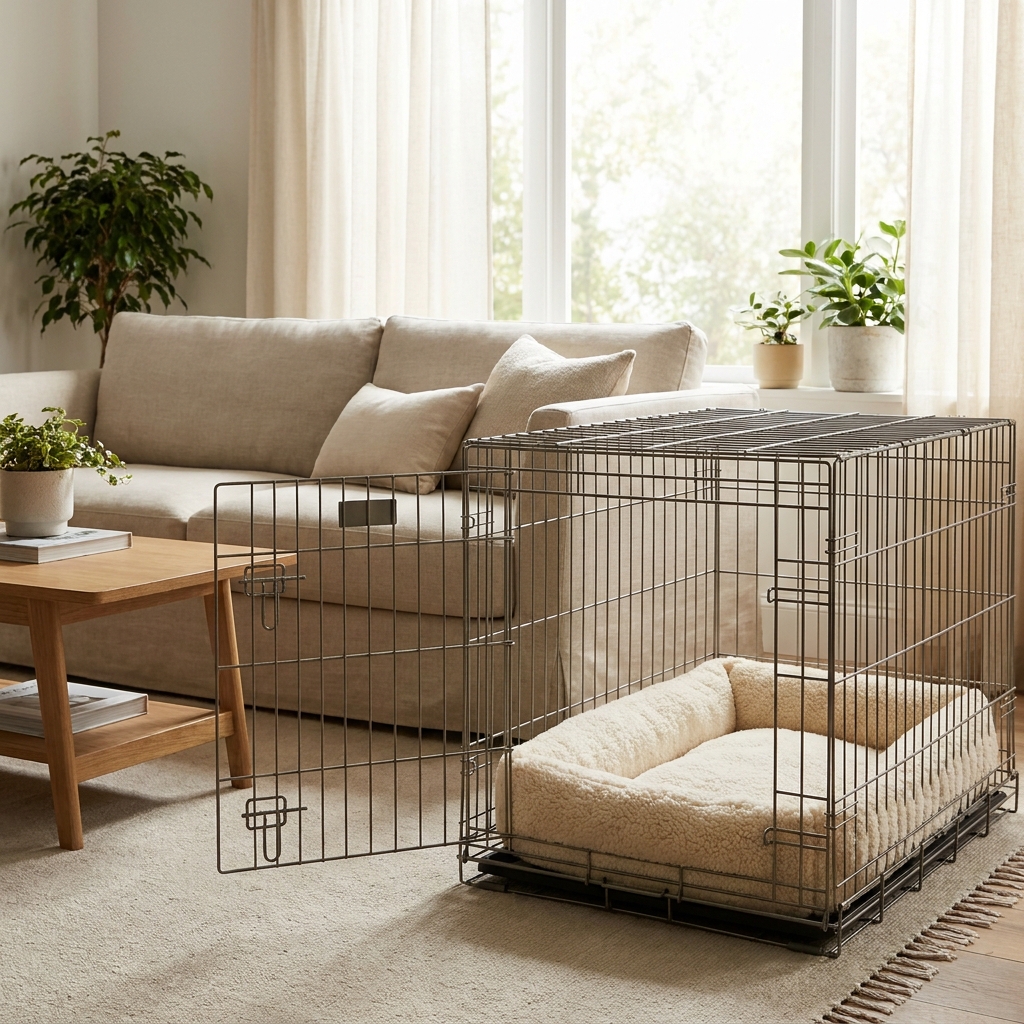
- Size: dog can stand up, turn around, and lie down comfortably. Not bigger, not smaller. A crate that is too large encourages the dog to use one end as a bathroom. A crate that is too small is uncomfortable and the dog will fight it. Most wire crates come with a divider - use it to grow the space as the puppy grows.
- Type: wire for most dogs, plastic for travel and airline, soft-sided only for calm adults. Wire is the most versatile and easiest to clean. Soft-sided crates feel den-like but a determined chewer will destroy them in minutes.
- Location: in the room where the family is, not isolated in a basement or garage. The crate is the dog's resting spot, not a punishment zone. If the crate is in a back room, the dog associates it with isolation and will resist it.
A 30-kg adult dog typically needs a 91 cm (36 inch) wire crate. A 10-kg dog needs a 61 cm (24 inch) crate. A 50-kg dog needs a 107 cm (42 inch) crate. Measure your dog from nose to tail and from floor to top of head, then add 5 cm to each.
Step 1: The crate is a fun place (days 1-3)
The first goal is to change the dog's emotional response to the crate from neutral or fearful to positive. The crate is open. The door is removed or tied open so it cannot accidentally close and scare the dog. High-value treats - small bits of chicken, cheese, or freeze-dried liver - are tossed into the back of the crate. The dog walks in, sniffs, eats, walks out. No pressure. No "go in" command.
Repeat this 5-10 times per day, for 2-3 days. By the end of step 1, the dog should be walking into the crate voluntarily to investigate, and the body language should be loose and curious rather than hesitant.
If the dog will not approach the crate at all, the problem is the crate is too scary, the location is wrong, or the dog has had a previous bad experience. Move the crate to a smaller space (a corner of the kitchen), drape a towel over the top to make it den-like, and use higher-value treats. Take a step back - the dog is telling you the emotional baseline is not yet neutral.
Step 2: Meals in the crate (days 3-7)
Now the dog eats every meal in the crate. The bowl goes all the way at the back. The door stays open. The dog walks in, eats, walks out. After 2-3 days, the door closes while the dog eats, and opens the moment the dog steps away from the bowl.
This step builds duration. The dog learns that being in the crate is associated with food, the most powerful positive reinforcer available. By the end of step 2, the dog should be eating meals in the crate and not trying to leave mid-meal.
If the dog panics, lunges at the door, or stops eating, the door has closed too long. Open it sooner. The dog is telling you the duration threshold is not yet met.
Step 3: Short closed-door sessions (days 7-14)
The dog goes into the crate, the door closes, and you stay in the room. Start with 30 seconds. Open the door. The dog walks out calmly. Wait a minute. Repeat. The dog learns that the door closing does not mean the dog is abandoned.
Gradually extend the closed-door time: 1 minute, 2 minutes, 5 minutes, 10 minutes. The dog should be calm throughout - lying down, sighing, chewing a stuffed Kong. If the dog is whining, barking, or scratching, the duration is too long. Drop back to the previous successful duration for a few days, then try again.
This step usually takes 7-10 days. There is no prize for finishing faster.
Step 4: Leaving the room (days 14-21)
Now you step out of the room. The dog is in the crate, you step into the hallway, you step back in. 5 seconds, 30 seconds, 1 minute. Build up to leaving the room for 5-10 minutes. The dog should still be calm.
The key milestone in this step is the dog being calm when you disappear from view. Most dogs that fail step 4 are not anxious about the crate - they are anxious about you being gone. The crate is a coincidence.
This is also when you start adding the cue. Pick a word ("crate", "kennel up", "place" - pick one and use it consistently) and say it just before the dog walks in. Pair the verbal cue with the action. Within a week, you can say the cue and the dog walks in.
Step 5: Leaving the house (days 21-30)
The final step. You walk out the front door, close it, and come back. 1 minute, then 5 minutes, then 15 minutes, then 30 minutes. The dog stays calm in the crate while you are physically absent from the house.
This step looks like separation anxiety training and shares much of the same protocol. The crate is a useful tool for separation work because it is a familiar space. But the dog still needs to be able to handle the crate with you physically gone for the training to count.
Build up to 4-hour absences by the end of step 5. If the dog is reliably calm in the crate for 4 hours, the crate training is complete. You can now use the crate for sleep, for management when you are busy, for travel, and as a base for further training.
Common mistakes
A few things derail the progression:
- Using the crate as punishment. "Go to your crate" should never mean "you did something bad." If the crate is the punishment, the dog learns to avoid it.
- Letting the dog out when the dog whines. The dog learns that whining produces the door opening. The dog whines more. The whining escalates. Wait for 5-10 seconds of quiet before opening the door.
- Skipping steps because the dog "seems fine." The dog is fine because the steps are easy. The next step is harder. Skip and the dog panics.
- Crating for too long. A dog should not be in the crate for more than 4 hours during the day for an adult, more than 2 hours for a puppy under 6 months. Crating for 8-10 hours a day is a management failure, not a training success.
- Putting a bed, blanket, or toy in the crate that the dog will destroy. No beds or blankets in the crate during early training. A hard plastic floor or a single layer of old towel only. The dog can chew a stuffed Kong. The dog cannot chew a stuffed bed without ingesting fabric.
The bottom line
A well-crate-trained dog is one of the most useful lifelong skills you can give a dog. The 5-step progression takes 3-4 weeks. The progression is the same for puppies, rescue dogs, and adults. Take the time, take the steps in order, and you will have a dog that walks into the crate on cue and stays calm for hours.
About the author
Marcus Whitfield is a certified dog behavior consultant based in Austin, Texas, with a background in animal behavior science from UC Davis. He has worked with hundreds of crate-training cases, including rescue dogs with crate anxiety, performance sport dogs, and family pets, and is a member of the International Association of Animal Behavior Consultants. See his full profile at [authors/Marcus Whitfield/](../Marcus%20Whitfield.md).