
Diabetic dog: blood-sugar-aware feeding schedules
If you are reading this, your dog has probably just been diagnosed with diabetes mellitus, and the vet has handed you a vial of insulin, a bag of prescription food, and the words "twice daily injections, twelve hours apart, same time every day." You nodded. You drove home. You looked at the schedule and realized that "twelve hours apart" is a fantasy if you work a normal 9-to-5, sleep in on weekends, and have a life.
The good news: a diabetic dog can live a full, normal, happy life. The bad news: you now have a part-time job. This article is about the part-time job, specifically the feeding half, because insulin gets the attention but feeding is what most people get wrong.
Why timing matters more than you think
Insulin works on a curve. Peak effect, duration, nadir - these are technical terms but the practical version is: the insulin is most active at certain times, weakest at others, and you want food in the dog when the insulin is pulling blood sugar down. If you feed the dog when the insulin has worn off, blood sugar spikes, you give the next injection, and the cycle becomes a roller coaster.
A stable diabetic dog is one whose blood glucose graph looks like gentle hills, not skyscrapers. Feeding schedule is the single biggest lever you have to flatten that graph.
The base schedule: two meals, two injections
Most diabetic dogs are on a 12-hour insulin protocol. The standard pattern:
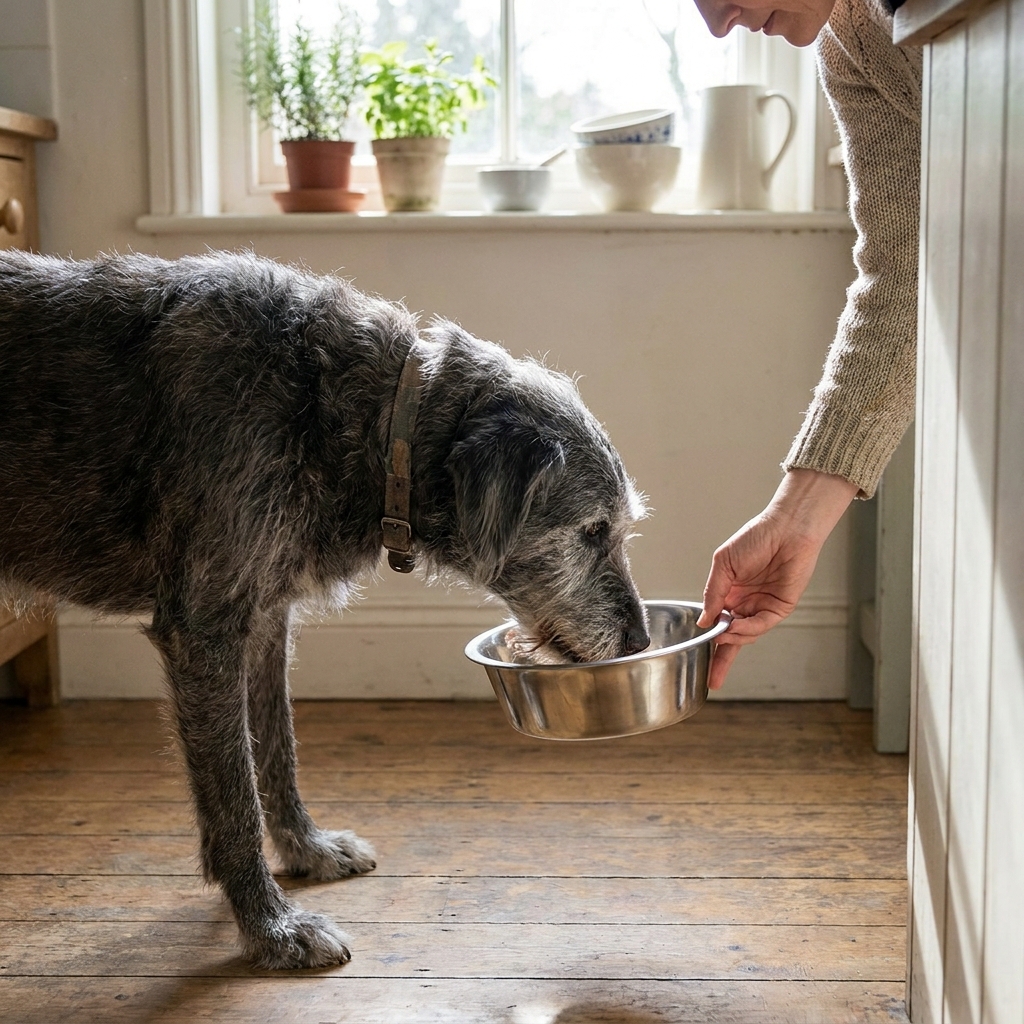
- 7:00 AM - Inject insulin, then feed a measured meal within 5 minutes
- 7:00 PM - Inject insulin, then feed a measured meal within 5 minutes
If you work a normal day, the morning can shift to 6:30 AM and the evening to 6:30 PM. The 12-hour window is what you protect. Same time on weekdays and weekends, even if your natural rhythm wants to drift.
For dogs on once-daily insulin (mainly dogs on glargine or detemir where the protocol allows), the pattern is simpler - one injection, one main meal, no second meal until the next day. Talk to your vet before assuming this is an option. Most diabetic dogs do better on twice-daily.
What to feed (and what the bag actually means)
The prescription diets for diabetic dogs (Hill's w/d, Royal Canin Diabetic, Purina DM) are formulated for one purpose: slow-release carbohydrates. They are not magic, and they are not your only option. What they do is replace high-glycemic grains with fiber and lower glycemic starches, which flattens the post-meal blood sugar curve.
You can get similar results at home with a vet nutritionist's help, but for most owners the prescription diets are easier and safer. If cost is an issue, ask your vet about a senior weight-management diet. The fiber and protein profile is similar, though the carbohydrate is not as tightly controlled.
Treats: this is where most people break the rules. A diabetic dog can have treats, but they must be:
- Low glycemic index (no wheat, no rice, no corn syrup)
- Counted as part of daily calories
- Less than 10% of total daily intake
- Given at consistent times relative to insulin
Good options: small pieces of cooked chicken, freeze-dried liver, green beans, carrot coins, vet-approved dental treats. Bad options: biscuits, rawhide, anything with sugar or starch as a main ingredient.
The "snack window" rule
This is the rule I made up for my own dogs and have since given to hundreds of clients. Pick a one-hour window each day, ideally mid-morning (around 10 AM) and another mid-afternoon (around 3 PM), when the dog's blood sugar is most stable and not in the middle of an insulin peak. That is your snack window. Anything the dog gets outside that window is a real conversation with yourself about whether the dog's blood sugar curve is stable enough to handle it.
Most diabetic dogs should not get treats in the two hours before or after an injection. Insulin is peaking in that window. Adding food during peak insulin is the fastest way to cause hypoglycemia.
Spotting low blood sugar at home
A feeding schedule that is too aggressive can drive blood sugar too low. Signs of hypoglycemia in dogs:
- Lethargy, weakness, "drunk" walking
- Trembling, shivering
- Disorientation, confusion
- Seizure (severe cases)
If you suspect hypoglycemia: rub a small amount of honey or sugar syrup on the dog's gums. If the dog is conscious and can swallow, offer a small meal. If the dog is seizing or unconscious, rub honey on the gums and get to an emergency vet immediately. Do not give insulin. Do not wait.
Own a glucose monitor for home use. The AlphaTrak 3 and similar pet-specific meters are more accurate on dog blood than human meters. A 30-second prick of the ear or lip gives you a real number to work with.
When to break the schedule
A diabetic dog's schedule is more rigid than a non-diabetic dog's, but it is not unbreakable. There are times you will need to bend:
- The dog refuses a meal. Withhold that insulin dose and call your vet. Giving insulin to a dog that did not eat is the most common cause of life-threatening hypoglycemia.
- The dog is vomiting. Skip the next meal and insulin dose, call your vet, monitor for ketones.
- You are travelling. Bring pre-measured meals in baggies, the insulin, the syringes, and a printed schedule. Tell anyone caring for the dog exactly what to do and what to do if the dog refuses food.
- Exercise. Brisk walks lower blood sugar for 12-24 hours. On heavy exercise days you may need to feed a small snack before the activity or reduce insulin by 1-2 units - only with your vet's guidance and a glucose curve to back it up.
Bottom line
A diabetic dog is a manageable condition, not a death sentence. The schedule is the hard part, and the schedule is mostly about you, not the dog. Once the rhythm is set - same time, same food, same insulin - you stop thinking about it and it becomes the new normal. Most of my long-term diabetic dog clients tell me, two years in, that they cannot remember life before the schedule. That is the goal.
About the author
Sarah Chen is a canine nutrition scientist based in Melbourne with a PhD in veterinary nutrition from the University of Sydney. She works with diabetic, kidney, and allergy cases at a referral nutrition practice and has personally managed more than 400 diabetic dogs in consultation with their primary vets. See her full profile at [authors/Sarah Chen/](../Sarah%20Chen.md).