Aquascape composition: visual balance rules for planted tanks
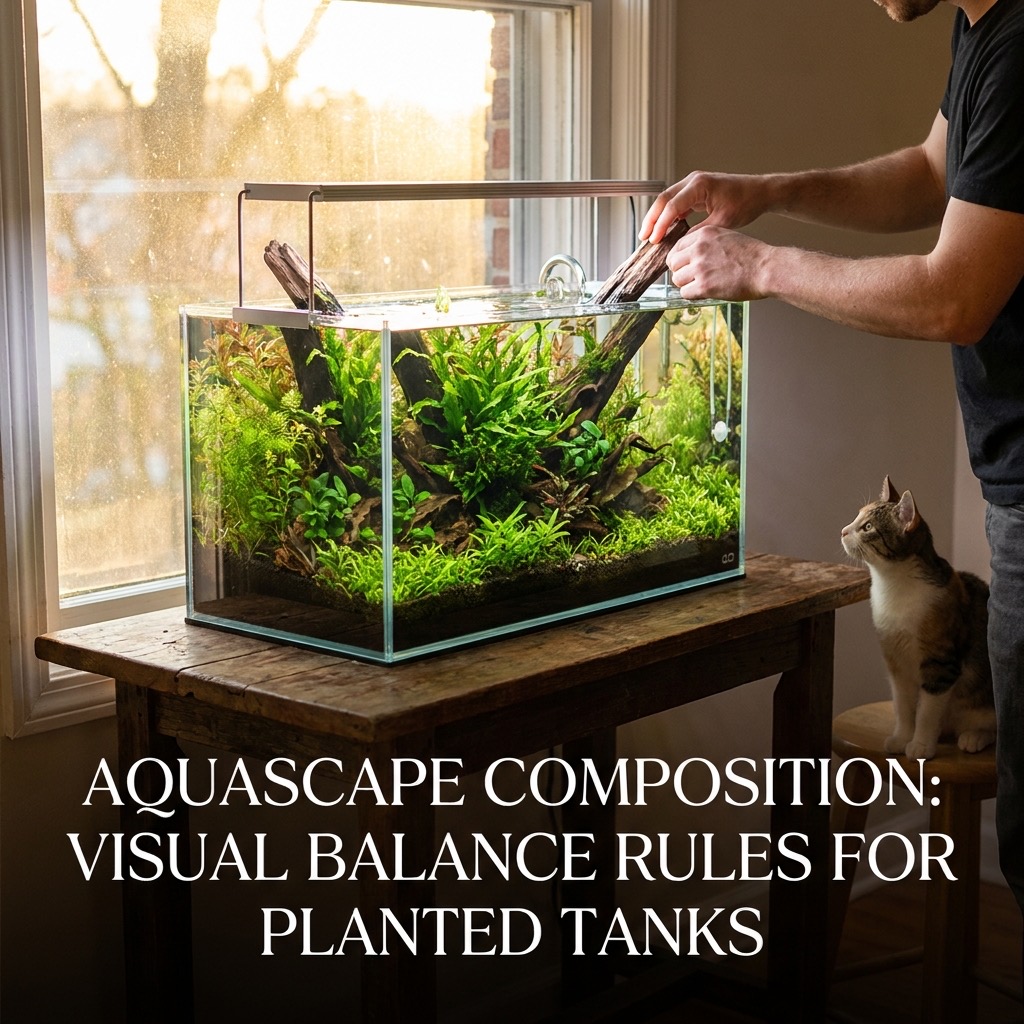
A planted tank is a piece of living art. The plants grow, the fish swim, the light shifts, the water moves. The composition is what makes a tank look like a slice of nature rather than a fishbowl with plants. Composition is the arrangement of hardscape, plants, and negative space into something that reads as intentional and balanced.
The rules of aquascape composition come from Japanese garden design, landscape painting, and photography. They're applied to a 3D underwater canvas with living materials that grow and change over time. The rules are learnable. The result, when applied well, is an aquascape that looks like a master painted it.
The principle: a slice of nature, not a garden
The first principle of aquascape composition: the tank is a slice of nature, not a garden. A garden has rows, symmetry, and visible order. Nature has irregularity, asymmetry, and apparent randomness — but the randomness is composed. A natural aquascape is built on this composed randomness.
The aquascape is not a garden because the rules of the garden (rows, symmetry, neat edges) don't translate to the underwater canvas. The aquascape is a slice of nature because the rules of nature (irregularity, asymmetry, depth) do translate.
The Japanese garden masters who created the aquascaping tradition (Takashi Amano, the founder of the Nature Aquarium style, is the most famous) took the rules of Japanese garden design and adapted them to the underwater world. The result is the modern aquascape.
The rule of thirds
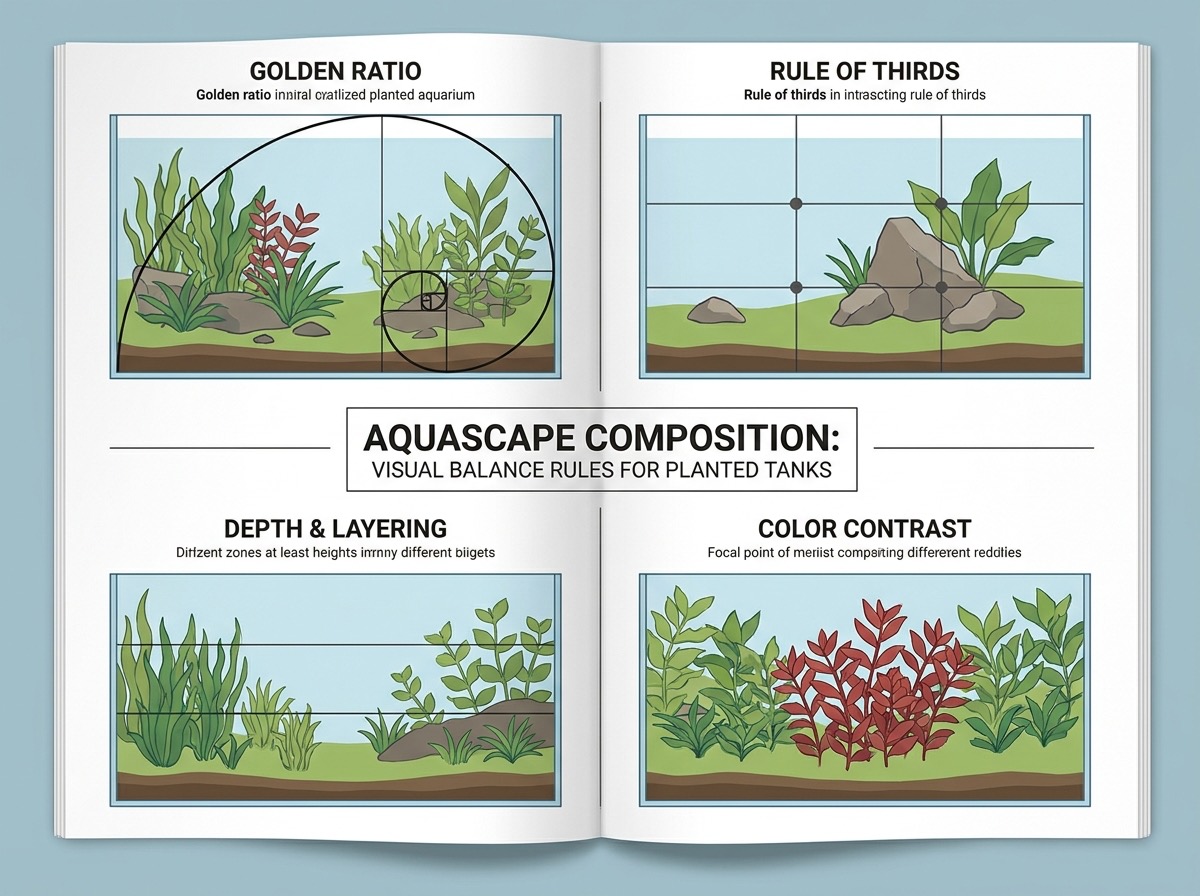
The rule of thirds, applied to aquascape, is the same as in photography:
- Divide the tank into a 3x3 grid (two vertical, two horizontal lines)
- Place the main elements at the intersections of the grid lines
- Use the grid lines to align secondary elements
- Avoid placing the focal point in the centre
In a planted tank, the rule of thirds applies to:
- The main hardscape element (the largest rock or wood piece): place at one of the upper-thirds or lower-thirds intersections
- The main plant grouping: place at one of the third intersections
- The transition between foreground and background: place along one of the horizontal third lines
The result: a composition that draws the eye around the tank, with a clear focal point and balanced negative space.
The "focal point" rule
A planted tank should have one clear focal point — the place the eye lands first. The focal point is usually:
- A standout hardscape element (a large rock, a piece of wood with a distinctive shape)
- A standout plant (a single red plant in a green field, a large Amazon sword, a striking Anubias)
- An open area of water with a single fish
- A combination of two or three elements
The rest of the tank supports the focal point. The eye moves from the focal point to the supporting elements and back.
A common mistake: too many focal points. The eye doesn't know where to land. The tank looks busy. The fix: identify the primary focal point and downplay everything else.
The "asymmetric balance" rule
Symmetry is static and unnatural. Asymmetry is dynamic and natural. A planted tank should be asymmetrically balanced:
- One side of the tank has more visual weight (larger hardscape, taller plants)
- The other side has less visual weight (smaller hardscape, shorter plants, open space)
- The eye perceives the tank as balanced because the visual weight is distributed
The Japanese concept of "fukinsei" (asymmetry) is the principle. A perfectly symmetrical tank looks like a mirror, not a slice of nature. An asymmetrically balanced tank looks like a natural scene.
The "depth" rule
A planted tank should have depth — the illusion of distance from the front glass to the back. The techniques:
- Foreground plants: small, low-growing plants (Monte Carlo, dwarf hairgrass, Hemianthus callitrichoides) at the front
- Midground plants: medium-sized plants (Anubias, Bucephalandra, Cryptocoryne) in the middle
- Background plants: tall, fast-growing plants (Rotala, Ludwigia, Vallisneria) at the back
- Hardscape placement: the largest rocks or wood at the back, smaller pieces in the middle, isolated pieces in the front
- Slope: the substrate slopes from low in the front to high in the back. The slope creates the depth illusion
The result: a tank that looks deeper than it is. The eye is drawn into the back, not blocked by the front glass.
The "negative space" rule
Negative space is the empty area of the tank — the open water, the bare substrate, the area between plant groupings. Negative space is what allows the eye to rest and the focal points to stand out.
The mistake: fill every inch of the tank with plants. The result looks crowded and busy. The eye doesn't know where to go.
The rule: at least 20-30% of the visible tank area should be negative space. For a 100-gallon tank, this might mean a sandy area in the front, an open area of water in one corner, or a clear area around a focal hardscape element.
The "Iwagumi" style (a minimalist aquascape with only rocks and small foreground plants) is built almost entirely on negative space. The rocks are the focal points, and the empty sand is the negative space.
The "golden ratio" rule
The rule of thirds is the simplified version. The more precise version is the golden ratio (1:1.618). The golden ratio is used in the most refined aquascapes:
- The main hardscape element is placed at the golden ratio intersection
- The main plant grouping is placed at the golden ratio intersection
- The transition between foreground and background follows the golden ratio line
For practical purposes, the rule of thirds is close enough. The golden ratio adds 5-10% visual refinement for a much more complex mental math. Most aquascapers work with the thirds.
The hardscape: the foundation of the composition
The hardscape (rocks and wood) is the structural foundation of the aquascape. The hardscape is placed first, and the plants are arranged around it.
Rock selection
The choice of rock affects the aquascape style:
- Seiryu stone (dragon stone): jagged, vertical, dramatic. Used in Iwagumi and Asian-inspired aquascapes
- Ohko stone (dragon stone): similar to Seiryu but more weathered
- Ryuoh stone: rounded, gentle. Used in nature aquarium style
- Lava rock: porous, light. Used in cichlid and African biotope tanks
- Spider wood: thin, branching, dramatic. Used in Asian-inspired aquascapes
- Driftwood (Mopani, Malaysian): heavy, gnarled. Used in African and nature aquarium styles
- Mangrove root: complex, branching. Used in biotope tanks
The choice of rock should match the desired style. A tank that mixes multiple rock types usually looks inconsistent. A tank that uses one rock type consistently looks intentional.
The "rule of three" for rocks
A common composition principle: use rocks in odd numbers, particularly in groups of three. Three rocks create a visual triangle, with the largest rock as the focal point and the two smaller rocks as support. The eye is drawn to the triangle.
A pair of rocks looks like a couple. A group of three looks like a composition. A group of four or more can look crowded unless carefully arranged.
The "main" rock and "sub" rocks
In a multi-rock composition:
- Main rock: the largest, most striking rock. The focal point
- Sub rocks: the smaller rocks that support the main rock. They are placed around and below the main rock, creating the sense of a mountain or hill
- Detail rocks: small rocks that fill in the composition. They should be in the same stone type as the main rock, but smaller
The main rock is placed first. The sub rocks are placed around it. The detail rocks are placed last, filling in the visual gaps.
The wood placement
Wood is used in aquascape for its organic, branching shapes. The principles:
- One main piece of wood, with supporting pieces
- The wood is anchored in the substrate, often with the help of rocks
- The wood's branching shape creates the "tree" or "root" structure of the aquascape
- The wood is often used in combination with rocks to create a hybrid hardscape
The "tree" wood placement (a large piece of wood with branching shapes, anchored at one end) is a classic aquascape technique. The "root" wood placement (a piece of wood with extensive branching, anchored in the middle) is another.
The plant placement: the layer of life
The plants are placed after the hardscape is complete. The principles:
Foreground plants
- Height: 1-3 inches
- Examples: Monte Carlo (Micranthemum tweediei), dwarf hairgrass (Eleocharis parvula), Hemianthus callitrichoides (HC), Glossostigma
- Placement: front of the tank, in open areas
- Care: high light, CO2 injection, fine substrate
Midground plants
- Height: 4-12 inches
- Examples: Anubias, Bucephalandra, Cryptocoryne, Echinodorus (Amazon sword), smaller stem plants
- Placement: middle of the tank, around the hardscape
- Care: medium to high light, CO2 injection helps
Background plants
- Height: 12+ inches
- Examples: Rotala, Ludwigia, Vallisneria, Hygrophila, large stem plants
- Placement: back of the tank, against the back glass
- Care: high light, CO2 injection, regular trimming
The "drift" technique
The plants should be placed in drifts — groups of the same species, with the group flowing across the tank. A drift of red plants, a drift of green plants, a drift of small-leaved plants. The drifts create the natural, composed-randomness look.
The mistake: single plants scattered throughout the tank. The result looks like a nursery, not an aquascape.
The "taller in the back" principle
Tall plants in the back, short plants in the front. The slope of the plants mirrors the slope of the substrate. The result: the tank looks deeper, and the eye is drawn into the back.
The trim: maintaining the composition
A planted tank is not a static composition. The plants grow, the composition changes, the trim maintains the design.
The trim frequency
- Fast-growing stem plants: trim every 1-2 weeks
- Slow-growing plants: trim every 2-4 weeks
- Foreground carpet: trim every 2-3 weeks to maintain density
The trim technique
- Use sharp aquascape scissors (straight or curved)
- Cut the stems just above a leaf node
- Replant the cuttings (the trimmings are free plants)
- Remove any yellow or damaged leaves
The "Dutch" vs "Nature" trim
The Dutch style (a more formal, traditional planted tank style) requires regular, structured trimming. The plants are arranged in rows and terraces. The trim maintains the structure.
The Nature style (the Amano-inspired style) requires less structured trimming. The plants grow naturally, and the trim maintains the overall shape without strict rows.
The "mistakes" of composition
A few common mistakes:
The "rock pile"
The aquascaper places many rocks of similar size throughout the tank. The composition looks like a pile, not a composition. The fix: identify a main rock and downplay the others. Use odd numbers of rocks (3, 5, 7).
The "wall of plants"
The background plants grow to the front glass, blocking the view. The composition looks like a wall, not an aquascape. The fix: trim the background plants regularly, maintain the depth.
The "no focal point"
The aquascape is uniformly composed — no main element, no clear focal point. The eye doesn't know where to go. The fix: identify the main element and emphasize it.
The "no negative space"
The tank is full of hardscape and plants. The composition is busy. The fix: remove some elements, create open space.
The "wrong scale"
The hardscape is too large or too small for the tank. A massive rock in a small tank dominates; a small rock in a large tank disappears. The fix: scale the hardscape to the tank size. A good rule: the main rock should be 1/3 to 1/2 the height of the tank.
The "biotope" alternative
The principles above apply to the Nature Aquarium style and its variants. There's an alternative: the biotope, which is a tank that replicates a specific natural environment.
A biotope tank:
- Uses only plants and fish from a specific geographic region
- The hardscape is from the same region
- The water parameters match the region
- The composition mimics the natural layout of the environment
Common biotopes:
- Amazonian blackwater: dark water, leaf litter, driftwood, Amazonian fish (Discus, Cardinal tetras)
- African rift lake: rocky, hard water, cichlids
- Southeast Asian blackwater: leaf litter, driftwood, rasboras
- Central American stream: rocks, plants, cichlids
The biotope tank is more constrained but produces a very specific, naturalistic look.
The "Dutch" style
The Dutch style is the original planted tank style, developed in the Netherlands in the 1930s. The principles:
- Terraced plants in rows, with each species in a distinct group
- Bright lighting, CO2 injection, nutrient-rich substrate
- No hardscape (the focus is entirely on the plants)
- The "Dutch street" — a row of contrasting plants of different colours, textures, and heights
The Dutch style is more formal and more work than the Nature style. It's popular in the international aquascaping competition circuit.
The "Iwagumi" style
The Iwagumi style is the minimalist style, focused entirely on rocks. The principles:
- 3 rocks (sometimes 5 or 7) arranged in a triangle
- Foreground carpet plants only
- No background plants
- The composition is built on the relationship between the rocks
The Iwagumi style is challenging because the rocks are the entire composition. Any error in the rock placement is visible. But when done well, the Iwagumi is the most striking of all aquascape styles.
The bottom line
Aquascape composition is the arrangement of hardscape, plants, and negative space into a natural-looking slice of underwater nature. The rules — thirds, focal point, asymmetric balance, depth, negative space — are principles that work across photography, painting, and aquascape. The aquascaper who knows the rules and applies them consistently builds a tank that looks intentional. The aquascaper who doesn't know the rules builds a tank that looks like a fishbowl with plants. The tools are rocks, wood, plants, and patience. The result is a tank that becomes more beautiful over time. The composition evolves as the plants grow, the hardscape matures, and the aquascaper learns. The first aquascape is the foundation. The tenth aquascape is the art. The principle is the same: composed randomness, asymmetric balance, and a clear focal point.
---
About the author: [Kenji Tanaka](../Kenji%20Tanaka.md) holds an MSc in Applied Aquatic Biology from Tokyo University of Marine Science and Technology, has 22 years of aquascape design experience, and has judged the International Aquatic Plants Layout Contest (IAPLC) for the past decade.