


Why cats are hard to train: the non-reward reality
I was on the floor of a Bologna apartment last spring, watching a four-year-old black cat named Otto. His owner — a calm, careful woman who had clearly read several books on feline behavior — was trying to teach him to sit. She had a clicker, a tin of treats, and a small patient voice. Otto. Sit. Otto. Sit. She clicked as his rear end lowered, fed him immediately, and praised. Otto took the treat, walked to the kitchen, jumped on the counter, and sat down by himself, in exactly the spot she did not want him to sit.
I knew what was about to happen. We talked for a few minutes about what training means for a cat, and the answer surprised her. Cats are not stupid, stubborn, dominant, or aloof. The system most people bring home from a dog class was designed for a different animal, and the cat's learning economy runs on a different currency. This is a guide to that currency — the non-reward reality — and to what does work when the dog-style methods don't.
The "non-reward" — what cats do not actually find rewarding
The first time I heard the phrase non-reward animal, it was from a senior veterinary behaviorist in Milan, and it has stayed with me. A dog, in operant terms, is a social reward animal: it works for approval, for eye contact, for the tone of the human voice, for the soft hand on the head. A cat, by contrast, is a non-reward animal in the social sense. None of those things are primary reinforcers. A cat can learn to tolerate them, even to enjoy them, but the wiring underneath is different.
What this means in a Bologna kitchen is that the clicker, the voice, the soft praise, and the gentle hand are all tertiary rewards — rewards built on rewards that were never the original point. For a dog, the human's smile is almost a primary reinforcer. For a cat, the human is at best a vending machine that happens to make sounds. The practical consequence is uncomfortable. Most of what we call training a cat is, from the cat's point of view, a negotiation with a vending machine that doesn't dispense fast enough, often enough, or for the right thing.
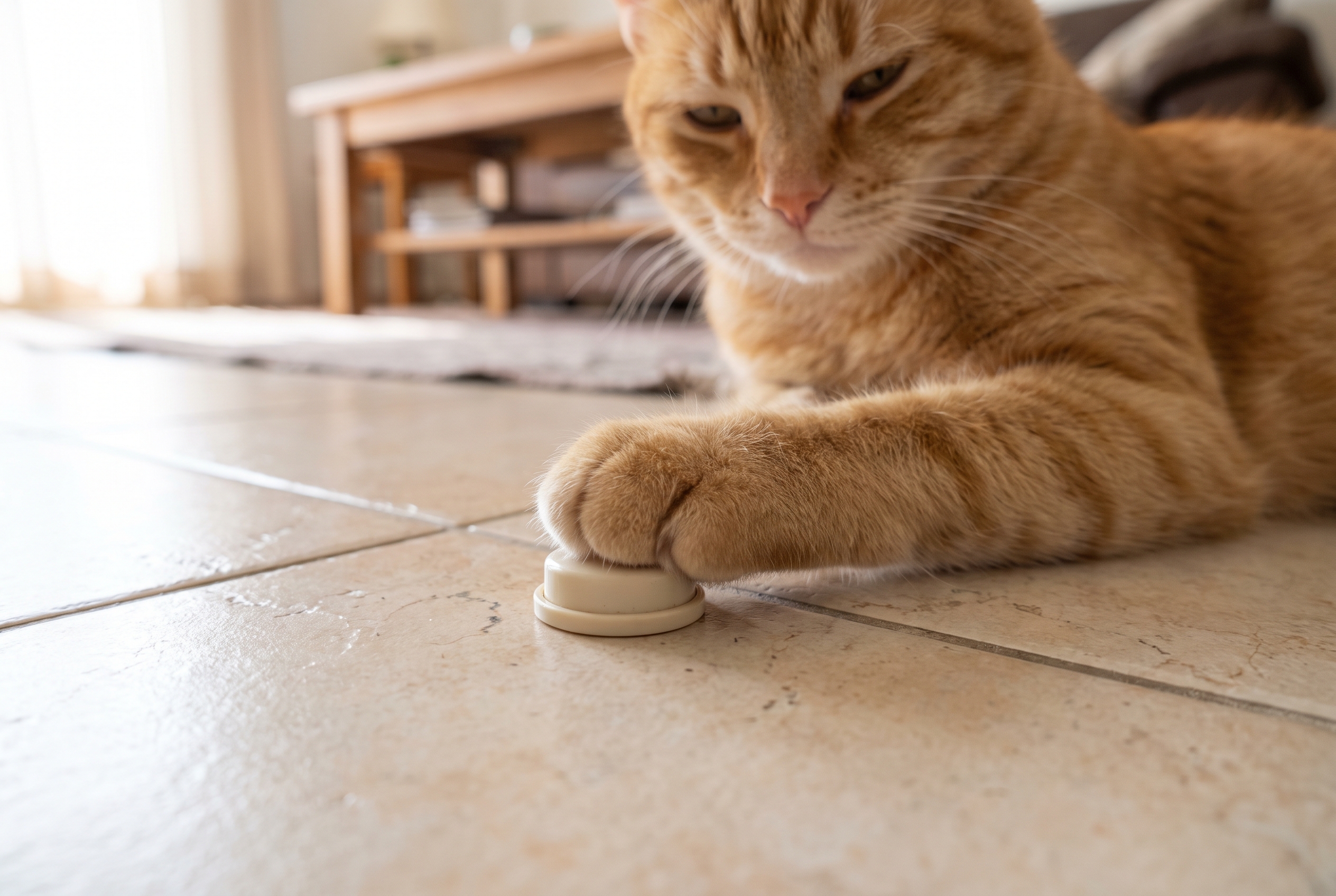
Four reasons cats break the dog template
I think of the gap as four distinct mismatches. They overlap, but each one trips owners up on its own.
They do not generalize. A dog that learns sit in the kitchen will, with practice, sit in the park, the garage, the dark. A cat that learns sit in the kitchen will often have to learn sit again in the hallway, on the bed, when the window is open. Each new context is, for the cat, a new negotiation. This is not obstinacy. It is how a small solitary hunter learns — this rock, this mouse, this exact angle. The brain is not built to assume yesterday's rule still applies to today's situation.
They are neophobic. Novelty is suspicious. A new object, a new sound, a new person — all get a 24-to-72-hour wait-and-watch period that would be unusual in a dog. I have watched cats refuse a new food for three days, then accept it on the fourth as if nothing had happened. The hesitation is not pickiness. It is the assessment phase, and it cannot be hurried.
They are self-rewarding. A dog is biologically wired to look at the human, to mirror, to check in. A cat is wired to complete the loop on its own. A successful wild hunt ends in the catch. The human is not in the loop. When we offer a click and a treat, we are asking the cat to perform a behavior whose natural reward is the thing itself — the toy, the spot, the sunny square — and accept a substitute. Some cats take the deal. Many do not.
They do not learn socially. Dogs watch other dogs and imitate humans. Cats do not, mostly. I have seen homes where one cat learned to use a scratching post properly and the other cats continued to scratch the sofa. They were not ignoring the lesson. They were not in the lesson. A cat's learning is its own.
What it looks like in a real multi-cat home
A friend in Modena runs a small cattery — five related indoor cats. Last year she tried to teach the group to come when called. Three months of work. One cat reliably comes. Two come most of the time, when they are not deeply asleep. Two still ignore her, including the oldest female, who is the most food-motivated of the group.
The pattern is what the science predicts. The fastest learner is the youngest, raised in the home from eight weeks. The second-fastest is the bold male. The two who didn't learn are older, more neophobic, and more comfortable self-rewarding. None of this is a moral failing. None of it is a sign of disrespect. It is a small solitary hunter with its own schedule.
What my friend did not do, which I think made the difference, was teach them as a group. Group training fails in cats in a way it does not in dogs. Each cat in a multi-cat home is a separate learner, in a separate mood, with a separate threshold for novelty, and — crucially — with a separate relationship to the other cats in the room. The cat being clicked in front of three others is not concentrating on the click. It is concentrating on the audience.
The methods that actually work — capturing, shaping, and environmental training
If the dog-style lure-reward-repeat approach mostly fails with cats, what works in its place? Three methods, all based on the cat's own learning economy.
Capturing is the simplest. You wait for the cat to do the behavior you want, and reward the exact moment it happens. The cat sits on the scratching post — click, treat. The cat uses the litter box — click, treat. The cat comes when called, well, when it is already coming — click, treat. The owner does almost nothing. The cat does almost everything. Paradoxically, this is the fastest way to teach a cat anything it does naturally, because you are not asking for something new. You are paying the cat for what it was already doing.
Shaping is capturing in slow motion. You want the cat to jump onto a cat tree. You click when it looks at the tree, then when it takes a step toward it, then when it is within a foot, then when a paw goes up, then when all four paws are on. This is slow — a week for a confident cat, a month for a cautious one. It works because every reward is for a behavior the cat chose. No luring, no pushing, no coercion. The cat builds the behavior the way a child builds a tower, one voluntary block at a time.
Environmental training is the one I wish more owners knew about. Most behavior problems in cats — counter-surfing, scratching the sofa, midnight yowling, inappropriate urination — are not training problems. They are environment problems. The fix is not a clicker. The fix is a different counter, a different scratching post, a different feeding schedule, a different litter box. The cat is already trained. The home is not yet trained to be a cat's home.
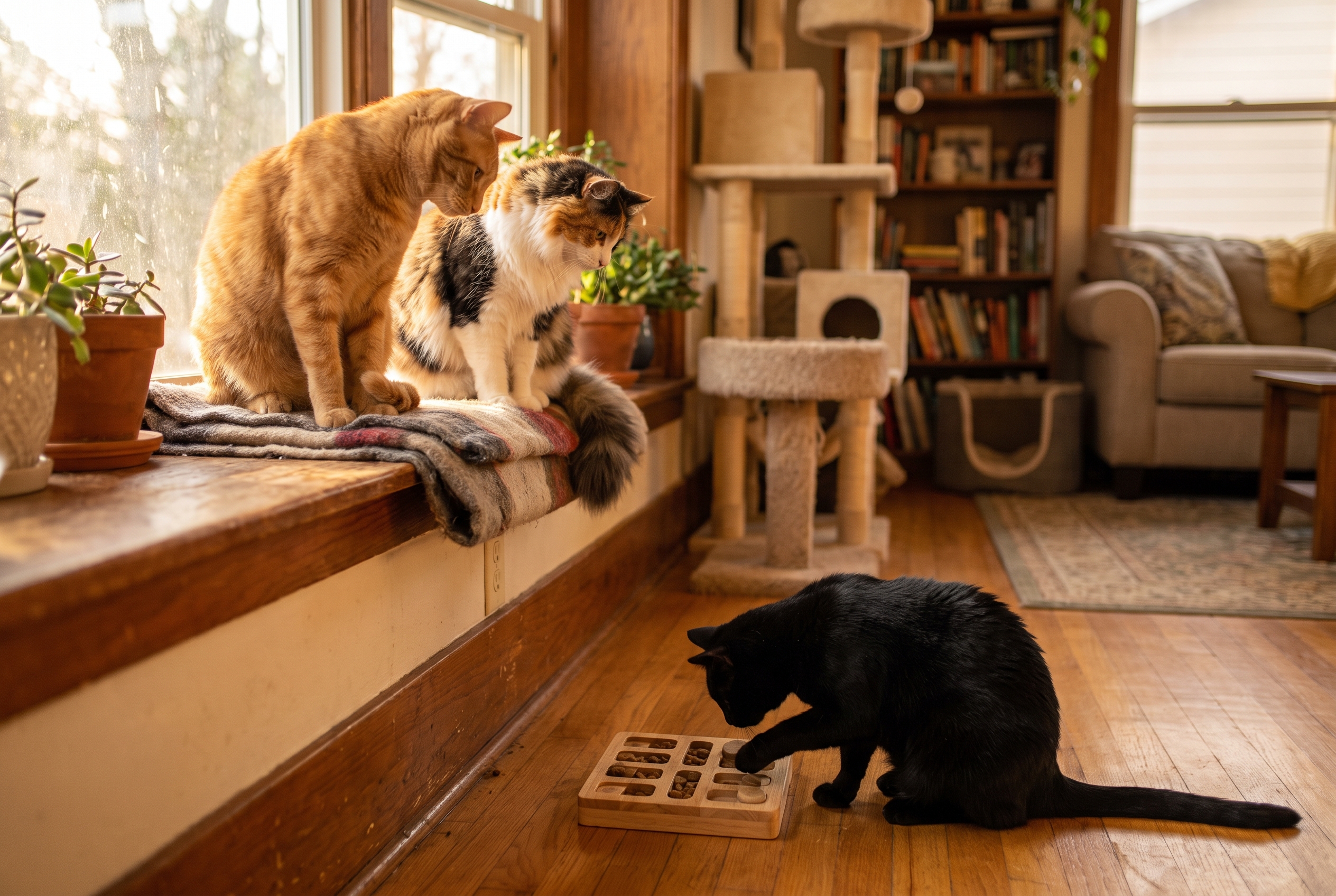
A two-week plan for the cat that doesn't do anything on command
For owners who want one practical thing in the next two weeks, this is the plan. It is gentle. It will not turn the cat into a dog. It will build the small bridge of vocabulary almost every multi-cat home eventually needs — the cat who comes when called for a vet emergency, the cat who steps onto a scale, the cat who goes into a carrier without a fight.
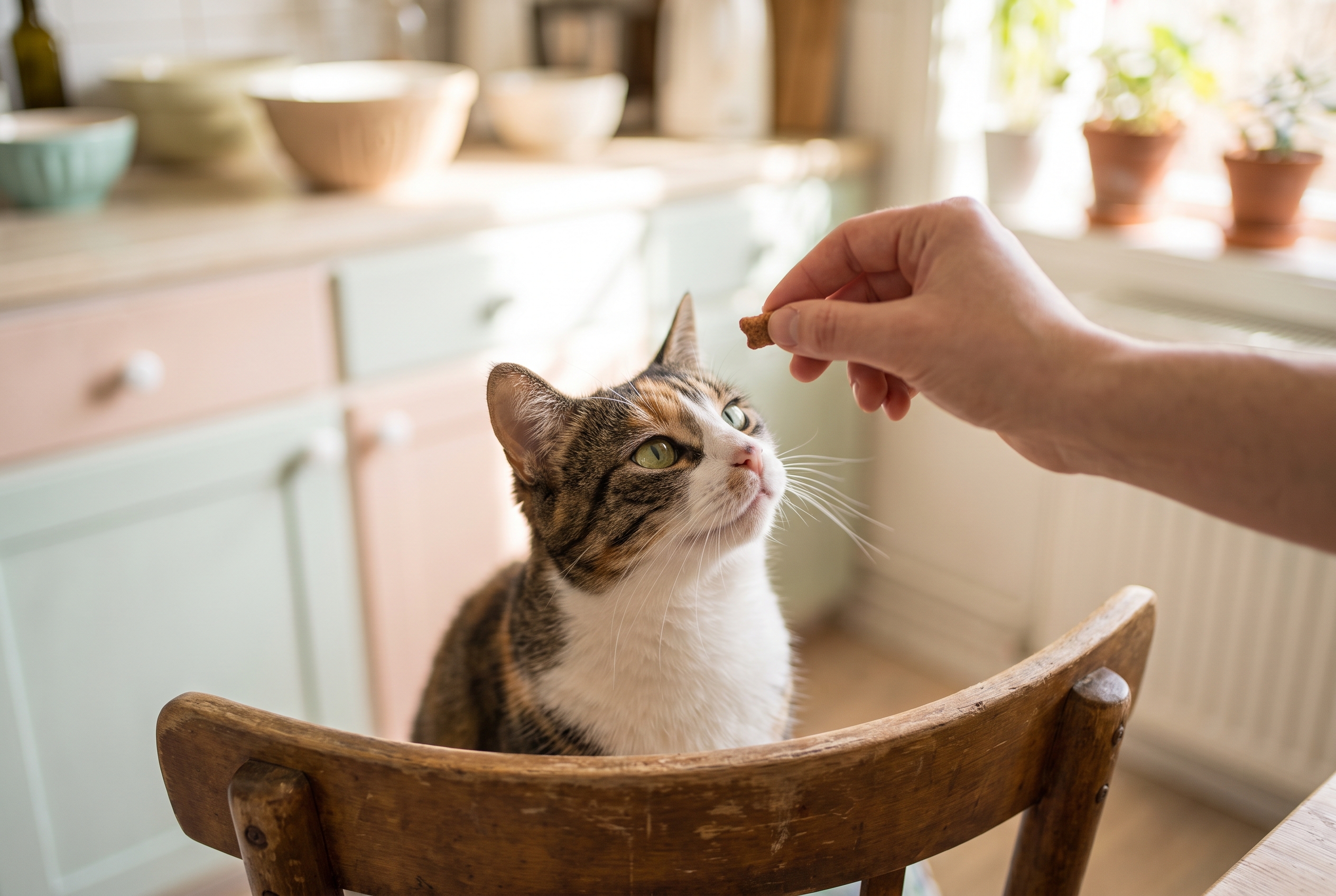
Week 1 — the no command week. Put the clicker down. Put the treats in a small tin on the counter. Three things, twice a day, for no more than three minutes. When the cat looks at you — click, treat. When it walks toward you — click, treat. When it does anything you like — click, treat. You are not teaching a behavior. You are teaching the cat that you are the vending machine, and the vending machine pays.
Week 2 — the one thing week. Pick one small behavior — come to the kitchen when I tap the counter — and capture it. Tap the counter softly. Wait. If the cat happens to walk in, click, treat. If it doesn't, do not call, do not coax. End the session. Try again later. The behavior usually appears by day four or five, in food-motivated cats. The first time it appears it feels almost accidental. It is not. It is the cat deciding the counter-tap means something.
By the end of two weeks, most cats will respond to the counter-tap at least half the time. This is the most realistic baseline for a cat. Not the dog's sit-stay-come, but a soft, conditional, voluntary behavior built on what the cat was already doing, because it does not ask the cat to be something it is not.
When to call a professional
Three situations in a multi-cat home are not training problems and need more than a plan. The cat has begun urinating outside the litter box — a vet visit comes first, because the cause is medical in roughly 60% of cases I see. Sudden-onset aggression toward people or other cats — same answer, vet first, behavior consultant second. Or the cat is so fearful that the capturing plan cannot get within three feet without it hiding. That is a desensitization case, not a training case, and the right person is an IAABC-credentialed feline behavior consultant or a veterinary behaviorist.
The Bologna apartment did not need a behaviorist. Otto did not learn to sit on command. He learned to come when called, about 70% of the time, mostly when he was already moving in that direction. His owner learned something more useful — that the clicker, the treat, and her own calm presence were a language, not a command, and that a cat will only ever speak a language it chose to learn. Most multi-cat homes, given that, will find the cat they live with is far more teachable than they thought. The lessons just look, from the outside, like a different kind of conversation.