
Cat-to-cat aggression: from hissing to full fight — when to step in
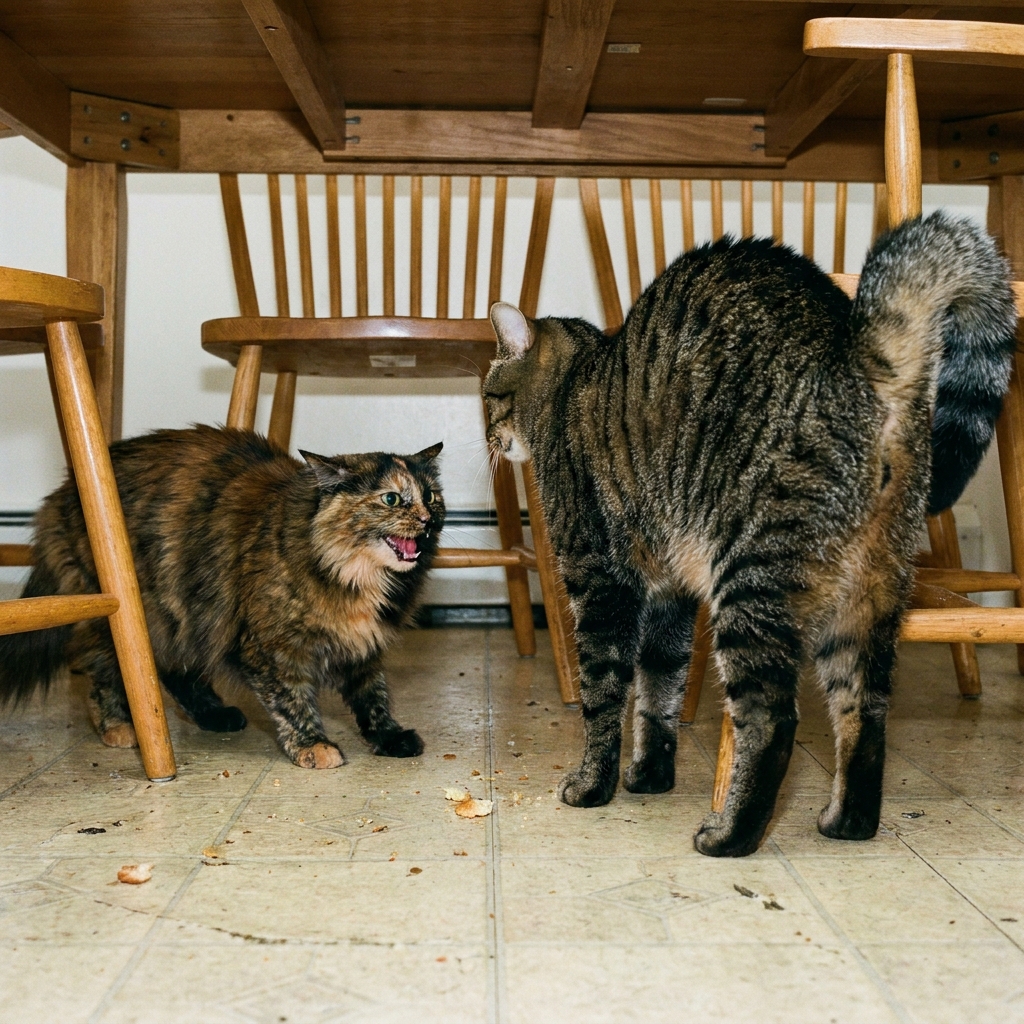
I am sitting on the floor of a kitchen in a small town outside Parma. Two cats live here: Pippo, a six-year-old tabby, and Minù, a three-year-old tortoiseshell adopted four months ago. The introduction went well — base-room, scent-swap, slow visual. And now Minù is pinned under the table, ears flat, hissing up at Pippo, who is standing over her with the stiff, still body of a cat that has decided this is a serious moment.
The owner, who has been doing everything by the book, asks: should I clap my hands? Pick one of them up? Spray water? Separate them with a cushion?
The answer to all of those is no, not yet. This is not a fight. It is a negotiation. Most of what we call cat-to-cat aggression in a multi-cat home is a long, slow, mostly silent negotiation humans only notice when it has tipped into something louder.
This is a guide to reading the negotiation, knowing when to step in, and knowing when stepping in would make it worse.
Reading the language: from a hiss to a flight
Cats have a vocabulary of conflict, and almost none of the louder words are the first ones used.
The earliest signals are body-orientation signals. A cat that turns its shoulder or its back to another cat is signalling I am not a threat, please do not come closer. A cat that lies down and shows its side is signalling the same, with slightly higher confidence. A cat that crouches low, tail wrapped around the body, is signalling I am small, I am not looking for trouble, please leave. None involve a sound.
The next layer is the displacement signals. One cat is on the windowsill. The other cat wants the windowsill. The second cat sits in the middle of the room and starts grooming — fast, exaggerated, almost frantic grooming of the shoulder. That is not a cat that has suddenly remembered it is dirty. It is a cat redirecting the energy of I am annoyed and I do not know what to do into a behaviour the body already knows.
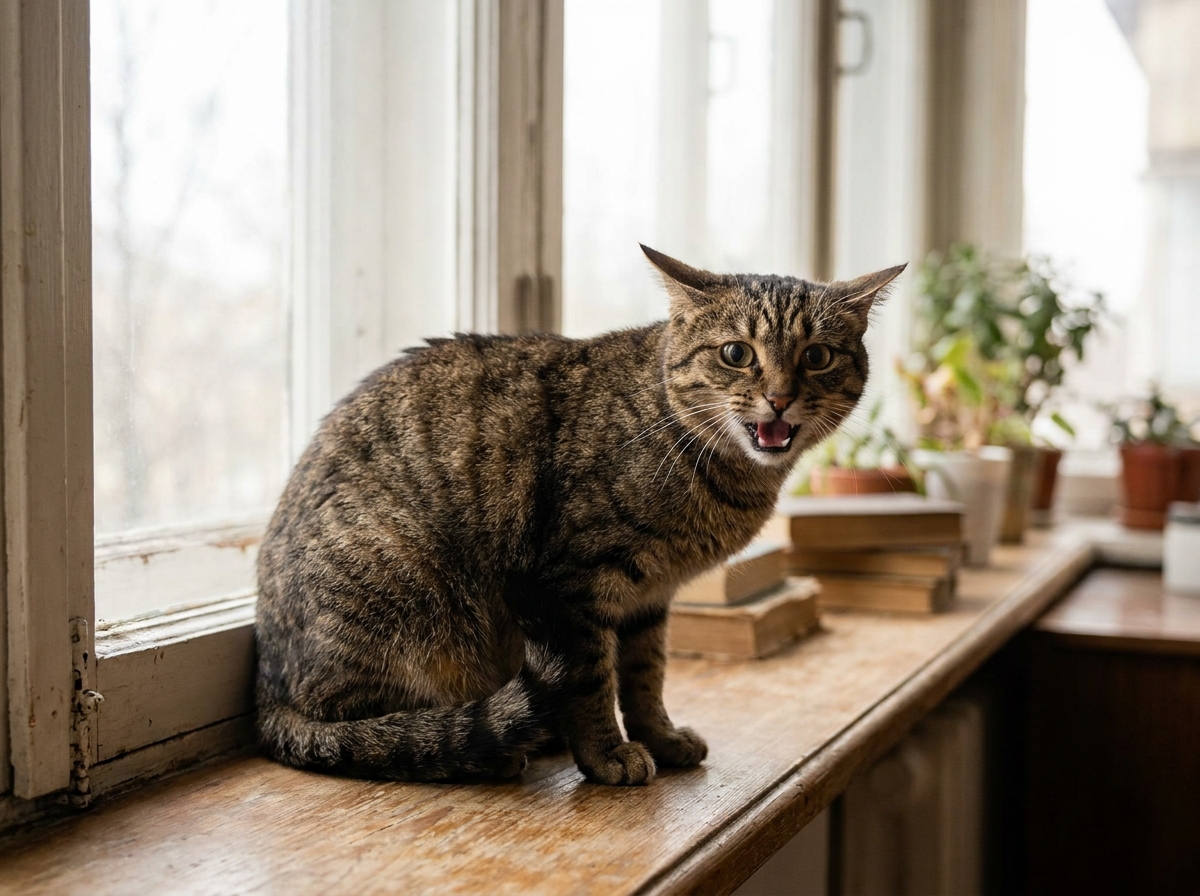
The hissing cat is the third layer. By the time a cat is hissing, the negotiation has been going on for hours, sometimes days. The hiss is not the beginning. It is the visible part of an iceberg that started under the surface.
The full fight is the fourth layer. Fur tufts on the floor, one cat streaking away, the other cat's pupils fully dilated, the air in the room changed. If you are seeing this layer often, the negotiation has failed many times before.
The four levels of cat-to-cat tension
I find it useful to put the spectrum into four levels, because the right response is different at each level, and the wrong response at one level can push the cats one level higher.
Level one — distance. The cats are in the same room but not looking at each other. They are taking different paths, using different shelves, choosing the sofa arm and the windowsill, and avoiding each other smoothly. This is not aggression. This is a multi-cat home working. New owners often mistake distance for a problem. It is usually the cats being polite.
Level two — displacement. The cats are tracking each other. One moves, the other adjusts. A cat leaves a room when another cat enters. A cat stares at another cat from across the room. There may be occasional low growls. There is no physical contact. This is the negotiation. It is uncomfortable, but it is not yet a problem that needs human intervention. It is a problem that needs better resource distribution — more height, more hides, more routes, more litter boxes.
Level three — active signalling. Hissing, swatting, chasing for a few steps, blocking a doorway, pinning another cat for one or two seconds. There is contact but no injury. This is the level that needs human intervention, in the right way.
Level four — full fight. Rolling, biting, screaming, fur pulled out, one cat cornered, the cats no longer responding to voice. This is a medical-grade emergency for the relationship. Step in, separate, and call a professional.
When to step in: a behavioural checklist
Most owners step in too early, and a small number step in too late. The right time is at level three, and only at level three. Here is the checklist.
Is anyone injured? A small tuft of fur is not an injury. A scratch on the nose is. A cat that hides for hours after an encounter, or stops eating for a day, is. Bleeding, limping, hiding, refusing food — these are medical signs. The cats need to be separated and one of them needs a vet.
Is the encounter repeating? A single level-three encounter in a multi-cat home, especially in the first six months, is not unusual. The same encounter three times a day, every day, is a sign the system is not working and a base-room reset is needed.
Can one cat leave? If the room has a clear exit and the lower-ranking cat is using it, the encounter is doing its job. If the lower-ranking cat is cornered — under furniture, in a corner with no escape, in a litter box it cannot leave — the system is failing. Interrupt before it escalates.
Is the human reaching in? Reaching into a level-three encounter is the most common way cat owners end up at the urgent care clinic. The fight does not stop. The cats redirect. The human bleeds. Do not reach in. Use a barrier, not a hand.
If the answer to the first three is yes, repeating, no clear exit, the right response is a flat object slid between the cats — a cutting board, a large book, a couch cushion at arm's length — to break the line of sight, not to hit either cat. The line of sight is what is keeping the encounter alive. Break it, and most level-three encounters dissolve in seconds.
Real multi-cat home: the Calabrese kitchen
In Parma, after I sat on the floor of the kitchen for a few minutes, what I saw was this. Pippo was not attacking Minù. He was standing over her because the table was the only place in the kitchen with a clear sightline to the front door. Pippo was guarding the resource. Minù was cornered.
The fix was not to separate the cats. It was to add a second route out of the kitchen. We moved a small stool to the corner, set a folded blanket on it, and added a tall cat tree in the adjoining hallway. Minù had a way out that did not pass under Pippo. The hissing stopped within a week. They are still not friends — they are polite roommates, which is what most multi-cat homes actually need.
The lesson from that kitchen is one I keep relearning. Cat-to-cat aggression is almost always a resource or a route problem wearing the costume of a personality problem. The fix is in the layout, not in the cats.
What not to do: the most common mistakes
Three mistakes show up in almost every home I visit with a cat-to-cat aggression problem.
Do not pick up the aggressor. Picking up the hissing or swatting cat almost always rewards the aggression — the cat learns that escalation lifts it away from the source of stress — and puts the human in the line of fire. The flat-object barrier is safer and faster.
Do not punish. A water bottle, a clap, a sharp word, a thrown cushion. None teach the cat what to do instead. They teach the cat that the human is unpredictable. The behaviour stops in front of the human and continues when the human is out of the room. This is worse than the original problem.
Do not force proximity. Cuddling the cats together, feeding them side by side, holding them in the same lap, locking them in a room to "work it out." Forced proximity does not build a bond. It builds a shared aversion. Choice-based introductions are the only way two cats learn to share territory.
A two-week plan: from hiss to truce
If the household is at level two or early level three, this is the plan I usually walk through. It is not fast, and it is not dramatic. It works because it gives the cats back the resources and the routes the home is missing.
Days 1 to 3 — observation. Walk through the home at four different times of day. Note every encounter: where it happened, who started, who left, who won the resource. Patterns appear in two days.
Days 4 to 7 — add the missing resources. Litter boxes up to the N+1 rule. Food and water stations, separated. Two tall cat trees, ideally in different rooms. Window perches in two different windows. The shy cat gets the quietest, highest perch in the home.
Days 8 to 10 — add the routes. Most multi-cat homes have one main corridor. That corridor is where the encounters happen. Add a second route — a shelf, a stool, a chair that lets the lower-ranking cat bypass the corridor entirely.
Days 11 to 14 — re-introduce choice. If the cats are still at level three, a full base-room reset is the right next step. Two weeks is usually long enough to know whether the resource fix is working.
When to call a professional
Three signs the home needs more than a plan. The encounters are level four, with injuries. One cat has stopped eating, is hiding for hours, or is using the litter box outside the box. Or the encounters are level three daily, and the resource-and-route fix has not changed them in two weeks.
A feline behaviour consultant — ideally one credentialed by the IAABC or with a veterinary behaviourist background — can read the household in a way a book cannot. Pain, in particular, is a common hidden cause. A cat with dental pain, arthritis, or a urinary issue is a cat that other cats pick on. A vet visit is the first step.

The kitchen in Parma did not need a behaviourist. It needed a stool, a blanket, and a tall tree in the hallway. Most multi-cat homes are the same. The plan is to give the cats the resources the home is missing and the routes the room is not offering. The hissing usually stops. The truce usually holds. The household becomes, quietly, the kind of place two cats can share.