
Indoor cat enrichment: designing vertical space your cat will actually use
There is a black cat called Otto who lives in a small top-floor flat in Bologna. His owner is a tidy person. Otto has a food bowl, two litter boxes, a soft bed by the radiator, a window perch his owner bought in his first week. Otto spends most of his day on top of the kitchen cabinets.
His owner thinks he is hiding. He is not. He is using the only vertical territory the flat offers. The kitchen cabinets are tall, stable, and look out over the main door — exactly the kind of perch an indoor cat chooses when given the choice. Once we added a tall cat tree near the living room window, Otto moved there in two days. The cabinet is now just a stop on the way.
Height is the single most overlooked resource in the indoor cat home. Most owners think about food, water, litter, a bed, a toy or two. Very few think about up. The cat thinks about up constantly.
Why height matters: it's not a luxury, it's a need
A cat's relationship to height is hard-wired. Outdoors, height gives safety, a vantage point over territory, an escape from a predator, a quiet place to eat. Indoors, the wiring is the same. A cat without usable height is not unhappy in any dramatic way — but it is using only half of its behavioural range.
The research is consistent. Studies of indoor cat welfare find that access to elevated resting spots is one of the strongest predictors of low chronic stress. Cats with height show fewer house-soiling incidents, fewer compulsive behaviours, and lower baseline cortisol. This is a welfare floor.
The practical signs a cat needs more height: it is on the kitchen counter, on top of the wardrobe, on the bookshelf, on the refrigerator. These are not misbehaviours. They are the cat solving a problem the home has not yet solved.
Read the cat before you read the room
Before you buy a cat tree or drill a wall shelf, spend three days watching the cat. Not interacting. Just noting where the cat already wants to be.
Where does the cat rest? Not the bed you bought — the bed the cat actually chose. Often the back of the sofa, the top of a stack of books, the corner of a high shelf, the windowsill. Note the height.
Where does the cat go when startled? Most cats bolt upward first. A cat with usable height recovers in minutes. A cat without it can hide for hours.
What does the cat look at? A cat watching the door, the window, the kitchen entrance is a cat that wants to see what is coming.
What routes does the cat already use? If the cat jumps from floor to chair to bookshelf to wardrobe, that is an existing route. You can formalise it with shelves, or leave it as an improvised highway.
In Otto's flat, the chosen path was sofa arm, kitchen counter, cabinet top. The new cat tree was placed so the cat could step from the sofa arm straight onto the first platform. Within forty-eight hours, Otto was using it.
The three zones: floor, mid, ceiling
A good indoor vertical layout divides the room into three rough zones, and gives the cat a path between them.
Floor zone — food, water, litter, the calmest bed the cat will use. This is where the cat does its slowest, most vulnerable work. Keep it low-traffic, away from the front door, away from the dog.
Mid zone — between 60 centimetres and 1.4 metres. This is where most social life happens. The cat can see the family, watch the kitchen, supervise homework, and still drop down quickly. Window perches and the lower platforms of a cat tree live here.
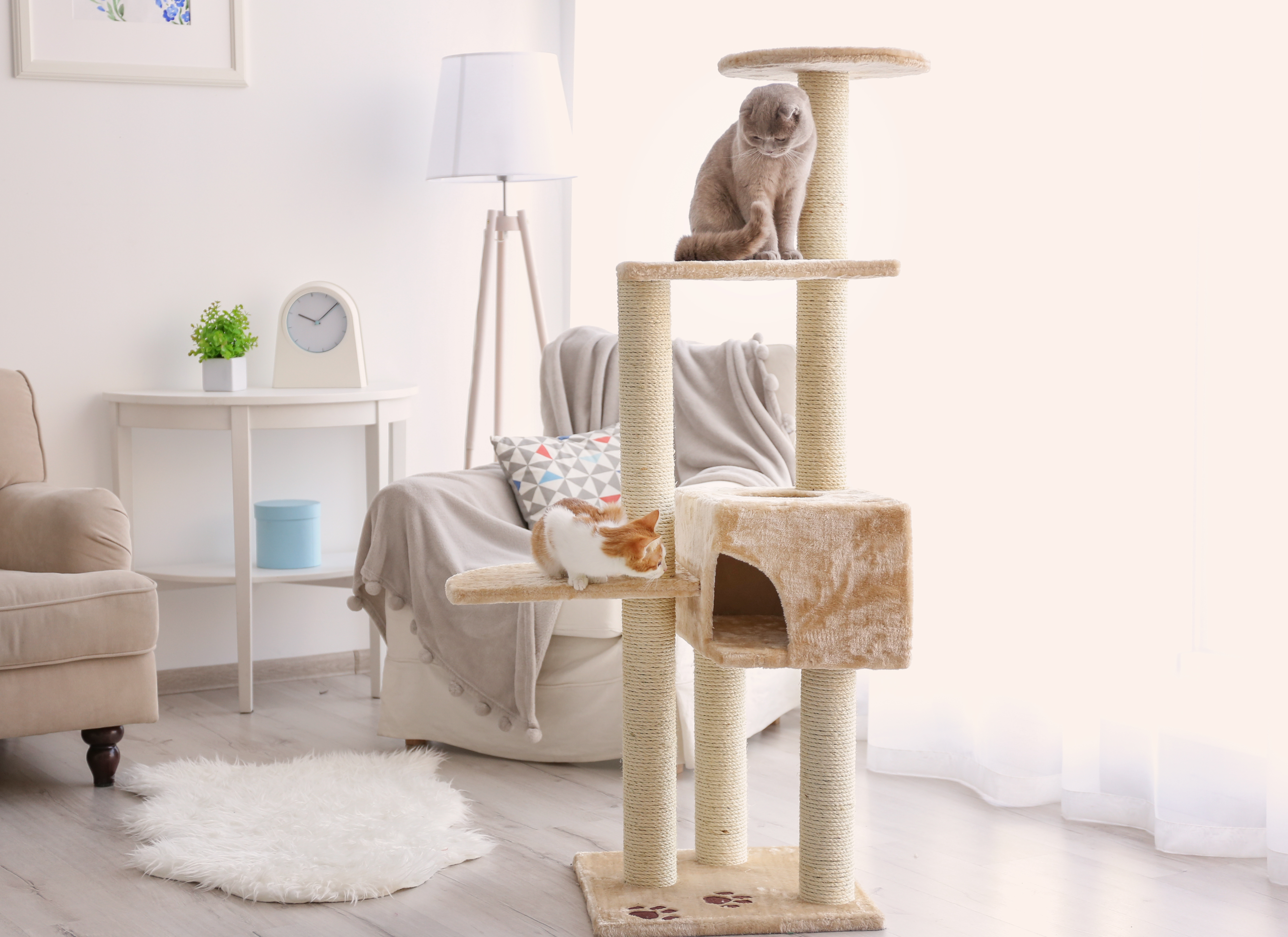
Ceiling zone — above 1.5 metres, ideally as high as the ceiling allows. This is the cat's retreat. The place it goes when it has had enough of the dog, the visitor, the toddler. A tall cat tree (1.8 metres or higher) or a set of wall shelves serves here.
Stand in any room and ask whether the cat has a clear, stable place to rest at each of these three heights. If the answer is no for any zone, that is the zone to fix first.
Real multi-cat home detail: the perch is also a peace treaty
I work mostly in multi-cat homes, and the most common reason a household feels tense is not personality conflict. It is competition for height.
In one home I visited recently — three cats, two confident, one shy — the confident cats had claimed the windowsill and the back of the sofa. The shy cat lived on the floor, behind the kitchen bin, and was being treated for a recurring cystitis no medication had fully resolved. The cystitis resolved within three weeks of installing one tall cat tree in a corner the shy cat could reach without crossing any cat's preferred path. The shy cat moved to the top platform on day two and rarely came down.
The fix is the N+1 rule. Three cats means four high resting spots, distributed across the home, with at least one in a quiet corner and at least one near a window. The tall spots are mostly for the shy cat.
The N+1 rule also applies to routes, not just to spots. A confident cat will block the single high pathway through a room. If there is only one way up, the shy cat will not use it. Two paths up to the ceiling zone give the shy cat a route that does not require passing under the confident cat.
Routes, not just perches: thinking in cat superhighways
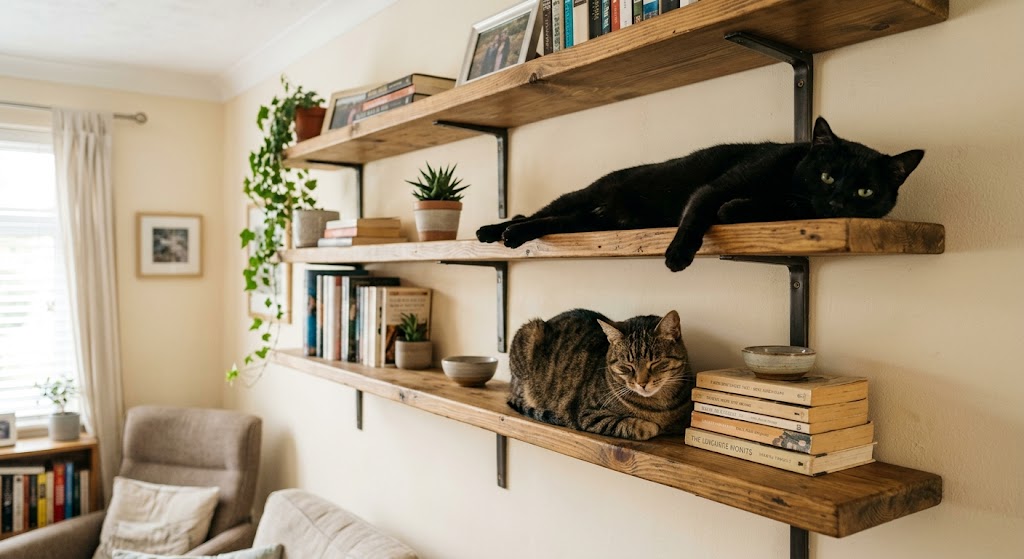
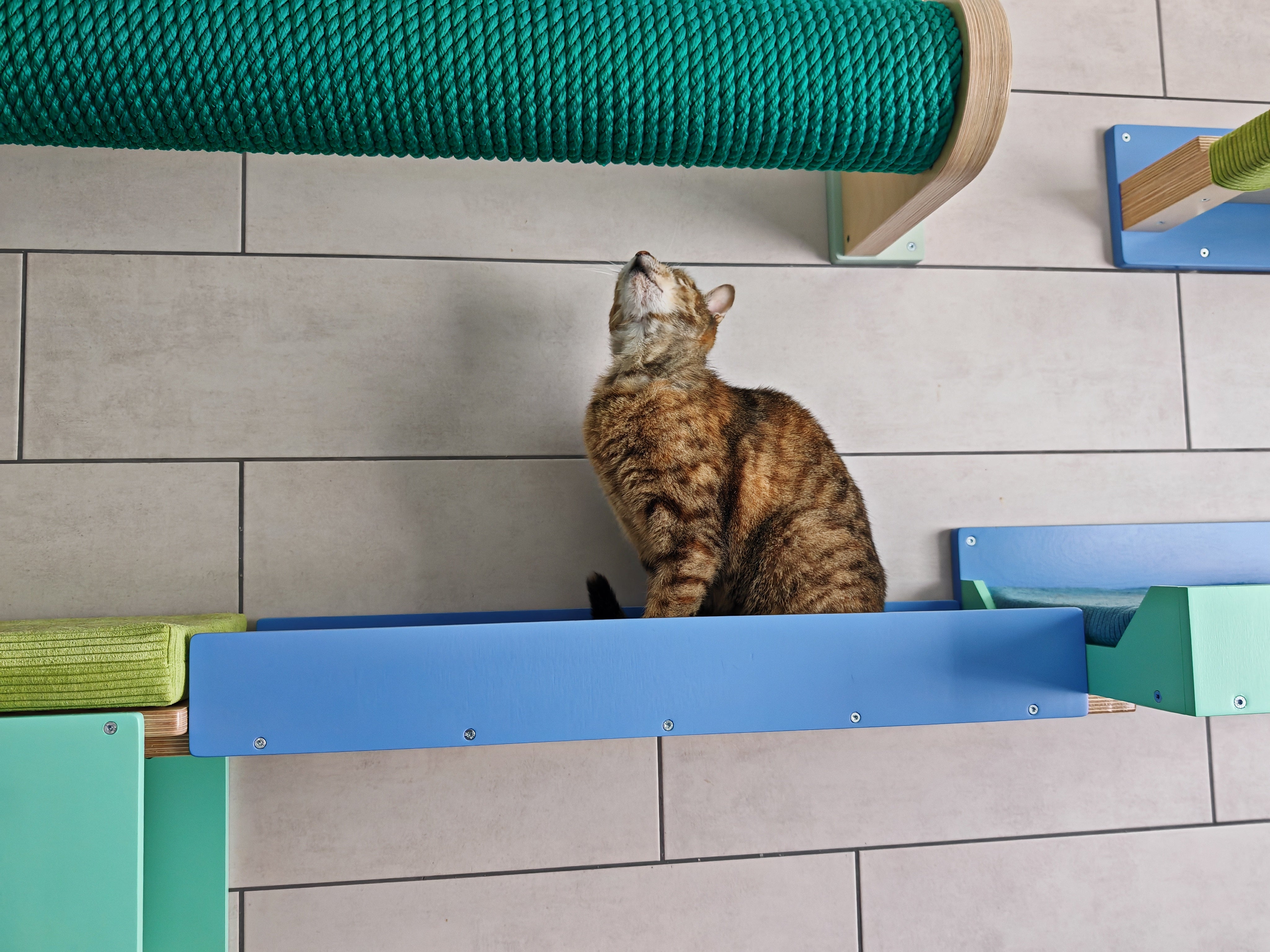
The most enriching vertical layout is not a tall cat tree in a corner. It is a connected route the cat can travel from one room to another without touching the floor. This is the idea behind the wall-shelf highways popular in cat-focused design.
A wall shelf route should follow the cat's existing path, not the designer's. A typical route: from the windowsill, along a short shelf, onto the top of a bookcase, across a bridge shelf, to the tall cat tree, and down via the second platform onto the sofa. No jump gap should be wider than the cat's body length.
Shelves should be at least 25 centimetres deep, longer is better. A shelf the cat can only cross is a shelf it will not use often. A shelf the cat can sprawl on is a bed.
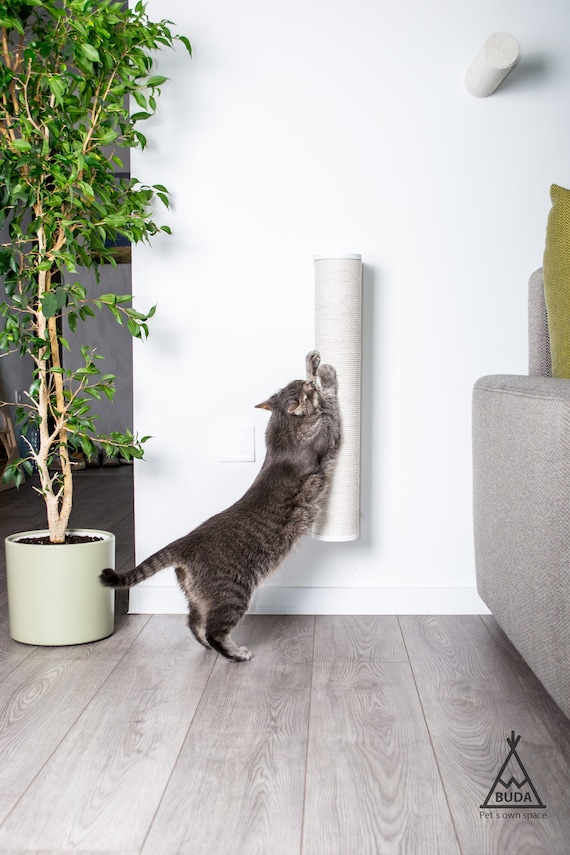
Stable mounting is not optional. A shelf that wobbles frightens the cat and is abandoned in a week. Use proper studs or masonry anchors, not drywall plugs, and load-test each shelf with twice the heaviest cat's weight. If you are renting, floor-to-ceiling poles and modular cat trees achieve the same effect and can be removed without damage.
The senior cat, the shy cat, the kitten
Vertical space is not one-size-fits-all. Three cases need a tailored approach.
The senior cat. A confident jumper at three becomes a careful, slow climber at twelve. The lowest platform should be under 40 centimetres from the floor, and the steps between platforms should be short. Some senior cats do better with low, wide shelves. If the senior cat has stopped using the high perch it used to love, do not mourn the loss. Add a soft bed at chair height, near a window. The cat wants the long view, not the height.
The shy cat. The shy cat needs the highest perch in the home, in a quiet corner, with a clear sightline to the room entrance. Place a familiar blanket on the platform. The shy cat will use a tall perch in a quiet corner; it will not use a tall perch in the centre of family life.
The kitten. A kitten is fearless in ways that often end in minor injuries. Tall narrow trees with high platforms are not appropriate for kittens under five or six months. Lower, wider cat trees, with a hideaway at the base, are better. A kitten on a tall narrow tree is a kitten who will fall off within a week.
A two-week plan for adding vertical space
This is the plan I walk through in homes. One cat at a time, one room at a time, no drilling on day one.
Days 1 to 3 — observation only. Walk through the home at four different times of day. Note where the cat rests, where it watches from, what routes it uses. Mark them on a rough floor plan.
Days 4 to 7 — add one element. In most homes that is the ceiling zone: a tall, stable cat tree (1.8 metres or higher, base at least 50 by 50 centimetres), placed so the cat can step onto the lowest platform from a chair, sofa, or stool, in a quiet corner with a clear sightline to the room entrance. A pinch of catnip at the base helps if the cat responds.
Days 8 to 10 — add the second element. A window perch, mounted so the cat can reach it from a stable chair, the cat tree, or a low shelf. A window perch is the single best mid-zone addition for an indoor cat.
Days 11 to 14 — connect the route. A second tall tree on the opposite side of the room, or a wall shelf linking the two, gives the cat a continuous route. This is the step that takes a flat from "a home with a cat" to "a home designed for a cat."
At the end of two weeks, the cat has three heights, two clear paths, and at least one spot in each room that belongs to it.
A short checklist before you start
Walk the home. Note the cat's chosen spots at three heights. Identify the missing zone. Buy one tall, stable cat tree, placed where the cat can step onto it from a chair or sofa, in a quiet corner with a sightline to the door. Add one window perch. Connect the two with a route. In a multi-cat home, repeat until you have N+1 high spots, and at least two paths between any two points.
Otto's flat is forty-eight square metres, and he now has five resting spots at four different heights. The cat does not need much. It needs up, and it needs up to be reachable. Slow, observational, kind. The plan is to make the climb a little safer, a little softer, and a lot more considered.