

Scratching the furniture: how to redirect a cat to a proper scratch post
The arm of the sofa is shredded. The corner of the new armchair has long pale ribbons hanging from it. The cat is sitting on the rug, looking perfectly innocent, and you are holding a spray bottle you have not yet used.
Take a breath. Punishing the cat does not work. The cat behaviour literature is very clear on this. What does work is a slower, observational approach: read the scratch marks, choose a post the cat will actually use, place it where the cat is already scratching, and make the old target unrewarding. Done in that order, most furniture scratching can be redirected within two to four weeks.

Why cats scratch: it's not vandalism
Cats scratch for four overlapping reasons, and the cat is doing all four at once.
Claw maintenance. A cat's claw grows in layers, and scratching peels the outer sheath away. You will sometimes find a curved, translucent sliver near the scratch post. The post is doing maintenance on the cat.
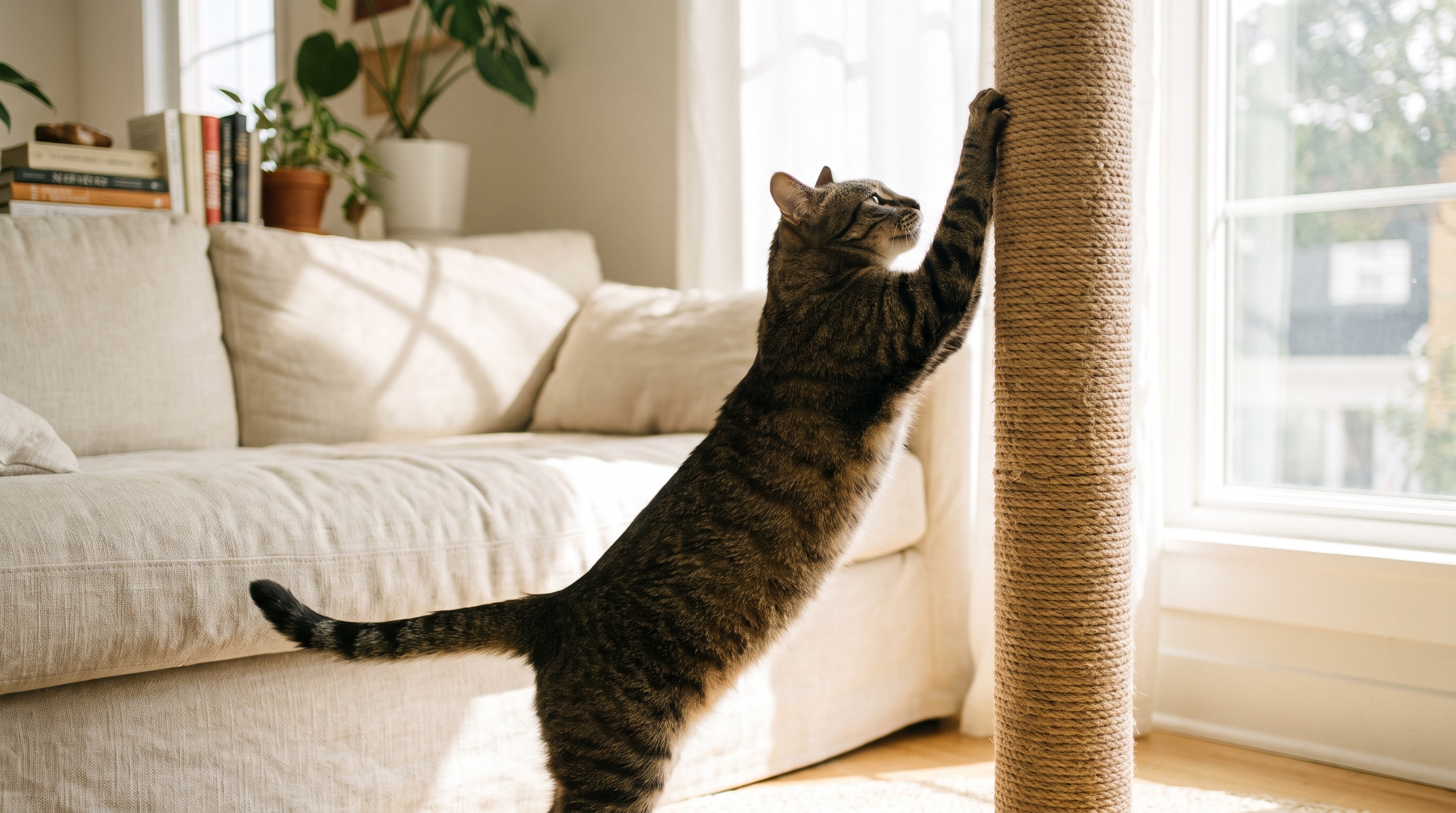
Stretching. Watch a cat at a tall post: it stands on its hind legs, reaches as high as it can, leans in, and pulls. A cat that cannot perform it on a suitable surface will find the next best thing.
Marking. The scratch marks are a visible signal: I was here, this is mine, I am a large and competent cat. Scent glands in the pads of the feet deposit a personal chemical signature when the cat scratches. A confident cat leaves many marks; an anxious cat often leaves more.
Emotional regulation. Cats scratch during the arousal spike that follows a nap, after a meal, when they see another cat through the window, and when their owner comes home. A cat that cannot scratch on an appropriate surface will still scratch — wherever the texture and height work.
Reading the scratch marks: what the cat is telling you
Before you buy a scratch post, look at the damage. The marks tell you which post to buy and where to put it.
Vertical or horizontal? Most cats prefer a vertical post they can stand against and pull. Some cats — particularly younger cats, some Oriental breeds, and many who used a doormat as a kitten — prefer a horizontal scratcher. Long downward ribbons on a chair arm mean vertical. Damage on a flat surface means horizontal.
How high? Most household scratching is between 60 and 90 centimetres from the floor — the height a cat reaches when it stands and stretches. If much higher, the post needs to be taller. If much lower, the cat may be older, arthritic, or recovering from an injury.
Which surface? Cats prefer rough, grabby textures that catch the claw. The cat scratching your tweedy wool sofa would not dream of touching the leather armchair next to it.
Where in the room? This is the most important clue. The most common scratch locations: the corner of a sofa facing the room entrance, the side of an armchair next to a window, the door frame of a frequently used room, and any furniture near a cat's sleeping spot. The cat is signalling, not hiding. In multi-cat homes, the dominant cat often scratches at the boundary between rooms; a more anxious cat scratches near its safe base.
Choosing a post the cat will actually use
Now you know what the cat wants. Buy accordingly. The wrong post in the right place is still the wrong post.
Material. Sisal — rope-wrapped or flat woven — is the best. It is rough, catches the claw, and peels satisfyingly. Carpet is a second choice, but loops can catch a claw and panic the cat. Cardboard scratchers (long corrugated ones) are excellent for horizontal scratchers. Avoid soft wood like pine.
Vertical posts: tall and stable. The post must be tall enough for the cat to stretch fully — at least 70 centimetres for an adult, taller is better. A 30-centimetre post is a kitten's toy. The post must also be stable; a wobbly post frightens the cat and gets abandoned. The best posts are heavy at the base, designed to wedge under furniture, or mounted on the wall.
Horizontal scratchers: long and heavy. A horizontal scratcher should be long enough for the cat to lie along and rake with both forepaws — at least 50 centimetres. Place it on a hard floor; a rug slides.
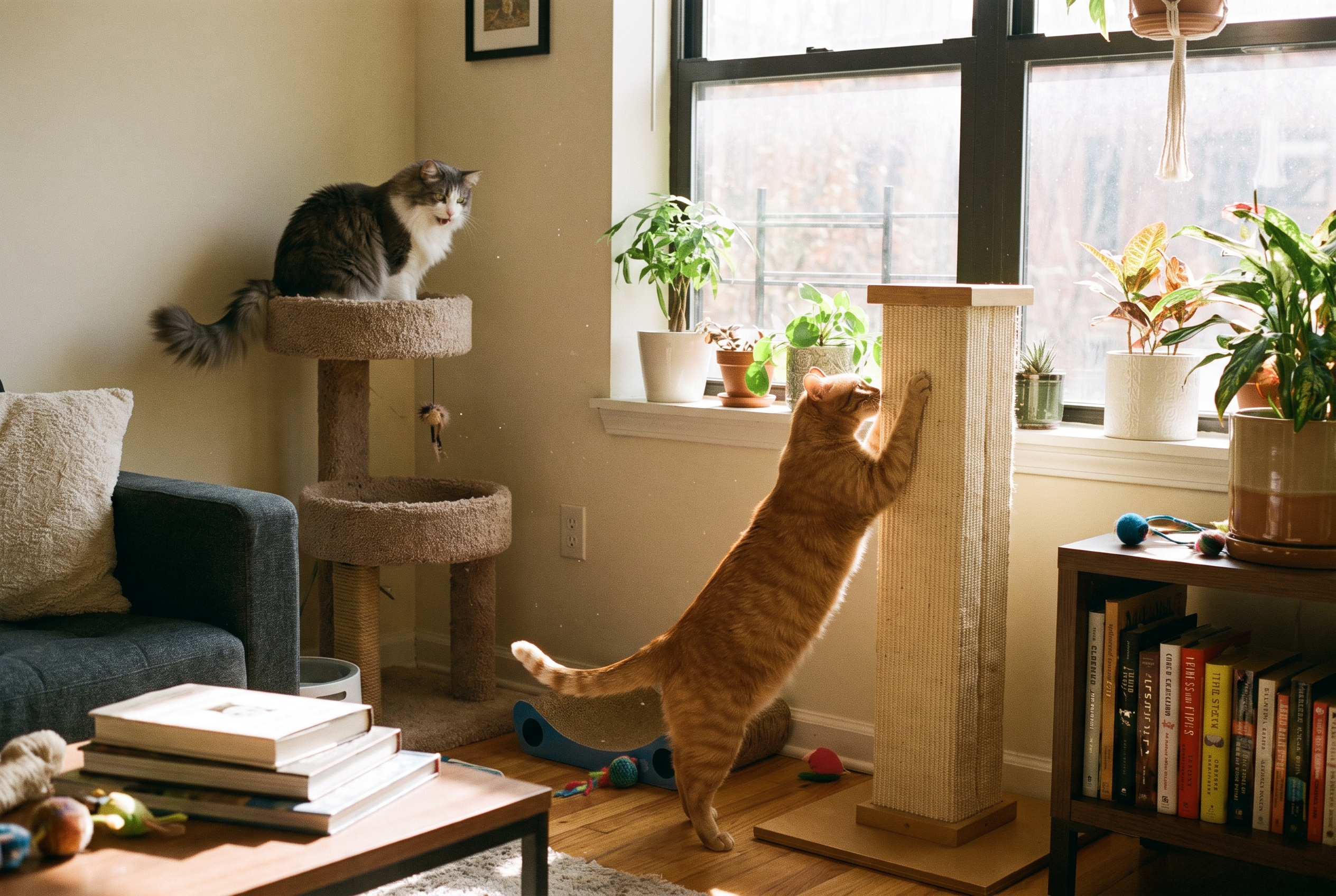
How many. In a single-cat home, two posts are the minimum — one vertical, one horizontal — and a third is better. In a multi-cat home, the N+1 rule applies: three cats means at least four scratch surfaces, distributed throughout the home. Two cats sharing one post often means one cat does not use it.
Placement: this is the part most owners get wrong
Buy the right post, put it in the wrong place, and the cat ignores it. This is the most common reason "we tried a scratch post and it didn't work."
Rule 1: the post goes where the damage is. Not in the corner of the spare room. Next to the shredded sofa, within a metre, on the same side. You can move the post later, slowly, after the cat is using it.
Rule 2: at least one post in a social area. Cats scratch in the rooms where the family spends time. A post hidden in the back bedroom gets ignored.
Rule 3: one post per pathway. In a multi-room home, place a post at each major transition point — the doorway between hall and living room, the corner of the kitchen near the food station, the window perch in the bedroom.
Rule 4: near the sleeping spot. The post-nap stretch is a real thing. If your cat sleeps on the windowsill, the post goes near the windowsill.

Make the old target unrewarding — gently
You cannot punish scratching. You can make the wrong surface feel wrong, while the new surface feels right. Both at once.
For fabric furniture, use wide double-sided tape or aluminium foil on the damaged area. Cats dislike sticky paws. Commercially available "scratch deterrents" (Sticky Paws and similar rolls) work well. The point is not to punish the cat. The point is to make the chair arm feel wrong while the post, six steps away, feels right.
For wooden door frames, use a clear plastic guard or a few layers of packing tape. The cat cannot get a claw into a slick surface. A tall post next to the door gives the cat the height it was after.
Do not use a spray bottle. It teaches the cat to scratch when you are not in the room, and it damages trust. The damage to the relationship is worse than the damage to the chair.
Trim the claws every two to three weeks. A regular trim reduces the damage if the cat does scratch the wrong surface, and makes the post feel better. Use a proper cat claw trimmer, press the pad to extend the claw, clip just the sharp tip, avoid the pink quick. Ask your vet to show you the first time.
A four-week redirection plan for one cat
This is the version I walk through in the home. It assumes one main target, a single cat, and a consistent family.
Week 1. Buy one vertical sisal post (minimum 80 centimetres) and one horizontal cardboard scratcher. Place the vertical post next to the damaged furniture. Place the horizontal scratcher near the cat's main sleeping spot. Apply double-sided tape or foil to the damaged area. Sprinkle a small amount of dried catnip on the base of each new post (skip this if the cat does not respond — about a third of adult cats do not).
Week 2. If the cat sniffs the post and walks away, move it half a metre closer to the cat's path, or rub the post with a soft cloth and then rub that cloth along the cat's cheek to mark it. If the cat scratches the post once — even a single tentative pass — praise softly and offer a small treat within five seconds. Do not pick the cat up to put it on the post.
Week 3. Continue the tape or foil. Add a second vertical post in another social area, ideally near a doorway. Begin a five-minute play session with a wand toy twice a day.
Week 4. The cat is using the post consistently. Begin to move the post, a few centimetres a day, to its final location. The tape can come off the chair now. If the damage is severe, reupholster that arm.
The median is four weeks. Some cats redirect in a week. Anxious cats, or cats who have been scratching the same chair for years, can take six to eight weeks. Be patient. The plan works.
Multi-cat homes: the scratch post is a social resource
The single most common reason scratching persists in a multi-cat household is that there are not enough posts, or the posts are clustered. I visited a home recently with three cats, one tall post in the living room corner, and shredded furniture in two bedrooms. There was just one post, and three cats were dividing up the rest of the house.
In multi-cat homes, the post is also a social signal. Two cats cannot share one tall post the way they can share a window perch; the post requires a full stretch, and the cat on the post is announcing itself. So the N+1 rule applies: three cats, four posts. Two in social areas, one near a shy cat's safe base, one at a transition point.
An anxious cat often scratches near its own resting spot, not in social areas. Give that cat a post of its own, with a familiar blanket at the base, and the post becomes part of the cat's safe place.
A short checklist before you start
Before you buy the post, take a slow walk around the home and look at the damage with the cat's eyes. Note each scratch location, height, surface, orientation, and which cat is doing it if you can tell.
For each scratch location, place one post within a metre. For social areas where the cat spends time but has not yet scratched, add one extra post. Apply the surface deterrent to the damaged furniture. Trim the cat's claws. Begin a five-minute play session twice a day — most cats scratch more when they have unspent hunting energy.
The arm of the sofa will recover. The cat will be more settled. You will have replaced a daily small frustration with a behaviour you both understand.
That's the work. Slow, observational, kind. It works.