
Indoor cat exercise: meeting the daily activity quota
Ginevra is a five-year-old tortoiseshell in a third-floor Bologna apartment with two other cats. Her owner told me, on a wet Tuesday in March, that she never does anything. At that moment Ginevra was on the windowsill with one eye open; her sister was under the bed; the youngest, a ginger named Pacio, was in the kitchen sink watching a drop of water fall. None had moved in forty minutes. The owner felt this was her own failure.
It was not. It is the most common pattern I see in fifteen years of indoor-cat work: the household where nothing is visibly happening, and the humans quietly conclude the cats are bored, lazy, or depressed. None of those words is usually right. The cats are doing what their biology tells them — saving energy in long quiet stretches, waiting for the next crepuscular peak. The problem is not the quiet. The problem is that, in most indoor homes, the next peak is also quiet, because the home is not designed to invite it.
This is a guide to the indoor cat's daily activity quota — what the science says, what it looks like in a real multi-cat home, and a plan any household can run in fifteen minutes a day.
The "lazy cat" is mostly a saved-energy cat
The first time I read the wild-cat energy budget literature, I had to put the paper down. A free-ranging feral cat makes between thirty and fifty discrete predatory attempts in twenty-four hours, across nine to fourteen hunting bouts. Most fail — the success rate, even in good habitat, is one in three. The cat burns energy slowly between bouts and rests deeply after a kill. She is not lazy. She is a bout hunter — a sprinter in a slow body.
The indoor cat who sleeps eighteen hours is not broken. The problem is what she is not doing during the other six. The free-ranging cat fills those hours with stalking, climbing, scent-marking, watching prey. The indoor cat fills them with a window, a slow blink at the wall, the fridge hum, a shift to a different sunbeam. Energy expenditure can drop 40–60% compared to a cat with outdoor access. That gap, over years, is what produces the slow weight gain that lands most indoor cats at the vet by age eight.
The fix is not "make the cat run more." The fix is to put bout-shaped activity back into the day, at times the body is already primed for it.
Reading the indoor cat's natural activity rhythm
Before changing anything, spend three days watching. Not playing, not luring — just watching, with a notebook. Note, every thirty minutes, what each cat is doing, in which room, and whether the eyes are open. After three days the pattern almost always looks like this:
- A long quiet block from late morning to early afternoon. Two or three cats asleep. The third on a perch, watching a window.
- A first crepuscular peak around the time the owner comes home — 5:30 to 7:30 pm in most homes. The biggest natural play window. Most indoor cats under-use it because the owner is cooking, opening mail, or trying to relax.
- A second, smaller peak an hour or two after sunset. In a flat with no prey, it often shows up as the zoomies — the ten-minute gallop that owners either find hilarious or alarming.
- A third, sometimes barely visible, peak in the hour before dawn. The cats who show it are the ones who wake the owner at 4:30 am. The 4:30 am wake-up is not a behaviour problem. It is a crepuscular peak with no outlet.
The owner's plan should sit on top of these peaks, not against them. Trying to play a cat at 11 am is a losing negotiation. Playing a cat at 6:15 pm, in the room she already likes, with a toy that moves the way prey moves, is a different conversation.
Three currencies: hunt, climb, social play
The indoor activity quota, when I sketch it for a household, is not one number. It is three numbers in three different currencies, and a cat rich in one and poor in the other two is not, in welfare terms, in good shape.
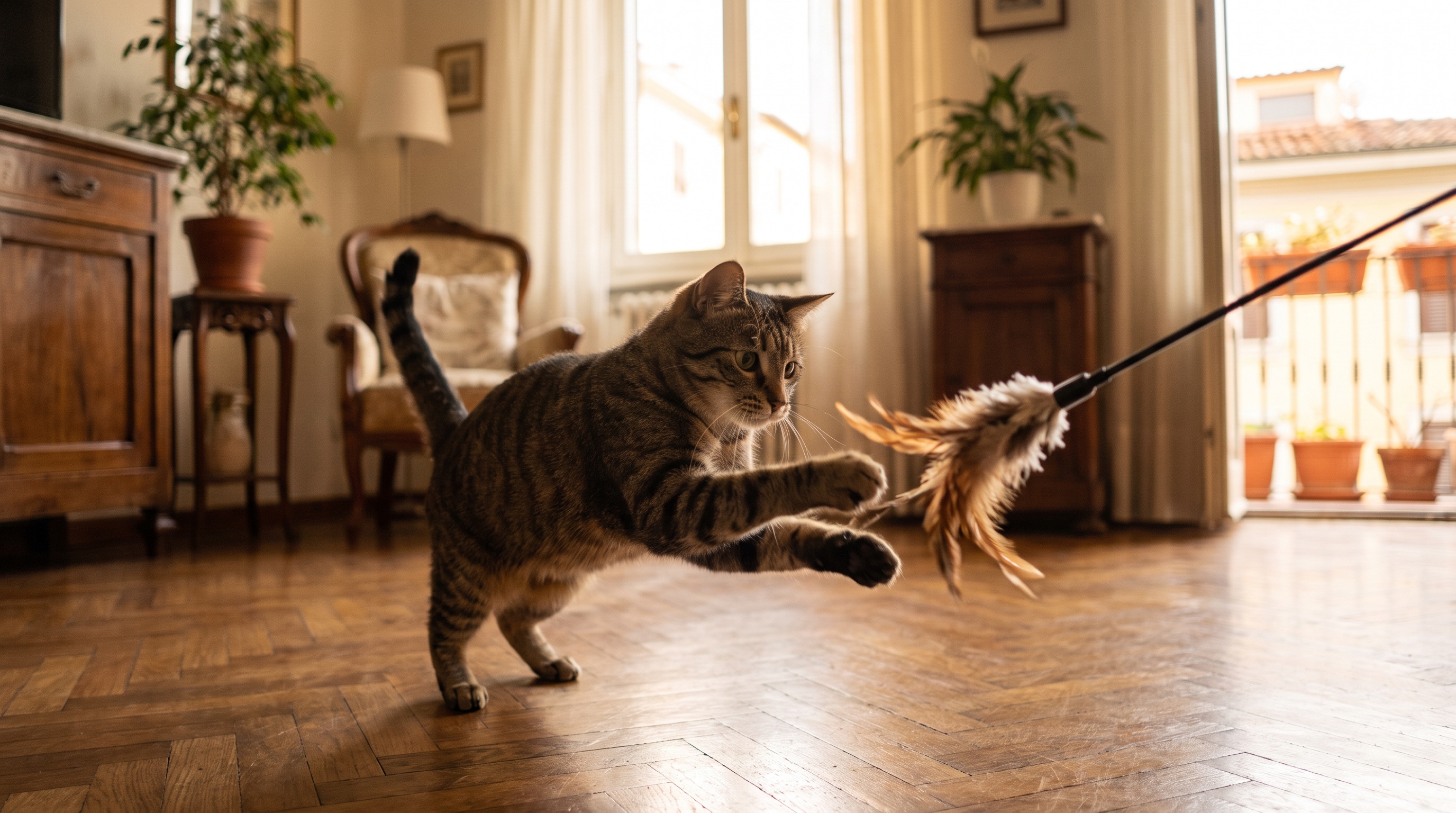
Hunt is the predatory sequence — orient, stalk, chase, pounce, catch, kill. The closest indoor equivalent is a wand toy moved with intention: low, slow, and disappearing behind a corner, not waved in the cat's face. A good fifteen-minute hunt, run twice a day, uses more energy than twenty minutes of fetch. End on a catch, not a fumble.
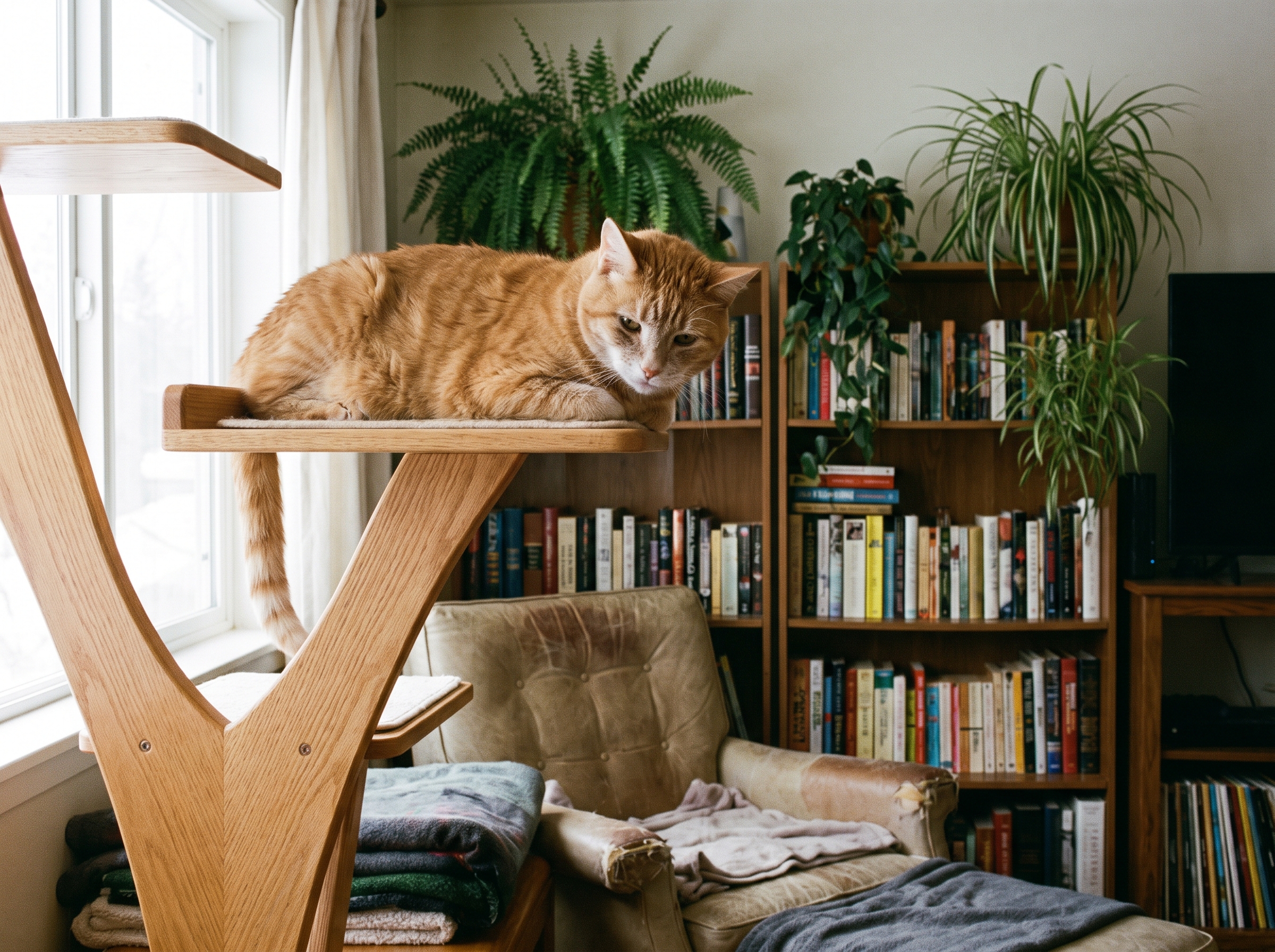
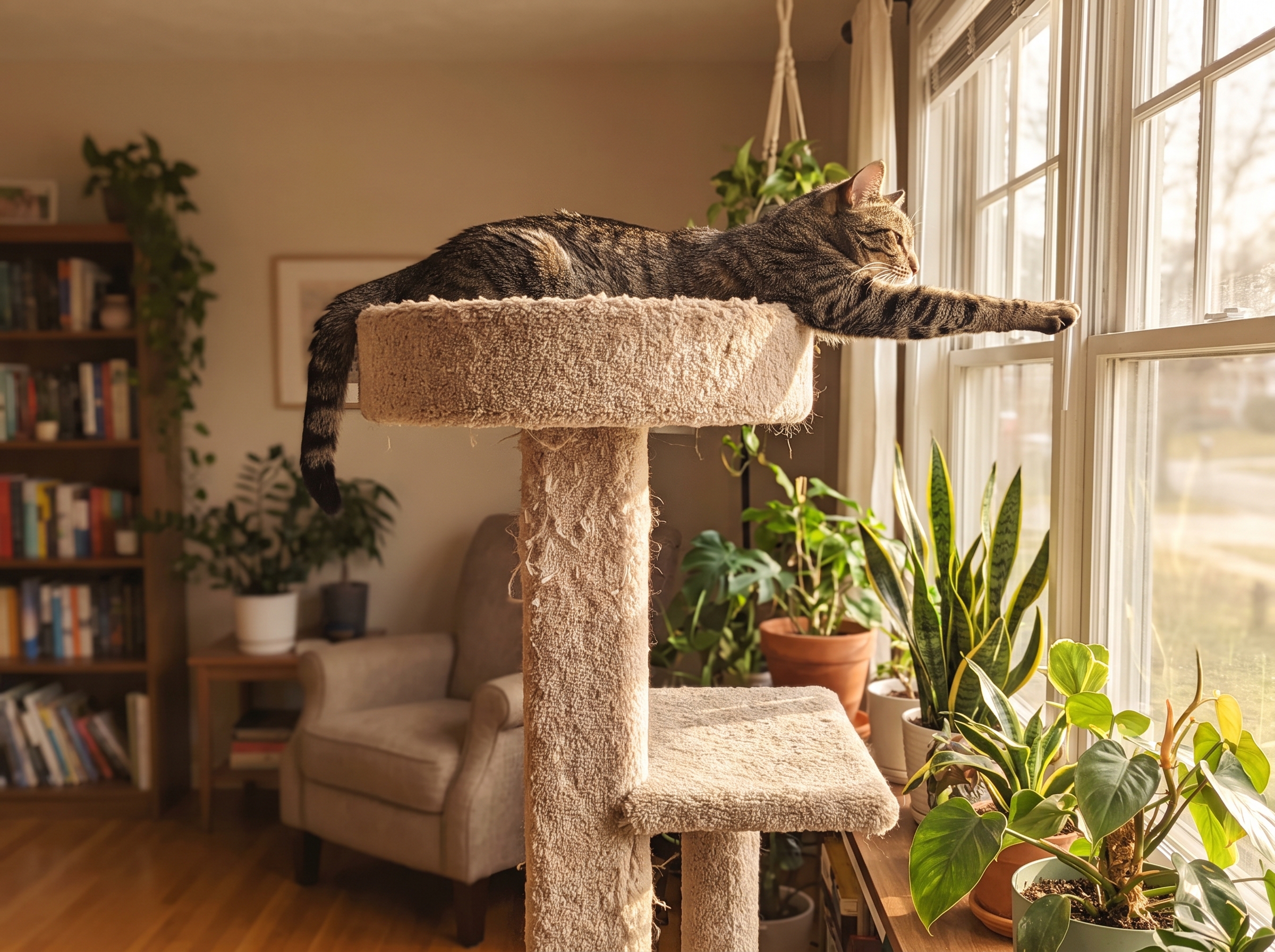
Climb is the vertical dimension. Cats are climbers by survival. In the wild, height is escape, observation, and territory. A flat with a single cat tree in a corner is, from the cat's point of view, mostly flat. Two or three vertical options in two rooms, at two heights, with at least one above the human's head, is closer to what the body expects. The cat who climbs three times a day uses different muscles than the cat who never leaves floor level.
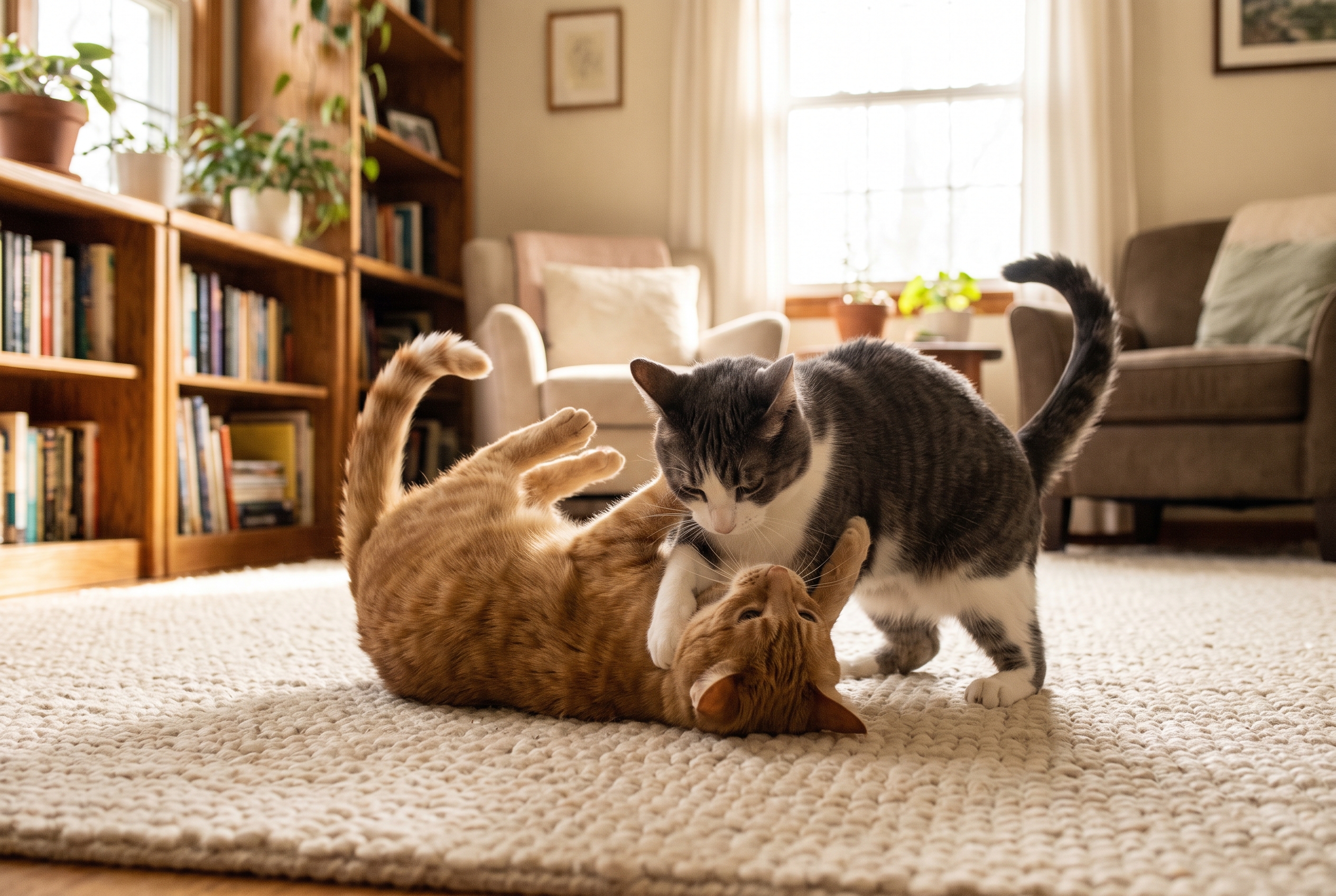
Social play is the most undervalued. In a multi-cat home, social play bonds the group and exhausts the youngest. In a single-cat home, social play is what the owner is — and the only honest version is one the cat starts and ends. Most owners play too long, too vigorously, with toys that move too fast. The cat disengages. The owner concludes she is not playful. The cat is, in fact, signalling the end of a natural bout.
What this looks like in a real multi-cat home
I have been visiting a small apartment in Modena once a season for four years. Five cats. The owner is patient, observant, and, in her own words, not athletic — relevant, because her cats' quota is built around what she can sustain on a normal day.
- Morning, 7:15 am, in the kitchen. A three-minute hunt with a feather wand, in the dark, before the lights go on. The crepuscular peak is just beginning. The hunt ends on a catch and a single freeze-dried treat. Two cats participate. One watches from the doorway. The youngest goes back to bed.
- Midday, the owner is at work. Two puzzle feeders in two different rooms. The cats do not play together. They do, separately, the small work of extraction — sniffing, pawing, pushing. This is not a hunt, but for an indoor cat the brain is part of the activity budget.
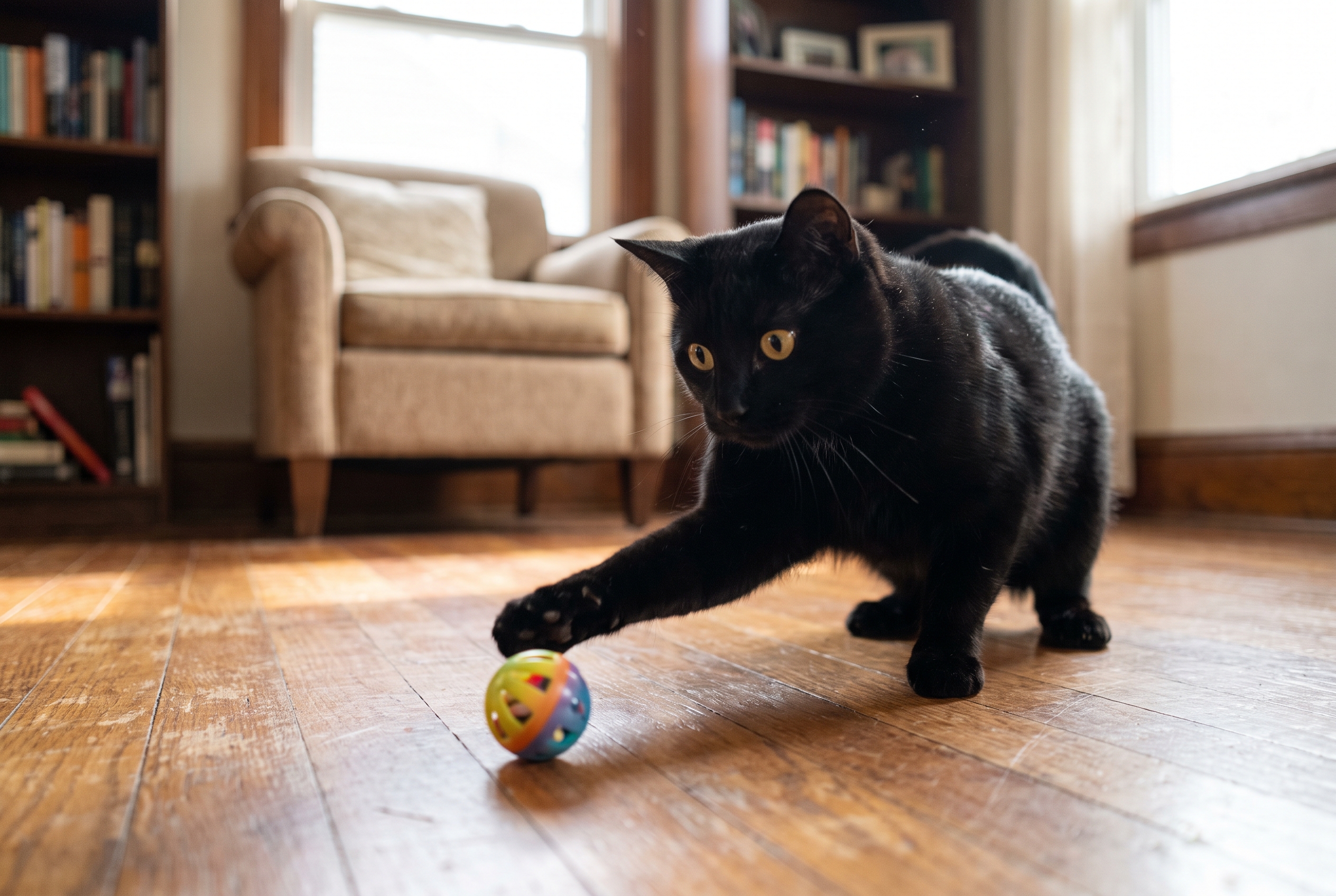
- Evening, 6:30 pm, in the long hallway. A ten-minute hunt, then five minutes of chase-the-rolling-ball. The owner is on the floor. The cats take turns. The oldest rarely joins but watches from the wardrobe, which counts.
- Late evening, the second peak. A short hunt in the bedroom, lights low. This is the bout that stopped the 4:30 am wake-ups — once the second peak had somewhere to land, the third went quiet.
Total active time is around twenty-five minutes. Real activity, including climbing on and off the wardrobe, is closer to an hour. The cats' weights are stable. The oldest, now twelve, has lost half a kilo over the past year with no diet change, only the quota.
A two-week starter plan for the under-active indoor cat
For an owner who wants a single, gentle place to start, this is the plan I leave on the kitchen table. It will not turn a quiet cat into a performer. In most homes, it lifts the daily activity budget by 20–30% within two weeks, mostly from things the cat was already half-doing.
Days 1–3 — observe only. Notebook, half-hour intervals. Note where each cat sleeps, where she watches from, which rooms are dead zones, and the times the cats are most alert.
Days 4–7 — one small hunt a day. Pick the larger of the two crepuscular peaks. Pick the room the cat already likes. Run a three- to five-minute hunt with a wand toy, ending on a catch. The point is to attach a behaviour to a time of day, not to exhaust anyone.
Days 8–11 — add one vertical option. A tall cat tree, a clear shelf, a cleared top of a wardrobe — anywhere the cat can be, briefly, higher than the human. Most cats find the new option within forty-eight hours. Two cats may compete for the same spot; add a second one nearby.
Days 12–14 — add one social-play window. Five minutes of chase-the-rolling-ball, or feather-on-a-string, in the evening, after the second hunt. This is the one that bonds the quota to the human. By the end of the second week, most cats initiate at least once a day — a soft paw on the toy, a head-bump at the wand drawer.
By the end of the two weeks, the household has a stable activity quota built into the natural peaks, in the rooms the cats already own, using behaviours they were already half-performing. The deepest trick of indoor cat welfare is not to invent the activity. It is to stop suppressing it.
When exercise is not the issue
A small honest section, because the alternative is the kind of confident article that misses real problems. Some indoor cats are low despite a good quota, and the cause is medical, not behavioural. Three flags, especially in cats over eight:
- A quiet drop in activity — slower on the stairs, less interest in the second-floor perch, longer sleep blocks — paired with a rising weight curve. The most common pattern of early feline osteoarthritis. Not cured by a better toy. Needs a vet.
- Activity that drops after a household change — a new flatmate, baby, or pet — and does not return within three weeks. Stress; the fix is environmental, not athletic.
- Activity that drops and appetite drops and the cat hides more than usual. A vet visit this week, not next month.
The quota gives a healthy cat the activity her body expects. It is not a substitute for a check-up. The owner who notices the change is the one who catches it.
A small closing thought, on the cat in the sink
I think of Pacio, the ginger in the kitchen sink, fairly often. He was not doing nothing — he was watching a drop of water fall, calculating its rhythm, trying to predict it. A small, voluntary, brain-engaged act, and it counted. Most of what an indoor cat does on a quiet day is some version of that: small, voluntary, easy to miss, important to leave alone. The activity quota is not a way of filling the cat's day. It is a way of not taking the rest of it away.