
The prey cycle play pattern: how to simulate hunting indoors for an indoor cat
Indoor cats hunt nothing but their food bowl, and that is why a lot of them are bored, fat, and stressed. The domestic cat is a solitary, obligate carnivore that evolved to spend 6-8 hours a day hunting small prey across a territory measured in acres. The indoor cat lives in a 600-square-foot apartment, eats a meal from a bowl in 90 seconds, and is then expected to sleep for 18 hours until the next meal. The behavioral fallout shows up as midnight yowling, scratching the couch, ambush attacks on the owner's ankles, inter-cat aggression, and the weight gain that drives the diabetes and joint disease that shorten the cat's life. The fix is the prey cycle play pattern, which is the play sequence that mimics the actual hunt — stalk, chase, pounce, catch, kill — and turns the indoor cat's daily routine from a passive, over-fed existence into a species-appropriate daily rhythm. In this article I will walk through what the prey cycle actually is, how to structure it, the equipment that helps, the common mistakes, and the behavioral changes you should see in 2-4 weeks.
What the prey cycle is
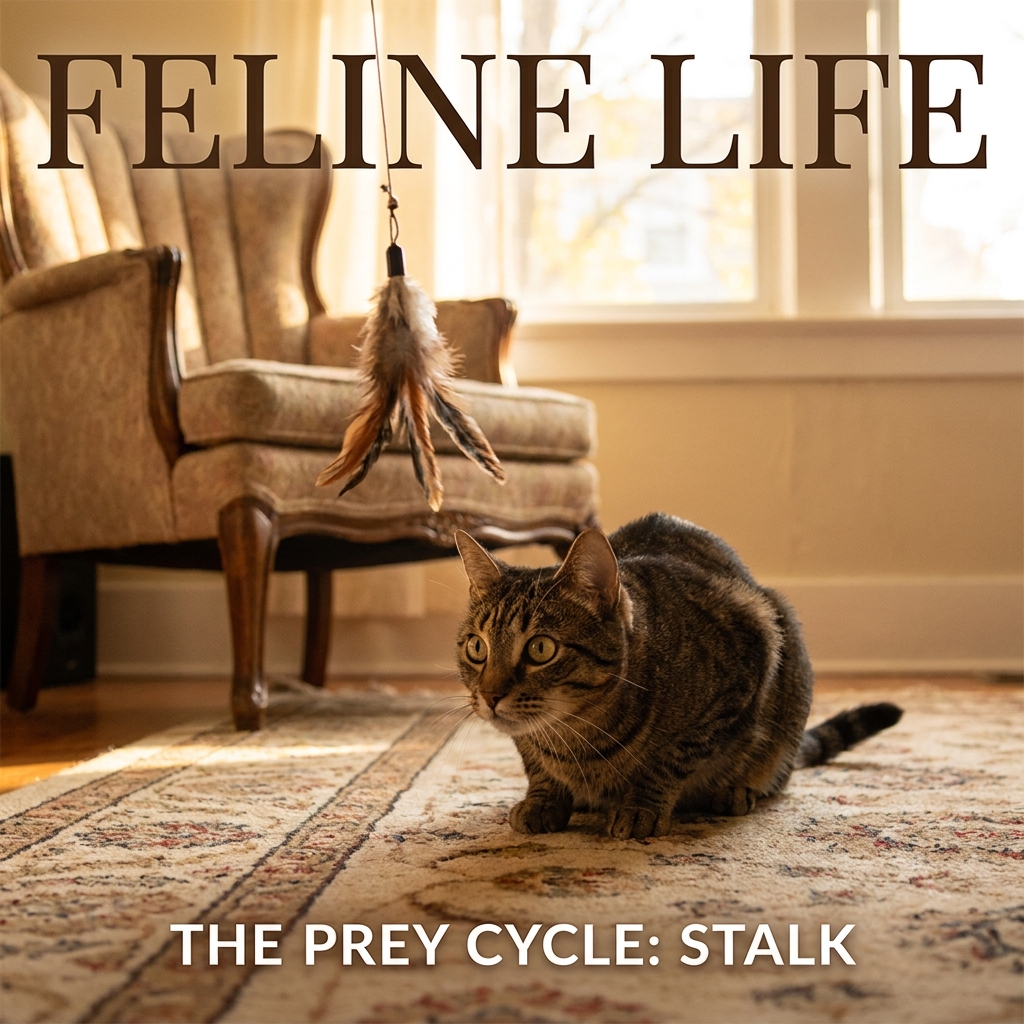
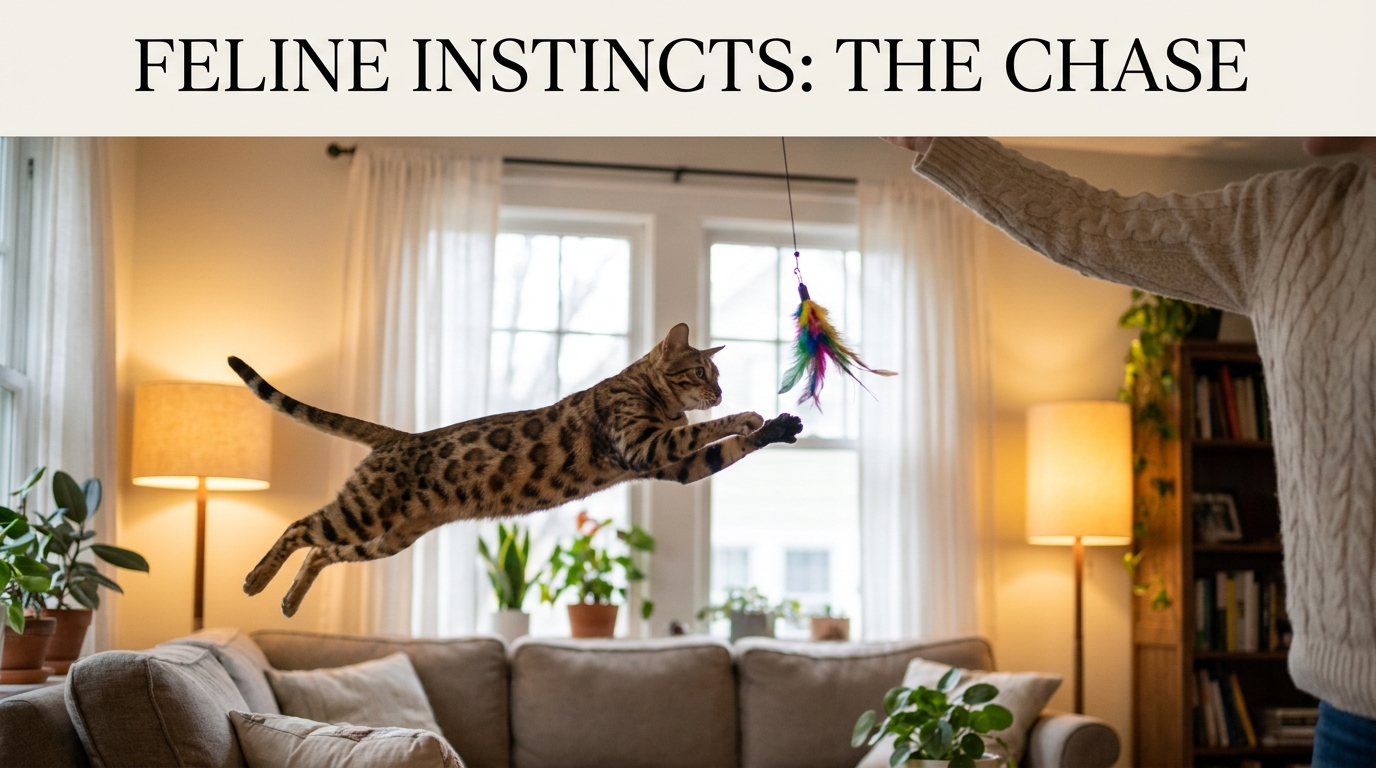
The prey cycle is the sequence of behaviors a cat performs during a real hunt. The sequence has four phases, in order. The stalk: the cat identifies a prey item, freezes, lowers its body, and tracks the target with focused attention. The chase: the cat pursues, accelerating, changing direction, using cover. The pounce: the cat launches at the prey, using the hind legs to propel itself forward and the front paws to grab. The catch and kill: the cat secures the prey with the front paws and delivers a killing bite to the neck.
Each phase corresponds to a different neurological state. The stalk is the predatory focus state, mediated by the brain's attention and reward circuits. The chase is the high-arousal state, with the adrenal system activating for the burst of speed. The pounce is the explosive release of stored energy. The catch and kill is the consummatory state, the same state that follows any successful action. The whole cycle is what the cat's brain is built to do. When the cycle is completed, the cat's brain releases a wave of satisfaction hormones and the cat grooms, eats, and sleeps. When the cycle is interrupted — usually by the owner ending play when the cat gets too rough or too excited — the cat's brain is left in the high-arousal state without the resolution, and the cat is more wound up, not less.
The prey cycle play pattern is the indoor version. The owner uses a wand toy (Da Bird, a feather wand, a kicker stick) to simulate the prey, and the cat performs the full sequence. The owner does not skip the stalk phase, does not skip the chase, does not skip the pounce, and does not skip the catch and kill. The whole sequence takes 10-15 minutes per session, and most indoor cats need 1-2 sessions per day.
The equipment: what actually works
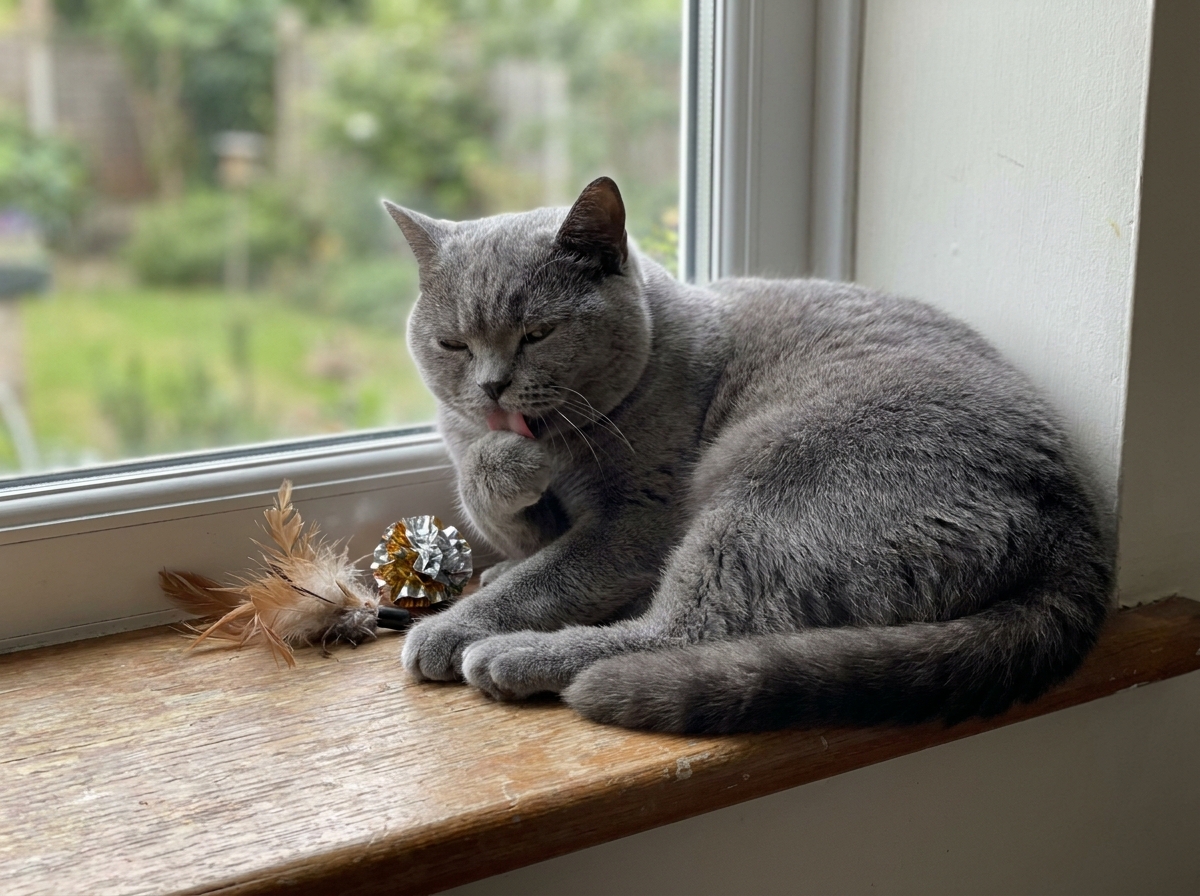
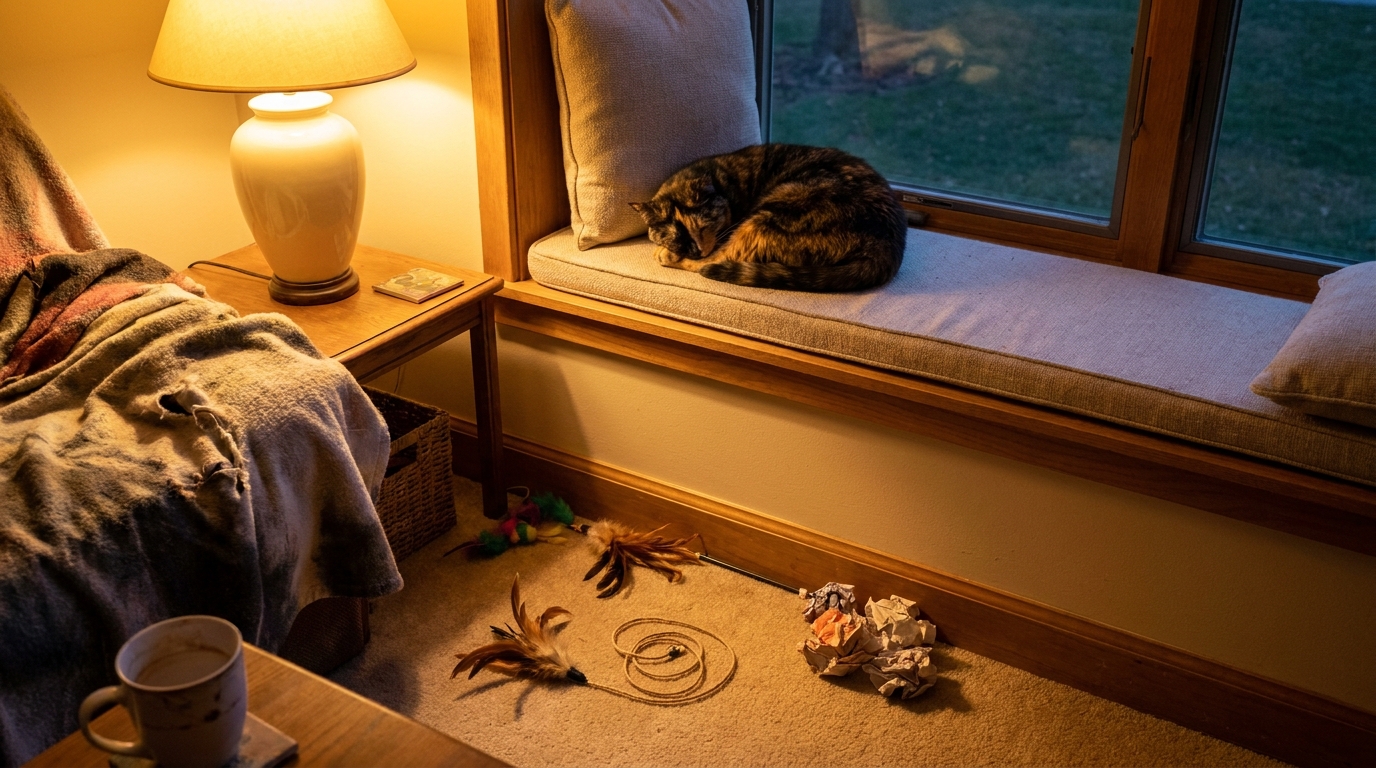
The wand toy is the single most important piece of cat enrichment equipment. A wand toy has a stick, a string, and a lure at the end. The lure is the prey. The owner controls the prey, and the cat performs the hunt. The most effective lures for indoor cats: feathers (particularly long, fluttering feathers that simulate bird flight), fur or feather lures that simulate mouse movement, and ribbon or crinkle lures that simulate insect or small mammal movement. The Da Bird wand is the gold standard for feather lures; the lure makes a sound and movement that triggers an immediate predatory response in most cats.
The equipment that does not work as well: laser pointers (the cat never catches the prey, the cycle is never completed, and the cat becomes frustrated), balls (the ball does not behave like prey, the cat loses interest in minutes), and catnip mice (the cat catches the "prey" in 30 seconds and the play is over). The wand toy is the only piece of equipment that allows the owner to control the prey, vary the behavior, and complete the cycle.
The second piece of equipment that helps is a kicker stick. A kicker stick is a long, soft, catnip-filled toy that the cat can grab with the front paws and rake with the back paws. The kicker is for the consummatory phase of the cycle — the catch and kill. The cat that has been stalking and chasing for 10 minutes is the cat that is ready to grab the kicker and complete the cycle. The kicker also serves as a redirect for the cat's bite intensity; the cat that has a kicker to bite is the cat that is not biting the owner's hand.
The session structure: 10-15 minutes, twice a day
The recommended session is 10-15 minutes, twice a day, ideally at consistent times. The morning session works for most households — the owner gets up, plays with the cat for 10 minutes before leaving for work, leaves the cat with a small meal after play. The evening session is for the second play bout and the pre-sleep wind-down. The cat that gets a play session before bedtime is the cat that sleeps through the night instead of running up the hallway at 2 am.
The session structure: phase 1 (3-4 minutes), the stalk. The owner moves the wand lure slowly, behind a piece of furniture, around a corner, under a blanket. The cat watches, freezes, lowers its body, follows. The owner does not move the lure too fast. The point of the stalk phase is to build the predatory focus, and the focus is built by slow, deliberate movement. Phase 2 (4-5 minutes), the chase. The owner increases the speed, varies the direction, makes the lure "notice" the cat and try to escape. The cat accelerates, changes direction, follows. Phase 3 (2-3 minutes), the pounce. The owner moves the lure into a position where the cat can launch — close to the cat, on the floor, behind a corner that the cat can ambush. The cat pounces. Phase 4 (2-3 minutes), the catch and kill. The cat grabs the lure, the owner lets the cat have it, the cat delivers the killing bite, the cat grooms briefly. The session ends with a small meal, which mimics the eat-after-hunt sequence. The whole session is 10-15 minutes. Twice a day.
The three common mistakes
The first is ending the session at peak intensity. The owner who stops playing when the cat gets too excited has stopped at the chase phase, before the catch and kill. The cat is left in a high-arousal state, and the cat will continue to be high-arousal for the next 1-2 hours. The cat that is high-arousal is the cat that runs up the hallway at midnight. The fix: always end the session at the consummatory phase, when the cat has caught and "killed" the lure. The cat that ends the session with a successful catch is the cat that is satisfied and ready to groom and sleep.
The second is the same wand, the same speed, every time. The cat that has the same play pattern every day is the cat that gets bored. The owner who varies the lure (feather one day, ribbon the next, mouse the next), varies the speed (slow stalk one day, fast chase the next), and varies the location (living room one day, bedroom the next) produces a cat that stays engaged. The prey cycle is the framework, but the play within the framework needs to be unpredictable, the way real prey is unpredictable.
The third is the laser pointer. The laser pointer is a predatory focus trigger with no resolution. The cat stalks, chases, pounces, and catches nothing. The cycle is never completed. The cat becomes frustrated, sometimes obsessive, and may develop compulsive behaviors. The laser pointer is not enrichment; it is a tool for triggering the cat's predatory focus without providing the resolution. If the owner uses a laser pointer (which I do not recommend), the pointer must end on a physical toy that the cat can catch and "kill." The cat needs the resolution.
What you should see in 2-4 weeks
The behavioral changes from a consistent prey cycle play pattern are usually visible in 2-4 weeks. The cat is more relaxed in the evening, less likely to ambush the owner's ankles. The cat sleeps through the night more reliably. The inter-cat aggression in multi-cat households is reduced (the predatory drive has an outlet, and the cats are less likely to redirect the drive onto each other). The scratching on furniture is reduced (the scratching is a marking behavior that the cat performs when under-stimulated; the cat with a daily play session is a less stressed cat, and a less stressed cat is a less marking cat). The cat is more engaged with the owner, more willing to be handled, and more responsive to the owner's calls. The relationship between owner and cat improves because the owner has become the source of the cat's most important daily activity.
The physical changes are also visible. The cat that is playing twice a day is a cat that is moving more, building muscle, maintaining a healthy weight. The cat that is playing is the cat that does not develop the obesity-related diseases that shorten the indoor cat's life. The play is not just enrichment; it is preventive medicine.
The one-page summary
A wand toy, twice a day, 10-15 minutes per session, following the stalk-chase-pounce-catch-kill sequence, with a small meal at the end. The lure varies. The speed varies. The session ends at the catch and kill, never at the chase. The laser pointer is not used. The kicker is for the consummatory phase. The result is a cat that is calmer, healthier, and a more pleasant companion. The cost is 20-30 minutes per day. The benefit is the cat's quality of life for the next 15 years.