
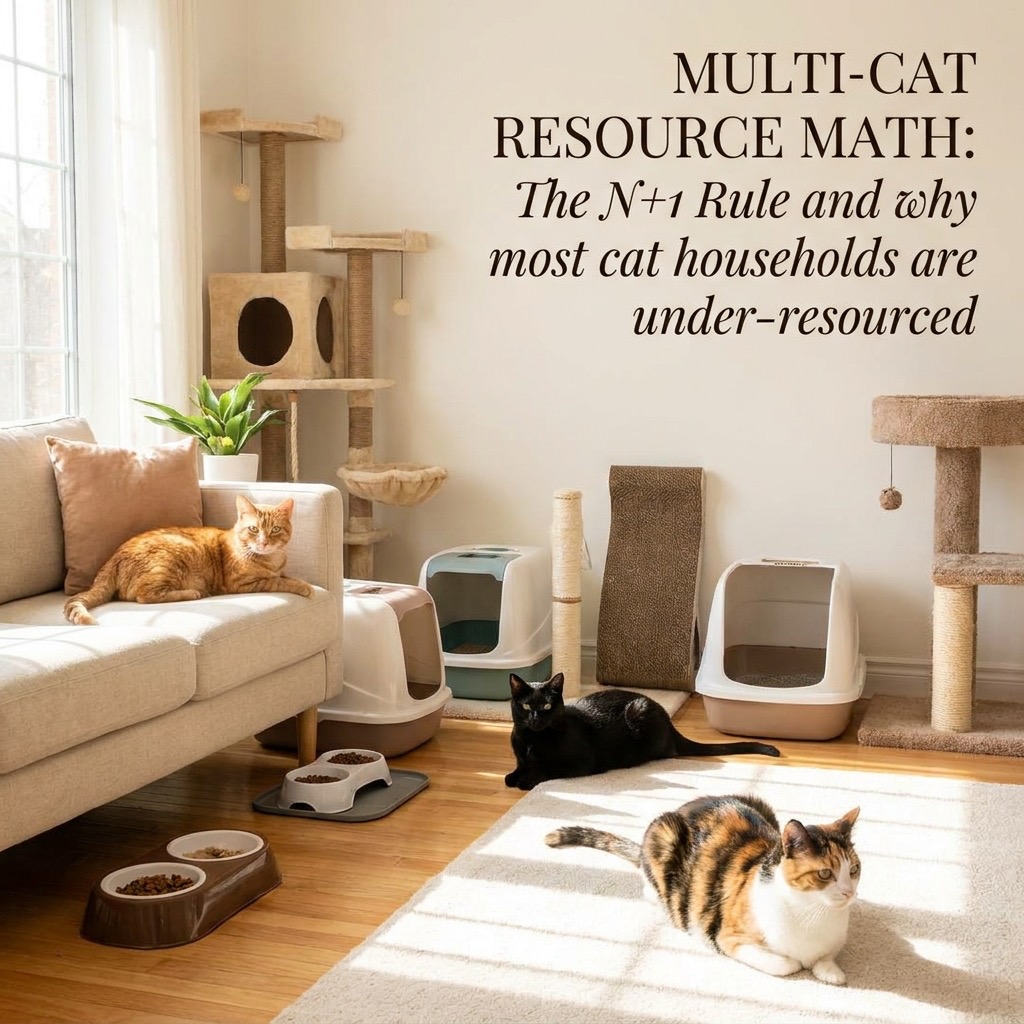
Multi-cat resource math: the N+1 rule and why most cat households are under-resourced
Most multi-cat households have one litter box, two food bowls (often side by side), and one cat tree. The cats are expected to share. The result is inter-cat tension, litter box avoidance, aggression, and behaviour problems that the owner reads as "the cats don't get along".
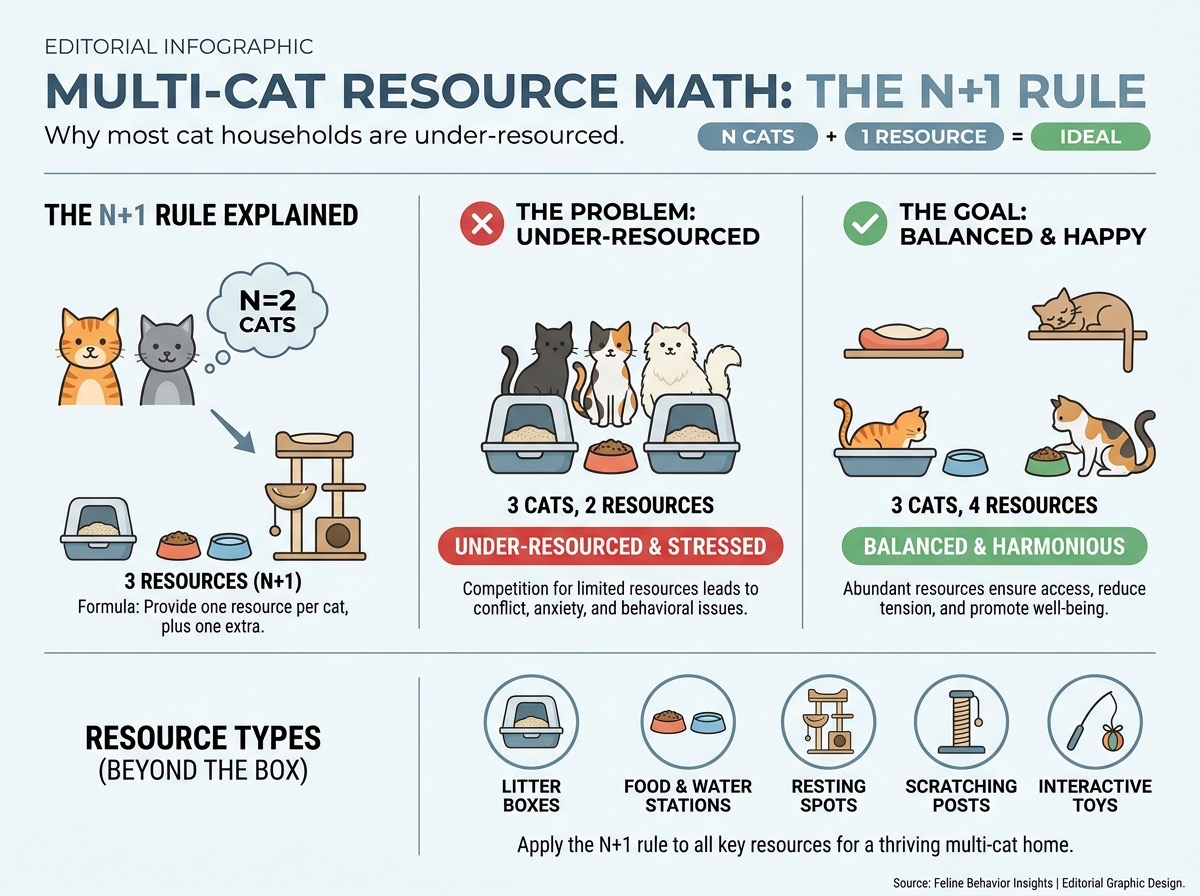
The cats don't get along because they don't have enough resources. The "N+1 rule" — provide one resource per cat, plus one extra — is the standard framework for multi-cat households. It works because cats are not social animals in the way dogs are. Cats are solitary survivors who happen to tolerate other cats under specific conditions. One of those conditions is resource abundance.
This is the math, the reasoning, and the practical implementation.
Why cats don't share
To understand the N+1 rule, you have to understand the cat's natural social structure. Cats are descended from the African wildcat, a solitary predator. The wildcat's social structure:
- Adults are solitary except during mating
- Females raise kittens alone
- Adults defend territories against other adults
- Resources (food, water, shelter) are defended
- Cats meet other cats only to mate or to fight
The domestic cat has been socialised to tolerate humans and, often, other cats. But the underlying social instinct remains. A cat perceives another cat in its territory as a potential threat, especially around resources.
The "social" multi-cat household is a human construct. The owner decides the cats are friends because they sleep near each other. The cats may tolerate each other, but they are not cooperating the way dogs do. They are managing a shared territory with the minimum possible conflict.
The minimum possible conflict requires:
- Each cat has access to resources without facing the other cat
- Each cat has a place to retreat
- The territory is large enough for each cat to have its own area
When the resources are inadequate, the conflict escalates.
The N+1 rule: the formal version
For a household with N cats, the N+1 rule says:
- Litter boxes: N+1 (so 2 cats need 3 boxes, 3 cats need 4 boxes)
- Food stations: N+1 (2 cats need 3 stations, separated)
- Water stations: N+1 (in different locations)
- Resting/sleeping spots: N+1 (in different locations)
- Scratching posts: N+1 (or at minimum, one per cat in different locations)
- Hiding spots: N+1 (in different locations)
- Toys: N+1 (rotated weekly to maintain novelty)
The "plus one" is the spare. The spare is the buffer. When one resource is occupied, soiled, or otherwise unavailable, the cats have a backup.
The litter box: the most important resource
The litter box is the resource that gets the most attention because litter box problems are the most common reason cats are surrendered to shelters. The N+1 rule for litter boxes:
The math
- 1 cat: 2 boxes (the +1 is hygienic insurance)
- 2 cats: 3 boxes
- 3 cats: 4 boxes
- 4 cats: 5 boxes
- 5+ cats: 6+ boxes, distributed throughout the home
The general rule is one box per cat plus one extra. Some behaviourists recommend one box per cat plus one per floor of the home, for households with multiple floors.
The placement
- Boxes should be distributed throughout the home, not clustered
- No two boxes should be next to each other (the cat that gets ambushed in one box will avoid it)
- Boxes should be in quiet, low-traffic areas, but not in remote corners (the cat needs to feel safe approaching)
- Each box should have at least two exit routes (so the cat is not cornered)
- Boxes should not be near food, water, or the cat's resting spots
- Boxes should be on different floors in multi-floor homes
The size and type
- Box length should be 1.5x the cat's body length (not including the tail)
- Most commercial boxes are too small. A under-bed storage box is often a better choice
- Some cats prefer covered boxes, others prefer open. Provide a mix
- Self-cleaning boxes can work, but the cat must be comfortable with the mechanism
The hygiene
- Scoop at least once daily
- Replace litter and clean the box weekly
- Use unscented clumping litter for most cats
- Each box should have a different substrate if the cat has shown preferences
The most common N+1 violation
The single most common N+1 violation: two cats, one litter box. The owner has read that two cats need two boxes, and provides exactly two. The cat that uses the box first is "guarding" it (or the other cat perceives it that way). The second cat finds a quieter location — often the owner's bed, the laundry basket, or the carpet.
Adding the third box (the +1) often resolves the issue immediately.
The food station: a different consideration
Food is a higher-value resource than the litter box. The cat is more motivated to defend food than to defend a bathroom. The N+1 rule for food:
The math
- 2 cats: 3 food stations
- 3 cats: 4 food stations
- Each station should be in a different location
The placement
- Food stations must be physically separated. Two bowls 2 feet apart count as one station
- Stations should be in different rooms or different areas of the home
- No station should be visible from another (the cat at one station should not see another cat at another station)
- Stations should be in areas the cat feels safe — not in high-traffic or noisy areas
The food type
- Some multi-cat households feed the same food to all cats. This works only if all cats have similar dietary needs
- For households with cats on different diets (one on a prescription diet, one on a maintenance food), the stations must be in different rooms with the door closed, or the cats must be separated at feeding time
- Microchip-activated feeders (SureFeed) are excellent for multi-cat households with different dietary needs. The feeder only opens for the cat with the matching microchip
The water station
- Water is sometimes overlooked, but it is a resource. Each cat needs access to water without facing another cat
- N+1 water stations, distributed throughout the home
- Many cats prefer running water (cat fountains) to still water
- Place water away from food (cats don't like water next to food in the wild — contaminated water source)
The resting spot: vertical space matters
Cats rest 12-16 hours per day. The resting spot is the resource the cat uses most. The N+1 rule for resting spots:
The math
- N+1 resting spots, distributed throughout the home
- Each spot should be different in some way (different height, different texture, different location)
The vertical space
Cats use vertical space heavily. A cat tree, a shelf, a window perch, the top of a wardrobe — these are all resting spots. The N+1 rule includes vertical space:
- One cat tree per cat (or one large cat tree with multiple perches)
- Multiple elevated resting spots (cat shelves, window perches)
- The cats can rest at different heights, observing each other or being apart
The "looking-out" spots
Many cats prefer spots where they can observe the environment (a window, a perch overlooking the room). N+1 "looking-out" spots. The cat that likes to watch the window from one perch is satisfied; the cat that likes to watch from a different perch is satisfied.
The hiding spots
Cats need to hide. A cat that is stressed, ill, or overwhelmed retreats to a hiding spot. N+1 hiding spots:
- One per cat, plus one extra
- Different locations throughout the home
- Some cats prefer high hiding spots (top of a wardrobe), some prefer low (under a bed). Provide both
A household with no hiding spots is a household where the cats have no escape from each other. Conflict escalates.
The scratching post: territory marking
Cats scratch to mark territory, to stretch, and to maintain their claws. The scratching post is a territorial resource:
- N+1 scratching posts
- Different orientations (vertical and horizontal — different cats prefer different orientations)
- Different materials (sisal, carpet, cardboard, wood)
- In prominent locations (the cat wants to mark the territory, so the post should be in a visible area, not hidden in a corner)
- Near the cat's resting spots (the cat often scratches after waking up)
A household with one scratching post for two cats is a household where the post is contested. The cats may scratch more aggressively, or one cat may use the post while the other avoids it.
The "shared" multi-cat household myth
Many multi-cat households look "shared" — the cats sleep on the same bed, they groom each other, they play together. The owner assumes the cats are best friends and resources don't need to be abundant.
The reality: the cats have a stable social structure with defined roles (dominant, subordinate, neutral). The structure holds when resources are abundant. When resources are scarce, the structure breaks down. The cats that were "friends" become combatants.
The N+1 rule is not a recommendation. It's a structural requirement for a stable multi-cat household.
The most common N+1 violations
The list, in order of frequency:
Two cats, one litter box
The most common violation. The fix is the third box. Many litter box problems resolve within 2 weeks of adding the third box.
Two cats, one food bowl
Two food bowls in the same spot, or two food bowls in the same room with no visual barrier. The cat that gets chased away from the food eats less, even if the food is replenished. The fix is three food stations in different rooms.
Two cats, one cat tree
The dominant cat owns the cat tree. The subordinate cat uses the floor. The fix is a second cat tree (or a vertical territory expansion: cat shelves, window perches, etc.).
No hiding spots
The household has no boxes, no cat caves, no perches where a cat can hide. The cats are always in view of each other. The fix is adding hiding spots.
One bed for the household
The owner buys one big cat bed. The dominant cat uses the bed. The subordinate cat uses the floor or the couch. The fix is multiple beds in different locations.
When N+1 is not enough
For some multi-cat households, the N+1 rule is not enough. The situations that require more:
Cats that don't get along
Cats that have a history of conflict need more space, not just more resources. The fix:
- Add vertical territory (cat shelves, ceiling-height cat trees)
- Add hiding spots
- Temporarily separate the cats and reintroduce them
- Consult a feline behaviourist
Cats of very different ages
A young cat and an elderly cat may have very different needs. The young cat wants to play; the elderly cat wants to rest. The fix:
- Multiple activity areas (one for play, one for rest)
- Vertical space (the young cat can use the high spots, the elderly cat can use the low spots)
- Different food stations (the elderly cat may need a prescription diet)
Cats with medical needs
A cat with a medical condition (diabetes, kidney disease, urinary issues) may need:
- A separate feeding station with a prescription diet
- A low-entry litter box (for arthritic cats)
- Easy access to water
- Quiet, comfortable resting spots
The N+1 rule is the starting point. The medical needs are the addition.
The exception: bonded pairs
Some cats are bonded — they sleep touching, they groom each other, they play together. The owner has one cat tree, one litter box (or two), and the cats seem fine.
For bonded pairs, the N+1 rule still applies, but the cats use the resources together. The cat tree is shared (one cat sleeps on the top, the other on the bottom perch). The litter boxes are used interchangeably. The food bowls are eaten from side by side.
The bonded pair is rare. Most multi-cat households are tolerant pairs or non-affiliated cats, and the N+1 rule is required.
The implementation: where to start
For most multi-cat households, the starting point is the litter box. Adding the +1 (third box for two cats) is often the highest-impact change.
After the litter box, the next priorities are:
- Food stations in different rooms
- Vertical territory (cat tree or shelves)
- Hiding spots
- Scratching posts
A complete resource audit, room by room, identifies the gaps. The owner goes through each room and asks: "Is there a litter box, a food station, a water station, a resting spot, a scratching post, and a hiding spot accessible to each cat in this room, without the cats facing each other?"
If the answer is no, the room is under-resourced for multi-cat living.
The timeline: how long to see results
Adding resources produces results quickly:
- Litter box: 1-2 weeks for the cat to consistently use the new box
- Food stations: 1-3 days for the cat to consistently use the new station
- Vertical territory: immediate (the cat uses the new vertical space right away)
- Hiding spots: immediate
- Scratching posts: 1-2 weeks for the cat to use the new post consistently
Most inter-cat tension resolves within 4-6 weeks of full N+1 implementation. Some cats (those with a history of severe conflict) take longer and may require a behaviourist.
The bottom line
The N+1 rule is the structural foundation of a stable multi-cat household. One resource per cat, plus one extra, distributed throughout the home, in different rooms and at different heights. The math is simple. The implementation requires thinking about the home from the cat's perspective, not the owner's. The result is a household where the cats tolerate each other (or actively enjoy each other), use the litter box, eat calmly, and rest without conflict. Most inter-cat problems are resource problems. The fix is the math.
---
About the author: [Elena Rossi](../Elena%20Rossi.md) holds an MSc in Applied Animal Behaviour from the University of Lincoln, is a Certified Clinical Animal Behaviourist (CCAB) with 14 years of feline behaviour consulting, and is the author of three books on feline behaviour.