
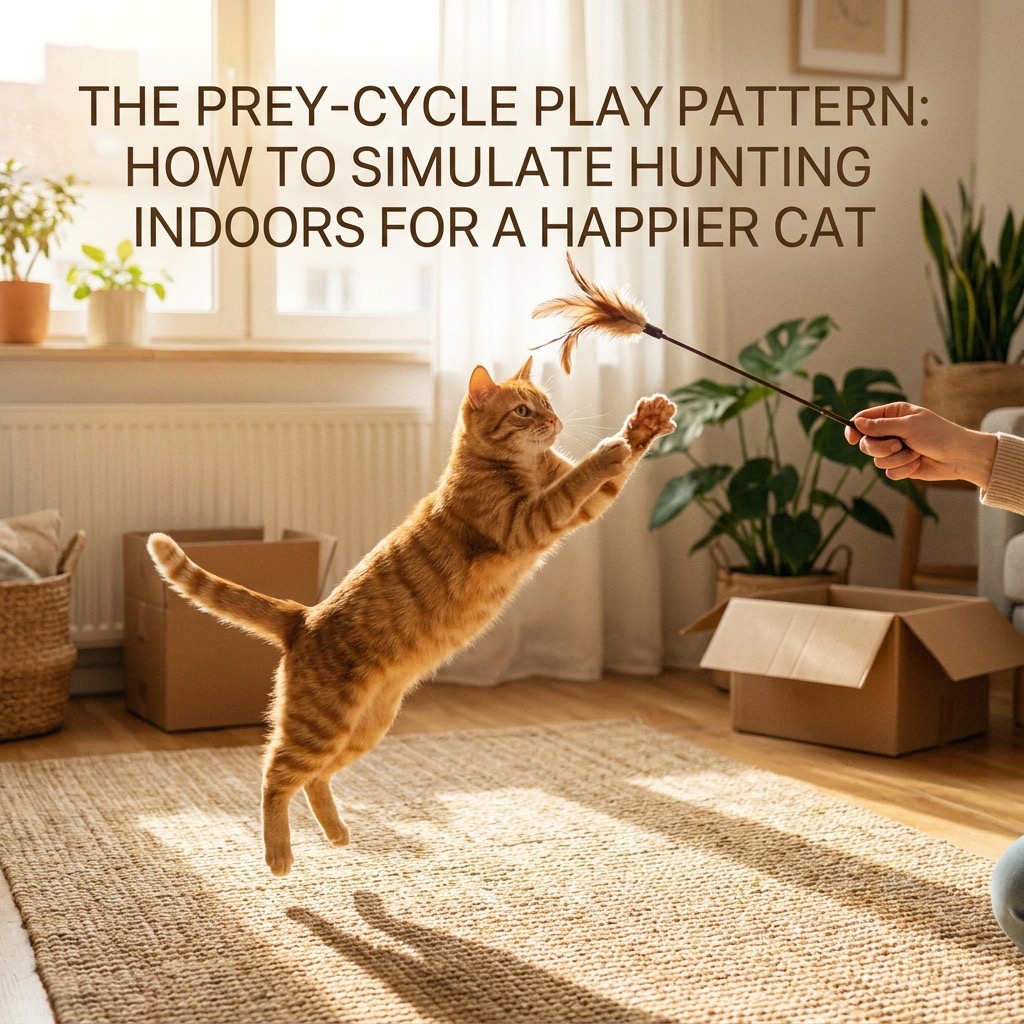
The prey-cycle play pattern: how to simulate hunting indoors for a happier cat
Indoor cats don't stop being predators because they live indoors. The hunting sequence is hardwired into the feline brain, and a cat that never completes the cycle is a cat that develops behavioural and physical problems. The bored, fat, bitey cat that wakes the owner at 3 AM is almost always a cat that has never been allowed to hunt.
The prey cycle is the solution. It's a structured play pattern that mimics the four stages of a real hunt, from stalking to the final capture. When done correctly, it transforms indoor cats. When done wrong — with random toy play, a few minutes here and there — it makes no difference.
This is the protocol that actually works.
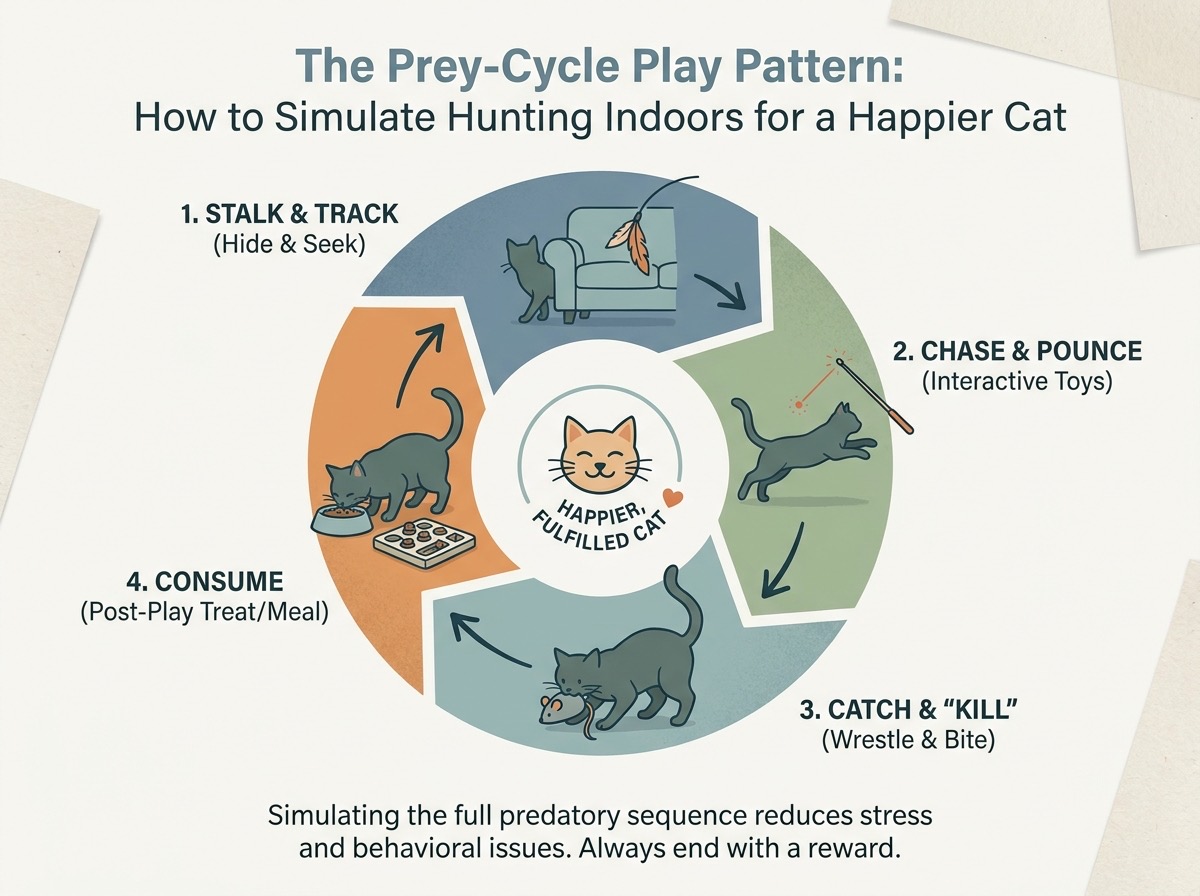
The four stages of the prey cycle
The natural feline hunting sequence is a four-stage pattern. Understanding each stage is essential to replicating it indoors.
Stage 1: search and locate
The cat uses its senses to detect prey. In the wild, this involves scanning the environment, listening, smelling, and identifying the location of the prey. The cat is alert, focused, and the pupils dilate.
Duration in nature: minutes to an hour, depending on prey density. The cat is highly active during this stage.
Stage 2: stalk and approach
The cat identifies a target and moves toward it with slow, deliberate, low-to-the-ground movement. The body is compressed, the pupils are wide, the tail is low or twitching. The cat is gathering information and getting into striking range.
Duration in nature: minutes. The cat is highly focused, almost motionless between movements.
Stage 3: chase and pounce
The cat breaks from cover and rushes the prey, culminating in a pounce, a grab, and a kill bite. The cat's body is in full athletic mode — sprinting, jumping, twisting, biting. The adrenaline is high.
Duration in nature: seconds. This is the explosive, high-intensity part.
Stage 4: dissect and consume
The cat brings the prey to a quiet area, manipulates it with the paws, and consumes it. This stage includes the "death roll" and the careful dissection of the prey. The cat is calmer, methodical, and the adrenaline is fading.
Duration in nature: minutes to an hour, depending on the prey and the cat's hunger.
Why the prey cycle matters
A cat that completes the prey cycle is a cat that has released its predatory energy in a structured way. The adrenaline spike, the focused stalking, the explosive chase, and the calm dissection are all part of the natural hormonal and neurological flow. The cat's brain is in the right state.
A cat that doesn't complete the prey cycle has the adrenaline and focus without the resolution. The result:
- Bitey, aggressive play: the cat bites the owner's hands or feet, because the predatory energy has no resolution
- 3 AM wakefulness: the cat has undirected hunting energy that peaks at dawn and dusk (natural hunting times)
- Overeating: the cat eats without hunting, breaking the natural sequence that controls appetite
- Obesity: related to overeating and lack of exercise
- Boredom-related behaviour: overgrooming, furniture destruction, excessive vocalisation
- Inter-cat aggression: predatory energy redirected to housemates
The prey cycle isn't enrichment. It's a fundamental need.
What the wrong kind of play looks like
Most cat owners do the wrong kind of play:
- A few mouse toys scattered on the floor. The cat ignores them within 30 seconds
- A laser pointer pointed at the wall for a few minutes. The cat chases, never catches
- A feather wand waved in the cat's face. The cat bats at it lazily
- An automated toy that does the same thing on a loop. The cat loses interest in days
These fail because they don't complete the prey cycle:
- Mouse toys on the floor: no movement, no chase, no capture. The cat doesn't perceive these as prey
- Laser pointer without a catch: the cat chases but never completes the sequence. The unresolved predatory energy accumulates. Many behaviourists consider laser-only play actively harmful
- Wand waved in the cat's face: no stalking, no chase, the prey is just handed to the cat. The cat becomes passive and disengaged
- Automated toys: the toy does the hunting, the cat just watches. No agency, no satisfaction
The result: the cat is "played with" but its predatory energy is unaddressed. The owner wonders why the cat is still bitey, fat, or 3-AM-wakeful.
The prey cycle play protocol
The right way to play with a cat follows the four stages of the prey cycle, in order, with attention to the cat's energy and engagement.
Tools
- Wand toy with a lure: a stick with a string and a small lure (feather, mouse, fabric) at the end. The Da Bird, Neko Flies, and similar toys are the standard
- Pole that can be hidden: a wand that can be moved around corners, under furniture, behind objects. Allows the cat to stalk and approach
- Pellets or treats: for the "consume" stage at the end of the play session
Avoid: laser pointers (unless followed with a real catch), automated toys (unless used as part of a structured session), mouse toys on the floor (not prey-like enough).
The session: 15-20 minutes, twice a day
The total daily play time should be 30-40 minutes, ideally split into two sessions. The most important session is the late evening session (just before the owner's bedtime). This is when the cat's predatory energy peaks naturally.
Stage 1: search and locate (3-5 minutes)
- The lure is hidden behind a piece of furniture, under a blanket, or in a paper bag
- The cat investigates, finds the lure, and the play begins
- The owner moves the lure slightly, simulating prey that has been detected but is still at a distance
- The cat's pupils should dilate; the cat's body should tense
Stage 2: stalk and approach (5-7 minutes)
- The lure moves slowly, just out of reach, across the floor or behind furniture
- The cat is in full stalking mode: body low, eyes focused, tail twitching
- The owner moves the lure away from the cat, never toward. The cat needs to work for the chase
- Hide the lure around corners, under chairs, behind curtains. The cat pursues
- Periodically, the lure "freezes" — this simulates prey stopping. The cat waits, plans, and stalks closer
Stage 3: chase and pounce (2-3 minutes)
- The lure moves faster, simulating prey fleeing
- The cat sprints, jumps, and pounces
- The cat catches the lure — this is critical. The cat must catch the lure
- The owner allows the cat to grab, bite, and "kill" the lure
- Pulling the lure away at the moment of capture teaches the cat that the prey is unattainable. This is the most common mistake in wand-toy play
Stage 4: dissect and consume (5-10 minutes)
- The cat has the lure. The owner allows the cat to manipulate it with the paws, bite it, and "dissect" it
- After 1-2 minutes of dissection, the owner presents a few high-value treats (freeze-dried chicken, a few pellets of the cat's food)
- The cat eats, completing the prey cycle
- The play session is over
The session end
The cat should be calm, ideally grooming, by the end of the session. If the cat is still aroused and bouncing off the walls, the session was too short. If the cat lost interest early, the session was too long or the play wasn't engaging.
The "consume" stage is what closes the loop. A play session that ends with the cat catching a lure but never eating afterward leaves the cat slightly aroused. The same hunt ending with a meal is fully resolved.
The schedule: dawn and dusk
The cat is crepuscular, meaning it's most active at dawn and dusk. These are the natural hunting times. Schedule the play sessions to align:
- Dusk session (just before the owner's bedtime): the most important session. The cat is naturally most active. The session burns off the energy that would otherwise wake the owner at 3 AM
- Dawn session (just before the owner's wake-up): also valuable. If the owner can manage it, a 15-minute play session before getting out of bed prevents the cat's dawn harassment
For owners who work full-time outside the home: the dusk session is non-negotiable. The dawn session is a bonus. A single 20-30 minute play session is better than none.
The "5 AM screaming" cat
The classic 5 AM screaming cat is almost always a cat that didn't get its evening play session. The cat has undirected hunting energy at the natural dawn peak, and the owner becomes the target. The fix:
- A 20-30 minute prey cycle session at 9-10 PM
- An automatic feeder set to deliver a small meal at 5-6 AM (the cat eats, then goes back to sleep)
- A puzzle feeder with a few treats in the early morning hours (the cat is occupied, not screaming)
These three changes, applied consistently for 2-3 weeks, usually solve the 5 AM screaming problem entirely.
The "biting the owner's hands" cat
The cat that ambushes the owner's ankles or bites the hands is a cat that has undirected predatory energy. The cat is using the owner as prey. The fix:
- Two prey cycle sessions per day
- The owner stops using hands and feet as toys (this is the most common cause)
- When the cat ambushes, the owner freezes (no response), then walks away. Engaging the cat in play ("just five minutes") reinforces the behaviour
- Provide a wand toy as a redirect when the cat starts stalking. The cat has a target, the owner has their ankles
A cat that gets two prey cycle sessions per day rarely ambushes the owner. The cat has its hunting energy addressed.
The "inactive, fat, senior" cat
The 12-year-old cat that has stopped playing, that sleeps 20 hours a day, that is overweight — is not "just old". The cat has likely lost interest in movement and play because the play was always unsatisfying. A prey cycle session often reignites the cat's interest.
For senior or overweight cats:
- Shorter sessions (10 minutes)
- Lower-intensity play (lure that moves slowly)
- Multiple short sessions throughout the day
- Higher-value treats at the end (the cat needs to feel the success)
Many senior cats that "don't play" actually do play when the play is structured correctly. The play has to engage the prey cycle, not just move a toy in front of the cat.
The multi-cat household
In a multi-cat household, the prey cycle is more complex. Two cats don't always want to play the same way, and the dominant cat often blocks the others from the toy.
Approaches:
- Separate play sessions: each cat gets its own 15-20 minute session
- Multiple wand toys simultaneously: if a partner or older child is available, two wand toys allow both cats to play
- Toy rotation: keep 4-5 wand toys and rotate them. The novelty keeps each cat engaged
In a multi-cat household, the prey cycle work is 2x to 3x the time. It's worth the investment.
What the cat learns from prey cycle play
The prey cycle isn't just exercise. The cat is learning:
- Self-regulation: the cat experiences the full predatory sequence, including the calm consume stage. The cat learns to manage its own arousal
- Appropriate outlets for predatory energy: the cat learns that the wand toy is the appropriate target, not the owner's hands or the other cat
- Confidence: the cat that catches prey, even simulated, gains confidence. The cat is a successful hunter
- Trust with the owner: the prey cycle involves the owner and the cat working together. The cat sees the owner as a partner in the hunt, not a target
- Satisfaction: a cat that has hunted and eaten is a satisfied cat. The cat sleeps, grooms, and rests
A cat that has had its prey cycle satisfied is a different animal than one that hasn't. The body language, the vocalisation, the interaction with the owner — all change.
Common mistakes in prey cycle play
A few things that look like prey cycle play but aren't:
The laser pointer only
The cat chases, never catches. The prey cycle is unfulfilled. The cat becomes frustrated. If you use a laser pointer, end the session by leading the cat to a real toy or a treat. The cat must catch something.
The 30-second toy wave
A few waves of the wand toy, then it's put away. The cat doesn't even reach stage 1. A real play session is 15-20 minutes, with all four stages.
The wrong time of day
A play session at 2 PM, when the cat is naturally napping, doesn't address the cat's peak energy at dusk. Schedule sessions at dawn and dusk.
The owner uses their hands
The owner wiggling fingers under a blanket, batting the cat with a hand — this teaches the cat that hands are toys. The cat bites and scratches the owner's hands. Hands are for petting and gentle handling. Wand toys are for hunting.
The cat catches the lure, and the owner pulls it away
The most common mistake. The cat has stalked, chased, and pounced. The cat's teeth are on the lure. The owner pulls the lure away. The cat learns that prey is unattainable. Allow the cat to catch, bite, and "kill" the lure.
The cat catches the lure, and the session ends
The cat has caught the prey but the consume stage is missing. The session is incomplete. Add the treats or the meal, and the cat completes the cycle.
Only one play session per day, only some days
The prey cycle is a daily need. The cat that gets play some days is the cat that has behavioural problems the other days. Consistency is the answer. Two sessions per day, every day.
The payoff: what changes
A cat that gets two daily prey cycle sessions for 4-6 weeks typically:
- Stops waking the owner at night
- Stops ambushing the owner's ankles and feet
- Stops biting during petting (the cat's arousal is managed)
- Eats more appropriately (the prey cycle regulates appetite)
- Maintains a healthier weight
- Interacts more positively with the other cats in the household
- Uses the litter box more reliably (less stress)
- Is more affectionate and engaged with the owner
- Is more confident in novel situations
The prey cycle is one of the highest-leverage things an indoor cat owner can do. The time investment is 30-40 minutes per day. The equipment is a wand toy and a bag of treats. The result is a cat that fits into the household.
The bottom line
Indoor cats need to hunt. The prey cycle is the four-stage sequence (search, stalk, chase, consume) that defines the natural feline hunt. Most indoor cats don't complete this cycle, and the result is behavioural and physical problems that owners usually don't connect to the lack of hunting. The fix is structured, daily play sessions that follow the four stages, ending with a real catch and a meal. Two sessions per day, 15-20 minutes each, with a wand toy, at dawn and dusk. The cat that gets this isn't a different animal — it's the same animal, with its needs met.
---
About the author: [Elena Rossi](../Elena%20Rossi.md) holds an MSc in Applied Animal Behaviour from the University of Lincoln, is a Certified Clinical Animal Behaviourist (CCAB) with 14 years of feline behaviour consulting, and is the author of three books on feline behaviour.