
Multi-floor apartments: cat superhighways and pathways
The most common mistake I see in multi-cat households is assuming the cats are fighting over the floor. They are not. They are fighting over the path, the height, and the time slot. The floor is one resource. The path between the food bowl, the litter box, the window, the scratching post, and the high resting spot is another. The vertical space - the tops of cabinets, the cat trees, the shelves - is a third. Each cat in a multi-cat home is trying to claim exclusive access to a subset of these resources, and if the apartment does not provide enough parallel paths and parallel resting spots, the cats resolve the conflict with stress, urine marking, or aggression.
The good news: a multi-floor apartment has a major advantage over a single-floor apartment. Vertical space is built in. The bad news: most owners do not design the apartment for the cats. The cats have to share one set of stairs, one set of high spots, and one set of pathways, and the dominant cat owns all of them by default.
This article is about designing the apartment so that the cats have parallel paths, parallel vertical options, and parallel resources. The result is a household where most cats can live without needing to negotiate space with each other most of the time.
The framework: territory as a 3D map
For a single cat, the apartment is the territory. For multiple cats, the apartment is divided into sub-territories. Each cat's sub-territory is shaped by:
- Spatial - the physical area the cat claims. Includes a primary resting spot, a feeding area, a litter area, a water source, and a safe retreat.
- Vertical - the heights. Cats at the same horizontal position can be in different vertical zones and not interact. The top of a wardrobe, the top of a kitchen cabinet, a high cat tree, a wall shelf - each is a different vertical zone.
- Temporal - the times of day the cat uses the space. One cat owns the living room from 6 AM to noon. Another cat owns it from noon to 6 PM. The temporal partition is invisible to owners but very real to the cats.
A well-designed multi-cat apartment provides:
- Parallel paths between key resources so the cats do not have to share routes.
- Multiple high resting spots so the dominant cat does not own the only one.
- Multiple feeding stations and multiple water sources.
- Multiple litter boxes (one per cat plus one extra).
- Multiple scratch posts of different orientations (vertical and horizontal).
- Multiple safe retreats in different parts of the apartment.
The multi-floor superhighway
A multi-floor apartment has a built-in feature most owners do not exploit: the stairs. The stairs are the natural superhighway. The problem is that the stairs are also the natural chokepoint. The dominant cat sits at the top, and no other cat can pass without a confrontation.
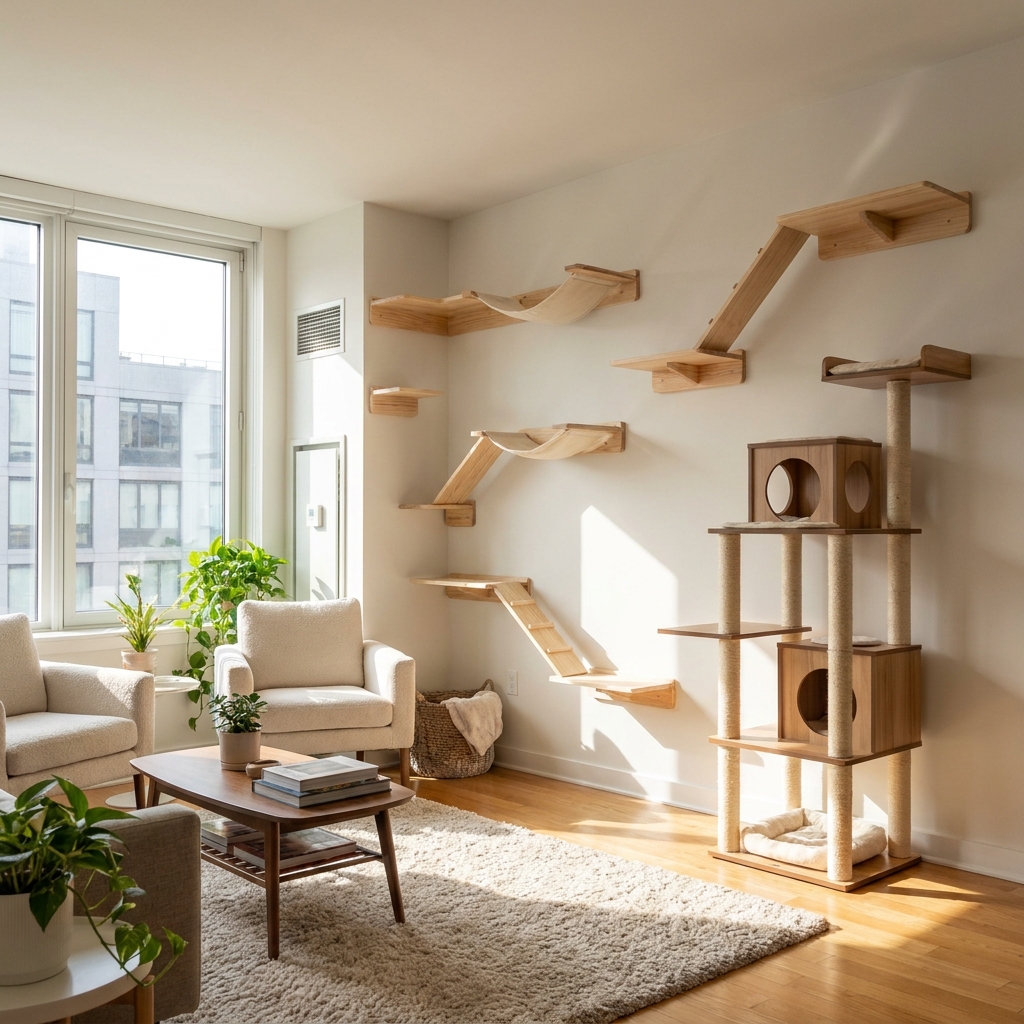
The fix is to provide alternative paths between floors. A cat tree in the living room that reaches to within 1 m of a ceiling joist, with a step-up shelf on the wall, lets a non-dominant cat bypass the stairs and reach the upper floor via the living room wall. A wall-mounted shelf system running from the second-floor landing to a perch in the upstairs hall lets a cat traverse the upstairs without going past the dominant cat's favored high spot.
The design I use most often for a two-floor apartment:
- Stair 1: the human stairs. Used by all cats, mostly in transition. Cannot be eliminated as a chokepoint, but can be de-emphasized by giving cats other options.
- Stair 2: a wall-mounted shelf system that runs from the first floor up to a wall-mounted perch in the upstairs hall. One cat uses this. Another uses the human stairs. The two paths are in different parts of the apartment.
- Stair 3: a tall cat tree in the living room with a hideaway box at the top, plus a wall shelf that connects from the top of the cat tree to a wall-mounted perch above the second-floor door. This is a third option for the third cat.
For a three-floor apartment, the design extends. The principle is the same: parallel paths, parallel perches, parallel retreats.
Resource distribution
The mistake that breaks multi-cat households most often is clustering all the resources in one room. A common scenario: one litter box in the bathroom, one food bowl in the kitchen, one cat tree in the living room, one water bowl next to the food. Five cats, one of each resource, in three rooms. The dominant cat controls all five by sitting in the kitchen.
The fix is distribution. Each cat needs to be able to eat, drink, eliminate, rest, and retreat in a space that is not controlled by another cat. The minimum:
- One litter box per cat plus one extra, in at least two locations on different floors.
- One feeding station per cat, separated by at least 2 meters so the dominant cat cannot eat from all of them.
- Multiple water sources in different rooms.
- Multiple scratch posts (at least one vertical, one horizontal, in different rooms).
- Multiple high resting spots, distributed across rooms and across floors.
The feeding station distribution is the single most impactful change. A household that has been feeding all cats from one bowl in the kitchen almost always sees a behavior shift when feeding is distributed.
The vertical map
The vertical map is the most under-utilized resource in most cat households. Cats at the same horizontal position are not in conflict if they are at different heights. A 1.5 m cat tree in the corner of the living room provides multiple vertical zones (lower perch, mid perch, top perch, top box), each of which can be claimed by a different cat.
Practical vertical space additions:
- A wall-mounted shelf system running around the perimeter of the living room, 2-2.5 m off the ground, with multiple perches. Cats can walk around the room at ceiling height.
- Tall cat trees (1.8-2.4 m) with multiple perches and a top hideaway box. The top box is the highest status spot - whichever cat owns the top box is the de facto dominant cat. The tree also provides lower perches for non-dominant cats.
- Clear paths on top of kitchen cabinets, with a ramp or steps to allow access. Most cats love cabinet tops, and the tops are usually unused by humans.
- Window perches at varying heights. Multiple cats can sit in the same window at different heights and watch birds without conflict.
The vertical map is the difference between a household with 4 usable spaces (one per room) and a household with 20 usable spaces (5 rooms times 4 heights). More spaces = more room for the cats to coexist without negotiating.
The time dimension
Cats in a multi-cat household often partition the day. The dominant cat owns the morning hours (6 AM to noon), a mid-ranking cat owns the afternoon, and a low-ranking cat owns the evening. If the apartment is not designed to allow the time partition - if all the resources are in the same room and the dominant cat's morning route covers the whole apartment - the partition breaks down and the dominant cat is in conflict with the other cats all day.
The fix is to allow the time partition to be respected. Multiple high resting spots in different parts of the apartment, multiple litter boxes, multiple feeding stations. The cats will work out the schedule if the apartment is set up to support it.
What to do when the partition breaks
The signs the partition is breaking:
- Cats blocking each other in hallways or doorways (the dominant cat is refusing to let the others pass).
- Cats staring at each other from across a room (the spatial partition is failing).
- Urine marking on vertical surfaces (the cat is trying to claim additional territory by scent).
- Aggression that is escalating over time.
- One cat hiding constantly, or spending all day in one room.
The fix is usually environmental, not behavioral. Adding parallel paths, parallel high spots, parallel resources often resolves the issue without the need for medication or behavior modification. In severe cases - where the cats have been fighting for months - both environmental changes and a behavior consultation with a feline behavior specialist are needed.
The bottom line
Multi-cat households are not about adding more cats to the apartment. They are about designing the apartment for the cats. The floor is one resource. The path is another. The height is another. The time slot is another. An apartment that supports all four is an apartment where most cats can live in peace. An apartment that does not is a household where the dominant cat owns everything and the others are chronically stressed. The design changes are simple. The impact is large.
About the author
Elena Rossi is a feline behavior specialist based in Milan with a degree in veterinary medicine and a post-graduate certification in animal behavior from the European College of Animal Welfare and Behavioural Medicine. She has spent 15 years working with cat behavior cases in private practice, shelter consultation, and as a scientific advisor for Italian and international feline welfare organizations. See her full profile at [authors/Elena Rossi/](../Elena%20Rossi.md).