
Stranger fear in cats: a desensitization plan for shy cats that hides when guests arrive
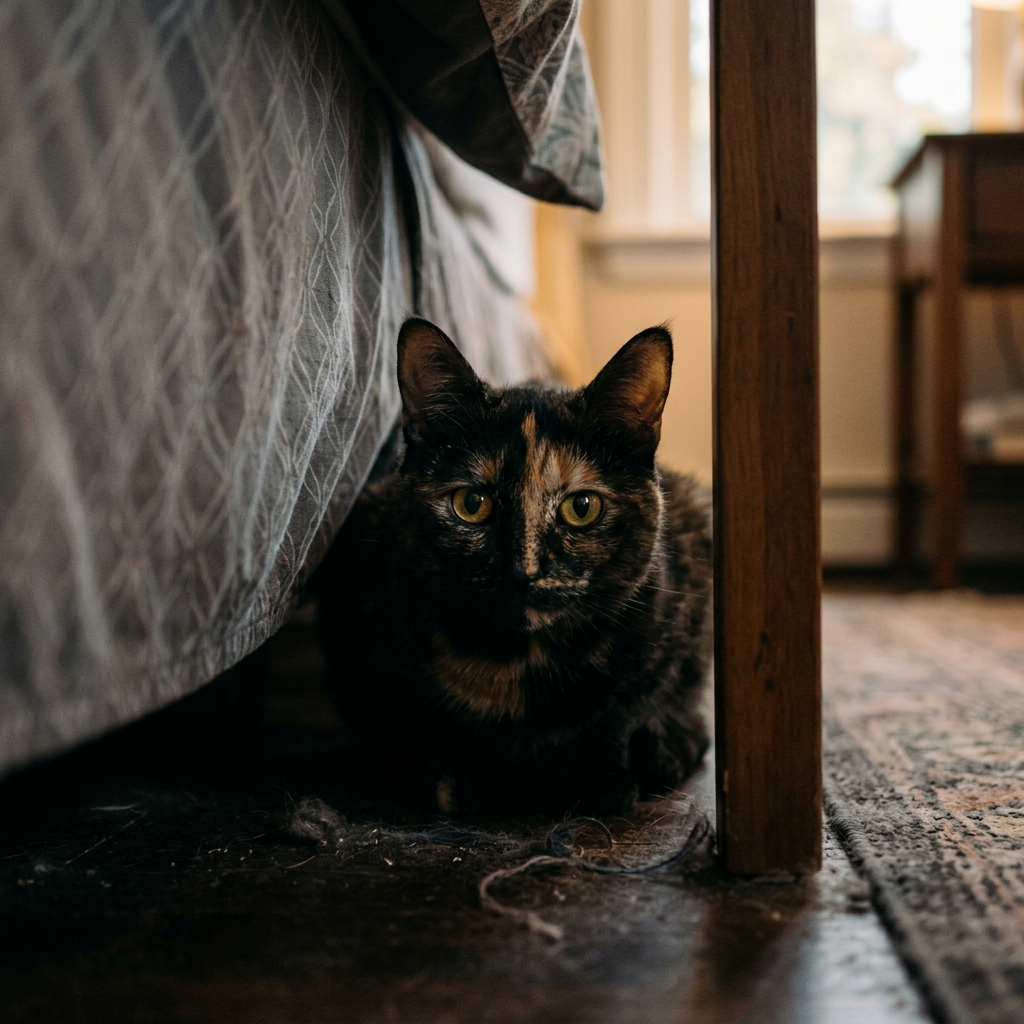
The cat that vanishes under the bed the moment the doorbell rings is a cat that is not being aloof, is not being "difficult," and is not being dominant. The cat is a cat that has learned that the sound of the doorbell predicts a stranger, and the stranger predicts an interaction the cat does not want. The hiding is the cat's stress response, and the hiding that lasts 4-6 hours after the guests leave is the cat's recovery time from a stress event that the cat did not consent to. The cat that hides, the owner that is frustrated, and the guests that never get to meet the cat are all stuck in a pattern that the desensitization and counterconditioning plan can fix. In this article I will walk through what stranger fear actually is, why some cats develop it and others do not, the 8-week desensitization protocol that builds a new association, and the management that supports the protocol without forcing the cat into an interaction it cannot handle.
What stranger fear is
Stranger fear is a learned emotional response in which a cat experiences a fear or anxiety response to a human the cat does not know. The response is not instinctive — kittens that are well-socialized to humans between 2 and 7 weeks of age do not develop stranger fear as adults, regardless of breed or genetics. The kitten that was not exposed to a variety of humans during the sensitive window is the cat that develops stranger fear as an adult.
The mechanism: the cat has not had the opportunity to form a positive association between "unknown human" and "good outcome." The cat's only experiences with humans are the owner (a known, safe human) and the occasional visitor (an unknown human who, from the cat's perspective, makes loud noises, moves unpredictably, stares at the cat, and tries to pet the cat without invitation). The cat's conclusion: unknown humans are unpredictable, and unpredictable is dangerous. The hiding is the cat's way of removing itself from the threat.
The severity ranges. The mild case: the cat hides under the bed for the first 30 minutes of a visit, then emerges cautiously, does not approach the guest, but tolerates the guest's presence. The moderate case: the cat hides for the entire visit, does not emerge until the guests are gone, and may hiss or swat if approached. The severe case: the cat hides for 4-6 hours after the guests leave, refuses to eat for 24 hours, and may have stress-related urinary issues. The desensitization protocol works for all three, with the timeline varying by severity.
Why some cats develop it and others do not
The development of stranger fear is multifactorial. The first factor is socialization. The kitten that is handled by a variety of humans (men, women, children, people of different ethnicities, people wearing hats and glasses and carrying umbrellas) between 2 and 7 weeks of age develops a generalized positive association with humans. The kitten that is handled only by the breeder, or that is removed from the litter before 7 weeks of age, does not develop the generalized association. The cat without the generalized association is the cat that treats every new human as a novel stimulus that needs to be categorized — and the cat's default categorization, without positive prior experience, is "potential threat."
The second factor is genetics. Some breeds (Russian Blue, Burmese, Siamese, Abyssinian) are more social with humans and more likely to enjoy human company. Some breeds (Persian, British Shorthair, some domestic lines) are more reserved and more likely to be cautious with strangers. The genetics are not destiny — a poorly socialized Siamese is a stranger-fearful cat, and a well-socialized Persian is a confident cat — but the genetics influence the starting point.
The third factor is experience. The cat that had a single bad experience with a stranger (a child that chased the cat, a dog walker that grabbed the cat) is a cat that has added a negative data point to its "humans" category. The negative data point is enough to shift the cat's emotional response from neutral to fearful. The cat that has had only neutral experiences with strangers is a cat that is more open to a desensitization protocol.
The fourth factor is household stress. The cat that is in a high-stress household (multiple cats in a small space, a new baby, a recent move, a recent loss of a family member) is a cat whose baseline stress is elevated, and the elevated baseline makes the cat more reactive to any additional stressor — including a stranger. The desensitization protocol works best when the household stress is also being addressed.
The 8-week desensitization protocol
The protocol uses the same DSCC (desensitization and counterconditioning) framework that I use for any fear-based behavior. The principle: gradually expose the cat to the feared stimulus (a stranger) at an intensity the cat can handle, and pair the exposure with a high-value reward the cat does not normally get. The cat's emotional response to the stimulus shifts from "fear" to "anticipation of reward." The protocol is not a quick fix; it is an 8-week commitment that produces a long-term change.
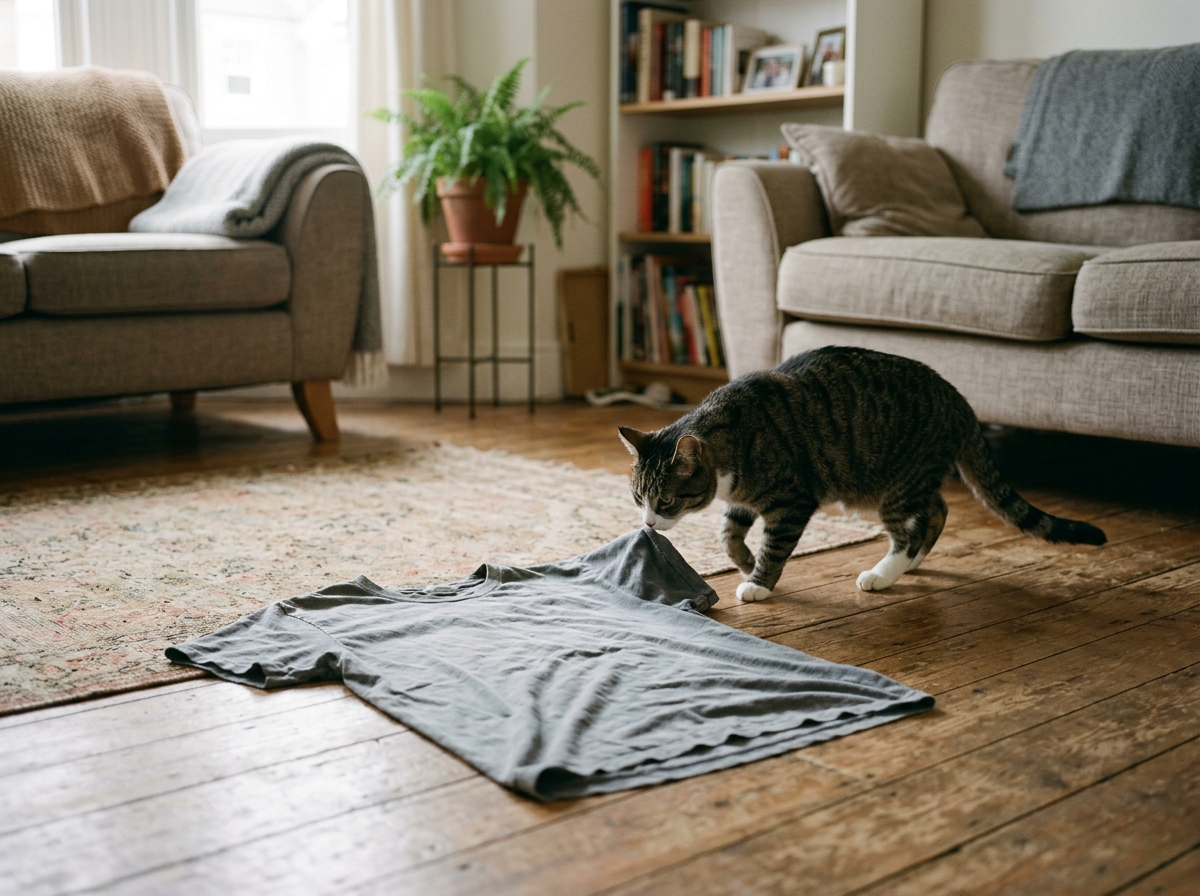
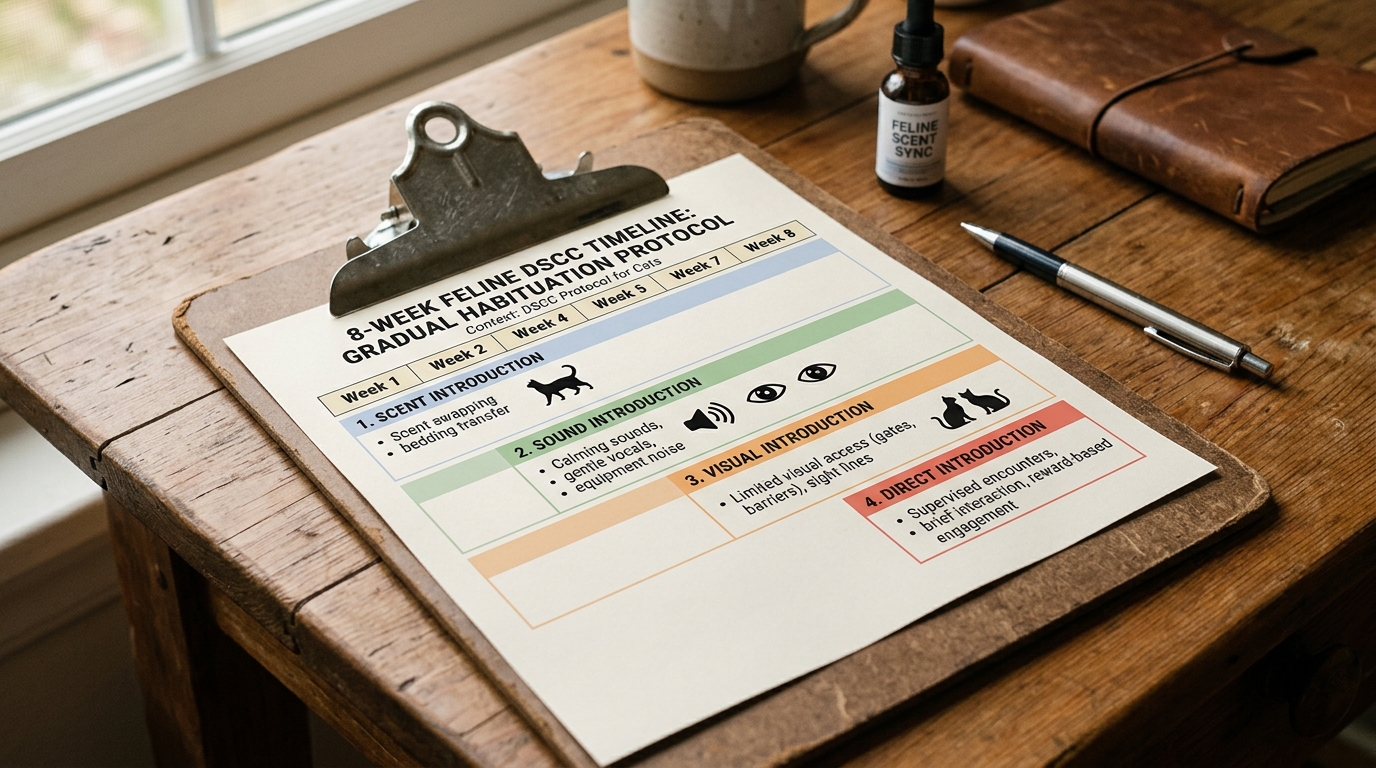
Week 1-2: the scent introduction. The cat does not see or hear the stranger during this phase. The owner asks a friend (not a family member — a friend the cat has not met) to provide a worn t-shirt or a piece of cloth that has the friend's scent. The cloth is placed in the cat's base room, on the floor, not in the food bowl or the litter box. The cat is allowed to investigate the cloth at its own pace. Most cats will sniff the cloth and walk away. A few cats may hiss at the cloth. The owner does not push, does not force interaction, does not put the cloth in the cat's face. The owner observes. The cloth is removed after a few hours. The owner notes the cat's response. The next day, a different friend provides a different cloth. The cycle continues, with new scents every day or two, for 1-2 weeks.
Week 3-4: the sound introduction. The cat hears a recorded stranger's voice (a podcast, a video call, a recorded conversation) at a low volume, in a room the cat is not in, while the cat is in a positive context (eating, playing, being petted). The volume is increased over the week, as long as the cat remains calm. The cat that remains calm at week 4 is ready for the visual introduction.
Week 5-6: the visual introduction. The cat sees a stranger from a distance, behind a barrier (a baby gate, a screen door, a window). The distance is far enough that the cat can see the stranger without the cat's stress response activating. The owner gives the cat a high-value treat (chicken, freeze-dried liver, a treat the cat only gets during these sessions) each time the stranger is visible. The cat learns: stranger visible = treat arrives. The stranger is repeated at the same distance, multiple times, until the cat shows no stress response at that distance. Then the distance is reduced, and the process repeats.
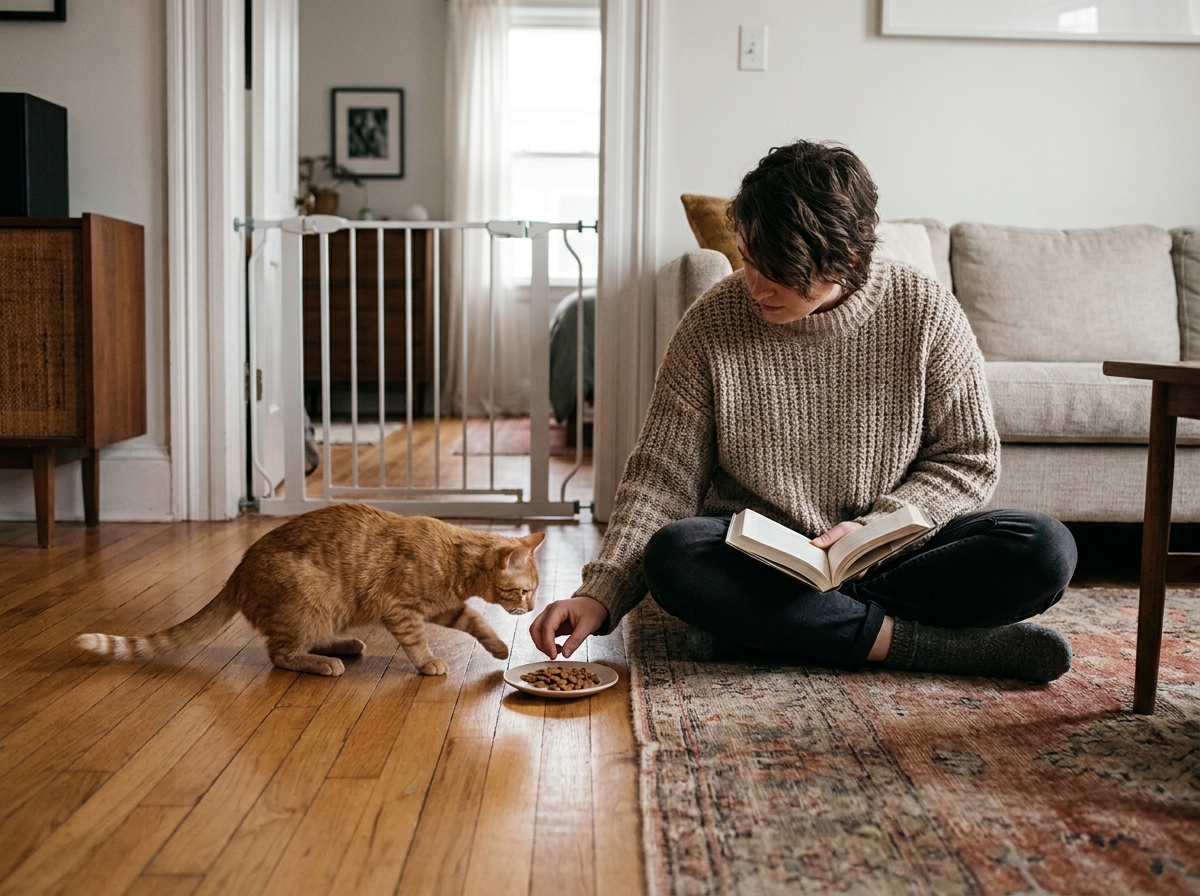
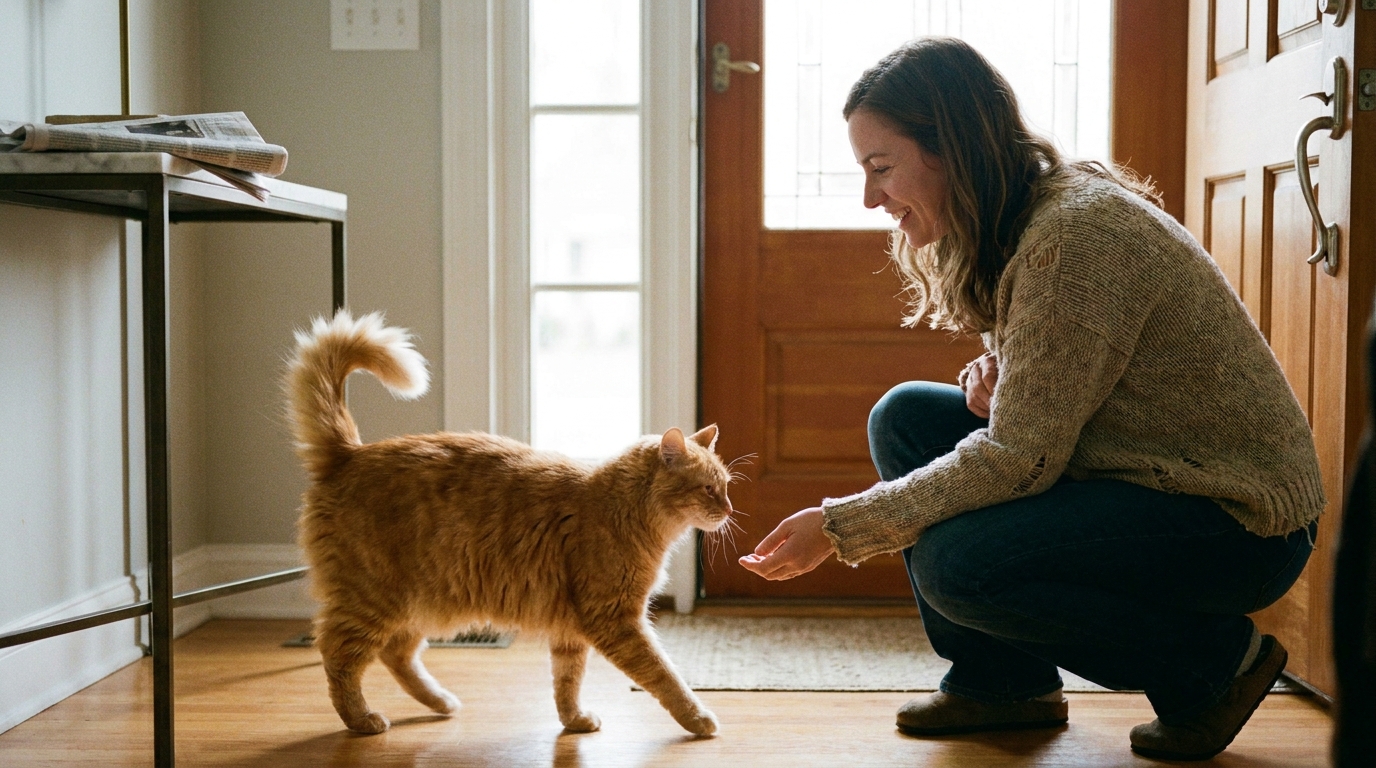
Week 7-8: the controlled direct introduction. The stranger is in the room, but is not approaching the cat. The stranger is sitting on the floor, ignoring the cat, reading a book or looking at a phone. The owner is nearby, giving the cat treats. The cat can approach the stranger at its own pace. The cat that approaches is rewarded by the owner. The cat that does not approach is not pushed. The session is 5-10 minutes. The session is repeated daily. By the end of week 8, most cats will approach the stranger, sniff the stranger's hand, and accept a treat from the stranger's hand.
The management that supports the protocol
During the 8 weeks, the cat is not exposed to uncontrolled stranger encounters. The owner does not have guests over, or the cat is confined to the base room during guest visits. The owner does not bring the cat to the home of a friend or family member. The owner does not force the cat to interact with the postal carrier or the neighbor. The protocol is the only exposure the cat gets, and the protocol is structured to keep the cat's stress response low.
The management also includes the cat's base resources. The cat that has a safe base room, with food, water, litter, and hiding spots, is a cat that has a low baseline stress. The cat that has a high baseline stress is a cat that does not respond as well to the desensitization protocol. The fix: ensure the base room is properly set up, ensure the N+1 rule is applied to the multi-cat household, ensure the cat has vertical space and quiet retreat areas.
The realistic outcome
The 8-week protocol produces a measurable change in most cats. The mild case: the cat that used to hide for 30 minutes now emerges within 5-10 minutes of a guest's arrival, and may cautiously approach a calm guest. The moderate case: the cat that used to hide for the entire visit now emerges in the second hour and may briefly interact with a calm guest who ignores the cat. The severe case: the cat that used to hide for 4-6 hours now hides for 1-2 hours and may eat in the same room as a calm guest. The change is not complete resolution in 8 weeks; the change is the start of a new association that continues to strengthen with continued management.
The maintenance that follows the 8 weeks: the cat continues to have controlled introductions to new people, ideally one new person per week, with the same protocol. The cat that has consistent positive introductions is the cat that generalizes the new association to most new humans. The cat that has the 8-week protocol and then returns to the previous environment (no introductions, only the occasional uncontrolled guest) is the cat that may regress. The maintenance is the part that keeps the protocol's effect.
The one mistake to avoid
The mistake is forcing the interaction. The owner who puts the cat in the room with a guest, who holds the cat while the guest pets it, who corners the cat and brings the guest to the cat — is the owner who is reinforcing the fear. The cat that is forced into an interaction learns that the interaction is inescapable, and the cat's fear response escalates. The fix: the cat always has an escape route, the cat is never held or cornered, the cat is not in the room with a guest if the cat is hiding. The protocol works because the cat is in control of the interaction. The protocol fails when the owner takes control away from the cat.
The one-page summary
A shy cat is not a cat that dislikes humans — it is a cat that has not learned that humans are safe. The 8-week DSCC protocol builds the new association, starting with scent, then sound, then visual, then controlled direct introduction. The management during the 8 weeks prevents uncontrolled exposure. The maintenance after the 8 weeks keeps the new association strong. The owner who runs the protocol is the owner who gives the cat the gift of being comfortable in a human world. The owner who forces the interaction is the owner who confirms the cat's fear.