

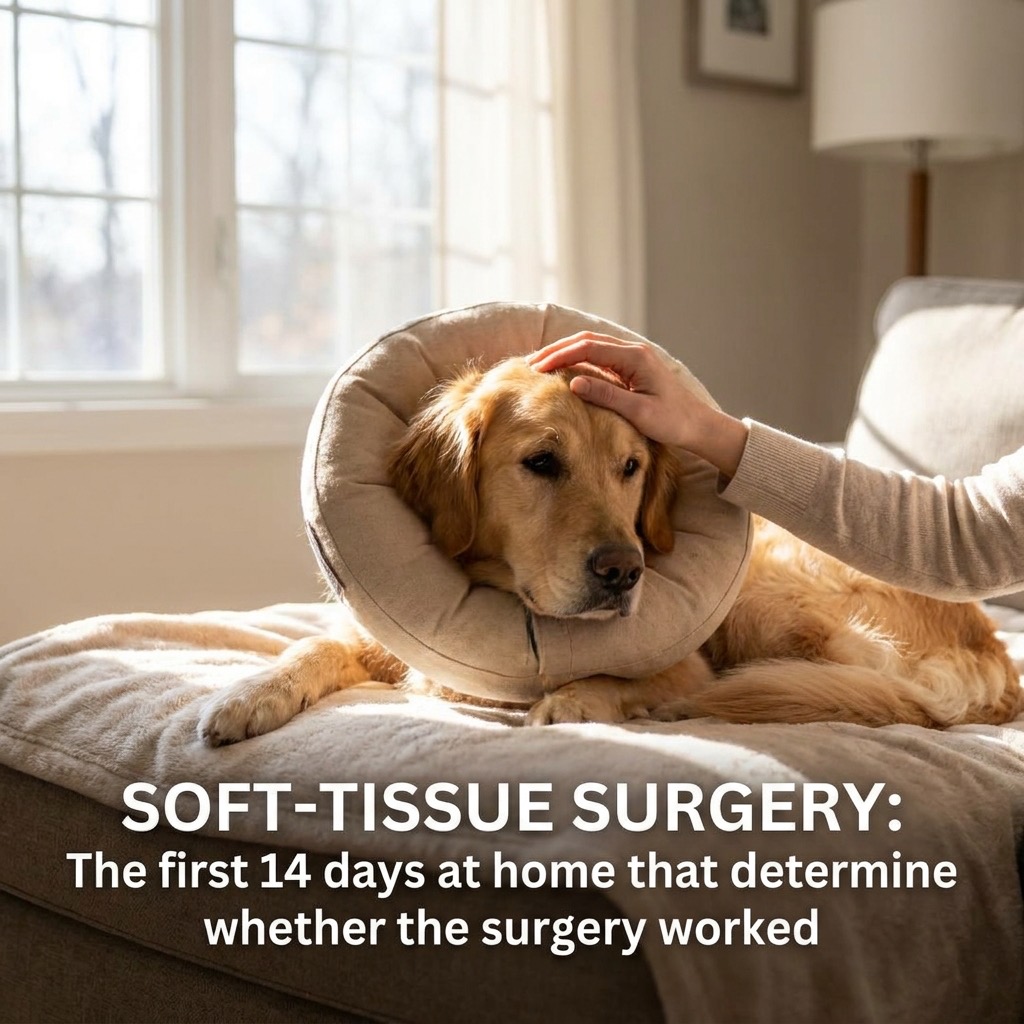
Soft-tissue surgery: the first 14 days at home that determine whether the surgery worked
A dog or cat comes home after soft-tissue surgery — a spay, a mass removal, a foreign body, a cystotomy, a laceration repair. The owner is handed a discharge sheet with a list of do's and don'ts. The owner nods, drives home, and within 24 hours the dog has licked the incision open, jumped off the couch, and is bleeding.
This is the most predictable complication in small animal surgery. The surgery was done correctly. The anaesthetic recovery was uneventful. The post-operative period at home was mismanaged. The result is a wound complication that requires additional surgery, additional cost, additional risk, and a longer recovery.
The first 14 days at home are where the outcome is decided. The protocol below is the one I give every client, and the one I wish every client followed.
The discharge conversation: what the vet should have told you
The discharge conversation after soft-tissue surgery covers several areas. The most important points, in order of urgency:
1. Activity restriction
The single most important instruction. Most wound complications in the first 14 days are caused by activity that exceeds the surgeon's recommendation. The standard:
- Strict rest for 10-14 days: leash walks only for elimination, no running, no jumping, no playing
- Crate rest or small room for dogs that won't self-restrict
- No stairs if possible (carry small dogs; block stairs with baby gates for large dogs)
- No off-leash time in the yard
- No bathing or swimming for 14 days (until sutures or staples are removed)
The "no" list sounds extreme. It is. A dog that ruptures its sutures by jumping off the couch has not had activity restriction. A dog that licks its incision until the wound opens has not had activity restriction (and probably doesn't have an E-collar). A dog that swims in a lake and develops an infection has not had activity restriction.
The owner who doesn't enforce activity restriction is the owner whose dog has a wound complication. The correlation is direct and strong.
2. E-collar or surgical suit
The dog or cat will lick the incision. This is not a question of training or temperament. The animal will lick. Licking introduces oral bacteria (including Pasteurella, E. coli, and Staphylococcus) into the surgical wound. The result is infection, dehiscence, and additional surgery.
The fix: an E-collar (cone of shame) or a surgical suit/recovery suit. The E-collar should be sized to extend 2 inches past the nose when the head is down. The surgical suit should fit snugly and cover the incision.
The owner who removes the E-collar "because the dog is miserable" is the owner whose dog has a wound complication. The E-collar stays on for the full 10-14 days, except when the owner is directly supervising the pet (and even then, watch carefully).
3. Medications
The discharge sheet lists the medications:
- Pain medication (NSAID like carprofen, meloxicam, or robenacoxib; or opioid like tramadol)
- Antibiotic (if prescribed — not all surgeries require antibiotics)
- Other medications (anti-nausea, appetite stimulant, etc.)
The owner should:
- Administer the medications on schedule, even if the pet "seems fine"
- Complete the full course of antibiotics, even if the incision looks good
- Watch for side effects of pain medication (vomiting, diarrhea, loss of appetite — particularly for NSAIDs)
4. Incision monitoring
The owner should check the incision twice daily for:
- Redness: some redness is normal in the first 3-5 days. Worsening redness, or redness extending beyond the immediate incision, is concerning
- Swelling: some swelling is normal. Increasing swelling, particularly firm or hot swelling, is concerning
- Discharge: small amounts of clear or slightly bloody discharge are normal in the first 24-48 hours. Yellow, green, or pus-like discharge is concerning
- Dehiscence: opening of the incision. Any opening should be evaluated by the vet
- Bleeding: small amounts of bleeding are normal. Active bleeding or large blood clots are concerning
The owner should photograph the incision daily. The photos allow comparison over time and provide documentation if the vet needs to evaluate the incision by phone or in person.
5. Diet and water
Most pets return to their normal diet the day after surgery. The exception: patients with gastrointestinal surgery (foreign body removal, intestinal resection) — these patients are on a specific diet progression (see below).
The owner should:
- Offer a small meal the evening of surgery (50% of normal amount)
- Return to normal feeding the next day
- Watch for vomiting, which can be a side effect of anaesthesia or pain medication
- Keep fresh water available at all times
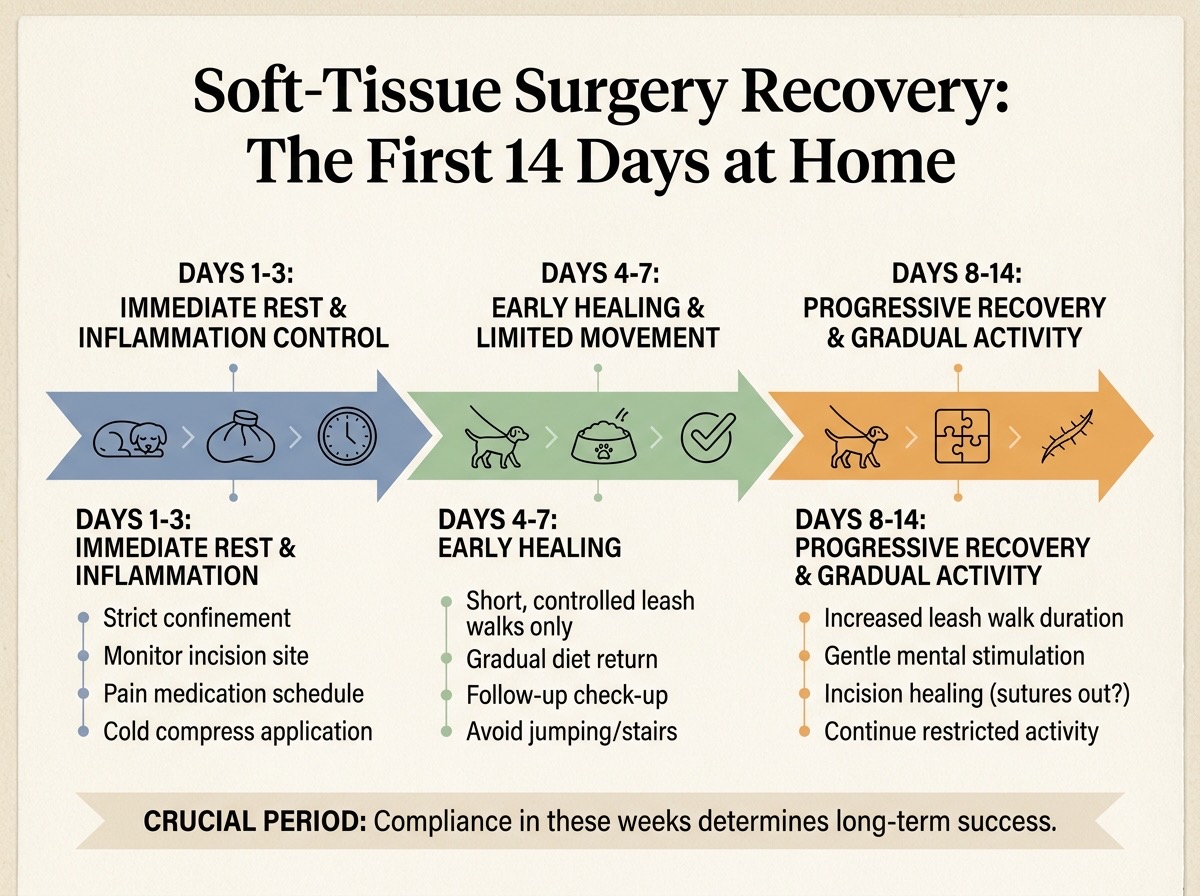
The 14-day recovery protocol, day by day
Days 1-3: the anaesthetic recovery phase
The pet is recovering from anaesthesia. Common signs:
- Sleepiness: the pet sleeps more than usual for 1-3 days
- Reduced appetite: eating less for 1-2 days
- Mild nausea: occasional vomiting or "lip-smacking"
- Disorientation: the pet may seem "off" for 24-48 hours
- Trembling: particularly in cats, mild trembling is common
The owner should:
- Keep the pet in a quiet, comfortable area
- Offer water frequently
- Offer small meals
- Watch for any signs of complications
- Administer pain medication as directed
The incision is fresh and fragile. The E-collar or surgical suit is in place. Activity is strictly limited.
Days 4-7: the early healing phase
The pet is returning to normal energy and appetite. The incision is starting to heal. The owner should:
- Continue strict activity restriction
- Continue the E-collar
- Continue pain medication (the pet may "seem fine" but is still healing)
- Check the incision twice daily
- Watch for any signs of infection or complication
This is the phase where the pet "feels better" and the owner relaxes the activity restriction. This is the phase where the wound opens. Don't relax the restriction.
Days 8-10: the suture/staple phase
If the incision has external sutures or staples, they are typically removed at 10-14 days. The incision is healing but not yet at full strength. The owner should:
- Continue activity restriction
- Continue the E-collar
- Watch for any signs of complication
- Schedule the suture removal appointment
If the incision has intradermal sutures (sutures under the skin that dissolve), there are no sutures to remove. The incision is still healing for another 2-4 weeks.
Days 11-14: the gradual return phase
Sutures or staples are removed (if present). The incision is inspected by the vet. The vet gives the go-ahead for a gradual return to normal activity.
The gradual return:
- Days 11-14: leash walks, no off-leash time, no running
- Days 15-21: longer leash walks, limited off-leash time
- Days 22-28: gradual return to normal activity, no high-impact activity (agility, intense play)
- After 4-6 weeks: full activity (depending on the surgery)
A dog that returns to full activity at day 14 is at risk of incisional hernia or dehiscence. The tissues need 4-6 weeks to reach full strength. The 10-14 day suture removal is the milestone for skin healing, not for tissue healing.
The specific post-op care by surgery type
Different surgeries have different recovery protocols.
Spay (ovariohysterectomy) or neuter
- Recovery time: 10-14 days
- Incision location: midline abdomen (spay) or scrotal area (neuter)
- Restrictions: no running, no jumping, no stairs, no bathing
- Complications to watch: incision swelling, seroma (fluid pocket under the incision), licking, infection
- Return to normal activity: 14 days
- E-collar: yes, for the full 10-14 days
Mass removal
- Recovery time: 10-14 days for small masses, 14-21 days for large masses
- Incision location: varies by mass location
- Restrictions: depends on the mass location. Mass removals from the chest or abdomen have more restrictions than mass removals from the skin
- Complications to watch: seroma, infection, dehiscence, regrowth
- Return to normal activity: 14-21 days
- Histopathology: ensure the removed mass is sent to the lab for analysis. The vet should call with results within 1-2 weeks
Foreign body removal (gastrointestinal)
- Recovery time: 14-21 days
- Incision location: midline abdomen
- Diet progression: critical. Start with small amounts of a bland, easily digestible diet (boiled chicken and rice, prescription GI food). Gradually transition to the normal diet over 5-7 days
- Complications to watch: vomiting, diarrhea, incision complications, peritonitis (leakage from the surgical site)
- Return to normal activity: 14-21 days
- Dietary fibre: the pet may need a fibre supplement or specialised diet for several weeks after surgery
Cystotomy (bladder stone removal)
- Recovery time: 10-14 days
- Incision location: midline abdomen
- Dietary change: often required. Many bladder stones form due to specific mineral compositions in the diet. The vet will recommend a stone-dissolution diet (Hill's c/d, Royal Canin Urinary) to prevent recurrence
- Complications to watch: hematuria (blood in urine) is normal for the first 3-5 days. Persistent hematuria, straining to urinate, or inability to urinate is an emergency
- Return to normal activity: 10-14 days
Laceration repair
- Recovery time: 10-14 days
- Incision location: varies
- Restrictions: depends on location. Paws and legs have more restrictions than the body
- Complications to watch: infection, dehiscence, especially in bite wounds or contaminated wounds
- Drain placement: many lacerations have a surgical drain that is removed in 3-5 days
- Return to normal activity: depends on location
Orthopaedic surgery (this is a different protocol, but worth noting)
- Recovery time: 6-12 weeks for most orthopaedic surgeries (TPLO, FHO, fracture repair)
- Restrictions: very strict for 4-6 weeks, then gradual return
- Physical therapy: usually recommended to restore function
- Complications to watch: implant failure, infection, non-union (failure of bone to heal)
- The protocol above is for soft-tissue, not orthopaedic. Orthopaedic recovery is its own topic
The complications: what to watch for and when to call the vet
A list of the most common post-op complications and the action to take:
Incision redness, mild
- Normal in the first 3-5 days
- Continue monitoring, take daily photos
- No action needed
Incision redness, spreading or worsening
- Concerning
- Take a photo, send to the vet
- Possible infection starting
Incision swelling, mild
- Normal in the first 3-7 days, particularly in areas with loose skin (chest, abdomen)
- A small, soft, fluid-filled pocket (seroma) is common and usually resolves on its own in 2-3 weeks
- Continue monitoring
Incision swelling, large, firm, or painful
- Concerning
- Could be hematoma (blood), seroma (fluid), or abscess (infection)
- Vet should evaluate
Incision discharge, clear or slightly bloody
- Normal in the first 24-48 hours
- Small amount, no odour
- Continue monitoring
Incision discharge, yellow, green, or pus-like
- Concerning
- Suggests infection
- Vet should evaluate within 24 hours
Incision opening (dehiscence)
- Concerning
- Even small openings can progress quickly
- Vet should evaluate the same day
- E-collar check — the pet is likely licking despite the collar, or the collar was removed
Bleeding, mild (a few drops)
- Normal in the first 24-48 hours
- Apply gentle pressure with a clean cloth for 5 minutes
- Continue monitoring
Bleeding, active (continuous or large volume)
- Emergency
- Apply pressure
- Call the vet immediately or go to the emergency clinic
Vomiting, single episode
- Possible side effect of anaesthesia or pain medication
- Withhold food for 2-4 hours, then offer small amounts
- If vomiting continues, call the vet
Vomiting, multiple episodes
- Concerning
- Could be medication reaction, surgical complication (peritonitis), or unrelated GI issue
- Call the vet
Diarrhea, mild
- Possible side effect of medication or stress
- Monitor
- Probiotics may help (FortiFlora, Proviable)
Diarrhea, severe or bloody
- Concerning
- Could be medication reaction, surgical complication, or unrelated GI issue
- Call the vet
Loss of appetite, 1-2 days
- Common in the first 2-3 days post-op
- Offer palatable food, warm it slightly to enhance smell
- If appetite doesn't return by day 3, call the vet
Loss of appetite, beyond day 3
- Concerning
- Could indicate infection, surgical complication, or medication issue
- Call the vet
Lethargy, mild (sleeping more than usual)
- Normal in the first 3-5 days
- Continue monitoring
Lethargy, severe (unresponsive, won't move)
- Emergency
- Call the vet or go to the emergency clinic
Difficulty urinating
- Concerning
- Could indicate urinary tract issue, medication side effect
- If unable to urinate at all, emergency
Difficulty breathing
- Emergency
- Could indicate anaesthetic complication, fluid in the chest, or other emergency
- Go to the emergency clinic immediately
The "E-collar" debate: alternatives that actually work
The traditional E-collar (cone) is effective but has drawbacks. Some pets refuse to eat, drink, or move with the cone. The owner removes the cone "for a minute" — and the pet licks the incision.
The alternatives that work:
Inflatable collar (donut style)
- A soft, inflatable collar that fits around the neck
- Less obstructive than a cone
- Effective for some pets, but not all (a flexible pet can reach around)
- May not prevent licking of abdominal incisions in cats
Soft fabric cone
- A fabric version of the rigid cone
- More comfortable but less effective
- Some pets can reach around the soft cone
Surgical suit / recovery suit
- A full-body suit that covers the incision
- Excellent for abdominal and chest incisions
- Less effective for limb or head incisions
- The pet can still lick uncovered areas
Surgical shirt (for spay/neuter)
- A shirt that covers the abdominal incision
- Similar to the recovery suit
- Less stressful than the cone for many cats
Neck brace
- A rigid neck brace that prevents the pet from turning to lick
- Less common but effective for determined lickers
The best approach: use the E-collar (or a combination) for the full 10-14 days, with the alternative as a backup if the pet is highly distressed. The goal is to prevent licking, not to make the pet comfortable. The incision is more important than the pet's preference.
The recheck appointment
Most surgeries require a recheck at 10-14 days for suture/staple removal. The recheck is also an opportunity for the vet to:
- Assess healing
- Identify any complications early
- Remove drains (if present)
- Discuss return to activity
- Update the owner on the histopathology (if a mass was removed)
The owner should not skip the recheck. The recheck is part of the surgery. The cost is usually included in the surgical fee.
The bottom line
Surgery is the easy part. The 14 days at home are where the outcome is decided. The protocol is straightforward: strict activity restriction, E-collar or recovery suit, medications as directed, twice-daily incision monitoring, gradual return to activity over 4-6 weeks. The owner who follows the protocol has a smooth recovery. The owner who doesn't has a wound complication, an additional surgery, and a longer recovery. The cost of the protocol is patience. The cost of skipping it is much higher. Trust the discharge sheet. Follow the restrictions. Use the cone. The 14 days feel long. They're the difference between a successful surgery and a complicated one.
---
About the author: [Sofia Martinez](../Sofia%20Martinez.md) holds a DVM from the National Autonomous University of Mexico and is board-certified by the American College of Veterinary Surgeons (ACVS) with 15 years of emergency and soft-tissue surgical practice.