

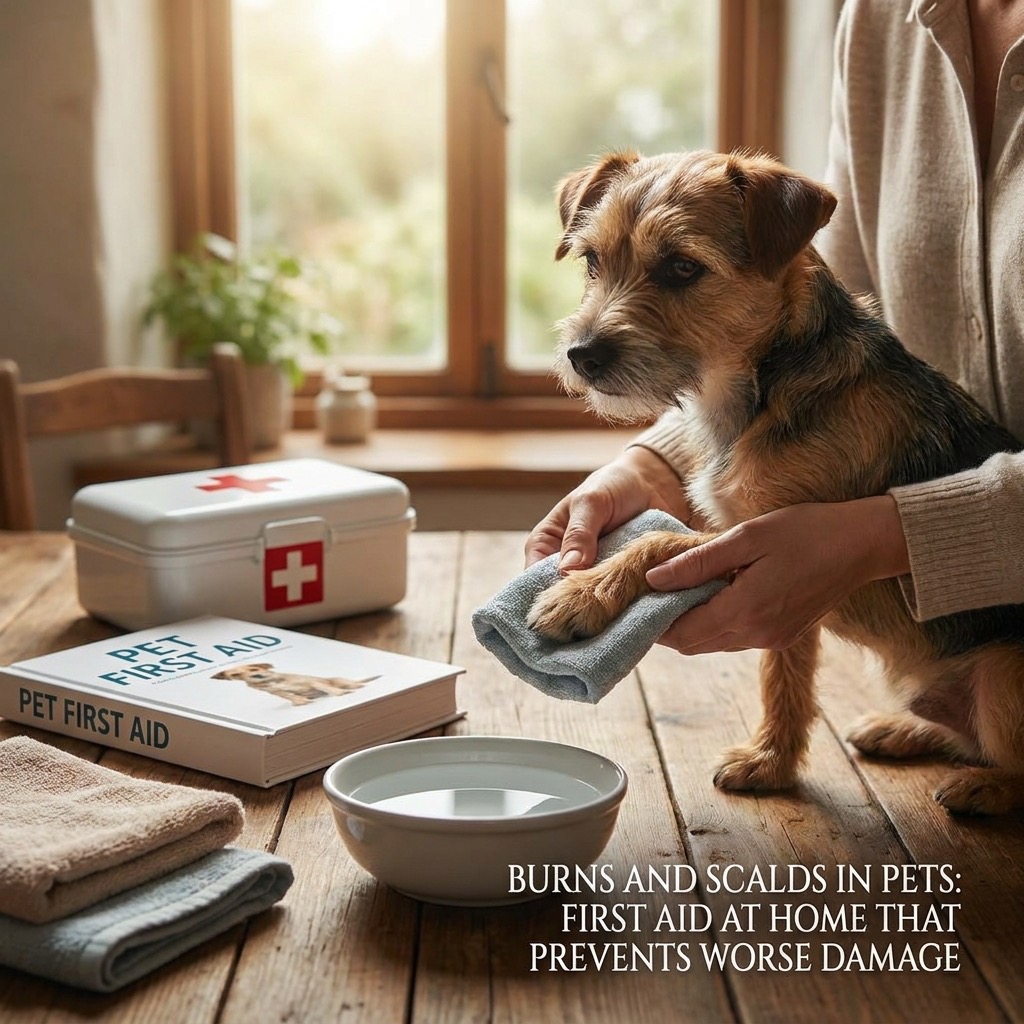
Burns and scalds in pets: first aid at home that prevents worse damage
Burns in pets are less common than other injuries (dogs and cats instinctively avoid most heat sources), but when they happen, they are uniquely time-sensitive. The depth and extent of the burn continue to worsen for 24–48 hours after the initial injury, and the systemic effects (shock, fluid loss, infection) develop faster than most owners expect. The first 30 minutes after a burn determine whether the burn heals cleanly or progresses to a life-threatening crisis.
This is what to do at home in those first 30 minutes.
What burns look like in pets
Pets hide pain and cover injuries by instinct. The visual signs of a burn may not appear for minutes to hours after the injury. Early recognition depends on knowing the risk situations.
Common causes
- Hot surfaces: stovetops, hot pavement in summer, car engines, heated rocks, hot water bottles that are too hot
- Hot liquids: spilled tea, coffee, boiling water, hot cooking oil
- Electrical burns: chewing electrical cords (cats and puppies especially)
- Chemical burns: contact with bleach, oven cleaner, drain cleaner, gasoline, turpentine
- Friction burns: rope burns from leashes or tethers, treadmill injuries (especially in dogs not conditioned to treadmills)
- Sunburn: pink or white-skinned areas (nose, ear tips, belly of light-coloured dogs)
- Cold burns (frostbite): prolonged exposure to freezing temperatures, especially on extremities (ear tips, tail tip, paws)
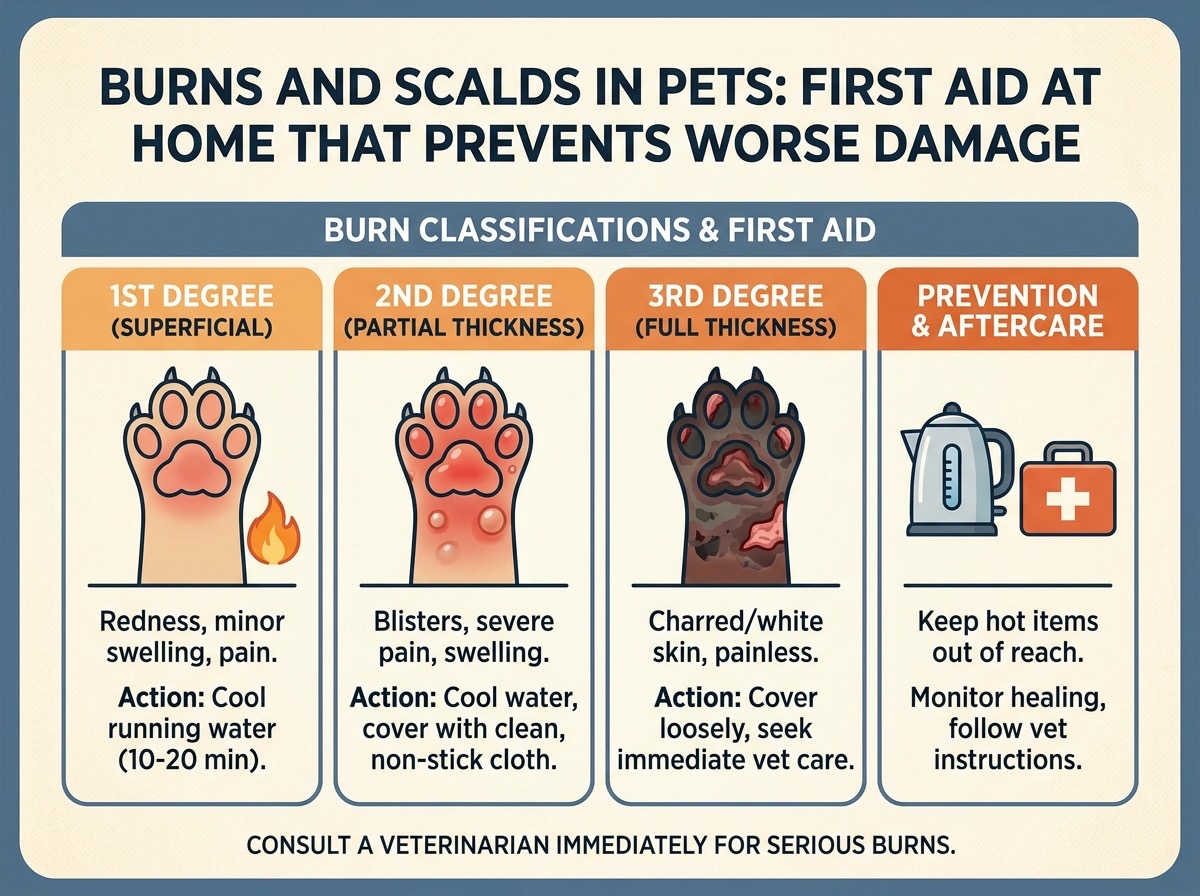
Burn classification (depth)
Burns are classified by depth, which determines treatment and prognosis:
| Degree | Depth | Visual signs | Pain level |
|---|---|---|---|
| 1st degree (superficial) | Epidermis only | Redness, mild swelling, hair intact, blanches with pressure | Mild to moderate |
| 2nd degree (partial thickness) | Epidermis and part of dermis | Blisters, wet appearance, hair may pull out easily | Severe |
| 3rd degree (full thickness) | All of dermis | White, leathery, or charred appearance; no pain (nerves destroyed) | None to severe (deep pain around the edges) |
| 4th degree | Below skin into muscle/bone | Charred, exposed underlying tissue | Often severe shock; minimal pain in the burn itself |
Most pet burns are 1st or 2nd degree. Third-degree burns are usually from prolonged contact (e.g., a dog tied in the sun without water) or electrical injury.
Surface area estimation
The "rule of nines" used for humans doesn't map directly to pets, but a rough estimate:
- Head and neck: ~10% of body surface
- Each forelimb: ~9% each
- Each hindlimb: ~14% each
- Thorax and abdomen: ~26%
- Back and pelvis: ~18%
A burn covering >20% of body surface is life-threatening. A burn covering >50% is usually fatal even with aggressive treatment.
The first 30 minutes: what to do
Step 1: stop the burning process (1 minute)
If the burn is still active (chemical on the skin, hot surface contact continuing, electrical contact):
- Thermal burns: move the pet away from the heat source. For chemical burns, rinse with copious water before doing anything else
- Electrical burns: turn off the power at the breaker. Do not touch the pet until the power is off
- Chemical burns: flush with cool water for 10+ minutes. Wear gloves to protect yourself
- Friction burns: stop the friction (remove leash, stop treadmill)
Step 2: cool the burn (10–15 minutes)
Apply cool (not cold) running water to the burn for 10–15 minutes. The goal is to stop the burn from progressing deeper into the tissue.
Why cool water: the burn process continues after the heat source is removed because the tissue is still hot. Cooling brings the tissue temperature down and stops the damage from progressing.
Why not ice or ice water: ice causes vasoconstriction and can worsen tissue damage. Cool tap water (15–20°C) is the right temperature.
How to apply cool water: gentle stream from a shower head, hose, or pitcher. Do not use high pressure. For burns on the body, the pet can stand in a shallow cool-water bath.
Duration: 10–15 minutes minimum. Longer is fine for chemical burns. For very small burns, even 5 minutes of cooling helps.
Step 3: prevent further damage (5 minutes)
After cooling:
- Cover the burn loosely with a clean, non-stick dressing (cling film / Saran Wrap works well — it doesn't stick to the burn and keeps it clean). Apply loosely so it doesn't constrict swelling
- Do not apply butter, oil, ice, toothpaste, or any home remedy — these all make the burn worse
- Do not break blisters — they protect the underlying tissue from infection
- Do not apply creams or ointments at home — these trap heat and can interfere with the vet's examination
Step 4: prevent shock (5 minutes)
Burns >10% of body surface area can cause hypovolaemic shock from fluid loss into the burned tissue. Watch for:
- Rapid heart rate
- Pale gums
- Weakness
- Cool extremities
If shock signs are present:
- Keep the pet warm (blanket over the body, not the burn)
- Keep the pet calm (low-stress handling, quiet environment)
- Transport to the vet immediately (do not wait)
Step 5: transport to the vet (within 30 minutes)
All burns >5% body surface area, all 2nd degree or deeper burns, and all electrical or chemical burns need veterinary assessment within hours. Burns continue to worsen for 24–48 hours; what looks like a small 1st-degree burn in the first hour can become a deeper burn by the next day.
Call ahead so the vet can prepare. Bring:
- The pet, wrapped in a clean towel or blanket
- Information about the cause (chemical container, temperature of liquid, voltage of electrical source)
- Time of injury
- Any medications the pet is on
Specific burn types and their first aid
Thermal burns (hot surface, hot liquid)
The protocol above applies. Most common scenarios:
- Kitchen spill: cool water for 10 minutes, cover loosely, vet visit if >5% area or 2nd degree+
- Hot pavement: pads of feet only. Cool water soak for 10 minutes, vet visit if blisters form or pads are visibly damaged
- Stovetop or oven contact: typically paws. Cool water 10 minutes, vet visit
Electrical burns (chewing cords)
Particularly common in puppies and kittens. The contact burn at the mouth is usually small (1–3 cm) but the internal damage from the electrical current can be severe:
- Pulmonary oedema (fluid in the lungs) develops within 24 hours in many cases
- Cardiac arrhythmias can occur immediately or delayed
- The visible burn is often a minor part of the injury
First aid: turn off power, assess breathing and heart rate, cool the visible burn for 5 minutes, transport to vet immediately even if the pet looks fine. Most electrical burn patients need chest X-rays and ECG monitoring even if they appear OK at the time.
Chemical burns
Caustic substances (oven cleaner, drain cleaner, bleach, lye) cause damage that continues until fully neutralised.
First aid: flush with copious water for 15–30 minutes. Wear gloves. For powder chemicals, brush off excess before flushing. For eye exposure, flush eyes for 15+ minutes.
After flushing, transport to vet. Bring the chemical container so the vet can identify the substance.
Friction burns
Common in working dogs, treadmill injuries, and leash burns.
First aid: clean gently with cool water, apply non-stick dressing, transport to vet. Friction burns are often deeper than they appear because the friction removes multiple layers of skin.
Sunburn
Common in light-skinned dogs with pink noses and ear tips. Can also affect the belly and inner thighs of dogs that sun themselves belly-up.
First aid: move to shade, cool compress for 10 minutes, apply pet-safe aloe vera or vitamin E oil. Severe sunburn (blistering) needs vet care. Prevent future sunburn with pet-safe sunscreen on exposed pink skin.
Frostbite
Less common in pet burns but worth covering. Affected areas (ear tips, tail tip, paws) become pale, cold, and may be painful.
First aid: warm gradually with body-temperature water (not hot). Do not rub the affected area. Once warm, dry gently and cover loosely. Vet visit for any non-superficial frostbite.
What the vet will do
Assessment
- Body surface area (using the pet-specific rule of nines)
- Burn depth (1st/2nd/3rd/4th degree)
- Systemic signs: heart rate, respiratory rate, mucous membrane colour, capillary refill time, temperature
- Evidence of inhalation injury (for facial burns or fires): singed whiskers, soot in mouth/nose, hoarse voice, stridor
Initial treatment
- IV catheter and fluid resuscitation: for burns >10% BSA, balanced electrolyte solution (LRS or Plasmalyte) at shock rates
- Pain management: opioids (methadone, hydromorphone, fentanyl). NSAIDs alone are not sufficient for burn pain
- Wound care: clipping hair around the burn, gentle cleaning with sterile saline, applying topical antimicrobial (silver sulfadiazine, honey-based dressings)
- Antibiotics: only if infection is present, not prophylactically
- Tetanus prophylaxis: in some regions, even for pets
Ongoing care
For 2nd degree or deeper burns, hospitalisation for 24–72 hours is typical:
- Continued IV fluids
- Daily wound cleaning and re-dressing
- Pain management
- Nutritional support (burns dramatically increase caloric needs)
- Monitoring for infection
Surgery
For 3rd degree or larger 2nd degree burns:
- Debridement (removal of dead tissue) once the burn demarcates
- Skin grafts for large areas
- Reconstructive surgery for functional or cosmetic restoration
Long-term outlook
Most 1st-degree burns heal within 7–10 days without scarring.
Most 2nd-degree burns heal within 14–21 days. Deeper 2nd-degree burns may scar.
3rd-degree burns always scar. The scarring may be functional (limiting mobility if over a joint) or cosmetic.
The long-term complications of severe burns include:
- Contracture scars: scar tissue that tightens, limiting mobility
- Hypertrophic scarring: thick, raised scars
- Chronic wound issues: scars can break down with minor trauma, months or years after healing
- Behaviour changes: many pets that have experienced severe burns become anxious around heat sources or in the kitchen
Prevention
Most burns are preventable. The biggest categories:
Kitchen and cooking
- Keep pot handles turned inward on the stove
- Never carry hot liquids while holding a pet
- Use back burners when possible
- Keep pets out of the kitchen during cooking
Electrical
- Cover exposed cords with cord protectors
- Use bitter apple spray on cords (cats especially hate it)
- Unplug appliances when not in use
- Hide cords behind furniture
Hot pavement
- Walk dogs early morning or late evening in summer
- Test pavement with your hand: if it's too hot for your palm for 5 seconds, it's too hot for paws
- Consider dog booties for hot pavement walks
Heating pads and hot water bottles
- Never use human heating pads on pets without supervision
- Use low-heat settings
- Wrap in a towel so direct contact is avoided
- Provide an escape route so the pet can move off the pad
Chemicals
- Store all cleaning products, automotive fluids, and yard chemicals out of pet reach
- Use pet-safe alternatives when possible
- Lock cabinets containing chemicals
The bottom line
Burns in pets are uncommon but uniquely time-sensitive. The first 30 minutes determine whether the burn heals cleanly or progresses to a systemic crisis. Cool water for 10–15 minutes, loose non-stick dressing, no home remedies, and transport to the vet for any burn >5% body surface area or 2nd degree or deeper. Prevention is the best medicine: kitchen safety, cord protection, summer pavement awareness, and chemical storage. A few minutes of prevention saves weeks of burn treatment and the lifelong scarring that often follows.
---
About the author: [Dr. Sofia Martinez](../Sofia%20Martinez.md), DVM, CertECC, is a UCM-trained veterinarian with 13 years of practice and former head of emergency surgery at Hospital Veterinari 24h in Barcelona.