
Soft corals: a starter list of species that thrive in beginner reef tanks
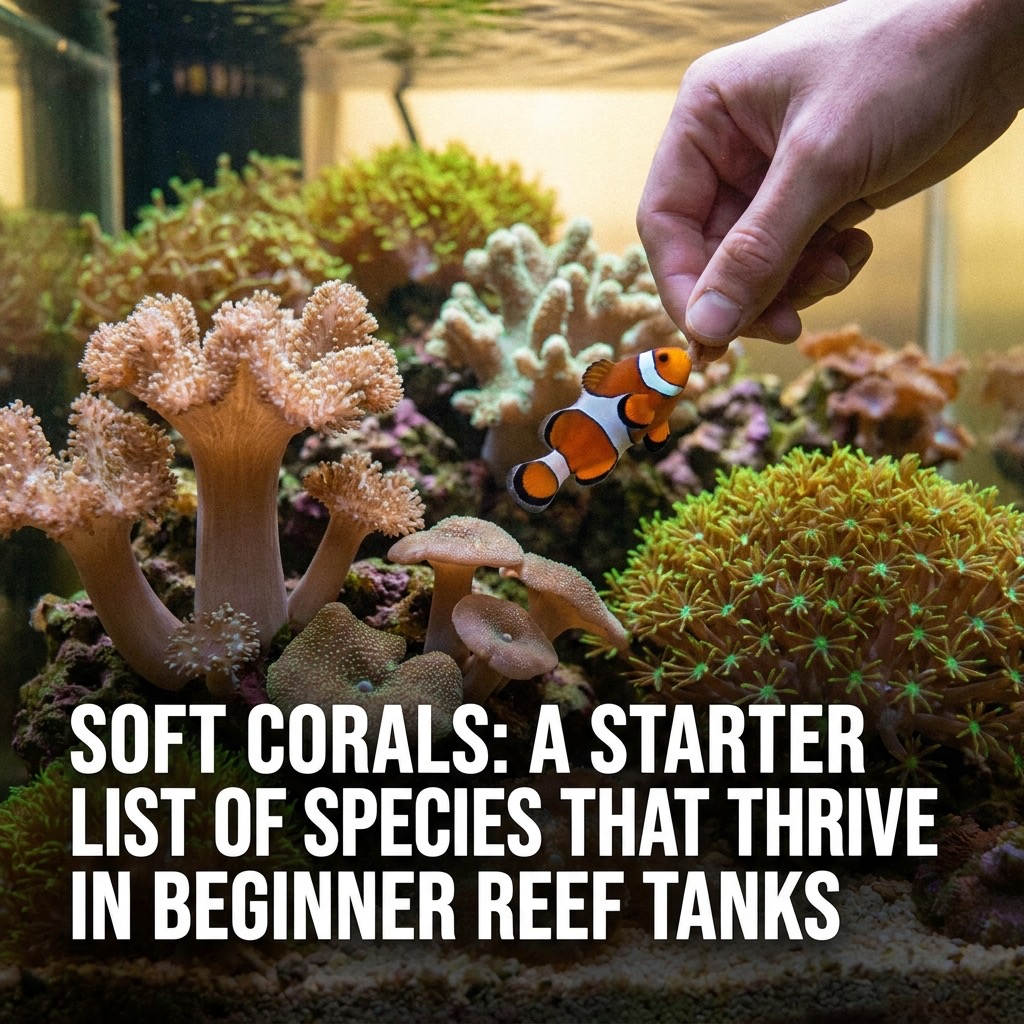
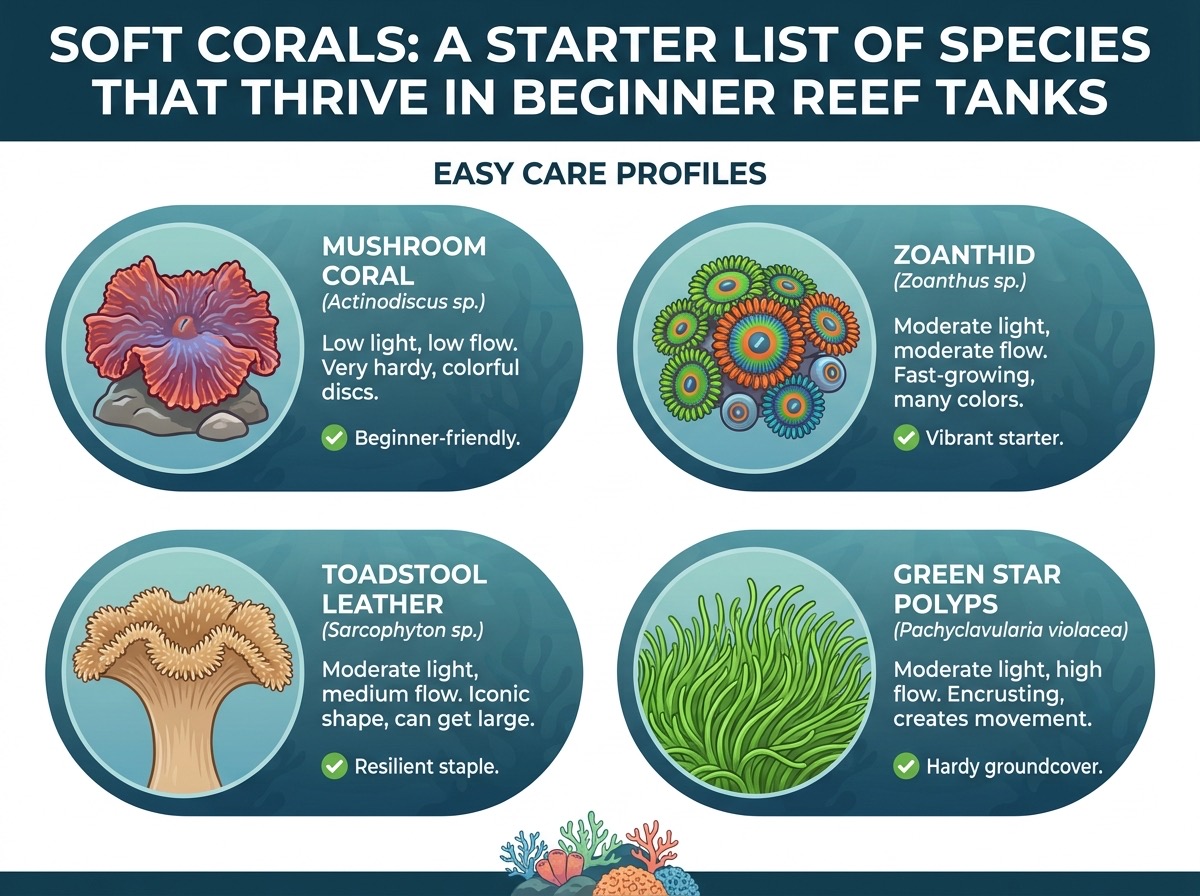
Soft corals are the corals that don't have a stony skeleton. They're flexible, often swaying with the current, and they tolerate a wider range of conditions than their stony cousins (LPS and SPS corals). For a beginner reefkeeper, soft corals are the right place to start. They grow, they colour up, they forgive the parameters that fluctuate, and they don't demand the precise calcium, alkalinity, and magnesium levels that stony corals require.
This is the starter list — the species I've seen thrive in beginner tanks for the past 12 years, and the species that give the new reefkeeper the confidence to expand into harder corals later.
The principle: match the coral to the tank
The first principle of coral selection: match the coral to the tank. A coral that requires high light, strong flow, and pristine water parameters is not a beginner coral. A coral that tolerates average light, moderate flow, and standard reef parameters is.
The variables that matter:
- Light intensity: low, medium, or high
- Water flow: low, medium, or high
- Water parameters: stability over absolute values for most soft corals
- Aggression: some soft corals are aggressive (release toxins) and need to be placed away from other corals
- Growth rate: fast-growing soft corals can overrun the tank. The reefkeeper needs to be willing to prune and frag
The starter list below is filtered for species that are forgiving, reasonably coloured, and reasonably behaved. The list is not exhaustive — there are hundreds of soft coral species — but it's a solid starting point.
The starter list: 12 species
1. Sinularia (finger leather coral)
- Difficulty: very easy
- Light: low to medium
- Flow: low to medium
- Aggression: moderately aggressive (releases terpenes that can affect nearby corals)
- Growth rate: fast
- Colour: tan, brown, green, sometimes pink or yellow
Sinularia is the prototypical beginner coral. It grows in long, finger-like polyps that sway in the current. It's tolerant of parameter swings, low light, and a wide range of conditions. The coral is moderately aggressive — it should be placed away from other corals, particularly stony corals. The coral will also shed its outer layer periodically (a process called "sloughing"), which is normal.
2. Sarcophyton (toadstool leather coral)
- Difficulty: very easy
- Light: low to medium
- Flow: low to medium
- Aggression: moderately aggressive
- Growth rate: moderate to fast
- Colour: tan, brown, sometimes green or yellow
Sarcophyton is another classic beginner coral. It looks like a mushroom or toadstool, with a thick stalk and a cap covered in small polyps. The polyps extend during the day to feed and retract at night. The coral is tolerant of a wide range of conditions and is one of the most resilient corals in the hobby.
3. Capnella (Kenya tree coral)
- Difficulty: very easy
- Light: low to medium
- Flow: medium
- Aggression: low
- Growth rate: very fast (can be invasive)
- Colour: tan, brown, sometimes pink
Capnella is a small polyp coral that grows in tree-like structures. It's one of the fastest-growing soft corals in the hobby, and it can quickly overrun a tank if not pruned. The upside: it's almost impossible to kill. The downside: it spreads aggressively and needs regular pruning to keep it from overgrowing other corals. Many reefkeepers keep Kenya tree specifically because it grows so fast — it's a confidence-builder for new reefkeepers.
4. Pachyclavularia (green star polyps)
- Difficulty: very easy
- Light: low to medium
- Flow: medium
- Aggression: low (encrusting growth can overgrow nearby corals)
- Growth rate: very fast
- Colour: green, sometimes purple or brown
Green star polyps (GSP) are a mat-forming coral that encrusts over rock and substrate. The polyps are bright green and small, opening during the day to feed. GSP grows aggressively and can quickly cover rock, glass, and even neighbouring corals. The coral is also one of the easiest to frag — a small piece placed on a frag plug will grow into a full colony.
GSP is often used as a "starter coral" for the new tank. The coral is tolerant of parameter swings, grows fast, and provides visible feedback that the tank is healthy.
5. Briareum (star polyps, clove polyps)
- Difficulty: very easy
- Light: low to medium
- Flow: medium
- Aggression: low
- Growth rate: very fast
- Colour: green, brown, sometimes purple
Star polyps are similar to GSP but with larger, more pronounced polyps. They form a mat over rock and substrate, and they grow aggressively. The polyps close when touched and open when the coral is undisturbed. Star polyps are slightly less invasive than GSP but still require regular pruning.
6. Zoanthus (zoanthids, button polyps)
- Difficulty: very easy
- Light: low to high (depending on species)
- Flow: low to medium
- Aggression: low to moderate (some species release toxins)
- Growth rate: moderate to fast
- Colour: extremely variable — every colour of the rainbow
Zoanthids are among the most popular corals in the hobby, and for good reason. They are available in a staggering variety of colours, they tolerate a wide range of conditions, and they grow well in most reef tanks. The polyps are small, button-like, and come in every colour combination imaginable.
Zoanthids are also a source of risk: palytoxin. Some zoanthids (particularly Palythoa species) contain palytoxin, a potent marine toxin that can be dangerous to humans. The risk is highest when the corals are fragged, when the rock is moved, or when the corals are exposed to air (e.g., during water changes). The owner should wear gloves and eye protection when handling zoanthids, and should never handle them with open cuts or wounds.
7. Rhodactis (mushroom corals, anemone-like corals)
- Difficulty: very easy
- Light: low to medium
- Flow: low
- Aggression: low
- Growth rate: moderate
- Colour: extremely variable — green, red, blue, purple, orange
Mushroom corals (Discosoma, Rhodactis, Ricordea genera) are not technically soft corals — they belong to the order Corallimorpharia — but they're commonly grouped with soft corals in the hobby. They're among the most forgiving corals in the hobby, tolerating low light, low flow, and parameter swings. They're also available in a stunning range of colours, with the "Florida" mushroom corals (collected from Florida reefs) being particularly colourful.
Mushroom corals can move slowly across the rock, and they can sting nearby corals with their sweeper tentacles. They should be placed away from other corals.
8. Discosoma (disc anemones)
- Difficulty: very easy
- Light: low to medium
- Flow: low
- Aggression: low
- Growth rate: moderate
- Colour: green, red, blue, purple, orange, brown
Discosoma is the most common mushroom coral in the hobby. The corals are small, disc-shaped, and available in a wide range of colours. They tolerate low light and low flow, and they're a good choice for shaded areas of the tank (under overhangs, in caves, etc.).
9. Ricordea (Florida mushrooms, Caribbean mushrooms)
- Difficulty: very easy to moderate
- Light: low to medium
- Flow: low to medium
- Aggression: low
- Growth rate: slow to moderate
- Colour: extremely variable — green, red, blue, orange, multicoloured
Ricordea is a related genus of mushroom corals, with two main species: R. florida (from the Caribbean) and R. yuma (from the Indo-Pacific). The corals are slightly more demanding than Discosoma, requiring more stable parameters. The colours are particularly vivid, with the "Florida Ricordea" being some of the most colourful corals in the hobby.
10. Euphyllia (anchor coral, hammer coral, torch coral, frogspawn)
- Difficulty: easy to moderate
- Light: low to medium
- Flow: low to medium
- Aggression: high (long sweeper tentacles)
- Growth rate: moderate
- Colour: green, gold, sometimes blue or pink
Euphyllia is technically an LPS (large polyp stony) coral, but it's commonly grouped with soft corals in beginner lists because of its hardiness. The coral has long, fleshy polyps with tentacles that can extend several inches. The tentacles wave in the current, giving the coral a flowing, animated appearance.
The four main Euphyllia species in the hobby:
- Anchor coral (E. ancora): branching skeleton, tentacles with anchor-shaped tips
- Hammer coral (E. parancora): branching skeleton, hammer-shaped tentacle tips
- Torch coral (E. glabrescens): branching skeleton, long tentacles with knob tips
- Frogspawn (E. divisa): branching skeleton, tentacles with multiple knob tips (resembling frog eggs)
Euphyllia is aggressive — the sweeper tentacles can extend 6+ inches and sting nearby corals. The coral should be placed in an area where it has room to extend without touching other corals.
11. Caulastrea (candy cane coral, trumpet coral)
- Difficulty: easy
- Light: low to medium
- Flow: low to medium
- Aggression: moderate (sweeper tentacles)
- Growth rate: moderate
- Colour: green, sometimes red or blue
Caulastrea is an LPS coral with a branching skeleton. The polyps are trumpet-shaped and have a fleshy mantle that covers the skeleton during the day. The coral is moderately aggressive and should be placed away from other corals.
12. Duncanopsammia (Duncan coral, whisker coral)
- Difficulty: easy
- Light: low to medium
- Flow: low to medium
- Aggression: low to moderate
- Growth rate: moderate
- Colour: green, sometimes blue or purple
Duncan coral is an LPS coral with multiple trumpet-shaped polyps on a branching skeleton. The polyps have long tentacles that extend into the current. The coral is relatively forgiving and is a good beginner LPS choice.
The care principles for soft corals
The care for soft corals is generally less demanding than for SPS corals, but the principles matter.
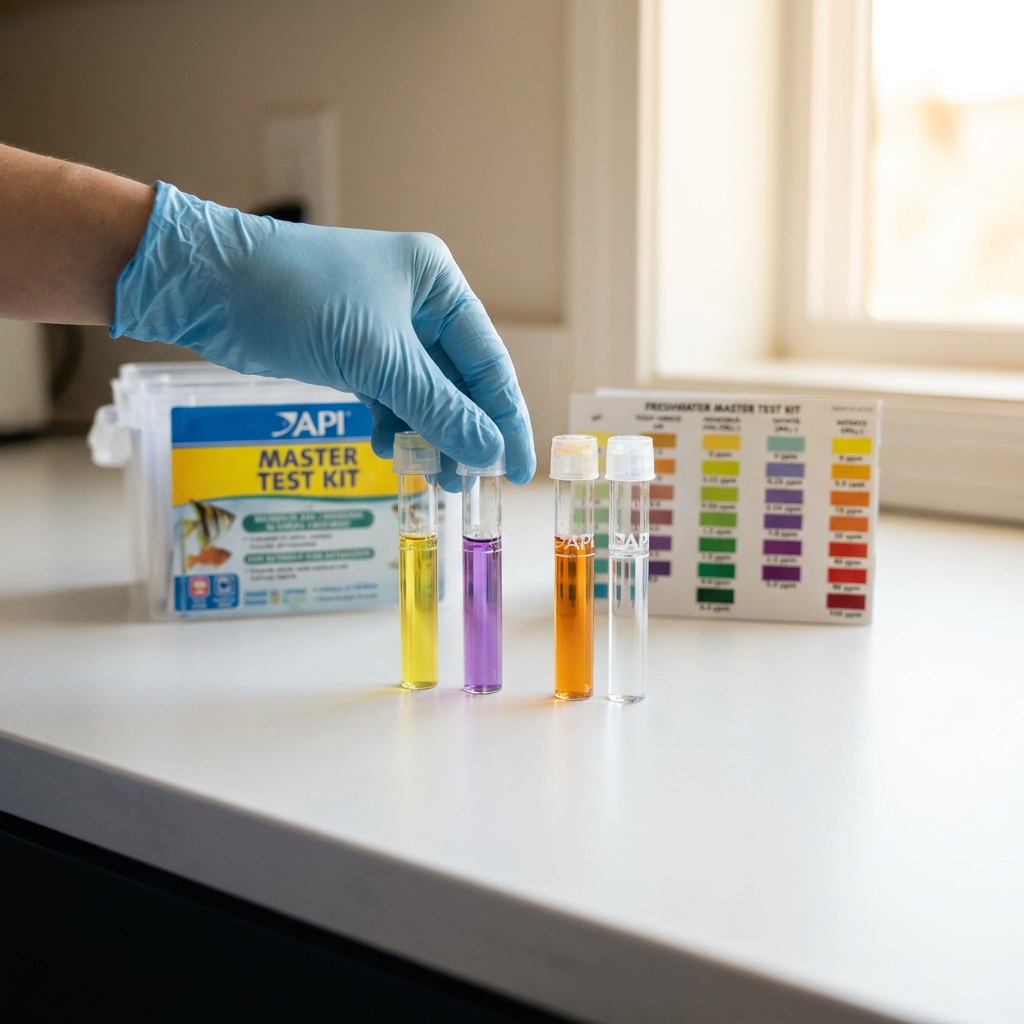
Water parameters
- Salinity: 1.024-1.026
- Temperature: 76-80°F (24-27°C)
- pH: 8.1-8.4
- Alkalinity: 8-11 dKH
- Calcium: 400-450 ppm
- Magnesium: 1250-1350 ppm
- Nitrate: 5-15 ppm (soft corals tolerate higher nitrates than SPS)
- Phosphate: 0.03-0.1 ppm
Soft corals tolerate a wider range of parameters than SPS corals. The numbers above are guidelines, not strict requirements. The more stable the parameters, the better — stability matters more than absolute values for soft corals.
Lighting
- Low light: 50-100 PAR
- Medium light: 100-200 PAR
- High light: 200+ PAR
Most soft corals thrive in low to medium light. The corals that prefer high light (some zoanthids, some mushrooms) can be placed higher in the tank.
Water flow
- Low flow: gentle, indirect flow
- Medium flow: moderate, alternating
- High flow: strong, direct flow
Most soft corals prefer low to medium flow. The flow should be enough to keep the polyps moving gently but not so strong that the polyps are blasted.
Feeding
Most soft corals get the majority of their nutrition from photosynthesis (the symbiotic zooxanthellae in their tissues). Some soft corals also benefit from supplemental feeding:
- Target feeding: meaty foods (Mysis shrimp, brine shrimp, plankton) offered directly to the polyps
- Broadcast feeding: small particulate foods distributed throughout the tank
- Liquid foods: amino acid solutions, designed for soft corals
The corals that benefit most from supplemental feeding: Euphyllia, Caulastrea, Duncanopsammia. The corals that don't need much supplemental feeding: Sinularia, Sarcophyton, Capnella.
The "aggression" consideration
Some soft corals are aggressive — they release toxins or extend sweeper tentacles to compete with neighbouring corals. The placement matters:
- Sinularia, Sarcophyton: moderately aggressive. Place away from stony corals
- Euphyllia: highly aggressive. Place with plenty of clearance from other corals
- Caulastrea, Duncanopsammia: moderately aggressive. Place with clearance
- Zoanthids, mushroom corals, GSP, star polyps: low aggression, but their encrusting growth can overgrow nearby corals
A reef tank with multiple soft corals needs space between them. The corals can be placed on separate rocks, with the rocks spaced to allow growth. The aggressive corals should be at the bottom of the tank, where their sweeper tentacles can't reach the more passive corals.
The fragging consideration
Fast-growing soft corals (GSP, star polyps, Kenya tree, zoanthids) often need to be fragged to control growth. Fragging is the process of cutting a piece of the coral and attaching it to a new surface (a frag plug, a rock, etc.) to grow a new colony.
The fragging process:
- Cut a small piece of the coral with a sharp razor or coral cutter
- Attach the piece to a frag plug (a small plastic or ceramic plug) or a piece of rock
- Use super glue gel or coral glue to attach the piece. The glue is safe for the coral
- Place the frag in a low-flow area of the tank to allow healing
- Return the parent coral to its original location
- The frag heals in 1-2 weeks and starts growing
Fragging is a good way to control the growth of aggressive soft corals, and it's also a way to share corals with other reefkeepers. The frag swap is a common social activity in the reefkeeping community.
The "starter coral package" recommendation
For a new reefkeeper setting up a 50-100 gallon mixed reef tank, the recommended starter package:
- 1-2 Sinularia or Sarcophyton: the foundational leather corals
- 1-2 GSP or star polyps colonies: the encrusting mat corals
- 1 Kenya tree colony: the fast-growing tree coral
- 1-2 Euphyllia colonies: the dramatic centrepiece (placed with clearance)
- 1-2 mushroom coral colonies: the colour contrast
- 1-2 zoanthid colonies: the colour variety
This package provides visual interest, growth activity, and forgiveness. The corals complement each other in terms of light and flow requirements, and they don't outcompete each other (with appropriate placement).
What to avoid as a beginner
A few corals that look like beginner corals but aren't:
Goniopora (flowerpot coral)
- Often sold as a beginner coral because it looks like a beautiful flower
- One of the hardest corals to keep alive long-term
- Requires constant feeding, perfect water parameters, and stable flow
- Most specimens die within 6-12 months in captivity
- Not a beginner coral
Catalaphyllia (elegance coral)
- Sold as a beginner LPS because of its dramatic appearance
- Has a very specific feeding requirement and is sensitive to parameter swings
- Not a beginner coral
Tubastraea (sun coral, black sun coral)
- Beautiful non-photosynthetic coral
- Requires daily target feeding of meaty foods
- Not a beginner coral
Heliofungia (mushroom coral, anemone coral)
- Looks like a mushroom coral but is actually a free-living LPS
- Requires excellent water parameters and stable conditions
- Not a beginner coral
The bottom line
Soft corals are the right starting point for most new reefkeepers. They tolerate the variables that kill stony corals, they grow in most reef tanks, and they provide visual interest from the start. The starter list of 12 species covers the range from encrusting mats (GSP, star polyps) to dramatic centrepieces (Euphyllia) to colourful oddities (zoanthids, mushrooms). The care principles are well-established, the parameters are achievable for a new tank, and the growth is rewarding. The reefkeeper who starts with soft corals learns the basics of water chemistry, lighting, flow, and feeding without the unforgiving demands of SPS corals. After 12-24 months of success with soft corals, the reefkeeper can expand into LPS and SPS with confidence. The soft coral stage is the foundation. The stony corals come later.
---
About the author: [Olivia Brown](../Olivia%20Brown.md) holds an MSc in Marine Biology from James Cook University and has 12 years of experience in public aquaria, with a specialisation in coral husbandry and reef ecosystem management.