
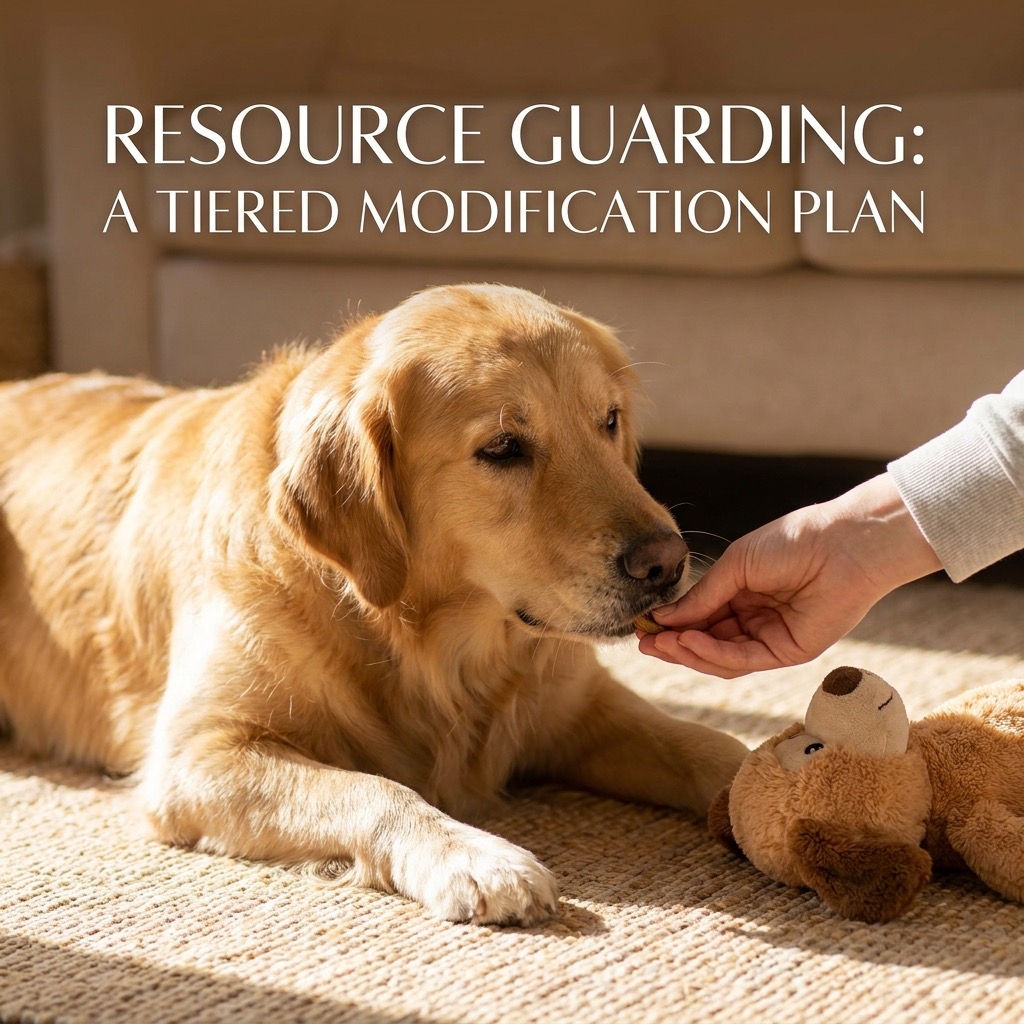
Resource guarding: a tiered modification plan that respects the dog
Resource guarding is the behaviour that triggers the most calls to my practice and the most misunderstood advice online. The "alpha" advice — take the bowl away, show them who's boss, force them to give up the toy — is exactly backwards. It makes guarding worse, faster, and more dangerous. The real solution is more methodical, slower, and ultimately far more effective.
This is the plan I use.
What resource guarding actually is
A dog that growls when you approach the food bowl, snaps when you reach for a chew, or freezes over a stolen sock is not being dominant. They are doing the only thing they have learned that works: making the scary thing go away.
Most guarding is a learned behaviour. The dog tried a softer signal first (look away, lip lick, body shift). Nobody noticed. They tried harder (low growl, stiff body). Still nobody backed off. They escalated to a snap or bite. Finally, the scary thing went away. The lesson: escalation works.
The fix is to change the dog's prediction. When a human approaches a valued resource, good things should happen — not scary things.
The safety tier system
Before any modification, classify the guarding on a safety tier. This determines whether you do the work yourself or whether you need a certified behaviour consultant.
| Tier | Behaviour | Who should run the plan |
|---|---|---|
| Tier 1 | Mild body stiffening, low growl, faster eating | Owner with guidance |
| Tier 2 | Hard stare, full growl, lip curl | Owner + certified consultant |
| Tier 3 | Snap that misses, freeze | Professional only |
| Tier 4 | Bite that makes contact | Professional + safety plan |
If your dog is Tier 3 or 4, do not attempt this plan without in-person help. The bite risk is real.
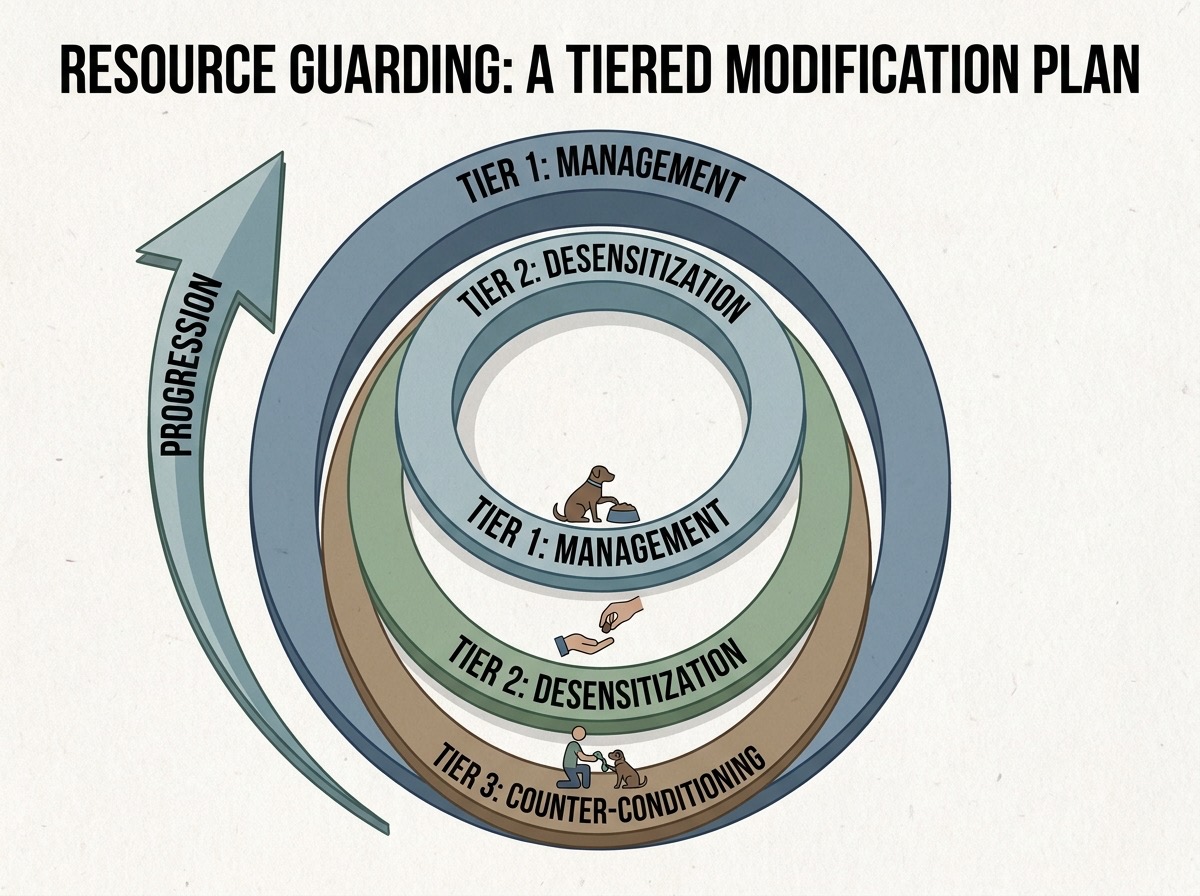
The 6-step modification plan (Tier 1 and 2)
The same six steps, applied to whatever resource the dog guards.
Step 1: Baseline data
For 3 days, log every guarding episode. What was the resource? Where was the dog? What did you do? What did the dog do? This gives you the triggers and the severity trend.
Step 2: Stop all confrontations
Until you have completed step 4, do NOT approach the dog while they have a resource. Do not take the bowl, the chew, the stolen sock. Manage the environment so guarding never gets rehearsed.
- Feed in a separate room if needed
- Pick up chews and high-value items when the dog can't be supervised
- Use baby gates to control access
Yes, this feels like "the dog won". It isn't. It is removing the rehearsal opportunity while you build the new association.
Step 3: Teach the "trade" cue
Pick a low-value resource. Say "trade", toss a higher-value treat away from the resource, dog leaves the low-value resource to get the higher-value treat. Repeat 20+ times per session across multiple sessions. The dog learns that "trade" = better thing appears.
Step 4: Hand-feeding as foundation
For the next 2 weeks, all food comes from your hand or from a "find it" scatter game. No bowl feeding. This rewires the dog's expectation of what hands near food means — not "taking", but "giving".
If your dog is too stressed by hand-feeding, mix in some of their regular kibble with high-value treats so every approach pays.
Step 5: Approach-with-addition protocol (the core work)
For the specific resource your dog guards (let's say the food bowl):
- Put down an empty bowl.
- Walk past at 3 metres. Drop a high-value treat near the bowl as you pass. Walk away. Repeat 10 times.
- Over 5+ days, gradually decrease the distance (3 m → 2 m → 1 m → arm's reach).
- At each distance, do 10+ repetitions per session. The dog must see your approach predict treat arrival, not food removal.
If at any distance the dog shows stiffness or low growl, you've moved too fast. Go back one distance step.
Step 6: Phase in bowl feeding
Once step 5 is smooth at arm's reach for 2+ weeks:
- Put food in the bowl. Approach. Drop something better in. Walk away.
- Put food in the bowl. Approach. Stand nearby. Drop something better in. Walk away.
- Put food in the bowl. Approach. Stand and talk softly. Walk away.
- Put food in the bowl. Approach. Touch the bowl edge. Drop something better in. Walk away.
Never lift the bowl while the dog is eating in the early phases. The "take the bowl away" drill that some trainers recommend actively contradicts the work above.
What to do when the dog growls
When the dog growls during any step:
- Stop moving. Do not back away (that rewards the growl).
- Wait 5 seconds.
- Drop a high-value treat AWAY from the resource.
- When the dog moves to get the treat, calmly walk away.
This converts the growl moment from "I made the human leave" to "I growl, the scary hand stops, and then food appears from somewhere else." It is not a complete solution, but it prevents escalation.
Common mistakes
- "Show them who's boss" — this makes guarding worse, faster
- Forcing the dog to give up a stolen item — you may get the item back but you have made the next guarding episode more likely
- Punishing the growl — the growl is the warning. Remove the warning and the next signal is a bite
- Moving too fast through the steps — the plan takes 6–12 weeks minimum
- Skipping step 2 — if the dog is still rehearsing the old pattern, the new pattern can't take hold
When to involve a professional
- Any Tier 3 or 4 behaviour
- Multiple resource types guarded
- Children in the household
- A bite has already occurred
- The dog is also showing other anxiety signs
Bottom line
Resource guarding is solvable. The path is not dominance — it is changing what the dog predicts when humans approach a resource. Slower than the "alpha" advice, but actually works, and does not damage trust. Plan for 2–3 months of consistent work, manage the environment to prevent rehearsal in the meantime, and call a certified behaviour consultant (CBCC-KA or similar) if the behaviour is more than mild.
---
About the author: [Marcus Whitfield](../Marcus%20Whitfield.md) is a Certified Canine Behavior Consultant (CBCC-KA) with 20+ years of practice. He has supported more than 3,000 families with canine behaviour challenges.