Reef lighting: PAR and spectrum fundamentals that actually grow coral
Lighting is the second most expensive purchase a new reef keeper makes (the first is the tank itself), and it is the purchase that most often goes wrong. The wrong light does not just fail to grow coral — it produces a tank full of nuisance algae, a tank where the expensive corals fade to brown, or a tank where the corals survive but never colour up. In this article I will walk through the four variables that actually matter for coral growth and colour — PAR, spectrum, mounting height, and photoperiod — and the choices a beginner or intermediate reefer should make for the most common tank sizes and coral mixes. I will not recommend specific brands; the lineup changes every year, and the principles outlast the products.
PAR, PUR, and the things lights actually do
PAR stands for photosynthetically active radiation. It is the measure of how much light in the 400-700 nanometer wavelength range is hitting a surface, expressed as micromoles of photons per square meter per second (μmol/m²/s). PAR is the only number that matters for plant and coral photosynthesis, and the PAR at the coral — not at the surface of the water — is what determines growth. A light that emits 800 PAR at the water surface delivers roughly 350-500 PAR at the substrate of a 24-inch deep tank, after the water column absorbs the rest. The PAR number on the box is almost always the surface PAR; the PAR at the coral depends on the depth, the water clarity, and the mounting height of the fixture.
PUR is a more recent term, photosynthetically usable radiation, and it refers to the subset of PAR that chlorophyll and the coral's symbiotic zooxanthellae can actually use. The usable wavelengths are roughly 400-480 nm (the blue and violet range) and 660-680 nm (the red range), with peak absorption in the 440-460 nm blue range. A light with very high PAR but a poor spectrum — for example, a light that emits mostly green and yellow — will produce a high PAR number but a low PUR number, and the coral will not grow as well as the PAR number suggests. The fix is to look at both PAR and spectrum, not just PAR.
The PAR targets for different coral types
The right PAR for a coral depends on the coral's natural habitat. Soft corals (mushrooms, leathers, zoanthids, palythoas) come from shallow, low-light areas and prefer 50-150 PAR at the coral. LPS corals (hammer, frogspawn, Duncan, Acanthastrea) prefer 100-250 PAR. SPS corals (Acropora, Montipora, Stylophora, Seriatopora) prefer 250-450 PAR, with the small-polyp demanding species (Acropora in particular) reaching their best colour at 350-500 PAR. A tank that mixes LPS and SPS is a tank that has to be lit for the SPS end of the range, with the LPS placed in the lower-flow, lower-light areas of the aquascape.
A common beginner mistake is to over-light. The first instinct is "more light = more growth," and the first 6 months produce a tank full of bright green hair algae and corals that are bleaching at the tips. The fix is to start at 60-70% of the manufacturer's recommended intensity and ramp up over 4-6 weeks. The corals acclimate to the new light gradually, the algae does not get a sudden light surge, and the tank finds its balance. A light that is too strong for too long is harder to recover from than a light that is too weak for a month; the corals can acclimate upward, but they cannot easily acclimate downward without bleaching.
The spectrum: what each channel does
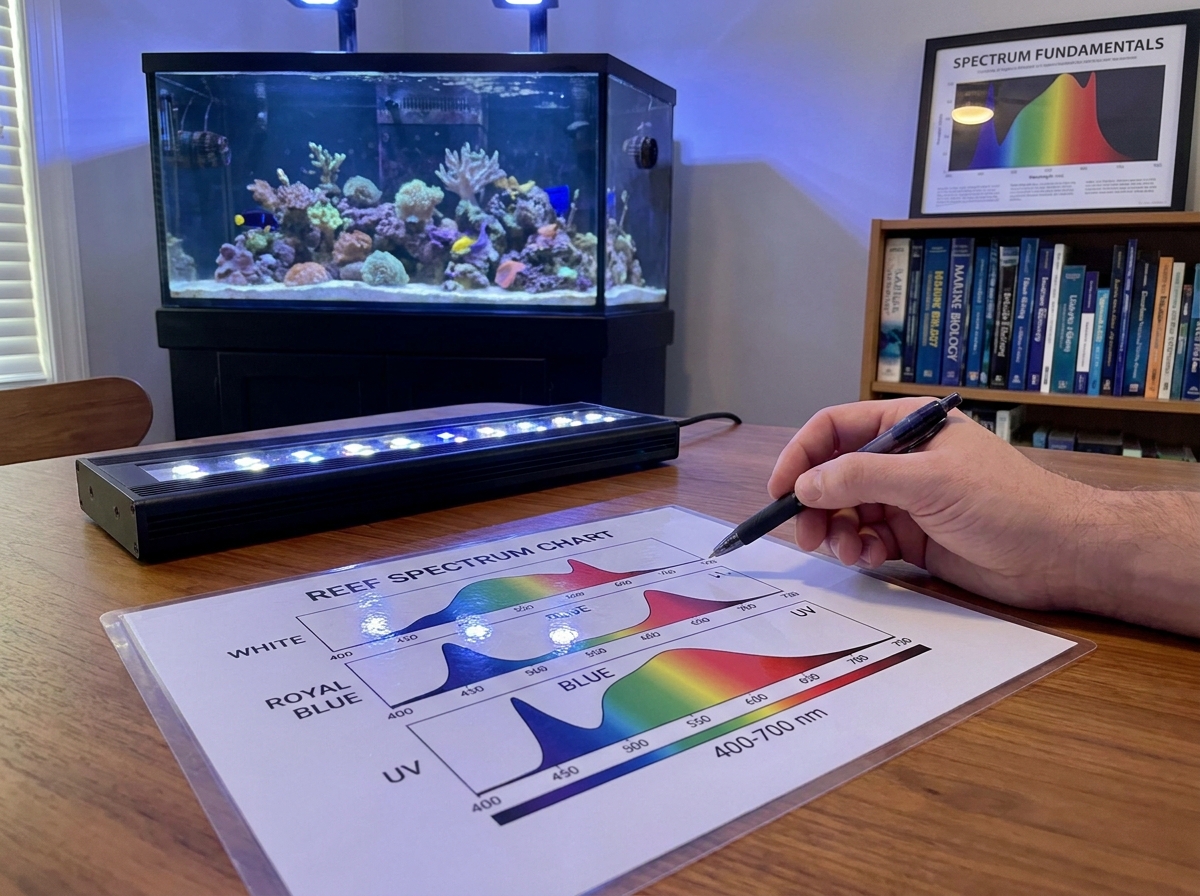
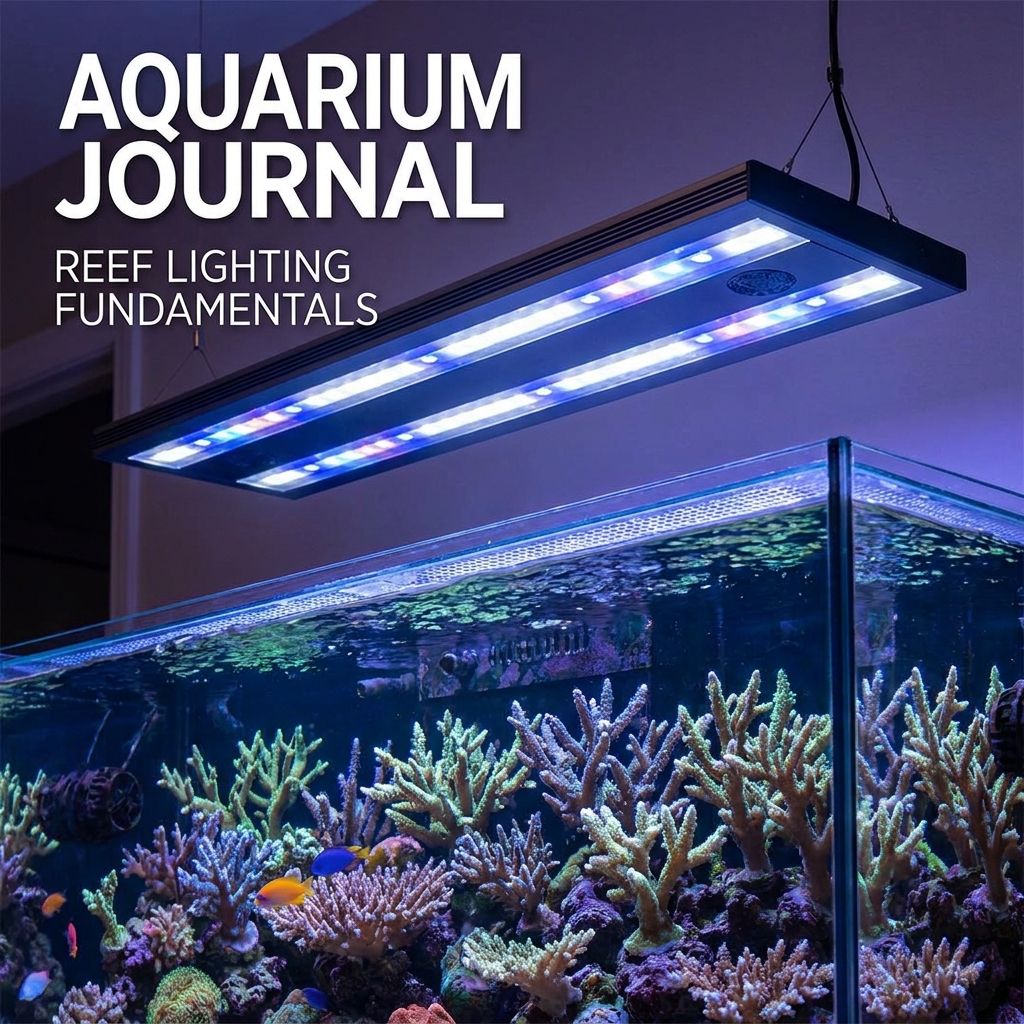
Modern reef LED fixtures have multiple channels, and the spectrum mix is what determines the colour of the light and the growth pattern of the coral. The four standard channels: white (6500K, broad spectrum), blue (450-460 nm, the peak chlorophyll absorption), royal blue (440-450 nm, slightly shorter wavelength, drives different pigment expression in some corals), and UV or violet (400-420 nm, drives fluorescent pigment expression in many corals, particularly Acropora).
A spectrum that is heavy in blue and royal blue — what reefers call a "blue-heavy" spectrum — produces the deep blue water look that most reef keepers prefer visually, and it drives zooxanthellae density in the coral tissue, which produces the bright fluorescent colours. A spectrum with more white produces a brighter, more yellow look that grows corals slightly faster (because the white channel includes more PAR) but does not bring out the fluorescent colours as well. The compromise: a 70/30 blue/white mix for a mixed reef, a 80/20 or 90/10 mix for a coral-focused SPS tank, and a 50/50 mix for a soft-coral tank where growth rate matters more than colour. The UV/violet channel, when present, is a small percentage of the total output, but it has an outsized effect on coral fluorescence and is worth using at a low intensity throughout the photoperiod.
Mounting height and spread
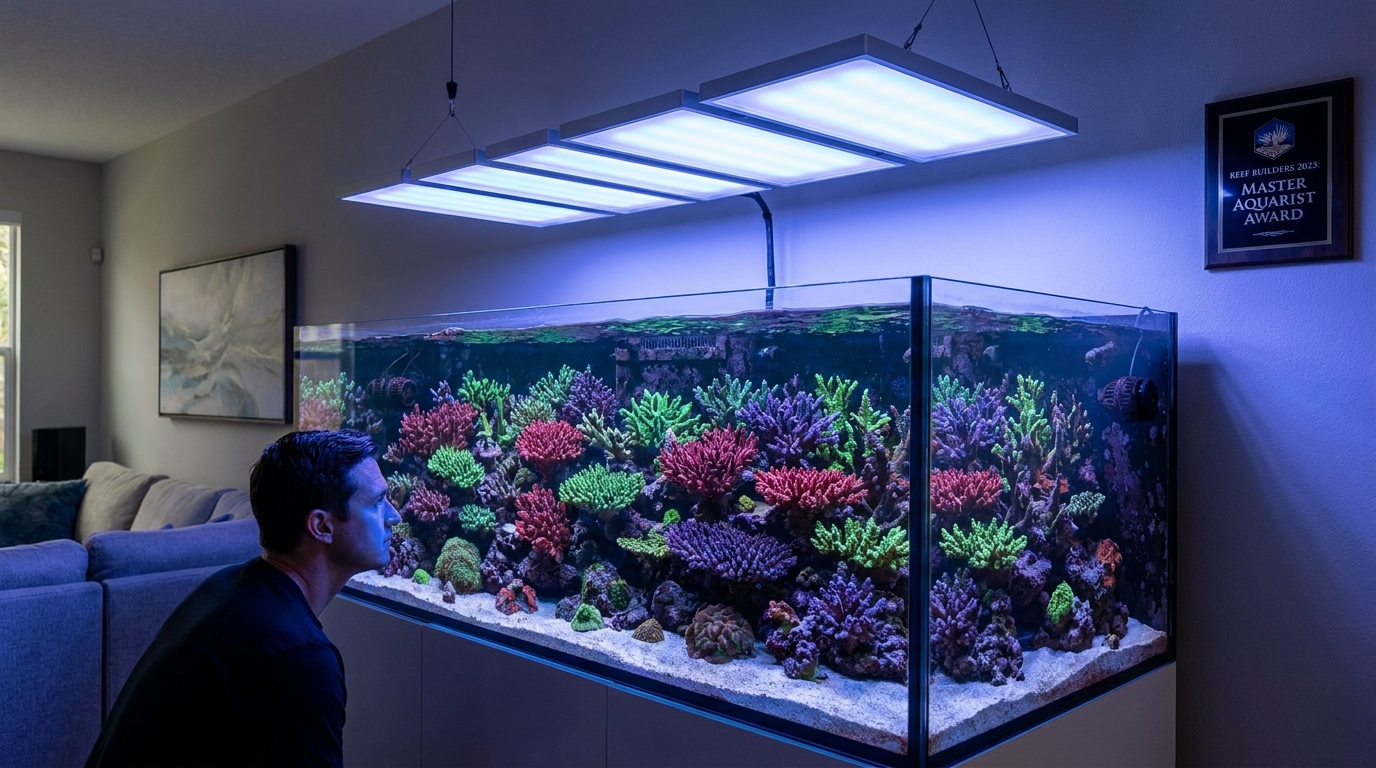
The mounting height of the fixture affects both the PAR and the spread. A fixture mounted 4 inches above the water delivers high PAR in a small spread. A fixture mounted 12 inches above the water delivers lower PAR in a wider spread. For a 24-inch deep tank, the typical mounting height is 6-10 inches above the water, with a fixture that has a wide enough lens to cover the full tank footprint. A small fixture that covers only the middle of the tank is a common beginner mistake; the corners of the tank get too little light, and the corals in the corners either grow slowly or fade.
For a deeper tank (30 inches or more), the mounting height has to compensate, and a single fixture may not be enough. Two fixtures, each at 6-8 inches above the water, with overlapping coverage, will produce more even PAR across a deep tank than one fixture at 12 inches trying to cover everything. The trade-off: more fixtures cost more, and the deeper tank also loses more PAR to water absorption, so the fixtures need to be more powerful. A 30-inch deep tank is a 30-50% PAR loss compared to a 24-inch tank, and the fixture that works for a 24-inch tank will not produce enough PAR at the bottom of a 30-inch tank.
The photoperiod: hours of light per day
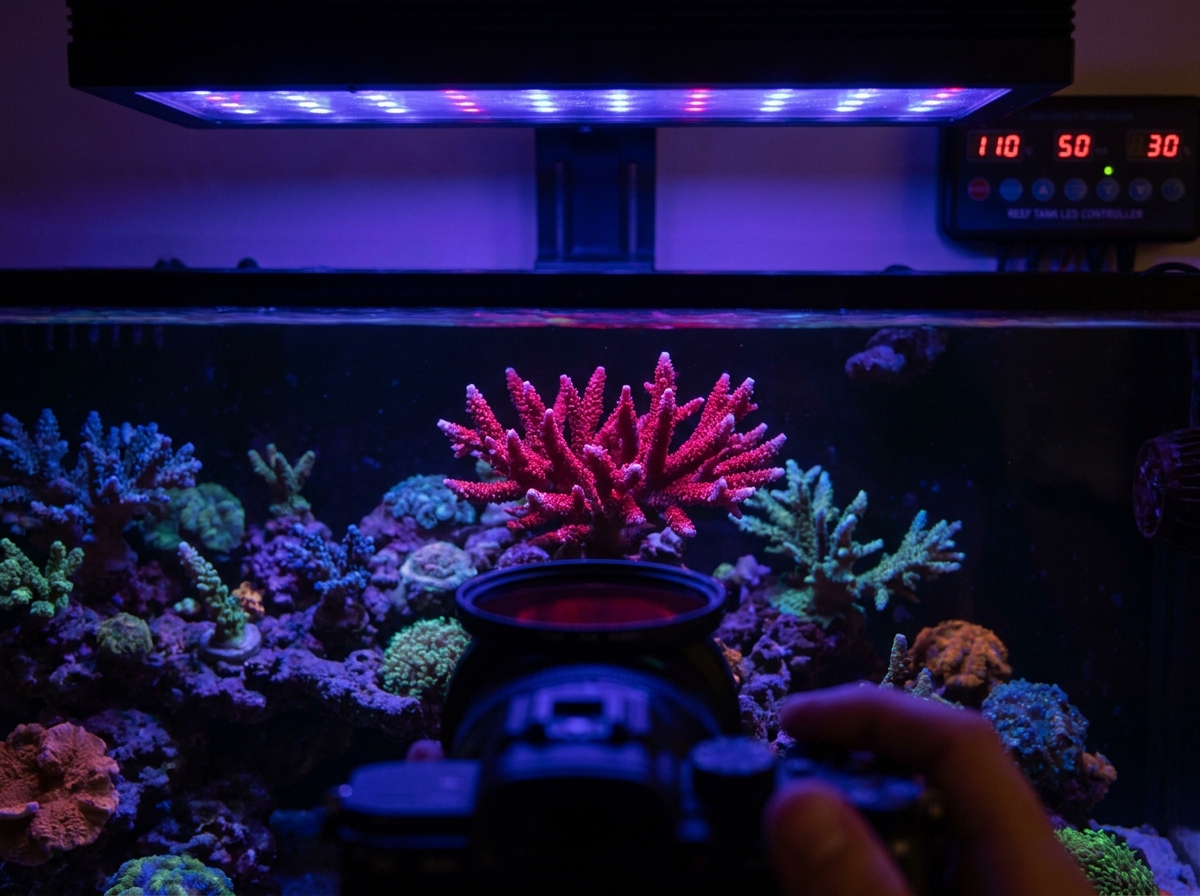
The photoperiod is the number of hours the light is on per day, and the way the intensity ramps up and down. A standard photoperiod is 8-10 hours of full intensity, with a 1-hour ramp-up at the start and a 1-hour ramp-down at the end. The ramp-up and ramp-down mimic sunrise and sunset, which reduces coral stress and reduces the phototropic shock of sudden light changes. Many reef keepers also run a separate, lower-intensity "moonlight" channel for 1-2 hours before and after the main photoperiod, which provides a small amount of light for nocturnal viewing without driving photosynthesis.
A photoperiod over 10 hours is rarely useful and often produces algae. The corals do not need the additional hours; they reach a photosynthesis plateau and stop using the light after 8-10 hours. The algae does not have the same plateau and continues to grow, so the longer photoperiod produces a tank with more algae and the same amount of coral growth. The fix: cap the photoperiod at 9-10 hours and let the corals use what they can in that window.
The PAR meter: the only tool that actually measures the light
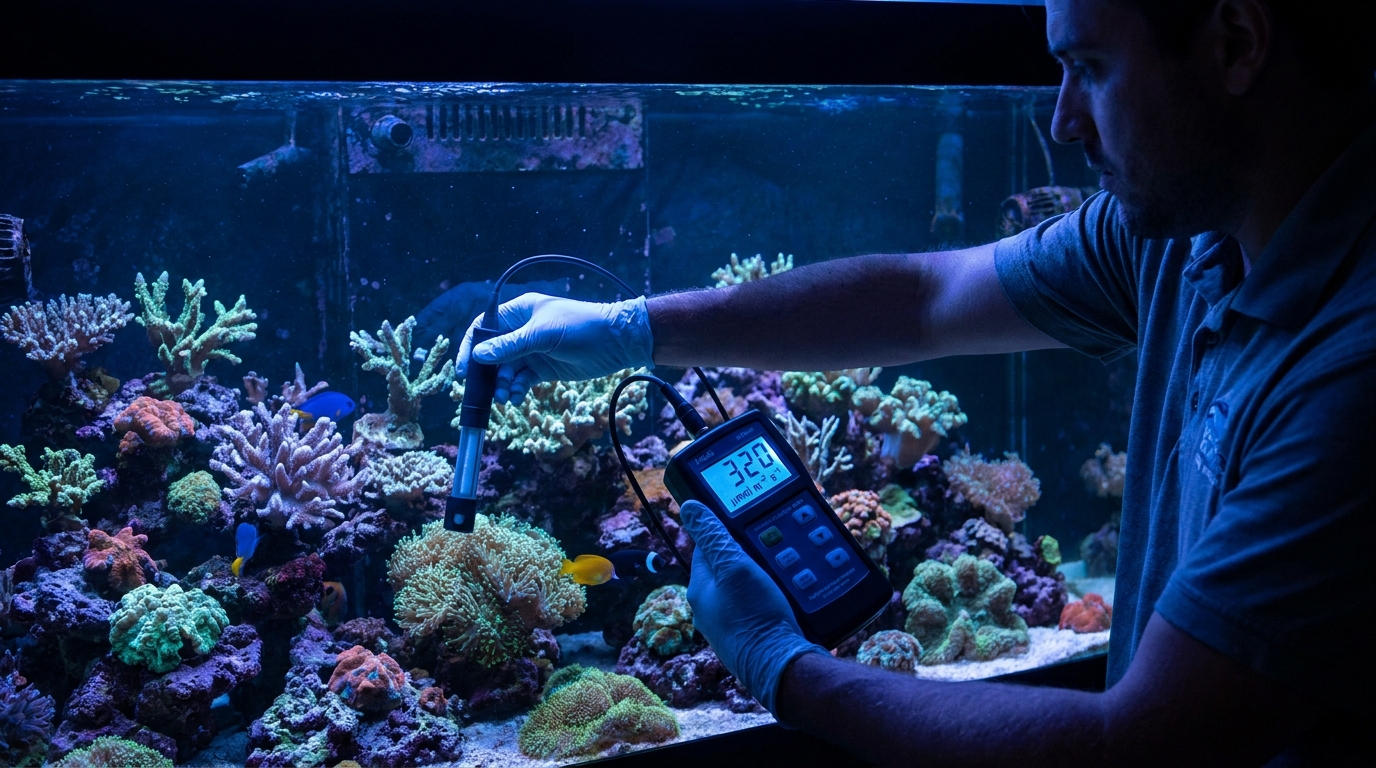
A PAR meter is a handheld device that measures the PAR at any point in the tank. The cost is $300-500 for a research-grade meter, and the meter is the single most valuable tool a serious reefer can own. The protocol: with the lights on and at the photoperiod intensity, hold the PAR meter sensor at the level of the coral and read the number. Do this at the top of the rockwork, the middle, and the bottom of the tank. The PAR map that emerges tells the reefer exactly which coral can be placed where, and which areas need more or less light.
A tank without a PAR map is a tank that the reefer is guessing about. A tank with a PAR map is a tank that the reefer is managing. The cost of the meter is recovered in 1-2 years through better coral selection, fewer algae outbreaks, and the ability to upgrade or change the lighting with confidence that the new setup will produce the right PAR at the right places.
Putting it all together
A starter reef tank lighting setup, for a 24-inch deep mixed reef, is: a modern LED fixture with white, blue, royal blue, and UV/violet channels, mounted 6-8 inches above the water, with the photoperiod set to 9 hours and a 1-hour ramp on each side. The intensity starts at 60-70% and ramps up over 4-6 weeks. The PAR at the substrate is targeted at 250-350 for the SPS areas, 150-250 for the LPS areas, and 75-150 for the soft coral and shaded areas. The reefer buys a PAR meter, maps the tank, and adjusts the placement of corals and the intensity of the fixture based on the map. This is the standard. Variations are around the standard, not away from it.