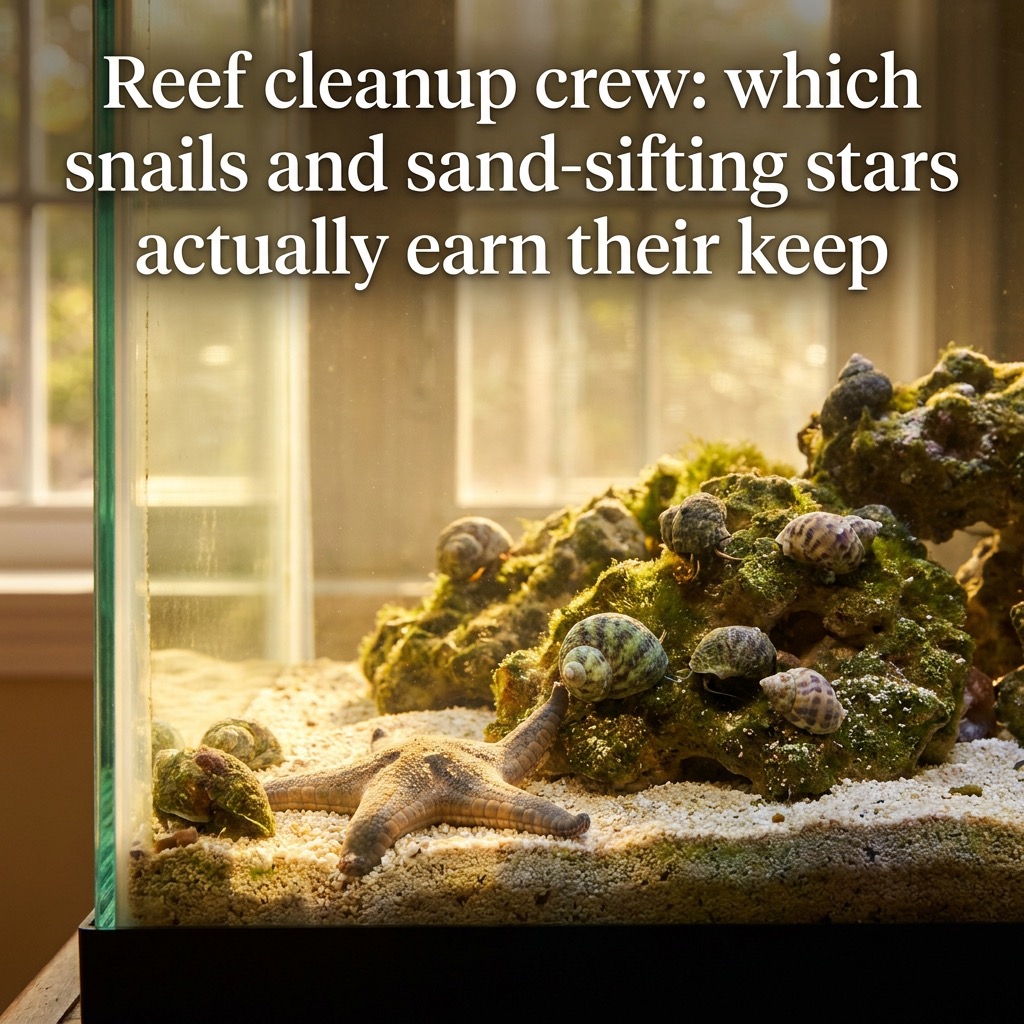
Reef cleanup crew: which snails and sand-sifting stars actually earn their keep
A reef tank's cleanup crew is part of the livestock, not a disposable accessory. Get the right species, sized right for the tank, and they do real work: glass stays cleaner, algae stays controlled, the sand bed stays oxygenated. Get the wrong ones — or too many, or the wrong size — and the cleanup crew becomes a problem that creates more problems.
This is what the long-running, evidence-based reefkeeping community has converged on after decades of trying everything.
The principle: matching the crew to the problem
The "best" cleanup crew is the one that addresses the specific algae and detritus issues of the tank. A tank with diatom problems needs different snails than a tank with hair algae. A tank with a deep sand bed needs different sand-sifters than a bare-bottom system. Start by identifying what you actually need to control, then build the crew around that.
The second principle: cleanup crew biomass is roughly correlated to tank size, not fish load. A 100-gallon tank with six fish needs more snails than a 50-gallon tank with six fish, because the larger tank has more surface area generating waste.
The third principle: cleanup crew is a long-term commitment. Most snails live 1-3 years. If you buy a crew for a hair algae outbreak, the outbreak resolves, the snails starve, and you have a die-off. Buy a crew sized to the tank's normal load, not the current crisis.
The reliable workhorses
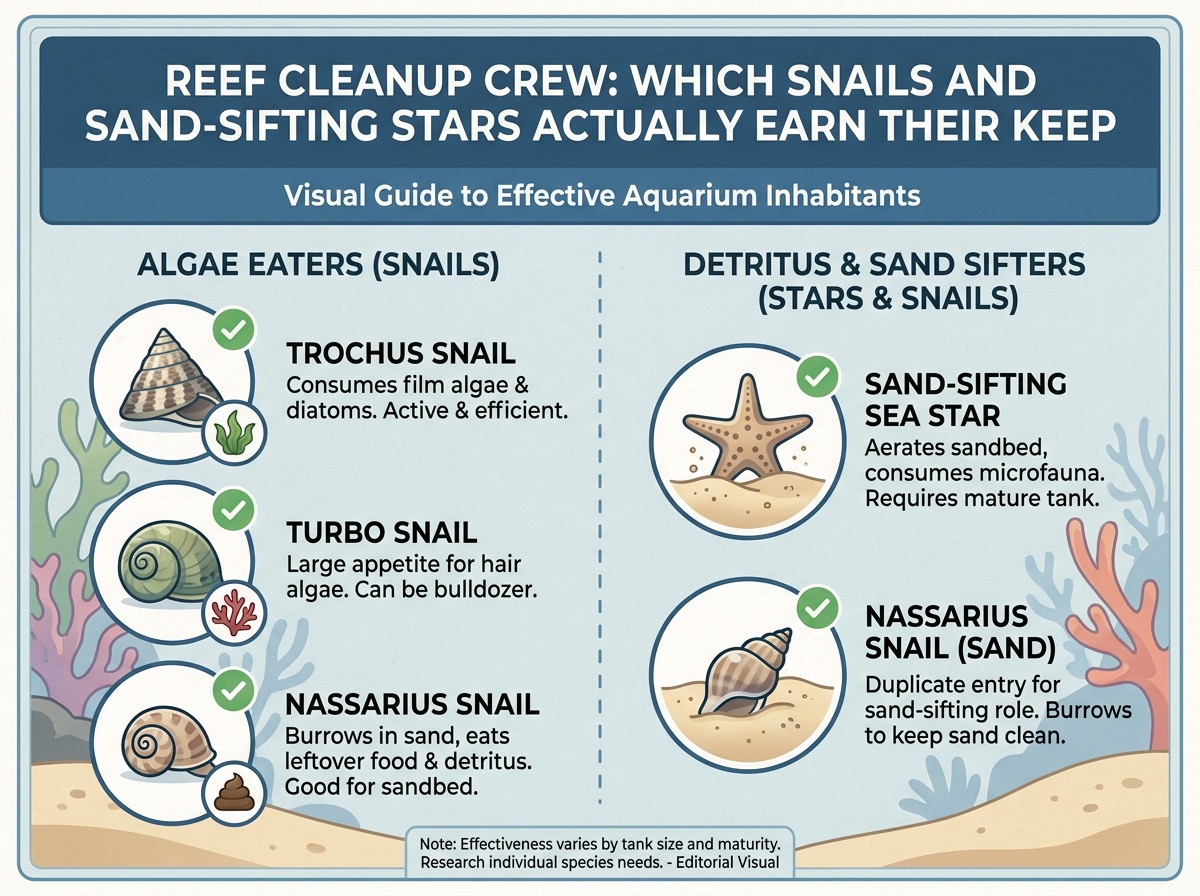
Trochus snails (Trochus sp.)
The single most useful snail in a reef tank. Trochus are conical, spiral-shelled snails that graze film and hair algae on rocks, glass, and substrate. They are hardy, breed readily in the tank, and tolerate a wide range of water conditions.
- Eats: film algae, diatoms, hair algae (short varieties), cyanobacteria (limited)
- Doesn't eat: bubble algae (Valonia), large hair algae, macroalgae
- Temperature: 72-78°F (22-26°C)
- Salinity: 1.024-1.026
- pH: 8.1-8.4
- Lifespan: 1-2 years
- Size: 0.5-1.5 inches
- Stocking: 1 snail per 2-3 gallons of water, adjusted for bioload
- Reproduction: lays eggs on rocks; larvae are difficult to raise, but natural settlement happens in mature tanks
Trochus have one quirk: they can crawl out of the tank. Use a lid, or accept losses. The flip side is that they don't fall over and die like some other snails — Trochus can right themselves.
Nerite snails (Nerita sp.)
Hardy, attractive, and excellent algae grazers. The most common reef species is the zebra nerite (Neritina natalensis) and various colour morphs.
- Eats: film algae, diatoms, some hair algae
- Doesn't eat: bubble algae, large algae
- Temperature: 72-78°F
- Salinity: 1.020-1.026 (can survive lower salinity — useful for treating parasites)
- Lifespan: 1-2 years in reef tanks (shorter than freshwater nerites)
- Size: 0.5-1 inch
- Stocking: 1 snail per 3-5 gallons
Nerites lay eggs in the saltwater tank (small white sesame-seed-like egg cases on rocks and glass), but the eggs don't hatch in typical reef conditions. They will, however, accumulate. Some owners scrub them off; others leave them.
Cerith snails (Cerithium sp.)
Long, spiral-shelled snails that do excellent work in the sand bed and on rock surfaces. They burrow in the sand during the day and emerge at night to graze.
- Eats: film algae, diatoms, detritus, uneaten food in sand
- Lifespan: 1-2 years
- Size: 0.5-1 inch
- Stocking: 1 snail per 2-3 gallons
Ceriths are the workhorse of the sand bed. They keep the upper sand layer moving, preventing the surface from compacting and developing anaerobic pockets. Excellent for tanks with a deep sand bed.
Astrea snails (Astrea sp.)
Conical snails similar to Trochus but slightly different shell shape. They are reliable algae grazers but have one significant drawback: they cannot right themselves if they fall on their back. A Trochus can flip itself over; an Astrea often cannot and dies.
- Eats: film algae, diatoms
- Lifespan: 1-2 years
- Size: 0.5-1.5 inches
- Stocking: 1 snail per 3-5 gallons
For this reason, many experienced reefers choose Trochus over Astrea despite the slightly higher cost.
The sand-sifters: useful but with caveats
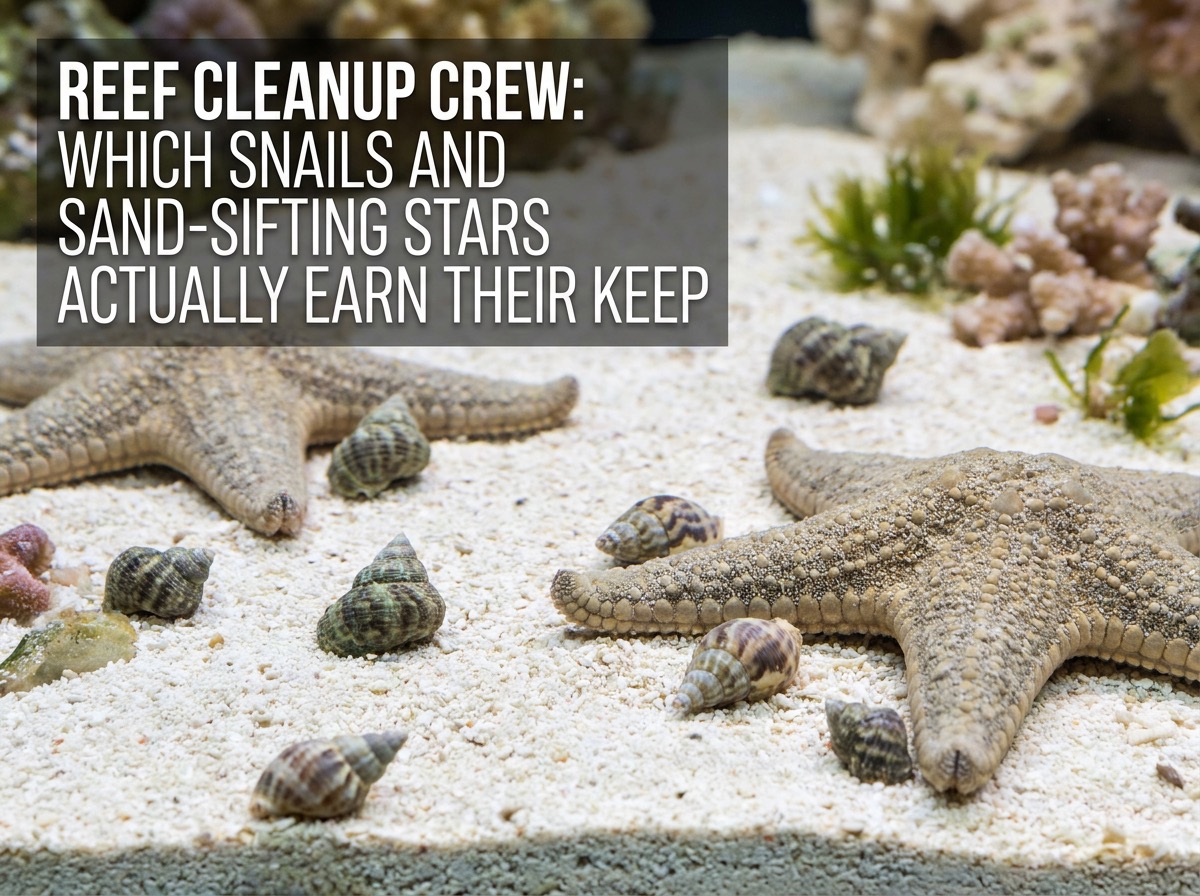
Sand-sifting sea stars (Astropecten polyacanthus)
Beautiful, fast-moving stars that bury themselves in the sand and eat detritus, uneaten food, and small invertebrates. They are efficient cleaners but problematic in mature tanks.
- Eats: detritus, amphipods, copepods, bristleworms, small snails
- Lifespan: 1-2 years in reef tanks
- Size: 4-8 inches across
- Stocking: 1 star per 50-100 gallons
The major problem: a sand-sifting star in a mature tank can decimate the microfauna population (amphipods, copepods) that corals and other invertebrates depend on. They also starve when the sand is "clean" — and a clean sand bed is the goal. They work themselves out of a job.
The common pattern: add a sand-sifting star, the tank looks great for 6 months, the star starts to lose body mass, the microfauna is depleted, the star dies. They are best added to new tanks with detritus problems, not established reefs.
Sand-sifting gobies (Amblygobius phalaena, Valenciennea strigata)
These fish do what the stars do, but more controllably. They ingest sand, sift it for food, and excrete clean sand. Excellent for sand bed maintenance in tanks large enough to support their activity.
- Eats: sand-dwelling microfauna, detritus
- Size: 4-6 inches
- Stocking: 1 goby per 50-100 gallons
The diamond watchman goby (Valenciennea puellaris) is smaller and works for tanks down to 30 gallons. Sand-sifting gobies do decimate microfauna like the stars, but they're easier to remove if the population crashes. They also tend to disturb corals less.
The "solves one problem, creates another" species
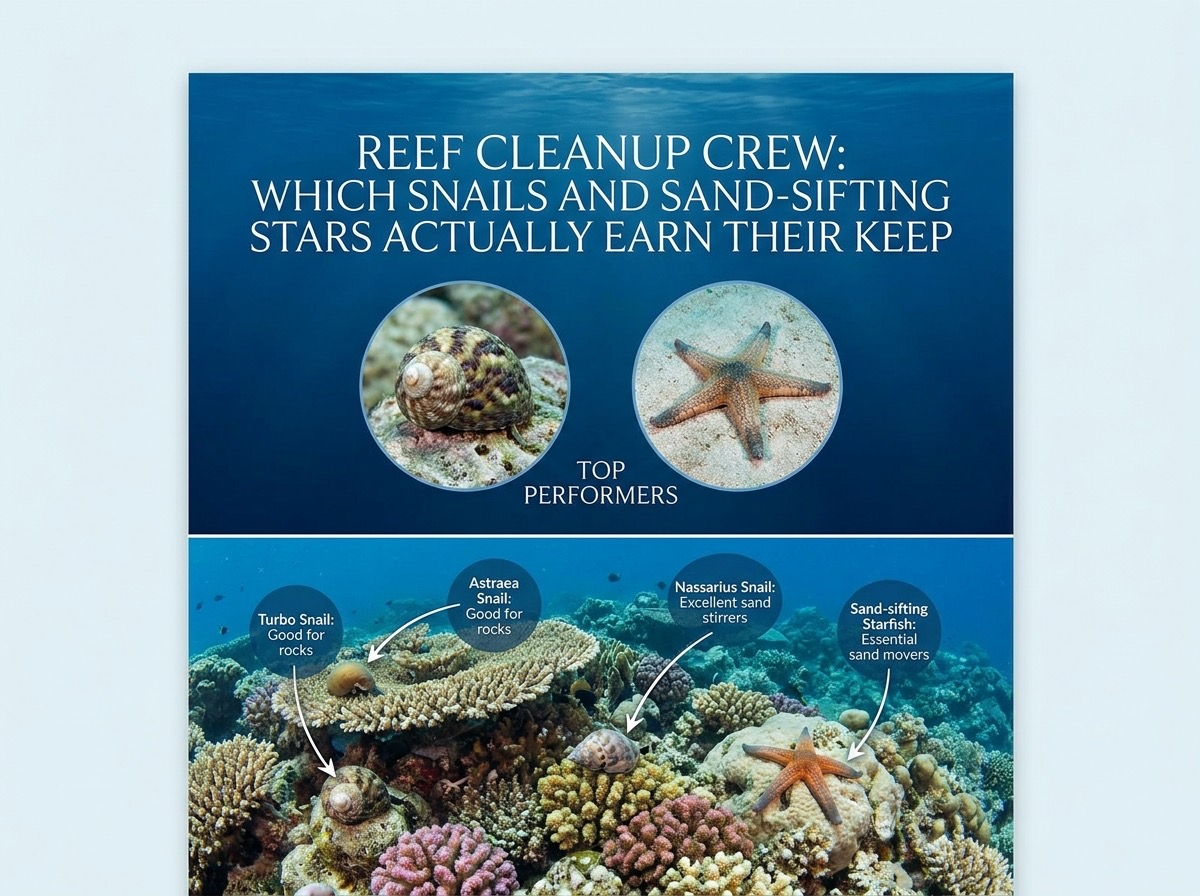
Turbo snails (Turbo sp., especially T. bruneus)
Large, fast, hardy snails that consume enormous amounts of algae. They look like workhorses. The issue: they grow large (2-3 inches) and can knock over frags, small corals, and rockwork as they move. They are also prodigious waste producers — a tank full of turbos has a much higher nitrate load than expected.
- Best use: large tanks (100+ gallons) with significant hair algae problems
- Stocking: 1 turbo per 10-15 gallons during treatment, reduce once algae is controlled
- Lifespan: 2-3 years
Margarita snails (Margarites sp.)
Small, attractive snails. They are often sold as the budget cleanup crew option. The catch: they are cold-water species that struggle in tropical reef temperatures. They live short lives and die off in established reef tanks.
Avoid for tropical reef tanks. They are appropriate only for cold-water or temperate systems.
Bumblebee snails (Engina sp.)
Small snails with attractive black-and-yellow striped shells. They are carnivorous, eating bristleworms and other small invertebrates. They are also known to prey on beneficial microfauna and occasionally on small fish. They breed readily and can become a population problem.
Use only if you have a specific bristleworm issue and are prepared to manage the population.
Nassarius snails (Nassarius sp.)
Active snails that burrow in the sand and emerge when they smell food. They are excellent detritivores but, like sand-sifting stars, they deplete microfauna. They are best added in modest numbers to established sand beds.
The algae-specific species
Bubble algae eaters
The only reliable bubble algae (Valonia) eaters in the trade are:
- Emerald crabs (Mithraculus sculptus): eat bubble algae, film algae, and some hair algae. They are the most reliable bubble algae solution. Stock 1 per 20-30 gallons. They can be aggressive as they mature — watch for aggression to small fish
- Sea urchins (Mespilia globulus, the tuxedo urchin): excellent algae grazers including bubble algae. They also eat coralline and other desirable algae. Best added to tanks with active bubble algae problems; not suitable for tanks without algae issues
- Rabbitfish (Siganus sp.): the only fish reliably eating bubble algae, but they get large (8-12 inches) and are not safe in reef tanks — they eat most soft corals and many LPS
Hair algae eaters
- Trochus, Nerite, Astrea: limited hair algae consumption (short varieties)
- Emerald crabs: yes
- Sea urchins (tuxedo, long-spine): yes, but they consume desirable algae too
- Lettuce sea slugs (Elysia crispata): specialist on hair algae. Beautiful, but they starve once the algae is gone
- Foxface rabbitfish (Siganus vulpinus): very effective hair algae eater, but not reef-safe long-term
Cyanobacteria eaters
Few animals reliably eat cyano. The best approach is addressing the root cause (low flow, high nutrients, old bulbs). Some animals will graze it incidentally:
- Trochus, Cerith: opportunistic
- Some hermit crabs: opportunistic
- Mandarin fish (Synchiropus splendidus): eat copepods, not cyano directly
Don't expect a cleanup crew to solve a cyano outbreak. The outbreak is a chemistry problem, not a grazer problem.
Hermit crabs: useful, with a personality caveat
Hermit crabs are a mixed bag. They do useful work (algae, detritus, uneaten food) and they're entertaining. They also have a habit of killing snails to steal their shells. A hermit that outgrows its current shell will sometimes drag a snail out of its shell to claim it.
The good species
- Scarlet hermit (Paguristes cadenati): small, peaceful, well-behaved. The most reef-safe hermit
- Blue-legged hermit (Clibanarius tricolor): small, peaceful, eats film algae
- Red-legged hermit (Clibanarius digueti): small, peaceful, eats hair algae
The problematic species
- Anemone hermits (Dardanus pedunculatus, others with commensal anemones): the anemones can sting corals. Generally unsuitable for reef tanks
- Halloween hermits: large, aggressive, will attack other hermits
- Large hermits in small tanks: any hermit over 1 inch in a tank under 30 gallons becomes a problem
Shell supply
Provide spare empty shells (turbo or trochus shells from pet stores or online). Hermits that can't find a new shell will sometimes attack snails. With a steady supply of empty shells, the population stays well-sized.
Building a crew: a basic recipe
For a 75-gallon mixed reef tank with a 3-inch sand bed, established for 6+ months:
- 30-40 Trochus snails (mix of sizes)
- 20-30 Cerith snails
- 10-15 Nerite snails
- 15-20 dwarf hermit crabs (scarlet or blue-legged)
- 5-10 emerald crabs (if bubble algae is or has been present)
- 1 sand-sifting goby (if sand bed is large enough to support it)
- 1 tuxedo urchin (optional, only if algae pressure is high)
This is roughly 1 snail per 2-3 gallons, which is the standard recommendation. The total cleanup crew is renewable: snails breed in the tank, hermits breed, and the population self-regulates within the carrying capacity of the system.
Adjustments:
- New tank (less than 6 months): half this stocking. The microfauna and algae haven't established, and a heavy crew can starve
- Mature tank with hair algae problem: temporarily add 5-10 turbo snails, increase emerald crabs to 1 per 10 gallons, remove after algae is controlled
- Tank with bubble algae problem: 1 emerald crab per 15-20 gallons, or 1 tuxedo urchin per 30 gallons
- Bare-bottom tank: skip sand-sifters, double up on rock grazers
- Deep sand bed (4+ inches): more ceriths, more nassarius, possibly a sand-sifting goby
What the cleanup crew doesn't do
A common misperception: the cleanup crew is the "natural filtration" of the tank, and a good crew reduces the need for water changes and protein skimmers. This is incorrect. The cleanup crew:
- Does NOT replace water changes. They convert particulate waste into dissolved waste (ammonia, nitrate). The dissolved waste still needs to be removed by water changes, protein skimming, or a refugium
- Does NOT replace protein skimming. A skimmer removes dissolved organics before they break down into nitrate. The crew can't do that
- Does NOT replace algae control. A healthy crew helps, but if nutrients are high, algae will still grow
- Does NOT keep a tank "low maintenance" forever. Eventually, the crew depletes its food source and needs supplementary feeding
The cleanup crew is one part of a system. Water changes, protein skimming, refugium, GFO, and carbon all still have roles.
Quarantine and acclimation
A quick note on getting cleanup crew into the tank safely:
- Quarantine all new cleanup crew for 2-4 weeks in a separate tank. Snails and crabs can carry pests, parasites, and the dreaded AEFW (Acropora-eating flatworm) on their shells
- Drip acclimate over 1-2 hours. The water the cleanup crew ships in is often very different from your tank water
- Inspect for hitchhikers: bristleworms (some are fine, some are problematic), mantis shrimp, aiptasia, flatworms
- Rinse in a separate container of tank water before adding to the display
Adding a cleanup crew without quarantine is one of the most common ways pest species enter reef tanks.
What to do when the crew dies off
If snails start dying in numbers (more than 1-2 per week), something is wrong:
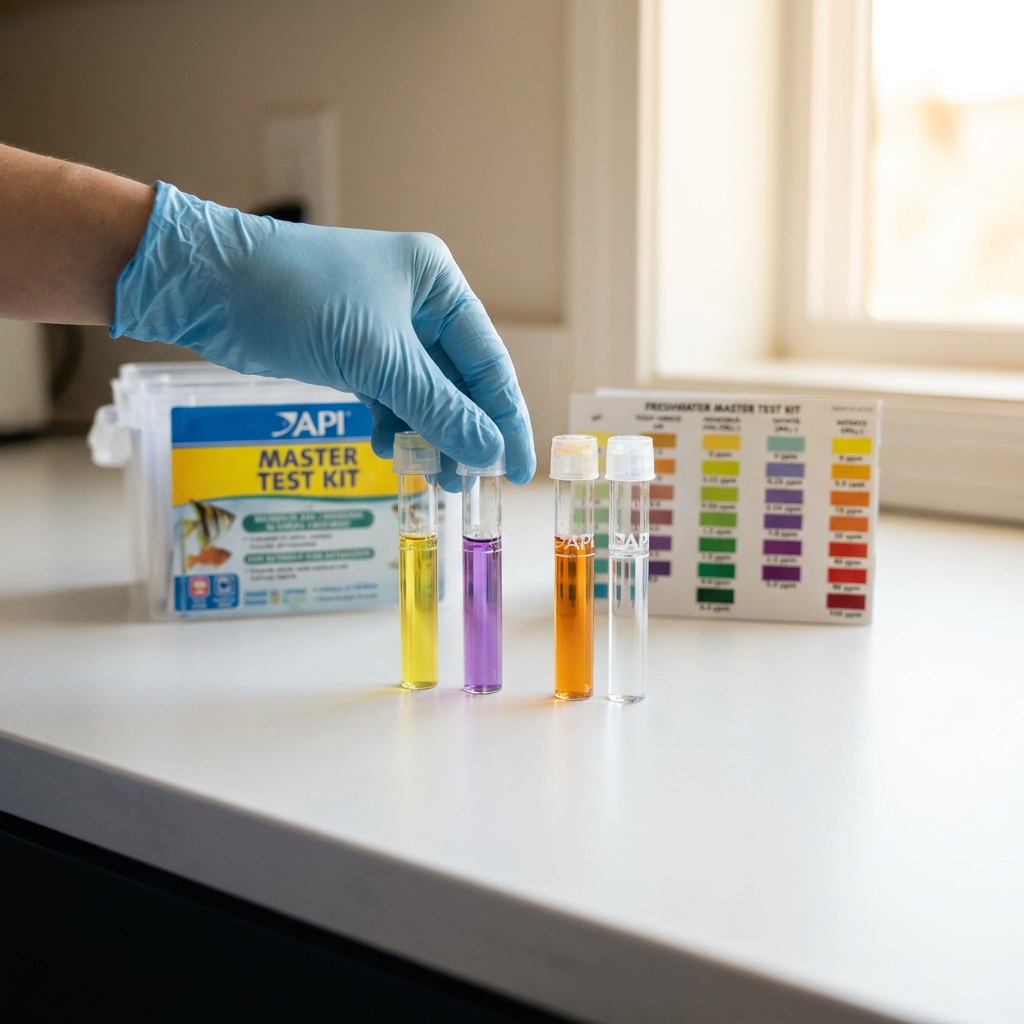
- Check water parameters first: ammonia, nitrite, nitrate, pH, salinity, alkalinity, calcium, magnesium. A spike in any of these can cause snail mortality
- Check for predation: some wrasses, triggerfish, and pufferfish will eat snails. Even "reef-safe" fish occasionally develop a taste for snails
- Check for starvation: if the tank is "too clean" (heavy filtration, aggressive algae control, few nutrients), the snails have nothing to eat
- Check for copper or other heavy metals: any medication or contamination with copper is deadly to invertebrates
- Check for inadequate acclimation: sudden parameter changes kill snails
A mass snail die-off is rarely the snails' fault. It's usually a water quality issue that needs to be identified and fixed.
The bottom line
The "best" cleanup crew is the one that addresses your specific tank's needs: algae type, sand bed depth, bioload, and tank maturity. Trochus, Cerith, Nerite, and dwarf hermits are the workhorses; turbo, sand-sifting stars, and sea urchins are the specialists for specific problems. Get the species right, the stocking right, and the quarantine right, and the cleanup crew does what it's supposed to do. Get any of those wrong, and the crew becomes another problem to manage.
---
About the author: [Olivia Brown](../Olivia%20Brown.md) holds an MSc in Marine Biology from James Cook University and has 12 years of experience in public aquaria, with a specialisation in coral husbandry and reef ecosystem management.