
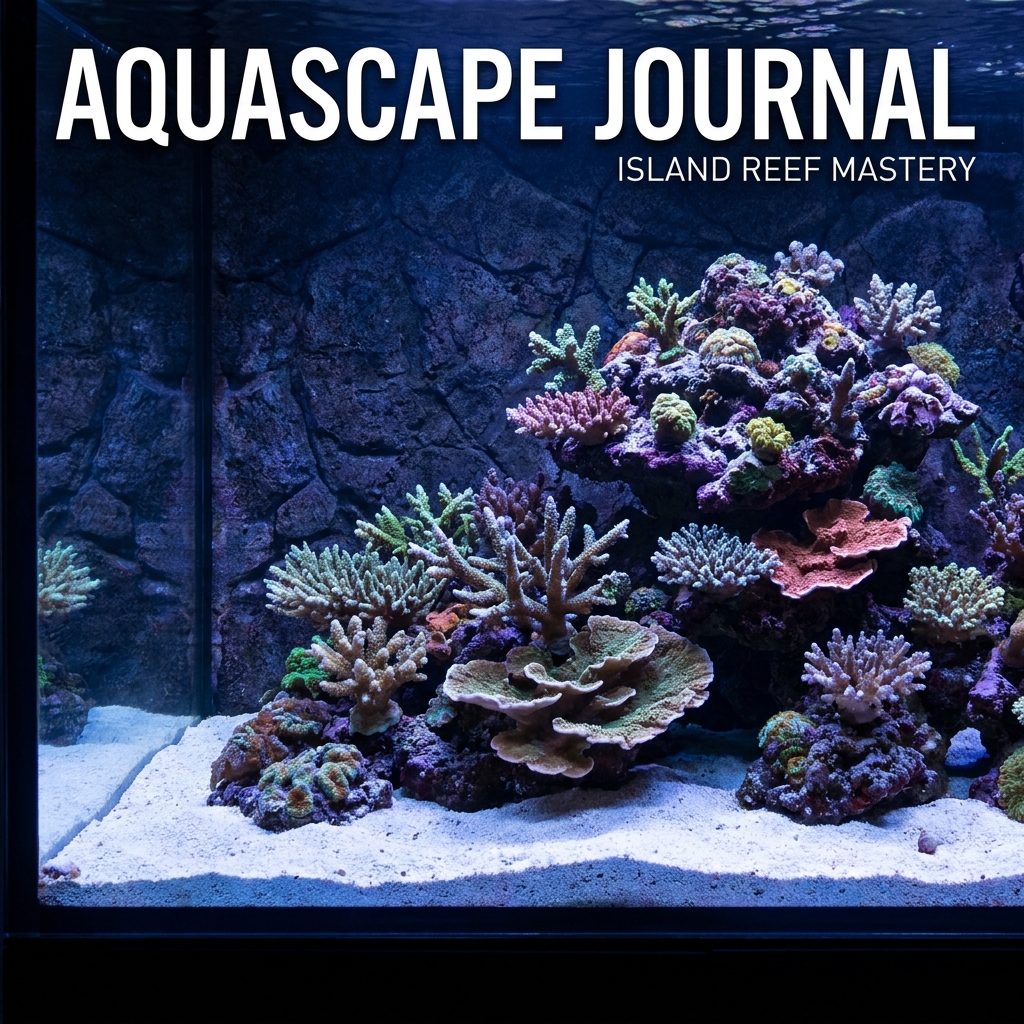
Reef aquascape composition: the rule of thirds that turns rock piles into reefs
The most common visual failure in reef keeping is the rock pile. The reefer who puts 30 pounds of live rock in a 40-gallon tank and lets the rocks settle where they land has a tank that looks like the rock did. The reefer who plans the rockwork against the rule of thirds, who creates depth and visual weight, who uses the negative space and the substrate and the foreground-background relationship, has a tank that looks like a slice of actual reef. The difference is not the rock, and it is not the equipment, and it is not the livestock. The difference is the composition. In this article I will walk through the rule of thirds, the principles of depth and visual weight, the three composition styles that reef keepers use, and the practical sequence for stacking rock that produces a tank that is visually compelling from any viewing angle.
The rule of thirds in reef aquascape
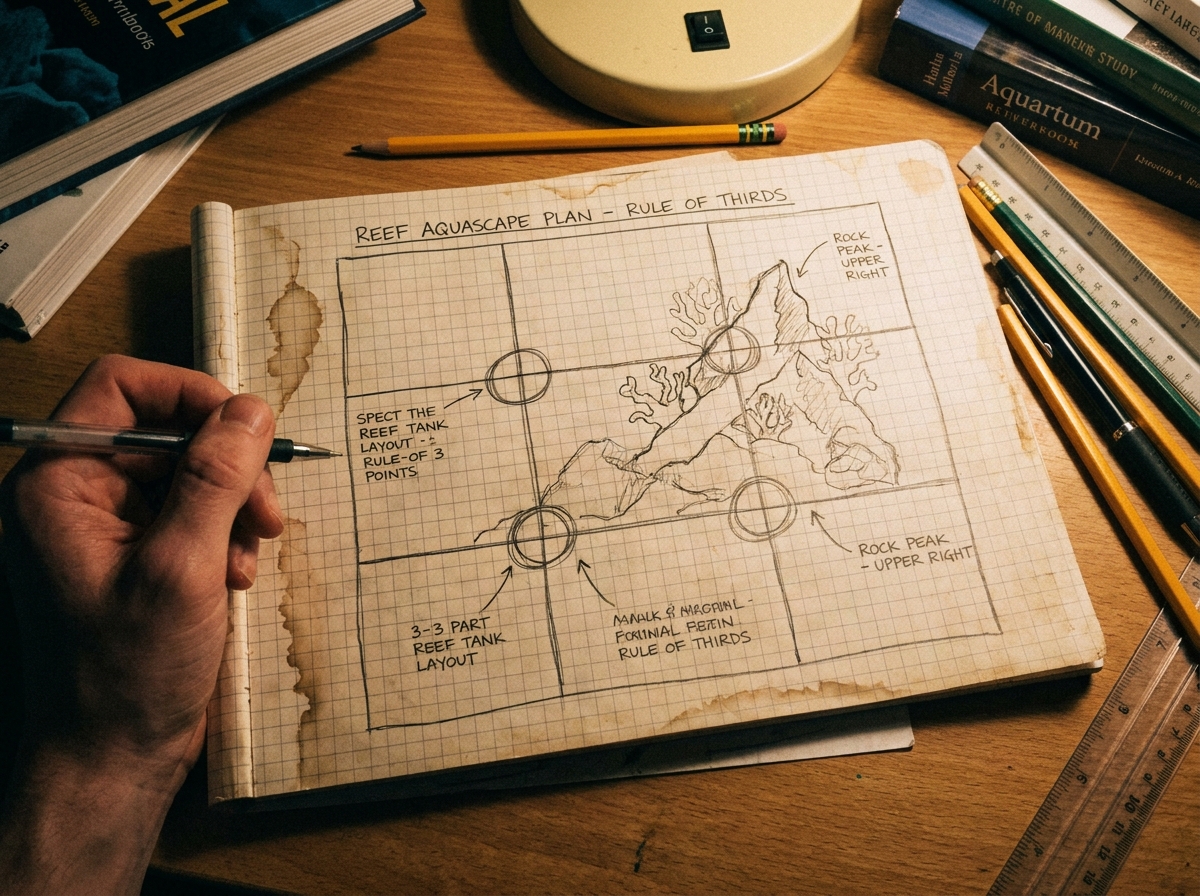
The rule of thirds is a composition principle that applies to painting, photography, and reef aquascape. The tank is divided into nine equal sections by two horizontal and two vertical lines. The four intersection points of these lines are the high-impact positions; the elements placed at these positions are visually weighted more than elements placed in the center or at the edges. The principle comes from the human visual system: the eye is drawn to the intersections, and the brain processes them as more interesting than the geometric center.
In a reef tank, the rule of thirds means that the highest point of the rockwork should be at one of the four intersection points, not in the center of the tank. The center of the tank is visually the weakest position. The intersection of the upper horizontal line and the right or left vertical line is the strongest position. A reefer who builds the rockwork with the highest peak at the upper-right or upper-left intersection has created a composition that the eye reads as deliberate, weighted, and interesting. A reefer who builds the rockwork with the highest peak in the center of the tank has created a composition that the eye reads as static, balanced, and boring.
The rule of thirds is not absolute. The composition can be modified by the tank's viewing position. A tank that is viewed from one side (a typical living room placement) has the strongest composition when the rockwork is weighted to one side rather than the other, with the higher peak away from the viewing position (right side, if the viewer is on the left). A tank that is viewed from three sides (a peninsula tank, an island tank) has the strongest composition when the rockwork is balanced around the center, with the highest peak in the middle. The composition has to match the viewing position, or the rule of thirds reads as a mistake.
The principles of depth
A reef aquascape that has only one depth (the rockwork is all at the same distance from the front glass) looks like a painted backdrop. A reef aquascape that has three depths — foreground, mid-ground, and background — looks like a three-dimensional environment. The three-depth principle is what separates a flat rock pile from a real reef.
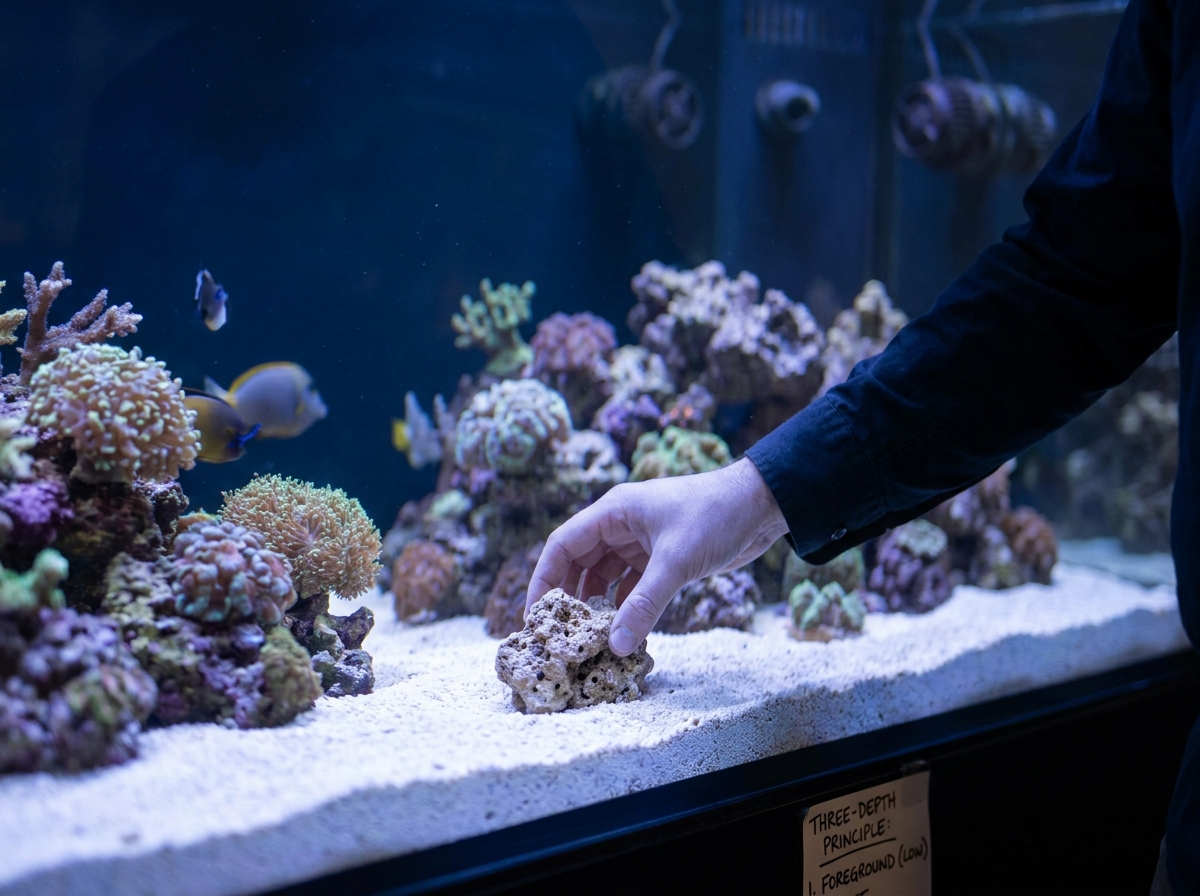
The foreground depth: the rocks closest to the front glass, usually 3-6 inches in. These rocks are smaller, lower, and form the leading edge of the composition. The foreground rocks are often partially buried in the sand. The foreground is what the eye hits first when looking at the tank; it has to be visually interesting but not visually dominant. A common mistake is putting the largest rocks in the foreground, which makes the tank look small and squashed. The fix is keeping the foreground low and modest.
The mid-ground depth: the rocks in the middle of the tank, usually 6-12 inches from the front glass. These rocks are larger, taller, and form the body of the composition. The mid-ground is where the rule of thirds applies most directly; the highest peak is in the mid-ground, not in the background. The mid-ground is also where the bulk of the coral placement happens.
The background depth: the rocks at the back of the tank, usually 12-18 inches from the front glass. These rocks are tall, narrow, and form the back wall of the composition. The background rocks are often stacked vertically to create the illusion of a continuous reef wall behind the mid-ground. The background is the visual support for the mid-ground; it should not compete with the mid-ground for attention.
The three-depth principle is implemented by stacking the rocks in stages. Stage 1: the background rocks against the back glass, forming the back wall. Stage 2: the mid-ground rocks in the middle, connected to the background. Stage 3: the foreground rocks at the front, partially buried. The reefer who builds in stages, with the eye constantly checking the rule of thirds and the depth relationships, produces a composition. The reefer who puts all the rocks in the tank at once and arranges them as a single layer produces a pile.
The three composition styles
Reef keepers use three composition styles, named after the reef environments they mimic. The first is the "wall" style: the rockwork is built as a vertical wall across the back of the tank, with the foreground open. This style is suited to tanks with strong flow, with coral placement on the wall, and with smaller fish. The wall style is the easiest to build and the easiest to maintain, and it is the most common in the hobby. The second is the "island" style: the rockwork is built as one or two large mounds in the center or off-center of the tank, with the foreground and the sides open. This style is suited to tanks with weaker flow, with coral placement on the islands, and with larger fish that need swimming room. The island style is harder to build and harder to maintain, and it is the more visually striking of the two. The third is the "valley" style: the rockwork is built as two mounds, one on the left and one on the right, with a low area in the middle that creates a valley. The valley style is suited to tanks with deep dimensions, with a strong focal point in the middle, and with a composition that emphasizes the foreground. The valley style is the most difficult to build and the most visually impressive.
The choice of style depends on the tank dimensions, the viewing position, the livestock, and the reefer's aesthetic preference. A long, shallow tank (48x18x18) is best suited to the wall or island style. A square or deep tank (36x24x24 or cube) is best suited to the island or valley style. A reefer who is uncertain about which style to choose should start with the island style; it is the most forgiving and the most common in the published aquascape work of the prominent reef artists.
The visual weight principle
Visual weight is the principle that some elements of a composition pull the eye more than others, even if the elements are physically the same size. A bright rock in the foreground has more visual weight than a dark rock in the background, even if they are the same size. A tall, narrow rock has more vertical weight than a short, wide rock, even if they have the same volume. A rock that is connected to the substrate has more weight than a rock that appears to be floating. The reefer who understands visual weight uses it to direct the eye through the composition.
The principle in practice: use darker, more textured rocks in the foreground and lighter, smoother rocks in the background. The contrast in visual weight makes the foreground feel closer and the background feel further, increasing the illusion of depth. Use vertical rock shapes in the foreground to draw the eye up and horizontal rock shapes in the background to draw the eye across. The eye follows the dominant direction. Use rocks that are physically connected to the substrate in the foreground, and rocks that appear to be growing out of the background rocks in the mid-ground. The connection creates visual weight.
The practical sequence for stacking rock
The first step is to plan the composition on paper. Draw the tank to scale, mark the rule-of-thirds intersections, and sketch the rockwork. The sketch is not a final plan; it is a starting point. The sketch is what the reefer refers to when the rockwork is in mid-build and the composition has drifted.
The second step is to start with the foundation. The largest, flattest rocks go on the bottom of the tank, on the substrate, where they will be stable. The foundation rocks are the most important structurally; everything else rests on them. The foundation should include at least one rock that touches the back glass, providing a physical anchor for the rest of the structure.
The third step is to build the background. Stack rocks vertically on the foundation rocks, leaning against the back glass. The background is the visual support; it should be solid and connected. The background is the place to use the more textured, more colorful rocks; these will be the most visible rocks once the composition is complete.
The fourth step is to build the mid-ground. Stack rocks on the foundation and on the background rocks, with the highest peak at one of the rule-of-thirds intersections. The mid-ground is the body of the composition; the mid-ground rocks should be the most numerous, the most varied in shape, and the most carefully placed.
The fifth step is to add the foreground. Place smaller, lower rocks at the front of the tank, partially buried in the substrate. The foreground is the leading edge; it should be visually interesting but not dominant. The foreground is the place to add the small details — a single standout rock, a small cave, a low arch.
The sixth step is the eye test. Look at the tank from the primary viewing position. The highest peak is at a rule-of-thirds intersection. The three depths are visible. The visual weight pulls the eye through the composition. The rocks are physically stable, with no rocks that can shift and crush coral. The composition is complete.
The two mistakes to avoid
The first is the single peak. The composition that has one rock pile in the center, with no foreground, no background, and no visual interest beyond the central pile, is the most common reef aquascape. It is the easiest to build, and it is the most boring to look at. The fix is the three-depth principle and the rule of thirds. The second is the unstable rock. The composition that looks beautiful in the first month but loses rocks in the third month — usually because the rockwork was not physically connected to the substrate or to the back glass — is a composition that does not last. The fix is the foundation rocks against the back glass, with the rest of the structure tied to them with epoxy or rock-safe cyanoacrylate. The composition is a long-term commitment; the rocks have to be stable for the life of the tank.
The honest summary
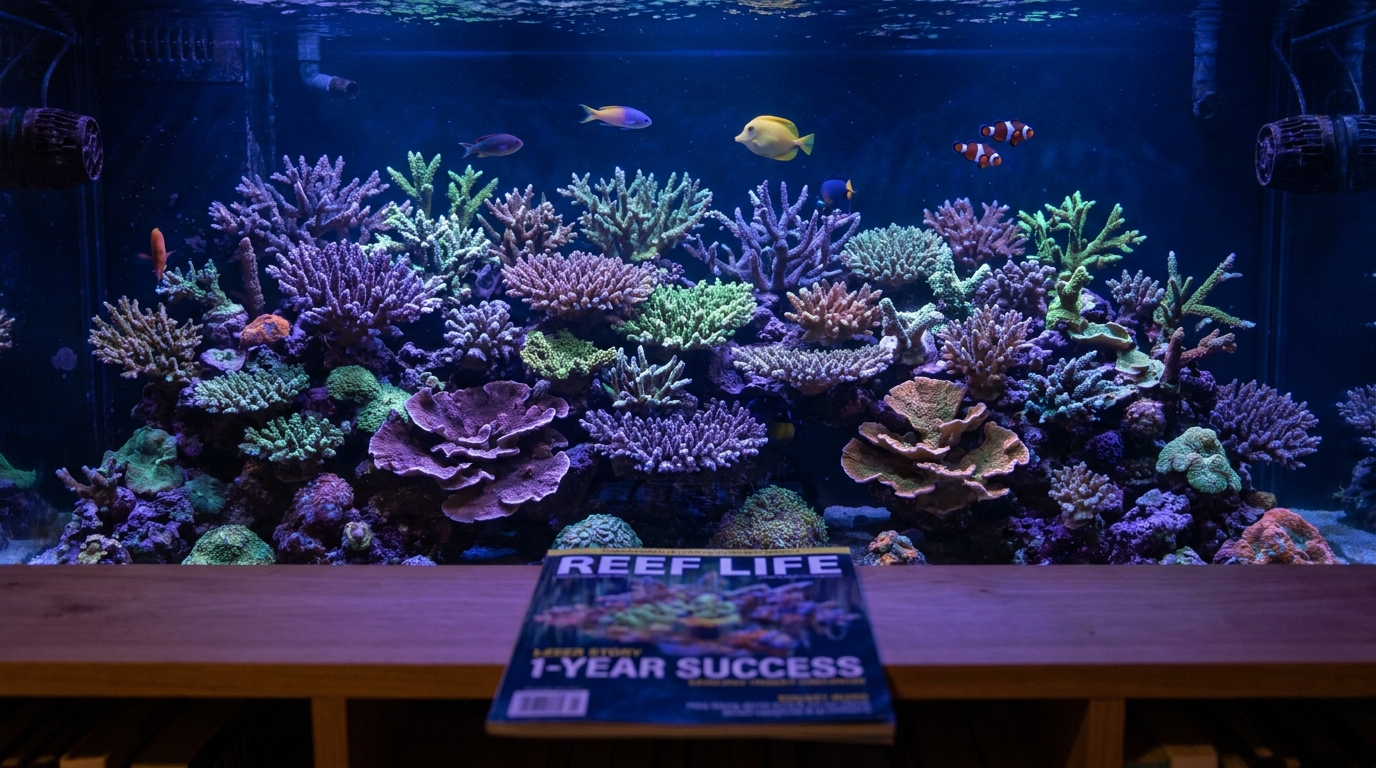
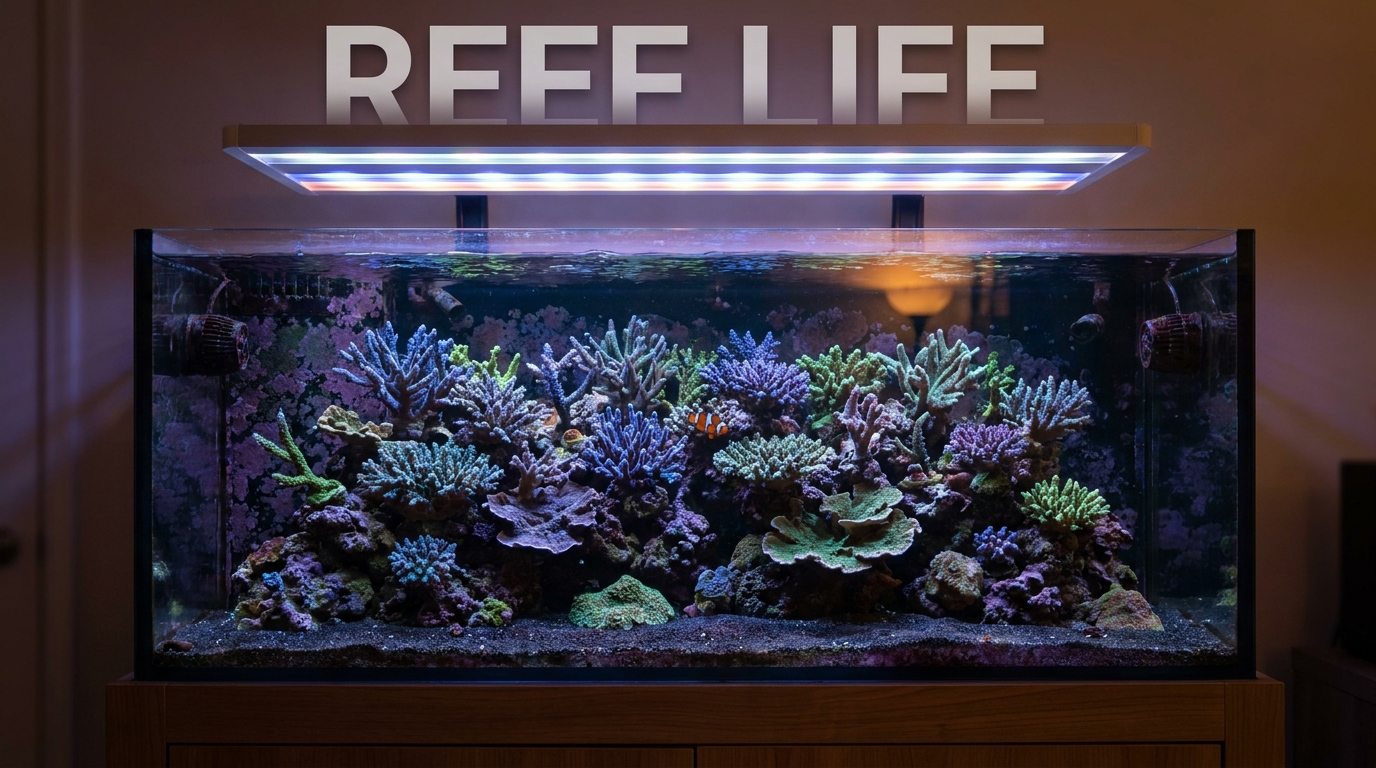
A reef aquascape that follows the rule of thirds, that uses the three-depth principle, that has the right visual weight distribution, and that is built in stages with the foundation against the back glass, is a composition that the eye reads as deliberate and that ages into a real reef over 6-12 months. The rock pile is what the reefer builds in an afternoon. The composition is what the reefer builds over a weekend, with the eye test, the sketch, and the discipline to take rocks out and restack them. The difference is the time, and the time is the work.